The India-EU Free Trade Deal signed on January 27, 2026, in New Delhi is more than another trade agreement added to the global ledger. It marks the end of a negotiation that stretched across two decades and the beginning of a new economic relationship between two large democratic markets. By linking India and the European Union into a single, rules based trade corridor spanning nearly two billion people and $25 trillion in economic output, the deal reshapes the scale and direction of future growth.
This story looks at how that shift moves beyond headline numbers and begins to translate trade access into jobs, investment, and a broader industrial and services revival across India.
Why This Topic Matters
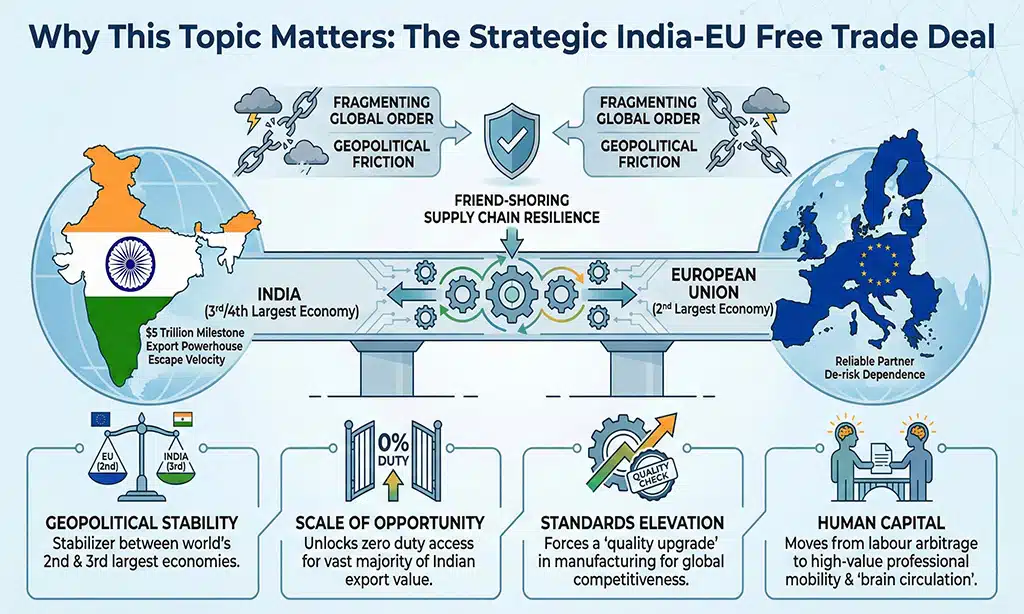
The India-EU Free Trade Deal is not just about reducing tariffs on wine or machinery; it is a strategic response to a fragmenting global order. With traditional trade routes facing geopolitical friction and “friend-shoring” becoming the new mantra for supply chain resilience, this deal provides a stable, rules-based corridor between the world’s second-largest (EU) and fourth-largest (India) economies.
For India, the timing is critical. As the nation approaches the $5 trillion milestone, the deal offers the “escape velocity” needed to transition from a domestic consumption-led model to a global export powerhouse. For the EU, it secures a reliable partner to de-risk its dependence on volatile markets. This section outlines the structural significance of the deal:
- Geopolitical Stability: Serves as a stabilizer between the world’s second-largest (EU) and fastest-growing major economy (India), which has just secured its spot as the world’s 4th largest and is on a clear path to the top 3.
- Scale of Opportunity: Unlocks zero duty access for the vast majority of Indian export value to the EU.
- Standards Elevation: Forces a “quality upgrade” in Indian manufacturing, making products globally competitive beyond Europe.
- Human Capital: Moves the needle from labour arbitrage to high-value professional mobility and “brain circulation.”
Top 5 Impacts of the India-EU Free Trade Deal
The following details the specific sectors and structural changes that will define India’s next phase of trade led expansion.
Impact 1: The Manufacturing Explosion in Labour-Intensive Sectors
The India-EU Free Trade Deal serves as a massive catalyst for industries like textiles, leather, and gems, which have long been hindered by a 10-15% tariff disadvantage. By eliminating these barriers, India can now compete on an equal footing with rivals like Vietnam and Bangladesh, with the potential to support over 6 million new jobs.
This sector is the biggest winner because it directly translates trade volume into livelihoods for artisans, women, and rural youth. Industry estimates suggest that zero duty access for textiles could boost exports from $7 billion to as much as $40 billion by 2032. Furthermore, the inclusion of stringent “Product Specific Rules”, specifically the ‘double transformation’ requirement, ensures that garments must be manufactured from the yarn stage upward within India to qualify. This critical technical safeguard prevents third-party countries like China from using the corridor as a “backdoor” to dump low-cost fabric into the European market under an Indian label.
| Feature | Impact Detail |
| Tariff Change | 12-17% reduced to 0% for Apparel & Footwear. |
| Job Creation | Projected 6.5 million new formal jobs by 2030. |
| Key Regions | Tirupur (Textiles), Agra (Leather), Surat (Gems). |
Impact 2: The Professional Services and Mobility Revolution
A cornerstone of the India-EU Free Trade Deal is the landmark mobility framework, which moves beyond traditional IT outsourcing. It secures commercially significant commitments across 144 services subsectors, including R&D, education, and professional consultancy, facilitating a new era of “Brain Circulation.”
The deal introduces a “Legal Gateway Office” in India, a one-stop hub to streamline visas for professionals and students. Crucially, it grants work rights to the spouses of Intra-Corporate Transferees, a move that makes European assignments vastly more attractive for top Indian talent. This mobility framework could create tens of thousands of high-value, formal professional roles for Indian talent. This is not just about exporting people; it’s about integrating Indian expertise into the core of European innovation hubs, especially in AI and Green Tech.
| Feature | Impact Detail |
| Visa Ease | Spousal work rights for Intra-Corporate Transferees. |
| Subsectors | 144 sectors opened, including IT, R&D, and Education. |
| Education | 18-month post-study work rights for Indian students in the EU. |
Impact 3: Digital Trust and the Rise of Global Capability Centers (GCCs)
The India-EU Free Trade Deal aligns India’s data protection standards with the EU’s GDPR, effectively eliminating the “compliance tax” on cross-border data flows. This regulatory harmony is expected to spark a surge in high-end Global Capability Centers (GCCs) across Indian metros.
European MNCs are now moving from simple cost-arbitrage to “definitive product ownership” in India. With the FTA providing intellectual property (IP) certainty, companies are shifting core technology development, such as semiconductor design and clean energy software to their Indian captive centers. This shift will create thousands of skilled jobs in AI, cybersecurity, and semiconductors, directly tying trade and regulatory alignment to employment growth. This transforms the Indian services sector from a “support desk” into a “global laboratory.”
| Feature | Impact Detail |
| Data Flow | Alignment with GDPR to reduce regulatory friction. |
| GCC Trend | Shift from back-office support to core R&D and IP creation. |
| Tech Focus | Artificial Intelligence, Semiconductors, and Cybersecurity. |
Impact 4: Calibrated Automobile Liberalization and “Make in India”
Under the India-EU Free Trade Deal, India has carefully opened its protected automobile market through a calibrated, phased reduction of tariffs on European cars from 110% to 10% over a 5-to-7-year transition period. This structured glide path is designed to encourage European manufacturers to eventually move from direct imports to local assembly (CKD) for premium models. To ensure market stability, the deal introduces a Tariff Rate Quota (TRQ) capped at 250,000 units annually, allowing for a controlled influx of high-technology vehicles while safeguarding the interests of domestic manufacturers. In exchange, Indian-made auto components gain reciprocal access to European supply chains. This is expected to create new formal manufacturing and engineering roles in local assembly and component production. This “co-development” model is expected to accelerate India’s transition into an EV and premium auto manufacturing hub.
| Feature | Impact Detail |
| Tariff Cut | 110% to 10% (phased/quota-based) for premium cars. |
| Strategy | Encourages local assembly (CKD) over direct imports. |
| Reciprocity | Indian auto-components gain zero-duty access to EU OEMs. |
Impact 5: The Sustainability Mandate and CBAM Compliance
The India-EU Free Trade Deal includes a forward-looking “Trade and Sustainable Development” chapter, addressing the EU’s Carbon Border Adjustment Mechanism (CBAM). While the carbon tax initially posed a challenge, the deal provides a roadmap for “Green Modernization” of Indian heavy industry.
India has secured financial assistance and technical cooperation to help small and medium enterprises (MSMEs) meet European environmental standards By aligning with these “green” benchmarks, Indian steel and aluminum manufacturers are essentially future-proofing their exports. This modernization is expected to create roles in energy auditing, green process engineering, and compliance, converting environmental standards into employment opportunities. This transition turns a potential trade barrier into a catalyst for industrial modernization, ensuring that “Made in India” becomes synonymous with “Sustainable in India.”
| Feature | Impact Detail |
| Green Aid | Reported MSME green support up to €500 million. |
| CBAM Shield | “Most Favored Nation” assurance on carbon flexibilities. |
| Industrial Shift | Decarbonization of Steel, Aluminum, and Chemicals. |
The Strategic Importance of the India-EU Free Trade Deal
Beyond the lists and tables, the India-EU Free Trade Deal serves as the definitive anchor for India’s “Viksit Bharat 2047” vision. In a world where trade is increasingly used as a weapon, this pact creates a “Digital and Industrial Bridge” that bypasses the volatility of global protectionism. It forces the Indian economy to mature, not just by selling more, but by producing better. The deal effectively ends the era of India as a “potential” superpower and starts the era of India as a “consequential” economic hub.
Jobs on the Ground: How Trade Translates Into Employment
Trade agreements often promise employment gains, but few clearly explain how jobs are created, where they emerge, and who actually benefits. The India-EU Free Trade Deal is different because it links market access directly to production, compliance, and skill absorption rather than relying on trickle-down growth.
At its core, the deal changes the incentive structure for businesses operating across India’s manufacturing and services economy. By removing tariff and regulatory uncertainty, it allows firms to plan long-term investments that translate into stable hiring rather than short-cycle contract work. This distinction matters because India’s primary employment challenge is not unemployment alone, but underemployment and informality.
In manufacturing, the job impact is driven less by export volumes and more by supply chain depth. When tariffs drop to zero for apparel, footwear, leather goods, and gems, Indian firms are no longer competing only on price. They are competing on reliability, compliance, and scale. To meet EU standards, exporters must formalize labor contracts, invest in skill certification, and upgrade factory processes. Each of these steps pulls workers into the formal economy.
This is why labour-intensive clusters stand to benefit disproportionately. Regions like Tirupur, Surat, Agra, and parts of eastern Uttar Pradesh are not just export hubs. They are employment ecosystems. A single large export order creates downstream demand for transport, packaging, quality inspection, logistics, and design services. The job multiplier effect is strongest in these clusters because the workforce is already semi-skilled and can scale quickly.
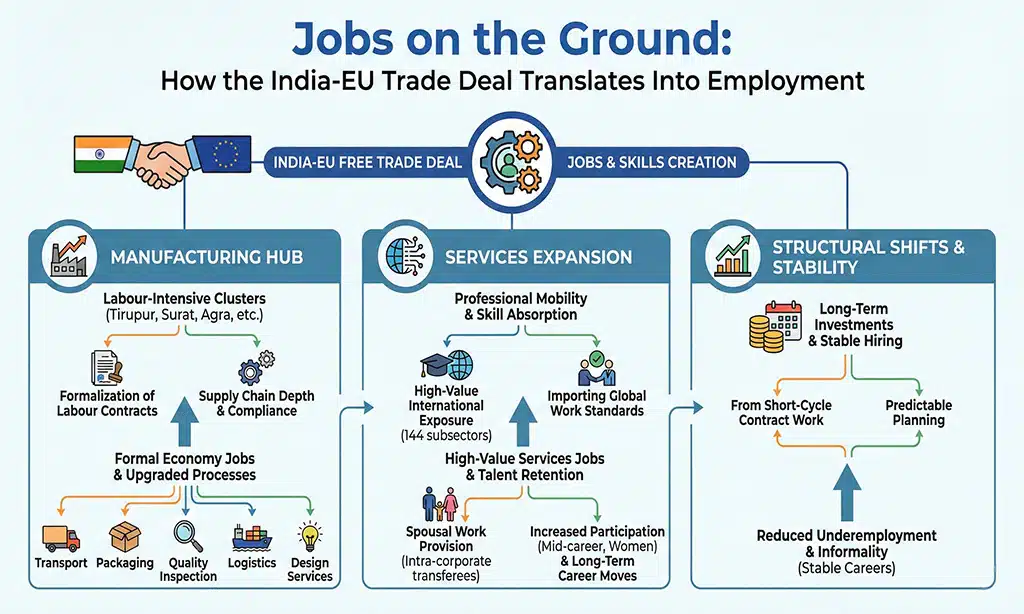
The services side of the deal addresses a different but equally important job issue. India produces millions of graduates every year, but high-value international exposure remains limited to a narrow slice of the workforce. By opening 144 services subsectors and simplifying professional mobility, the deal expands the range of Indian professionals who can access global work environments.
This is not just about sending workers abroad. It is about importing global work standards back into India. Professionals who rotate through EU firms in engineering, research, design, and sustainability return with exposure to advanced processes. This feeds into domestic hiring as Indian firms raise their expectations and pay structures to retain talent.
The spousal work provision for intra-corporate transferees is especially significant. It turns overseas assignments into viable long-term career moves rather than short disruptive stints. This increases participation by mid-career professionals and women, groups that are often excluded from global mobility despite being highly skilled.
Skills, Sustainability, and the Future of Work
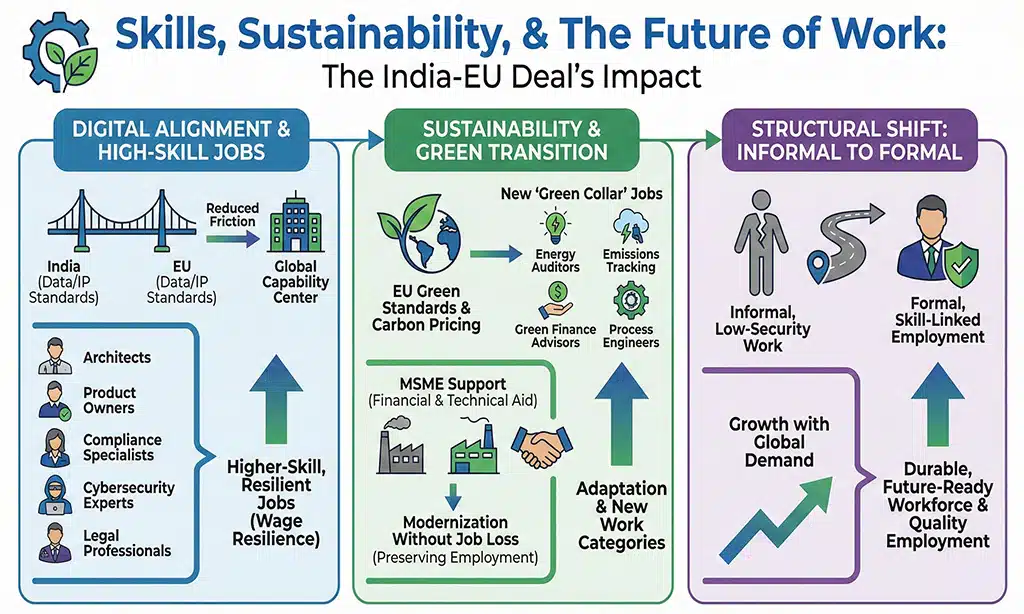
Digital alignment under the deal has a quieter but deeper employment impact. When India aligns data protection and intellectual property standards with the EU, it reduces friction for companies setting up global capability centers. These centers do not hire at entry level alone. They require architects, product owners, compliance specialists, cybersecurity experts, and legal professionals.
This shifts India’s services employment profile upward. Instead of absorbing labor into low-margin support roles, the economy creates jobs that sit closer to decision making and product ownership. Over time, this also improves wage resilience during global downturns because higher-skill roles are less vulnerable to cost-cutting.
The sustainability chapter of the deal addresses one of the most misunderstood job concerns. Environmental compliance is often seen as a threat to employment in heavy industry. In reality, the transition creates new categories of work. Energy auditors, emissions tracking specialists, green finance advisors, and process engineers become essential roles as firms adapt to carbon pricing and reporting requirements.
For small and medium enterprises, the EU-backed financial and technical assistance is crucial. Without it, compliance costs would have led to job losses. With it, MSMEs can modernize without shrinking their workforce, preserving employment while upgrading productivity.
Taken together, the India-EU Free Trade Deal does not create jobs overnight. What it does is more structural. It nudges India’s economy away from informal, low-security work and toward formal, skill-linked employment that grows with global demand. It aligns trade with labor outcomes rather than treating jobs as an afterthought.
This is why the deal matters beyond GDP projections. It changes the quality, geography, and durability of employment. For a country where millions enter the workforce each year, that shift may be its most consequential outcome.
Final Thought
The India-EU Free Trade Deal is the ultimate game-changer for the subcontinent, moving the needle from abstract economic growth to the micro-reality of millions of high-quality jobs. By merging India’s demographic dividend with Europe’s technological sophistication, the pact ensures that the current manufacturing and services upswing is not a temporary surge, but a permanent structural upgrade. For the Indian professional and the European investor alike, the road to the future now runs through this historic $25 trillion corridor.
What ultimately sets this agreement apart is its focus on durability. Jobs created through predictable market access, regulatory alignment, and long-term investment behave differently from those driven by short export booms. They anchor communities, encourage skill formation, and reward productivity over informality. As firms commit capital and talent with greater certainty, employment becomes more resilient to global shocks. For India, this means a workforce that grows with global demand rather than being displaced by it. For Europe, it offers a stable production and talent partner in an uncertain world. That mutual dependence is the deal’s quiet strength.
Read Part 1: China’s Invisible Hand in the India-EU Trade Deal
Read Part 2: India-EU Trade Deal: How Tariff Cuts Could Transform Exports
Read Part 4: Beyond Borders: How the India-EU Trade Deal Reshapes Supply Chains and Tech