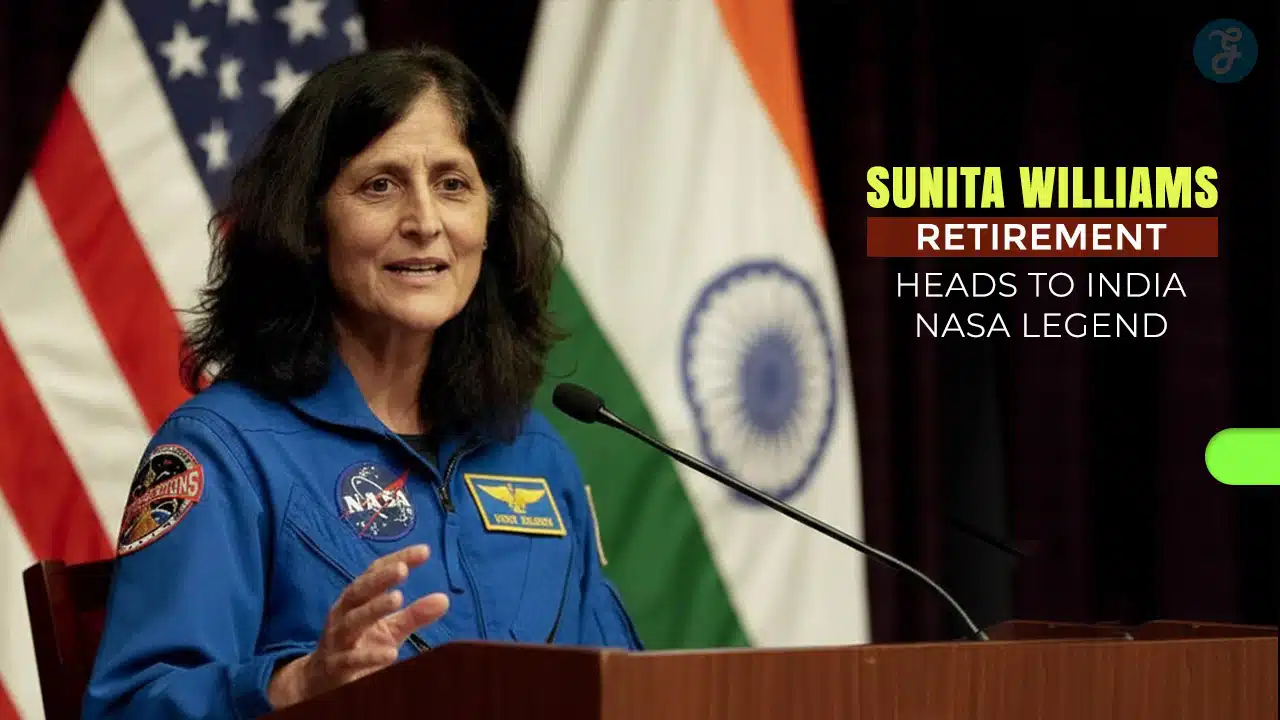
Sunita Williams’ retirement marks the conclusion of a pivotal chapter in NASA history—bridging the Space Shuttle era and the commercial space revolution. Her immediate transition to a high-profile tour in India signals a strategic shift: from exploring low-Earth orbit to cementing U.S.-India space collaboration for the Artemis generation.
From Crisis to Closure: The Trajectory of a Legend
The announcement of Sunita Williams’ retirement in January 2026 was less a surprise and more a formal closing of a loop that began with high drama in mid-2024. When Williams and Butch Wilmore launched on Boeing’s Starliner, it was meant to be a swift certification flight. Instead, thruster malfunctions turned an eight-day sprint into a nine-month marathon, testing not just the spacecraft but the resilience of its crew.
Her return in March 2025 aboard a SpaceX Dragon capsule—rather than the vehicle she launched in—symbolized the volatile transition period NASA is currently navigating. By stepping down now, Williams follows a precedent set by other commercial crew pioneers like Doug Hurley and Bob Behnken, who retired shortly after completing their historic DM-2 mission. For astronauts of her caliber, there is often no “next mission” that can top the complexity of commanding a troubled test flight and safely guiding a crew through an unplanned, extended orbital residency.
The Human Cost of “The New Space Race”
The narrative of Williams’ retirement cannot be separated from the operational realities of modern spaceflight. Her final mission underscored the fragility of the commercial crew program. While SpaceX has become the reliable workhorse, the struggles of the Starliner program placed immense pressure on veteran astronauts to act as the ultimate failsafe.
The Physical Toll: Spending 286 continuous days in microgravity at age 59 (during the mission) is physiologically taxing. The sheer duration of her final stay likely accelerated the decision to retire. NASA administrators have cited her leadership during this period as “trailblazing,” a polite acknowledgement that she managed a crisis that could have easily become a catastrophe.
Diplomacy in Orbit: The India Connection
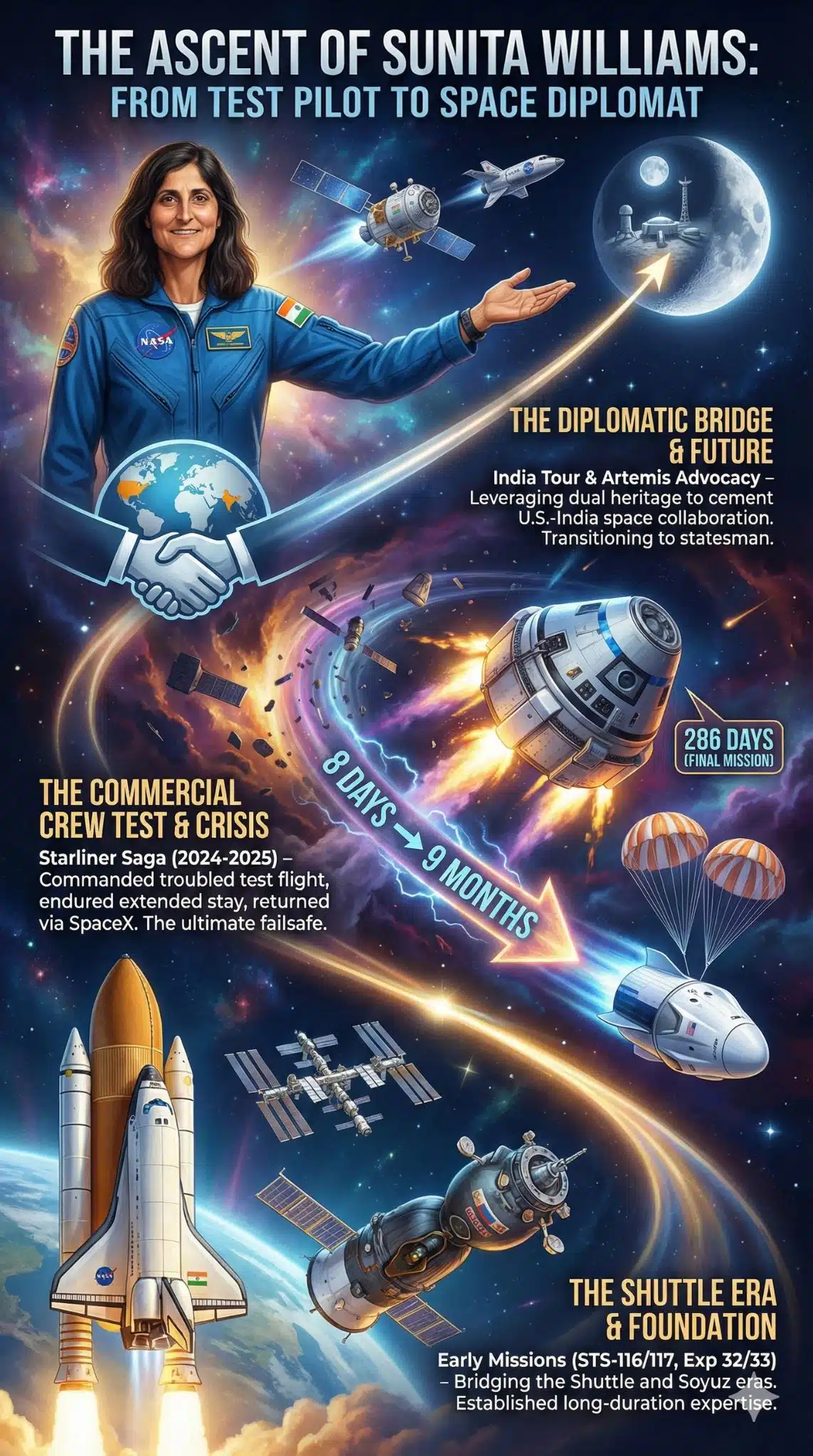
Williams is currently touring India, a visit she describes as a “homecoming.” This tour is functionally a soft-power diplomatic mission. With India’s Gaganyaan mission on the horizon and an ISRO astronaut scheduled to fly to the ISS (a mission Williams narrowly missed overlapping with), her presence bridges the gap between American technical heritage and Indian aspiration.
During her sessions at the American Center and IIT Delhi in January 2026, Williams has pivoted from discussing technical schematics to advocating for “rules of engagement” in the new space race. She is effectively transitioning from an operator to a statesman, using her dual heritage to foster trust between two space powers that are increasingly wary of China’s lunar ambitions.
Comparative Analysis: The Evolution of a Career
To understand the magnitude of her departure, one must look at how her missions have evolved alongside NASA’s own shifting priorities.
The Evolution of Sunita Williams’ Spaceflight Career
| Feature | Mission 1 (STS-116/117) | Mission 2 (Expedition 32/33) | Mission 3 (Boeing Crew Flight Test) |
| Year | 2006–2007 | 2012 | 2024–2025 |
| Vehicle | Space Shuttle Discovery | Soyuz TMA-05M | Boeing Starliner / SpaceX Dragon |
| Primary Role | Flight Engineer | Station Commander | Test Pilot / Commander |
| Planned Duration | ~6 months | ~4 months | 8 Days |
| Actual Duration | 195 Days | 127 Days | 286 Days |
| Key Achievement | First Marathon in Space | Triathlon in Space | Managed Starliner Malfunction |
Operational Impact: What NASA Loses
Williams represented the “old guard” of astronaut proficiency—pilots who could fly the Space Shuttle, the Soyuz, and modern commercial capsules. Her retirement leaves a vacuum in the Astronaut Office’s experience pool.
NASA Astronaut Experience Deficit (Post-Retirement)
| Metric | Sunita Williams’ Stats | Impact of Loss |
| Cumulative Days | 608 Days (2nd highest for NASA) | Loss of deep-duration physiological data. |
| Vehicle Certifications | 3 (Shuttle, Soyuz, Starliner/Dragon) | Few active astronauts have 3+ vehicle ratings. |
| Spacewalks | 9 (50+ Hours) | Loss of critical EVA leadership and training mentorship. |
| Crisis Management | High (Starliner Thruster Failure) | Irreplaceable real-time crisis experience. |
The “Overview Effect” and Future Advocacy
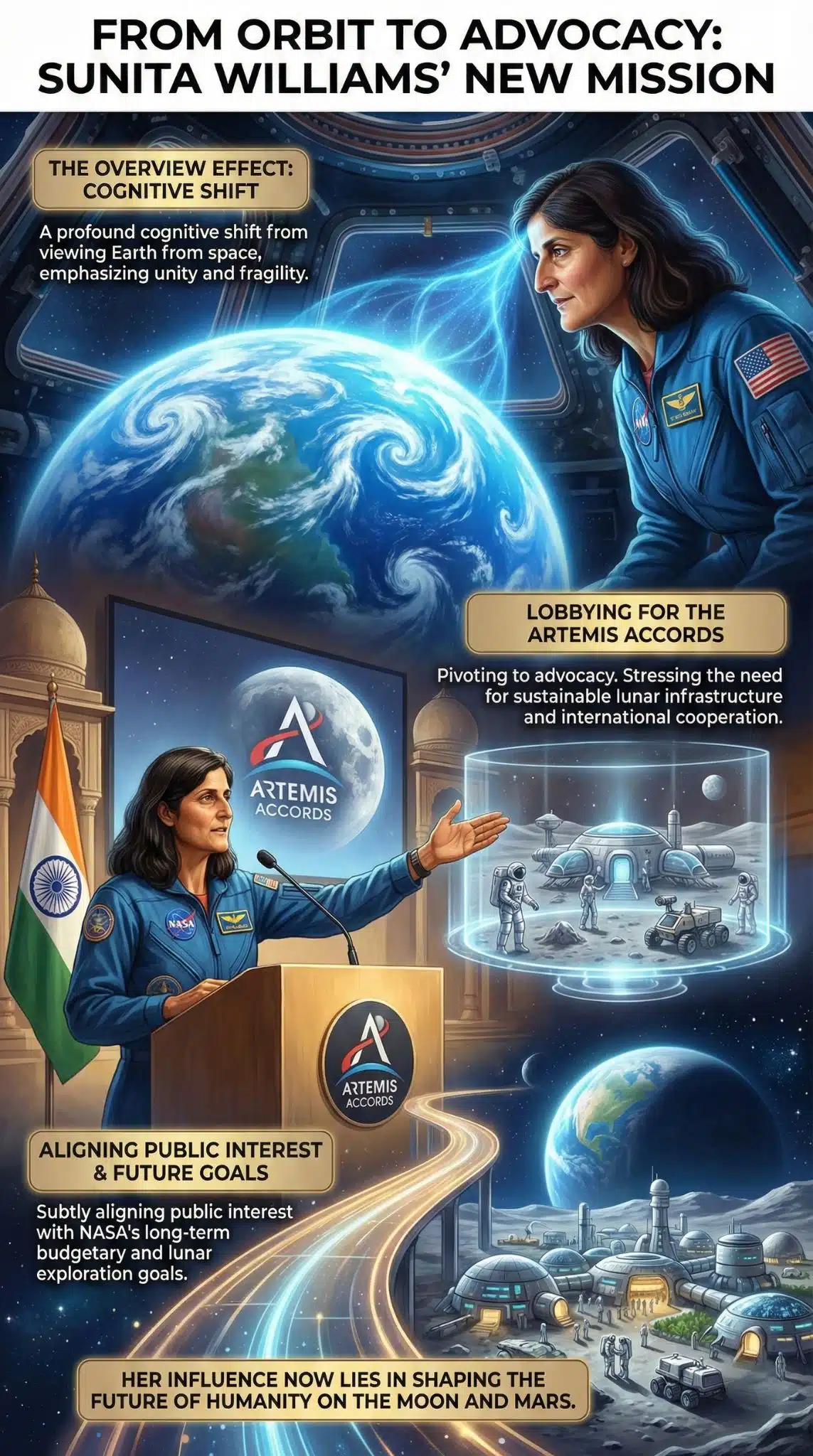
In her post-retirement speeches, Williams has emphasized the “Overview Effect”—the cognitive shift that happens when viewing Earth from space. However, her specific focus on the Moon and Mars indicates where her influence will lie next. She is not just reminiscing; she is lobbying for the Artemis Accords. By stressing the need for sustainable lunar infrastructure during her India tour, she is subtly aligning public interest with NASA’s long-term budgetary goals.
Future Outlook: The Consultant Commander?
What happens next for a retired legend of this magnitude?
- Commercial Advisory: It is highly probable Williams will join the board of a private space firm (like Blue Origin or Sierra Space) to guide human-rating certification for future vehicles, similar to former astronaut Peggy Whitson.
- US-India Space Liaison: Given the geopolitical weight of the US-India Initiative on Critical and Emerging Technology (iCET), Williams could formally or informally serve as a liaison for upcoming joint missions, ensuring the seamless integration of Indian astronauts into NASA-led architectures.
- Educational Leadership: Her current tour suggests a strong inclination toward STEM education, potentially leading a new academy or scholarship fund aimed at women in aerospace.
Final Words
Sunita Williams did not just fly in space; she survived the most turbulent developmental phase of modern spaceflight. Her retirement is a signal that the “Test Pilot” era of commercial crew is ending, and the “Operational” era has truly begun. As she tours India, she carries the torch not just for NASA, but for a future where spaceflight is a collaborative, global endeavor.
- Official Retirement: Sunita Williams retired from NASA effective December 27, 2025, concluding a 27-year career with 608 cumulative days in space.
- The “Starliner Saga” Factor: Her retirement follows the unplanned extension of the Boeing Starliner test flight, which stretched from 8 days to nearly 9 months, ending with a SpaceX return in March 2025.
- Strategic Timing: Her current India tour is not just a victory lap; it aligns with deepening ISRO-NASA ties and the upcoming joint missions to the ISS.
- Legacy: She leaves as the woman with the second-highest cumulative time in space for a NASA astronaut and a critical figure in validating commercial crew vehicles.