
I run structured data across a publishing operation with a news site, seven content hubs, a shop, a mobile app, fifteen free browser tools and seven language subdomains. That is a lot of surface area, and most of it needs different markup. Over the past two years I have cut my list of schema for better AI search visibility down to eight types. The rest either stopped working or never earned the maintenance.
One thing first, because it shapes everything below. Google has never published a schema requirement for AI Overviews or AI Mode. There is no AI-specific markup. Anyone selling you a special block of JSON-LD that gets you cited is overstating it. What structured data actually does is remove ambiguity.
It tells a machine who you are, who wrote this, what it costs and when it changed, without asking it to guess. That is a trust and clarity job, not a ranking switch, and it is worth doing for exactly that reason. We cover the rest of the overclaiming in our piece on AI search myths in SEO.
1. Organization: The Anchor for Any Schema Built for Better AI Search Visibility
If you implement one thing, implement this one. Every other type on the list points back at it.
The organization schema states who publishes the site. Name, URL, logo, and sameAs links to the profiles you actually control. For a publisher, it NewsMediaOrganization is the sharper choice, because it accepts properties that matter for trust.
We publish a corrections policy and a fact-checking policy as real pages. For a long time they sat in the footer and nowhere else. Pointing the markup at them costs nothing and turns two links into a stated claim about how the operation runs.
Put the block in your site-wide template, give it an @id, and reference that @id everywhere else instead of repeating the details. Consistency beats completeness here. If your organization name appears three different ways across your site, social profiles and app listing, fix that before you add another property.
2. Person: Who Wrote This, in a Form a Machine Can Check
Author markup is the second half of the same job. The organization says who published it. The person says who wrote it.
Give each writer a real bio page. Mark that page up as a Person “with,” then have every article reference the @id rather than repeating a name string. Add jobTitle, knowsAbout for their actual subjects, and sameAs point to a LinkedIn profile or equivalent that exists.
The trap is inflation. knowsAbout is not a wish list. If the page says someone is an authority on six subjects and they have written about one, you have created a mismatch that is easy to check and embarrassing when checked.
Our own author pages carry the founder, the editor and the CTO. Each writes in a narrow lane. That narrowness is the point.
3. Article and News Article: Dates That Are Actually True
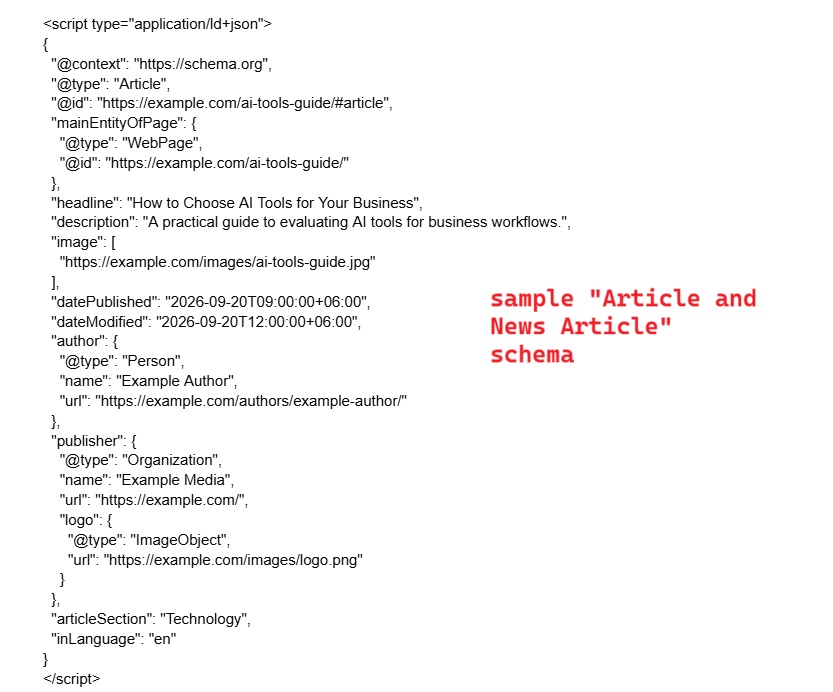
Article markup is still one of the few types that produces a visible rich result, and it carries the freshness signal.
The required work is small: headline,author referencing your person,publisher referencing your organization,and dateModified.
dateModified is where most sites quietly cheat. Bumping the date without changing the content is the fastest way to teach a system that your timestamps mean nothing. I only move it when something on the page actually changes, and I try to make the change visible on the page itself. If an AI system is choosing between two sources on a moving topic, the one whose dates match its content history is the safer cite. More on how that plays out in how AI Overviews are changing SEO strategy.
4. BreadcrumbList: Cheap Structure That Machines Read
Breadcrumbs are the least glamorous type here and one of the easiest wins. They still produce a rich result, and they state where a page sits without requiring anyone to reverse-engineer your URLs.
This mattered more on our site than I expected. Our articles sit under hub categories, but our fifteen tool pages sit at the root, because they were built as standalone products. From the outside, nothing connects a calculator to the hub that owns it. Breadcrumbs are the cheapest way to say it out loud.
Keep them matching the visible navigation. If the breadcrumb trail in your markup does not exist anywhere on the page, you have created a second mismatch for no benefit.
5. FAQPage: The Honest One
This is the type people argue about, so here is the current position, plainly.
FAQ-rich results no longer appear in Google Search as of May 7, 2026. The Search Console report and Rich Results Test support were removed in June 2026, and API support ended in August. For most sites the practical loss happened back in August 2023, when eligibility was narrowed to well-known government and health sites.
The rich result is gone. The schema type is not deprecated, and the markup still describes your content accurately to anything that parses it. That is the entire remaining case for it, and I think it is still a decent one, because a question with a direct answer under it is the easiest shape for a machine to lift.
What I stopped doing is bolting FAQ blocks onto pages that had no questions in them. That was always a rich-result play, and the rich result is what died. Write the questions because readers ask them, then mark them up.
HowTo sits in the same place, one deprecation cycle earlier. Restricted in 2023, no rich result on any surface now, still a valid schema.
6. Product, Offer and AggregateRating: For Better AI Search Visibility Still Pays Directly
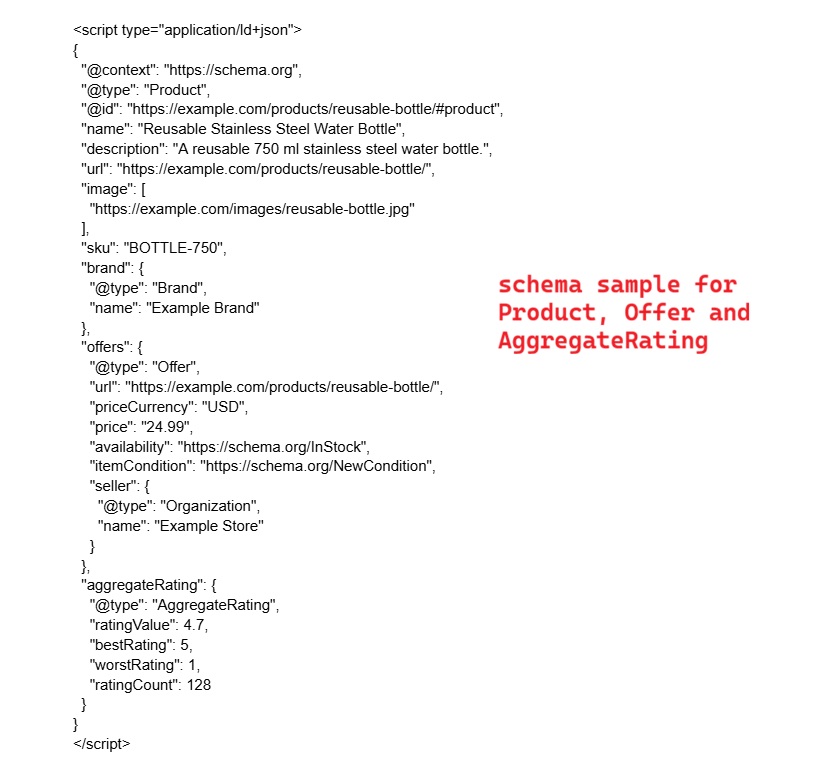
Product markup is one of the types that kept its rich results, and it is the one with the clearest commercial return.
The combination that matters is Product plus Offer with price, currency and availability, plus AggregateRating if you have real ratings. AI answers about what to buy lean hard on this, because price and stock are facts that cannot be inferred from prose.
Two rules I do not bend. The rating has to be genuine, and it has to be visible on the page. Invisible or invented review markup is one of the few structured data errors that can earn a manual action rather than just being ignored. Keep availability current. A tool can be wrong about your price; you should not be.
7. SoftwareApplication and WebApplication: For Tools and Apps
If you ship software, this one is underused.
We run fifteen free browser tools and a mobile app for children learning letters. Both categories answer questions that get asked in plain language: a free freelance rate calculator and an alphabet tracing app for a five-year-old. SoftwareApplication lets you state, and aaoffers block with a price of zero.
Free is worth stating explicitly. A machine cannot tell that a tool is free by looking at a page that simply has no pricing on it. Silence reads as unknown, and unknown is not what gets recommended. This is the same logic behind using generative AI for SEO work at all: state things plainly instead of hoping they are inferred.
8. VideoObject: The Transcript Is the Point
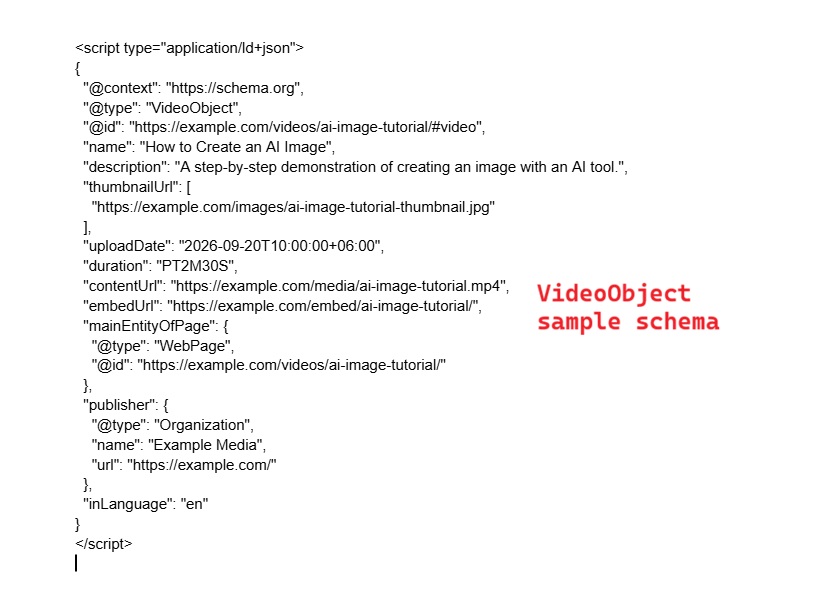
Video markup takes, and a contentUrl or embedUrl.
The property people skip is transcript, and it is the one that matters most here. A language model cannot watch your video. It can read the transcript. A page with an embedded video and no text is close to empty as far as these systems are concerned, no matter how good the video is.
Latest Google Update to Be Taken
Pruning matters as much as adding. Google has said that structured data, which is not being used, does not cause problems, but it also has no visible effect, so it is pure maintenance cost.
The seven types retired in June 2025, including Course Info, Claim Review, Estimated Salary and Special Announcement. Dataset markup, which only feeds Dataset Search rather than Google Search. And any markup describing something a reader cannot see on the page.
| Schema type | Still a rich result? | Worth keeping? |
|---|---|---|
| Organization / NewsMediaOrganization | No | Yes, it anchors everything. |
| Person (author) | No | Yes |
| Article / NewsArticle | Yes | Yes |
| BreadcrumbList | Yes | Yes |
| FAQPage | No, retired May 2026 | Yes, for machine readability only |
| Product + Offer + AggregateRating | Yes | Yes |
| SoftwareApplication | No | Yes, if you ship software |
| VideoObject | Yes | Yes, with a transcript. |
Final Thoughts
None of this is a shortcut, and anyone promising that structured data alone gets you cited is selling something. Schema for better AI search visibility works by making facts explicit that a machine would otherwise have to infer, and inference is where you lose.
If you are starting today, do it in this order. Organization first, once, site-wide. Author pages next. Article markup with dates you can defend. Then breadcrumbs. Those four cover most pages on most sites and take an afternoon.
Then go back and check one thing that is easy to skip: does every claim in your markup appear somewhere a reader can see it? If the answer is no anywhere, fix the page before you touch the JSON-LD.