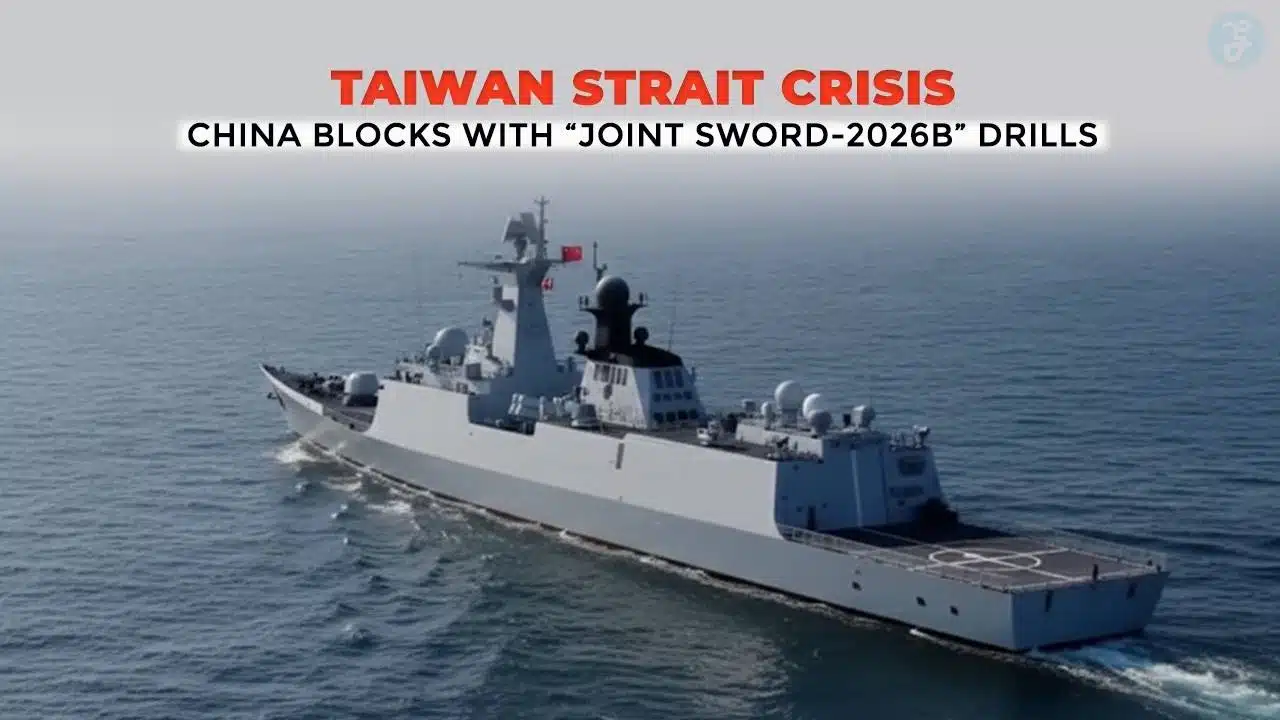
China Taiwan Blockade Strategy 2026 has entered a new and perilous phase, moving beyond the era of performative military “drills” and into a state of normalized, permanent encirclement. As the People’s Liberation Army (PLA) launched its 2026 training season on January 4, it did so on the heels of “Justice Mission 2025,” a massive, snap exercise that proved Beijing no longer needs weeks of buildup to paralyze the island.
What we are witnessing today is not merely a rehearsal for war, but the implementation of a “Law Enforcement Blockade” designed to choke Taiwan into submission while keeping international intervention at bay through legal and tactical ambiguity.
Key Takeaways: The 2026 Strategic Reality
- From Drills to Doctrine: The China Taiwan Blockade Strategy 2026 has shifted from temporary “exercises” to a permanent “posture of encirclement.”
- The Law Enforcement Trap: By using the China Coast Guard (CCG) as the lead agency, Beijing is attempting to “legalize” the blockade, framing it as domestic law enforcement to paralyze international military responses.
- Asymmetric Attrition: The introduction of drone carriers like the Jiutian allows the PLA to overwhelm Taiwan’s expensive air defenses with low-cost “swarms.”
- Energy & Digital Isolation: With only 11 days of LNG reserves and a reliance on vulnerable undersea cables, Taiwan faces a “total isolation” scenario that targets societal collapse over military defeat.
Operationalizing the Strait: Why 2026 Marks the End of Military Pretense
The transition from the Joint Sword-2024 series to the Justice Mission 2025 maneuvers marks a fundamental shift in Beijing’s strategic calculus. In 2024, the world watched as China practiced “punishment” scenarios; by the end of 2025, those scenarios had evolved into a seamless, multi-domain “Justice Mission.”
The “New Normal” of Snap Exercises
For decades, military analysts looked for “tells”—large-scale mobilizations of troops and ships—that would signal a coming blockade. In 2026, those tales have disappeared. The PLA has successfully normalized “snap drills” that begin less than an hour after their public announcement. By keeping the island in a constant state of “gray-zone” pressure, Beijing is eroding the distinction between routine training and actual invasion preparation.
Thesis: The Art of Short-and-Sharp Isolation
Beijing’s current doctrine is no longer focused solely on a bloody amphibious assault—a “D-Day” style invasion that would risk massive PLA casualties and global condemnation. Instead, the China Taiwan Blockade Strategy 2026 is perfecting the art of “Short-and-Sharp” isolation. The goal is to induce a total political and economic collapse within Taiwan in as little as 48 to 72 hours, forcing Taipei to the negotiating table before a single US carrier group can even arrive in the Philippine Sea.
The Trigger: A New Arms Race in the Strait
The intensity of the latest PLA maneuvers can be directly traced to the seismic shift in Taiwan’s defensive posture and its deepening relationship with Washington.
The $11.1 Billion Catalyst
In late December 2025, the US administration approved a record-breaking $11.1 billion arms package for Taiwan. This wasn’t just a quantitative increase; it was a qualitative escalation. The package included:
- HIMARS (High Mobility Artillery Rocket Systems): Expanded units to provide mobile, lethal counter-strikes.
- ATACMS (Army Tactical Missile Systems): Long-range missiles capable of striking PLA staging areas deep within the Chinese mainland.
- Loitering Munitions: Thousands of “kamikaze drones” designed to create a “hellscape” in the Taiwan Strait for any invading fleet.
Beijing’s Red Line: Targeting Asymmetry
The PLA’s “Justice Mission 2025” specifically targeted the infrastructure required for these asymmetric systems. During the December 29–30 drills, PLA Rocket Forces practiced high-precision “decapitation” strikes against mobile launcher sites and drone command centers. Beijing’s message is clear: any attempt by Taiwan to acquire “offensive” deterrence will be met with immediate, overwhelming tactical neutralization.
Strategic Anatomy of the Blockade: The CCG Factor
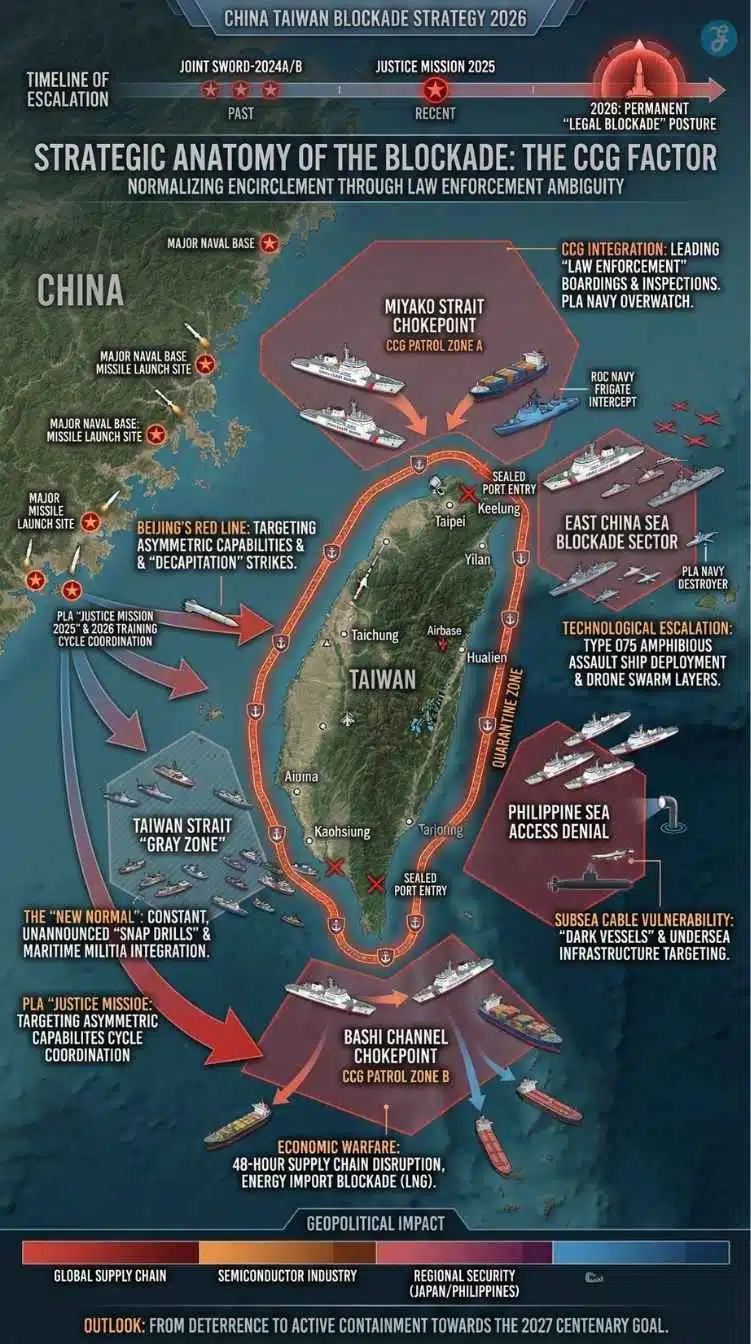
The most significant evolution in the China Taiwan Blockade Strategy 2026 is the total integration of the China Coast Guard (CCG) into frontline military operations.
The “Five-Point Encirclement”
During the latest maneuvers, the PLA and CCG established seven distinct zones, up from the six seen in 2024. These zones effectively sealed off the ports of Keelung in the north and Kaohsiung in the south, while also creating a “wall” in the Bashi Channel to the south and the Miyako Strait to the north.
Legalizing the Blockade: “Quarantine” vs. War
By using the CCG to lead these operations, Beijing is attempting to frame the blockade as a domestic “law enforcement action.”
- Boarding and Inspection: CCG vessels have begun practicing “legal” boardings of commercial ships in the Taiwan Strait.
- The Ambiguity Trap: If the CCG stops a vessel, is it an “armed attack” that triggers a US military response? By staying just below the threshold of kinetic war, China is creating a “legal blockade” that complicates international intervention and forces allies into a diplomatic stalemate.
“The CCG is no longer a maritime police force; it is the tip of the spear in a non-kinetic war of attrition.” — Excerpt from 2026 Regional Security Report
The Information Choke: Undersea Cables as a Strategic Target
A kinetic blockade of ports is only one half of the China Taiwan Blockade Strategy 2026. The other, more insidious half is the “Information Quarantine.” Taiwan is connected to the global internet via 24 undersea fiber-optic cables (14 international and 10 domestic). In the “Justice Mission 2025” maneuvers, the PLA demonstrated that it no longer views these as civilian infrastructure, but as primary military targets.
The Matsu Precedent and “Dark Vessels”
Following the suspicious cable-cutting incidents of 2023 and 2025, Beijing has refined the use of “dark vessels”—commercial-looking sand dredgers and fishing trawlers that disable their AIS (Automatic Identification System) to sever cables under the guise of maritime accidents. In the 2026 strategy, this has been elevated to a formal “Space-to-Seabed” doctrine. By severing just three key cable clusters near the Bashi Channel, the PLA could theoretically reduce Taiwan’s bandwidth by 99%, plunging the island into a digital dark age.
Cyber-Kinetic Synchronization
The blockade is not just about physical ships; it is about the “Great Firewall” moving seaward. During the January 2026 training cycle, the PLA Strategic Support Force (SSF) practiced synchronized cyber-attacks on Taiwan’s satellite downlinks. The goal is to ensure that when the physical blockade begins, the world—and the Taiwanese people—receive only the information Beijing allows them to see.
Economic Warfare: The Global Supply Chain “Choke”
The China Taiwan Blockade Strategy 2026 is as much about the global economy as it is about territorial control.
Semi-Conductor Vulnerability
Taiwan remains the world’s beating heart for advanced semiconductors. A 48-hour blockade doesn’t just stop the flow of chips; it shatters the global “Just-in-Time” (JIT) manufacturing model. During the December 2025 drills, industry analysts noted that the mere threat of a prolonged blockade caused a 12% spike in global silicon futures.
Aviation and Shipping Disruptions
The “Justice Mission 2025” caused the cancellation of over 850 international flights and the rerouting of hundreds of commercial vessels. The Bashi Channel, a critical artery for energy imports for Japan and South Korea, was effectively turned into a “no-go” zone for two days. This is “Economic Decapitation”—proving that Beijing can inflict global financial pain without firing a single shot.
The Swarm Doctrine: From “Jiutian” to SeaShark
The most radical technological shift in the China Taiwan Blockade Strategy 2026 is the transition from “Big Hull” diplomacy to “Swarm” attrition.
The “Jiutian” Aerial Drone Carrier
In mid-December 2025, the PLA conducted the maiden flight of the Jiutian, a massive 16-meter-long drone carrier. Capable of carrying six tons of payload, the Jiutian is designed to deploy hundreds of loitering munitions (kamikaze drones) in a single sortie. This “swarm-in-a-box” capability allows the PLA to overwhelm Taiwan’s expensive “T-Dome” air defenses through sheer mass. For every $2 million Patriot missile Taiwan fires, China can launch 50 drones costing $20,000 each.
SeaShark and Undersea Warfare
While Beijing focuses on aerial swarms, Taipei has responded with its own “asymmetric” counter-blockade. The Thunder Tiger SeaShark 680 and 800 unmanned surface vessels (USVs) are Taiwan’s answer to the Black Sea drone tactics. These sea drones are designed to hide in the “clutter” of the Strait, waiting for high-value PLA assets like the Type 075 amphibious ships to enter the “Five-Point Encirclement” zones.
This creates a “War of the Drones” where the side with the most resilient AI-mesh network wins. Beijing’s 2026 strategy relies on “Electronic Isolation”—using massive jamming ships to sever the link between Taiwanese operators and their sea drones, effectively blinding the island’s asymmetric vanguard.
Geopolitical Responses: The T-Dome and the Japan Corridor
In response to the tightening noose, Taiwan and its neighbors are frantically rewriting their defense doctrines.
Taiwan’s “T-Dome” Defense
President Lai Ching-te has pushed for a historic defense budget, aiming for 3% to 5% of GDP. The centerpiece is the “T-Dome”—a multi-layered, AI-integrated defense shield designed to intercept everything from massive ballistic missiles to swarms of low-altitude drones. However, internal legislative gridlock in Taipei remains a significant hurdle to the rapid deployment of these systems.
The Japan-Philippines Corridor
Tokyo has officially categorized a Taiwan blockade as a “survival-threatening situation.” Prime Minister Sanae Takaichi’s administration has greenlit the deployment of electronic warfare units and surface-to-air missiles on Yonaguni Island—just 110km from Taiwan’s east coast. Simultaneously, the Philippines has become a critical “rear-guard” base for US logistics, though Beijing’s diplomatic pressure on Manila continues to create friction in the alliance.
The Resilience Paradox: 11 Days of LNG and the Energy Brink
The ultimate success of the China Taiwan Blockade Strategy 2026 depends on one metric: Time to Collapse. Beijing’s “Anaconda Strategy” is designed to outlast Taiwan’s strategic reserves.
| Resource | Reserve Capacity (2026) | Daily Vulnerability |
| Liquified Natural Gas (LNG) | 11–12 Days | 50% of Power Generation |
| Coal | 42 Days | Primary “Emergency” Fuel |
| Food (Rice/Grain) | 6–7 Months | High Caloric Deficit |
| Crude Oil | 146 Days | Transportation/Military Vital |
The LNG Chokepoint
Taiwan’s transition to green energy has inadvertently created a strategic “Achilles’ heel.” Because LNG is difficult to store in large quantities, the island’s 11-day reserve is the primary target of the 2026 blockade strategy. If the PLA can prevent just three LNG tankers from docking at the Taichung or Yongan terminals, the island will face rolling blackouts within a week. This “Energy Guillotine” is designed to trigger civil unrest and force the Taiwanese government to capitulate before military stores are even depleted.
The “Island Control Model”
Beijing has codified this into the Island Control Model. Unlike a traditional siege, which waits for starvation, this model uses “Active Deprivation.” By selectively allowing certain “humanitarian” shipments while blocking all industrial and energy imports, Beijing creates a psychological wedge between the populace and the government, framing the “blockade” as a “regulation of chaos” caused by the ruling party’s “pro-independence” stance.
Future Outlook: The 2026–2027 Escalation Curve
As we move toward the second half of 2026, the China Taiwan Blockade Strategy 2026 will likely culminate in a “Full-Spectrum Quarantine” rehearsal. Analysts expect the PLA to move from “entering” territorial waters to “occupying” maritime corridors, potentially seizing an uninhabited outlying island to test the international response to a “salami-slicing” land grab.
The message from the 2026 PLA Training Season is unambiguous: The time for “warnings” is over. Beijing is now in the “Execution and Refinement” phase of a strategy that views Taiwan as an isolated fortress whose walls are being systematically dismantled, brick by brick.
As we look toward the remainder of 2026, all eyes are on the 2027 Centenary Goal.
- PLA Readiness: US intelligence suggests that by 2027, the PLA aims to have the “full capability” to execute a successful cross-strait invasion, regardless of US intervention.
- Anticipating Joint Sword-2026B: Based on current patterns, the next major escalation, potentially named Joint Sword-2026B, is expected to occur around October 2026. This exercise will likely feature the first full integration of the Type 076 amphibious assault ship, a vessel designed specifically for drone-heavy “island-capture” scenarios.
Final Thought: From Deterrence to Active Containment
The China Taiwan Blockade Strategy 2026 has moved past the point of no return. Beijing has successfully normalized the encirclement of Taiwan, turned the Coast Guard into a paramilitary blockade force, and demonstrated its ability to hold the global economy hostage. The “status quo” in the Taiwan Strait is no longer being maintained; it is being systematically dismantled.
For Taiwan and its allies, the window for effective deterrence is closing, replaced by a new reality of “active containment.”