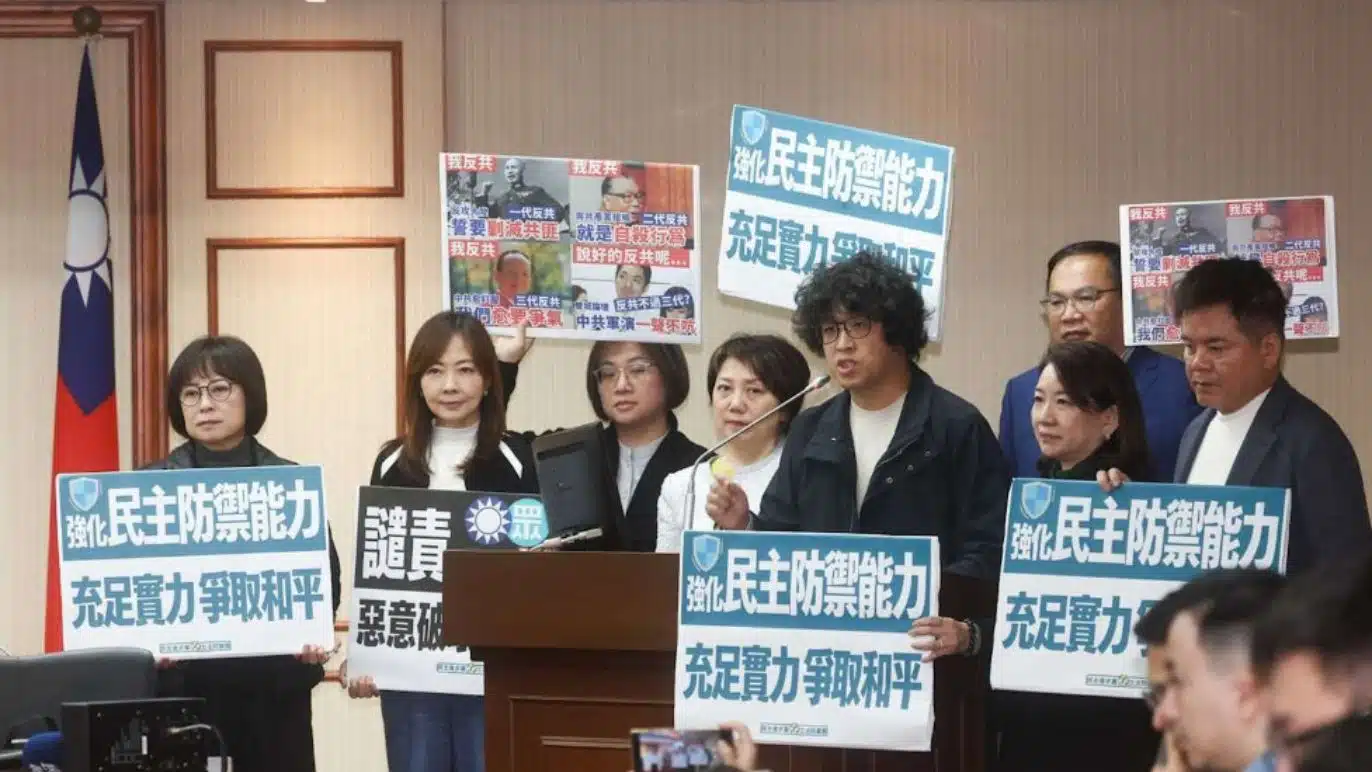
In a dramatic escalation of tensions across the Taiwan Strait, Taiwan’s opposition parties have repeatedly blocked a landmark NT$1.25 trillion (US$40 billion) special defense budget, even as China’s People’s Liberation Army (PLA) conducted live-fire drills with rockets landing inside Taiwan’s 24-nautical-mile contiguous zone for the first time. The move by the Kuomintang (KMT) and Taiwan People’s Party (TPP) has ignited fierce protests from the ruling Democratic Progressive Party (DPP), which accuses the opposition of undermining national security amid Beijing’s most provocative military posturing yet. This standoff unfolds against a backdrop of intensified Chinese aggression, raising urgent questions about Taiwan’s preparedness for potential conflict.
Budget Proposal Sparks Legislative Firestorm
President William Lai Ching-te’s administration unveiled the ambitious eight-year special defense budget on November 27, 2025, aiming to fund critical weapons procurement and joint development programs with the United States from 2026 to 2033. Valued at NT$1.25 trillion—equivalent to roughly US$39.8-40 billion—the package represents one of the largest defense investments in Taiwan’s history, designed to bolster asymmetric warfare capabilities against China’s overwhelming numerical superiority. Lai justified the urgency in a Washington Post op-ed, citing Beijing’s explicit goal of military readiness for unification by 2027, a timeline that has loomed large over regional security dynamics.
The Executive Yuan approved the draft bill following consultations with U.S. counterparts, emphasizing procurement of advanced air defense systems, missiles, and indigenous production initiatives to enhance deterrence. However, the proposal hit an immediate wall in the Legislative Yuan’s Procedure Committee, where KMT and TPP lawmakers—holding a slim joint majority—voted it down from the agenda for plenary review. By December 30, this marked the fifth such blockade, with opposition forces passing alternative agendas in 10-8 votes that sidelined the bill.
DPP lawmakers erupted in protests, surrounding the legislative podium and chanting slogans like “Taiwan needs security, not another Wu Sangui!”—a historical reference to a Ming Dynasty general accused of betraying China to the Manchus. Puma Shen, a DPP legislator, lambasted the opposition for refusing even basic committee scrutiny, arguing that the Procedure Committee’s role is merely procedural, not substantive oversight. The chaos underscores deep partisan divides in Taiwan’s parliament, where post-election dynamics have empowered the opposition despite the DPP’s presidential hold.
Opposition Demands Transparency from Lai
KMT and TPP leaders frame their resistance not as anti-defense but as a push for accountability, insisting President Lai personally brief the legislature on spending details before any vote proceeds. KMT caucus whip Fu Kun-chi emphasized that the party supports bolstering defenses but cannot endorse a “blank cheque” based on scant documentation—merely two to six pages outlining the proposal. TPP echoes this, calling for Lai to report directly and field questions, a demand the president has partially accommodated by expressing openness to a state-of-the-nation address while rejecting full interpellation as unconstitutional.
KMT caucus secretary-general Lo Chih-chiang went further, accusing Lai of being the true blocker by dodging legislative scrutiny and provoking Chinese drills through provocative policies. He noted that under past KMT governance, PLA aircraft and vessels rarely crossed the Taiwan Strait median line—a claim DPP counters by highlighting Beijing’s escalating “gray-zone” tactics regardless of Taiwan’s leadership. Opposition lawmakers argue for a special act to govern the budget first, ensuring fiscal amendments align with the Act Governing the Allocation of Government Revenues and Expenditures.
This procedural brinkmanship has stalled the bill repeatedly, with the latest rejection on December 30 coinciding with active PLA exercises, amplifying accusations of poor timing. Critics within the DPP warn that such delays play into Beijing’s hands, eroding Taiwan’s deterrence at a pivotal moment when U.S. arms sales— including a recent US$11.1 billion package announced December 17—demand swift integration.
Chinese Rockets Pierce Taiwan’s Contiguous Zone
Just as the budget battle raged, China launched “Justice Mission 2025,” its largest live-fire drills to date, with rockets landing closer to Taiwan than ever recorded. On December 30, the PLA fired 27 rockets from Fujian Province’s Pingtan and Shishi areas: 17 from Pingtan fell outside the 24-nautical-mile contiguous zone off northern Taiwan, while 10 from Shishi splashed down within it, off southern Tainan City. Lt. Gen. Hsieh Jih-sheng of Taiwan’s Ministry of National Defense (MND) confirmed this as the nearest PLA live-fire incursion to Taiwan proper, breaching the zone defined for customs, immigration, and security enforcement beyond the 12-nautical-mile territorial sea.
The drills, announced December 29 as a “stern warning to Taiwan independence separatist forces,” involved 71 PLA aircraft (35 crossing the median line into Taiwan’s ADIZ), 13 naval vessels, and 15 coast guard ships encircling the island. PLA Eastern Theater Command spokesperson Senior Colonel Shi Yi framed the operation—running from 8 a.m. to 6 p.m.—as a rehearsal for blocking foreign interference, with designated no-go zones in surrounding waters and airspace. Taiwan’s Coast Guard Administration monitored the vessels, warning off eight that briefly entered the 24-nautical-mile line.
Taiwan activated an ad hoc emergency operations center, safeguarding key infrastructure while Lt. Gen. Lien Chih-wei highlighted countermeasures against PLA disinformation campaigns embedded in the drills. These exercises follow a pattern of escalation: over 3,000 median line crossings in 2024 alone, a 300% surge since 2021, per MND data, signaling Xi Jinping’s push for 2027 readiness. Analysts view this as a “dress rehearsal” for blockade or invasion scenarios, testing Taiwan’s response amid U.S. President Donald Trump’s recent reelection and shifting Indo-Pacific postures.
Broader Context of Strait Tensions
Taiwan’s defense push responds to years of Chinese coercion, including massive amphibious drills, “gray-zone” incursions, and rhetoric vowing to “crush” foreign meddling. Beijing claims Taiwan as sovereign territory, rejecting its democratic governance, while Taipei bolsters ties with Washington through arms deals and joint exercises like Han Kuang, which simulated invasion defenses earlier in 2025. The US$11.1 billion arms sale—featuring missiles and radar—directly preceded the PLA response, linking U.S. support to Beijing’s fury.
Global observers express alarm: Japan’s missile deployments near Taiwan prompted Chinese warnings, while European and Indo-Pacific allies urge Taiwan’s readiness. Economically intertwined yet militarily polarized, the strait hosts routine PLA sorties—over 150 aircraft in October alone—eroding the median line’s de facto status. President Lai’s budget seeks to fund HIMARS, Sky Sword missiles, and U.S. co-productions, aiming for self-reliance amid procurement backlogs.
Domestically, public sentiment favors robust defenses: polls show majority support for higher spending, though opposition leverages fiscal conservatism and pro-unification leanings among KMT bases. The TPP, a wildcard, bridges generational divides by demanding transparency without outright rejection.
Political Ramifications and Protests Erupt
The budget blockade has fueled street protests, with DPP supporters decrying opposition “treason” amid rocket flyovers, evoking memories of chaotic legislative brawls. Lawmakers traded barbs: DPP accuses KMT of “helping Beijing,” while opposition retorts that Lai’s intransigence invites aggression. President Lai, open to addressing parliament but firm on separation of powers, navigates a constitutional tightrope.
Internationally, the impasse draws scrutiny: U.S. lawmakers push Taiwan engagement reviews under Trump-signed bills, while allies like Japan and Australia monitor for spillover. Economically, delays risk stalling US$61 billion in total defense outlays announced earlier, including baseline hikes.
Expert Analysis: Deterrence at Stake
Security analysts warn that prolonged delays weaken deterrence, especially post-U.S. arms notifications that provoke PLA “punishment” drills. The contiguous zone breach signals eroded red lines, with rockets off Tainan testing naval responses. Funding asymmetric assets—drones, sea mines, mobile launchers—could offset PLA’s carrier groups and hypersonics, per think tanks.
Opposition insistence on details is legitimate, experts concede, given past procurement scandals, but timing amid drills appears politically motivated. Resolution may hinge on compromise: a special act for oversight, allowing committee review without presidential grilling.
Path Forward Amid Escalating Drills
As “Justice Mission 2025” wraps, Taiwan’s MND vows heightened vigilance, with reservists mobilizing and U.S. INDOPACOM eyeing contingencies. The legislature reconvenes soon, where DPP may force agenda inclusion or seek cross-party talks. President Lai’s team eyes 2026 rollout regardless, leveraging executive powers for interim funding.
Yet, with rockets landing unprecedentedly close and opposition dug in, Taiwan faces a precarious 2026: bolstering defenses or risking vulnerability. Stakeholders urge unity, as Beijing watches, poised for further tests. Global markets jitter at strait risks, underscoring the high stakes of this legislative drama.