The British high street and out-of-town retail landscape are undergoing a seismic shift. Gone are the days when a retail park was simply a concrete expanse of “big box” stores and a sprawling car park. As we look toward 2026, the most successful developments are those that embrace a holistic approach to the consumer experience. Family-Friendly Retail Park Concepts UK are no longer just about convenience; they are about creating “destinations”, spaces where leisure, retail, and community converge to offer a full day out for multi-generational visitors.
In this deep dive, we explore how forward-thinking developers and planners are reimagining these spaces. We will look at the integration of immersive leisure, the non-negotiable demand for sustainability, and the “placemaking” strategies that are turning shopping trips into family memories.
Key Takeaways
-
Experience Over Transaction: Families demand leisure, dining, and entertainment options (bowling, climbing, cinemas) alongside traditional retail.
-
Placemaking Matters: Landscaping, wide pedestrian zones, and “town square” event spaces are critical for increasing dwell time.
-
Inclusivity is Essential: High-quality parent rooms, sensory-friendly hours, and fully accessible facilities are now expected standards.
-
Green & Sustainable: Biodiversity, nature trails, and EV infrastructure attract the modern, eco-conscious family.
-
Tech for Convenience: Smart parking and click-and-collect drive-thrus remove the friction from the shopping trip.
The New Currency: Prioritising Time and Togetherness
To truly understand the surge in innovative Family-Friendly Retail Park Concepts UK, we must first look at the shifting priorities of the modern British household. In 2026, “time” has become the most valuable currency. Families are increasingly time-poor, balancing hybrid working models with school runs and extracurricular commitments. Consequently, the weekend outing has to work harder than ever before. It is no longer enough for a location to simply supply goods; it must facilitate “quality time.”
This shift has forced developers to rethink the fundamental purpose of out-of-town destinations. Parents are actively seeking locations that solve the “multi-generational dilemma”—finding a single venue that satisfies a toddler’s need to play, a teenager’s desire for social independence, and a parent’s wish for a decent coffee or a seamless shopping experience. The retail parks that succeed are those that position themselves not as shopping centres, but as lifestyle hubs where the friction of modern parenting is removed, allowing the focus to return to family connection.
The ‘Third Place’ Philosophy
This evolution draws heavily on the sociological concept of the “Third Place”—a social surrounding separate from the two usual social environments of home (first place) and the workplace (second place). Historically, high streets or community centres filled this void, but Family-Friendly Retail Park Concepts UK are now stepping in to claim this territory. By transforming sterile concrete lots into vibrant community assets, these parks are fostering a sense of belonging that online shopping simply cannot replicate.
The result is a move away from the “in-and-out” efficiency model toward a “stay-and-play” ecosystem. When a retail park feels like a safe, welcoming public space—complete with green infrastructure and social zones—it encourages longer dwell times. This isn’t just a design choice; it is an economic strategy. The longer a family feels comfortable and entertained, the more likely they are to dine, shop, and return. As we explore the essential features below, keep in mind that each element is a building block in creating this new, community-centric “Third Place.”
1. The Evolution: From Transactional to Experiential
The traditional retail model was transactional: drive in, buy, drive out. However, the Family-Friendly Retail Park Concepts UK market has pivoted hard toward the “experience economy.” By 2026, the primary driver for footfall is not just the purchase of goods—which can be done online—but the experience of the visit.
The Rise of “Retailtainment”
Modern families are seeking value for their time as much as their money. Leading retail parks are responding by anchoring their developments with leisure facilities that extend dwell time.
-
Immersive Leisure Anchors: We are seeing a move beyond the standard cinema complex. The new wave includes climbing centres, indoor skydiving, e-sports arenas, and interactive “edutainment” hubs like KidZania-style concepts scaled for regional parks.
-
Competitive Socialising: Venues that combine dining with activity—such as boutique bowling lanes, mini-golf with gourmet food trucks, or escape rooms—are becoming standard fixtures. These venues appeal to families with older children and teenagers, a demographic often overlooked in traditional “play area” planning.
Placemaking and Public Realm
The physical environment of a retail park is crucial. “Placemaking” is the buzzword for 2026. It involves designing spaces that people want to be in, regardless of whether they are spending money at that exact moment.
-
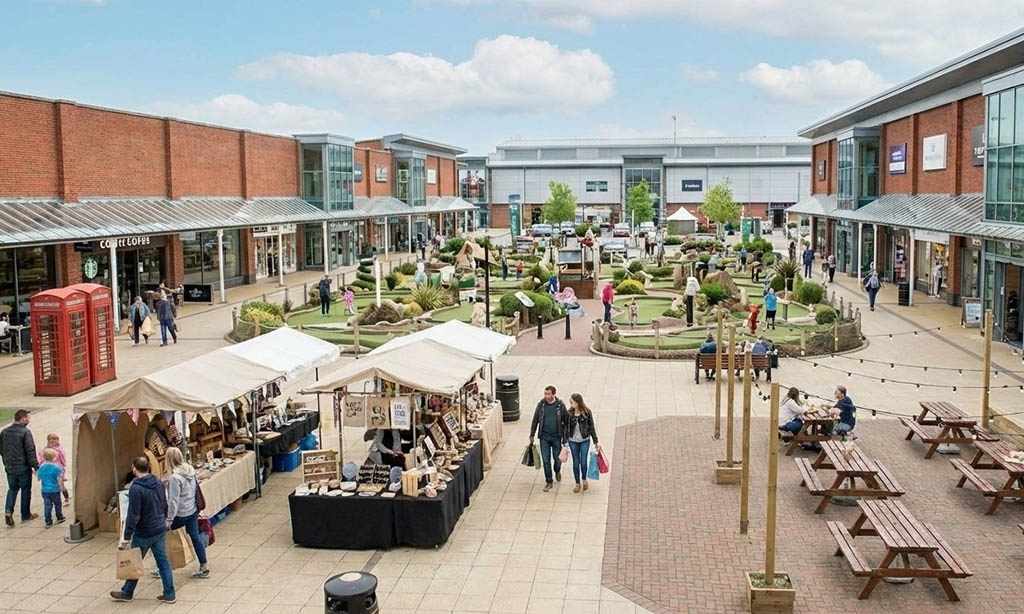
Pedestrian-First Design: Shifting the focus away from the car and toward the pedestrian. Wide, landscaped boulevards, covered walkways for rainy British weather, and plenty of seating areas are essential.
-
The “Town Square” Concept: Creating a central hub or plaza that hosts seasonal events—Christmas markets, summer beach festivals, or outdoor cinema screenings. This builds a sense of community and habit; families visit the park not just to shop, but to see “what’s on.”
2. Designing for the Modern Family: Accessibility and Inclusivity
A truly Family-Friendly Retail Park concept’s UK strategy must be inclusive. The definition of “family” is diverse, and facilities must reflect this. In 2026, accessibility is not a box-ticking exercise; it is a competitive advantage.
Essential Facilities for Comfort
The difference between a stressed parent cutting a trip short and a relaxed family staying for lunch often lies in the facilities.
-
Parent and Child Rooms: These have evolved from simple changing tables to comfortable feeding suites with bottle warmers, private booths, and sensory-calming decor.
-
“Changing Places” Toilets: Fully accessible facilities with hoists and adult-sized changing benches are now a standard expectation for inclusive retail destinations.
Sensory-Friendly Shopping
Recognising neurodiversity is a key trend.
-
Quiet Hours: Many parks now implement specific hours where music is turned off, and lighting is dimmed to accommodate children with autism or sensory processing sensitivities.
-
Sensory Gardens: Landscaped areas designed with calming textures, smells, and sounds provide a retreat from the hustle and bustle of the retail environment.
| Feature | Traditional Retail Park | Modern Family-Friendly Concept (2026) |
| Parking | Tight spaces, car-focused | Wide family bays, smart indicators, EV charging |
| Play Areas | Small, generic plastic frame | Bespoke, natural materials, risk-play, water features |
| Dining | Fast food drive-thrus | Food halls, street food markets, and sit-down family dining |
| Seating | Minimal benches | Social seating pods, landscaped picnic areas |
| Navigation | Basic signage | App-integrated maps, interactive digital totems |
3. The Gastronomy Revolution: From Food Courts to Food Halls
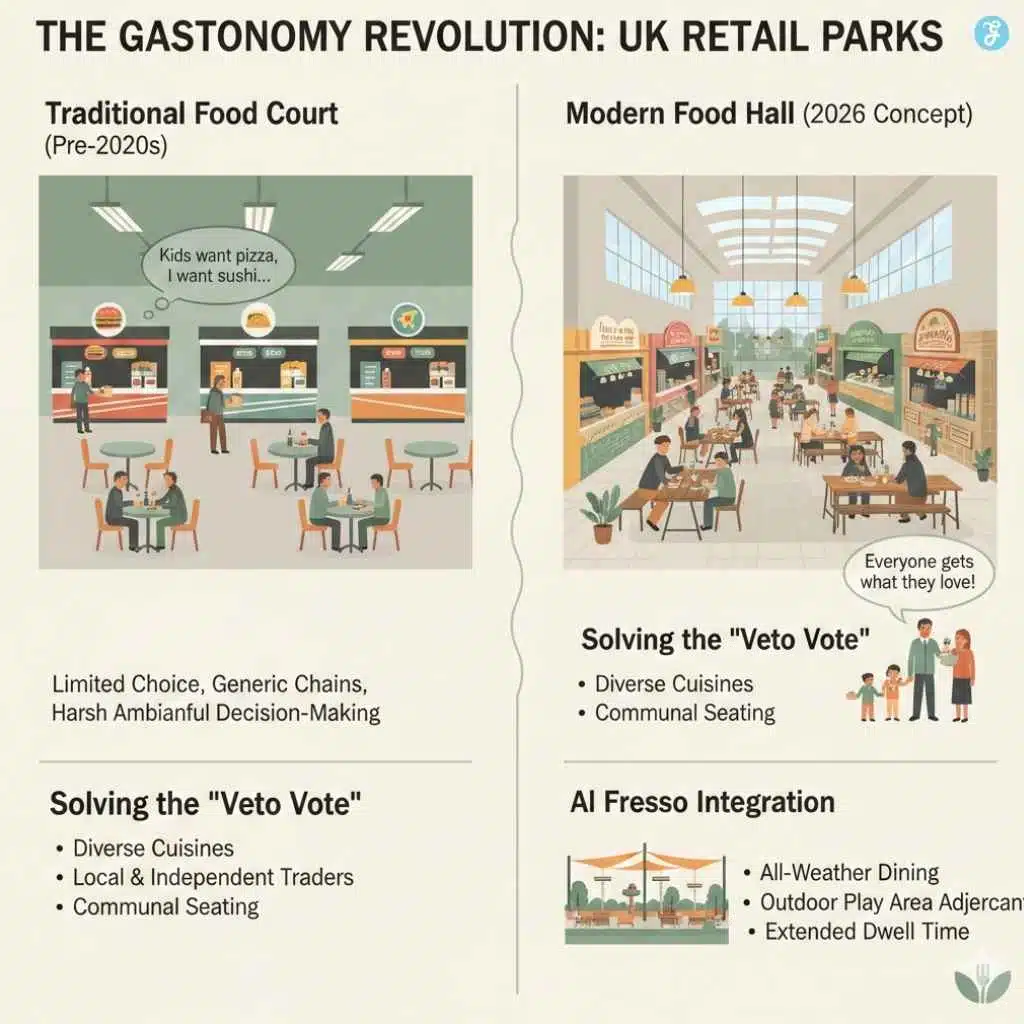
One of the most significant changes in Family-Friendly Retail Park Concepts UK is the total reinvention of the dining experience. In the past, “family dining” at a retail park meant a choice between a generic burger chain or a lukewarm coffee shop sandwich. By 2026, the sophisticated palate of the modern family has forced a revolution.
The Rise of the Social Food Hall
The traditional “food court”—with its plastic trays and fluorescent lighting—is dead. It has been replaced by the “Food Hall” concept.
-
The “Veto Vote” Solution: The genius of the food hall lies in its ability to solve the family argument of “what do we want for dinner?” In a food hall, parents can order artisanal wood-fired pizza, the teenager can grab bubble tea and a bao bun, and the toddler can have simple pasta. Everyone eats what they want, but they sit together at communal, rustic tables.
-
Local Heroes: Developers are increasingly inviting local independent street food traders into these spaces rather than just relying on national chains. This gives the retail park a unique “flavour” and supports the local economy, a key value for community-minded shoppers.
Al Fresco Integration
Post-pandemic habits have stuck, and outdoor dining is now a year-round expectation, not just a summer luxury.
-
All-Weather Dining: Leading retail parks are investing in high-quality retractable canopies, heated parasols, and wind-shielded “pods.” This allows families to enjoy an outdoor meal near the play area even during the crisp British autumn, extending the “day out” feel.
4. Bridging the Age Gap: Catering to Tweens and Teens
A common failure in older retail park designs was the “age gap.” Facilities catered to toddlers (soft play) and adults (shopping), leaving the 12–17 demographic bored and disengaged. When teenagers are bored, families leave earlier. The new wave of Family-Friendly Retail Park Concepts UK specifically targets this “forgotten” demographic.
“Instagrammable” Moments and Social Spaces
Teenagers drive social media trends, and smart developers are designing spaces that are inherently shareable.
-
Selfie Spots: Art installations, neon signage, and mural walls are being integrated into the public realm specifically to encourage TikTok and Instagram content creation.
-
Digital Connectivity: Free, high-speed Wi-Fi and USB charging points built into street furniture (benches, lamp posts) are non-negotiable. If a teenager can stay connected, they are happy to stay longer.
Active Entertainment
This demographic needs “high-energy” engagement.
-
Urban Sports Zones: We are seeing the inclusion of small skate parks, pump tracks for scooters, and outdoor table tennis zones. These areas are robust, low-maintenance, and provide a “cool factor” that traditional playgrounds lack.
-
Tech-Led Retail: The tenant mix is shifting to include “experience centres” for brands like Apple, gaming lounges, or sneaker concept stores that appeal specifically to the youth market, turning the retail park into a legitimate hangout spot.
5. The Safe Haven: Security Without Intimidation
For parents, safety is the baseline requirement. However, the aesthetic of safety has changed. In 2026, families do not want to see high fences and patrolling guards in high-vis jackets; they want to feel safe without feeling watched.
“Host” Security Models
The “security guard” is being rebranded as the “community host.”
-
Customer Service Focus: Security personnel are trained in hospitality first, security second. Their uniform is softer—often lacking the intimidating tactical gear of the past—and their role is to assist with directions, help with lost children, and provide a reassuring presence.
-
Passive Surveillance: Design plays a huge role here. Family-Friendly Retail Park Concepts UK utilise “Crime Prevention Through Environmental Design” (CPTED). This involves clear sightlines (no dark corners), excellent LED lighting that mimics daylight, and low-level landscaping that doesn’t block views, ensuring parents can see their children playing from a distance.
Child Safety Tech
-
Digital Wristbands: Some premium retail parks are trialling systems where parents can pick up a digital wristband for their child upon entry. If the child wanders off, the parent can track their location via the park’s app, reducing the sheer panic of a lost child scenario in a busy crowd.
6. The Green Draw: Sustainability and Nature
Sustainability is a massive draw for the eco-conscious family of 2026. Parents are increasingly teaching their children about the environment, and they prefer to visit destinations that align with these values.
Biodiversity Net Gain
Under new UK planning regulations (and consumer pressure), retail parks are becoming greener.
-
Pocket Parks and Nature Trails: Integrating “wild” areas where children can explore nature. This might include bug hotels, educational signage about local flora, or small wetlands that double as sustainable drainage systems.
-
Green Walls and Roofs: Architecture that incorporates living plants not only looks better but improves air quality and acoustic dampening, creating a more pleasant environment for young children.
Sustainable Mobility
-
EV Charging Hubs: With the ban on new petrol/diesel cars looming, families need reliable charging. A Family-Friendly Retail Park Concepts UK must offer high-speed charging hubs where parents can charge their car while they shop and play.
-
Active Travel Links: Safe cycle paths connecting the retail park to local residential areas, complete with secure bike storage and repair stations, encourage families to cycle rather than drive.
7. Technology: enhancing Convenience, Not Replacing It
While the physical experience is paramount, technology plays a vital role in removing friction from the family day out.
The Frictionless Arrival
-
Smart Parking: Apps that allow families to book a parking space in advance (perhaps near the play area or crèche) eliminate the stress of circling for a spot.
-
Ticketless Systems: ANPR (Automatic Number Plate Recognition) systems linked to user accounts mean no fumbling for tickets or loose change at the barrier—a small but significant win for busy parents.
The “Phygital” Shopping Experience
-
Click-and-Collect Drive-Thrus: For the parent who needs to pick up groceries but has a sleeping toddler in the back, dedicated drive-thru collection lanes are a game-changer.
-
Augmented Reality (AR) Trails: Retail parks are using AR apps to create “treasure hunts” around the site. Children can use a smartphone to find virtual characters or collect badges, guiding the family flow around the park and toward key retail zones.
8. Case Studies: The Blueprint for Success
To understand the practical application of Family-Friendly Retail Park Concepts UK, we can look at evolving examples that are setting the standard.
Rushden Lakes (Northamptonshire)
Rushden Lakes is frequently cited as the prototype for the future. It sits within a nature reserve, offering boating on the lake and nature walks alongside flagship retail stores. It proves that retail and nature are not mutually exclusive but symbiotic.
Liverpool ONE (City Centre Context)
While urban, Liverpool ONE demonstrates how to integrate open-air retail with family leisure. Its “Chavasse Park” is a massive green roof park that hosts events and picnics, effectively functioning as a city park surrounded by shops.
Fosse Park (Leicester)
The “Food Central” and “Fosse Park West” expansion focused heavily on the social experience, delivering wider walkways, a distinct food hall architecture, and significant landscaping to soften the “concrete jungle” feel of the original 1980s layout.
Future-Proofing: The 2026 Vision
As we move through 2026, the concept of flexibility will be paramount. The retail parks that thrive will be those that can adapt.
-
Modular Spaces: Areas that can be a farmers’ market on Saturday morning, a yoga studio on Sunday, and a pop-up cinema on Friday night.
-
Health and Wellness: We will see more integration of health services—GP practices, dentistry, and wellness clinics—making the retail park a “one-stop-shop” for family life admin.
-
Residential Integration: The “mixed-use” trend will accelerate, with residential developments being built on the perimeter of retail parks, creating a captive audience and a walkable community feel.
Final Thought: Family-Friendly Retail Park Concepts UK
The Family-Friendly Retail Park Concepts UK sector is in a state of exciting reinvention. The successful parks of tomorrow are not defined by the square footage of their retail units, but by the quality of the time families spend there.
By blending “retailtainment,” intuitive technology, sustainable design, and genuine inclusivity, developers are creating spaces that families choose to visit again and again. In 2026, the retail park is no longer just a place to buy things; it is a place to be together.
Frequently Asked Questions (FAQ)
1. What defines a “family-friendly” retail park in the UK context?
It goes beyond just having a toy shop. A truly family-friendly park offers a holistic environment: safe and wide pedestrian walkways, high-quality baby changing and feeding facilities, engaging play areas for different age groups, diverse dining options (not just fast food), and leisure activities that allow for a full “day out” experience.
2. How are retail parks adapting to the “experience economy” in 2026?
Retail parks are shifting their tenant mix. You will see fewer rows of identical shops and more “leisure anchors” like climbing walls, trampoline parks, e-sports arenas, and boutique cinemas. They are also hosting regular events—food festivals, outdoor markets, and seasonal celebrations—to give families a reason to visit beyond shopping.
3. Why is sustainability important for family retail destinations?
Modern families are increasingly eco-conscious. They prefer destinations that align with their values. Features like solar power, extensive green spaces (biodiversity net gain), and ample electric vehicle (EV) charging points are major draws. Furthermore, green spaces provide a healthier, more pleasant environment for children to play in.
4. What is “placemaking” in retail park design?
Placemaking is the art of creating public spaces that promote people’s health, happiness, and well-being. In a retail park, this means moving away from the “car-park-first” design. It involves creating beautiful, landscaped areas, social seating, public art, and safe zones where children can run freely without the danger of traffic.
5. Are UK retail parks becoming more inclusive for neurodiverse families?
Yes, this is a significant and positive trend. Many top-tier retail parks now offer “quiet hours” where music and bright lights are reduced. They are also incorporating “sensory gardens” or quiet zones where families can take a break from the sensory overload of shopping. Staff are also increasingly trained to support visitors with hidden disabilities.