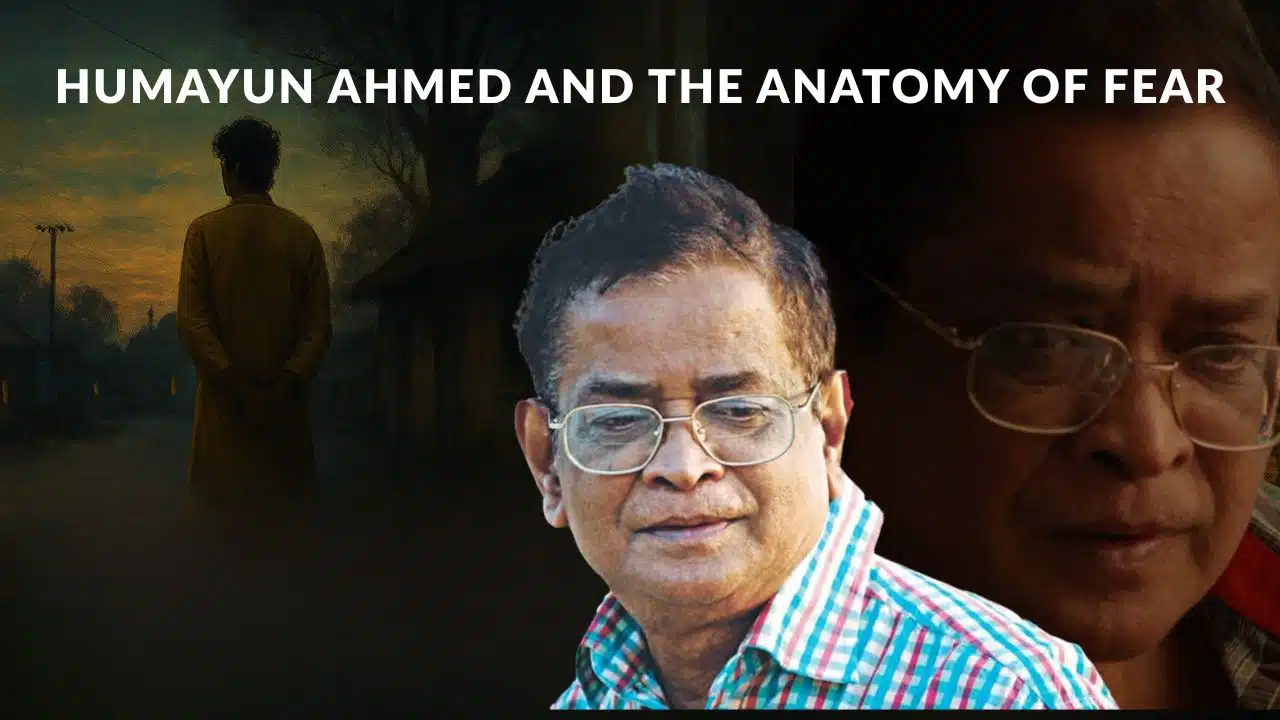
Humayun Ahmed is often celebrated as the greatest storyteller of modern Bangla literature—a master of human emotion, an architect of unforgettable characters, and a magician of simplicity. But there is one territory where he remains astonishingly unmatched, even decades later: horror.
It’s not about ghosts, monsters, or blood. That is where his terror lives.
Humayun Ahmed’s horror short stories are not just entertaining; they are diagnostic tools that dissect the human condition. While many writers rely on spectacle, he relies on silence. While other writers depict danger, he evokes a sense of it in you. His monsters rarely appear. His terror rarely explains itself. And his impact rarely fades.
I would argue without hesitation:
Humayun Ahmed is the master of modern Bangla psychological horror.
Stories like Devi, Nishithini, and the unforgettable Ami O Amra reveal a singular truth—his horror is never in the supernatural. Your spine tightens for no reason in the ordinary, almost-normal, quiet shift of the air.
And among all his works, one story crystallizes this genius into its purest form:
“Bhoi” (Fear)—a story with no ghosts, no demons, and no answers, yet one of the most terrifying pieces of Bengali literature ever written.
Beyond Monsters: How Humayun Built Horror from Nothingness
To understand Humayun Ahmed’s horror, you must first forget what you think horror is. Most writers place danger outside the character. Humayun Ahmed puts it inside them.
In classic horror, terror is often explicit—a creature, a haunting, a curse. But in Humayun Ahmed’s universe, terror is a presence, a disturbance in the psychological air, something felt but never seen.
Similar to Stephen King’s The Mist, the true horror lies not in the creatures outside the supermarket, but in the people trapped within—their fear, suspicion, and hysteria. Similarly, in John Carpenter’s The Thing, the monster is not as terrifying as the paranoia it instills in human beings.
Humayun achieved the same effect with extraordinary restraint. His horror does not roar. It whispers.
The Most Underrated Horror Story in Bangla Literature: “Fear”
“Fear” is not simply a horror story; it is an exercise in psychological architecture.
A lonely examiner arrives in a remote village to supervise an exam. His room is a former storeroom in an abandoned palace. There is no electricity. There is only a hurricane lamp, a jungle outside, and silence thick enough to breathe.
And then there is Siraj Uddin. He is not a ghost, a villain, or a cliché. He is just an ordinary man with a simple smile, kind eyes, and an unsettling presence that slowly seeps into the protagonist’s mind like damp air slipping through a crack in the wall.
What makes “Fear” terrifying is not what happens—but what might be happening.
Humayun Ahmed provides you:
-
no murder on the page,
-
no supernatural revelation,
-
no visual scare,
-
no jump moment.
Yet he creates an atmosphere where every beat of silence becomes suspicious. Fear erupts in the moments after Siraj Uddin leaves the protagonist alone. Fear comes without shape, without sound, without motive. The true antagonist of “Fear” is not Siraj Uddin. It is uncertainty.
Siraj Uddin: One of Literature’s Most Terrifying “Ordinary Men”
Humayun Ahmed understood a profound truth: the most terrifying creatures are those who remain hidden. Siraj Uddin is crafted with surgical brilliance. He is unmarried, solitary, polite, and devout—the kind of man you forget two minutes after meeting him. But he has one ability: he can enter someone’s mind.
He achieves this ability not through supernatural powers, but through a slow and deliberate psychological infiltration. He uses his snake stories and warnings, along with his timing, gentle persistence, and calculated intrusions.
Humayun Ahmed turns fear into a contagion that spreads only within the protagonist’s mind. The doorman feels nothing. The villagers feel nothing. Only Mr. X collapses under its weight.
Siraj Uddin becomes a Bangladeshi version of Mamiya from the Japanese film Cure—a soft-spoken enigma who transforms ordinary people into conduits of terror without ever lifting a weapon.
Siraj Uddin is terrifying not because of what he does, but because:
-
There’s no logic behind his actions.
-
no motive is strong enough to anchor him,
-
There is no explanation for how he triggers fear,
-
and no proof that he does anything at all.
He is the horror of ambiguity. He embodies the terror of implication. He embodies the terror of being aware that something is incorrect—yet remaining uncertain about its nature.
When Fear Has No Logic, It Becomes Universal
Humayun Ahmed’s genius lies in his understanding of the human mind. He knew that fear born from logic is manageable. But fear born from nothing is devastating.
The fear in “Fear” is:
-
irrational,
-
sudden,
-
person-specific,
-
invisible,
-
unexplainable.
It is the fear we have felt:
-
when a door is half open,
-
when a shadow moves in silence,
-
when we sense someone behind us,
-
when our heart beats faster for no reason.
Humayun Ahmed weaponizes universal human psychology. He provides the initial context, but it is your own imagination that creates the haunting elements. That is why “Fear” stays with readers long after the final line. The story does not contain the monster. It is in you.
Why Humayun Ahmed’s Horror Is Truly World-Class
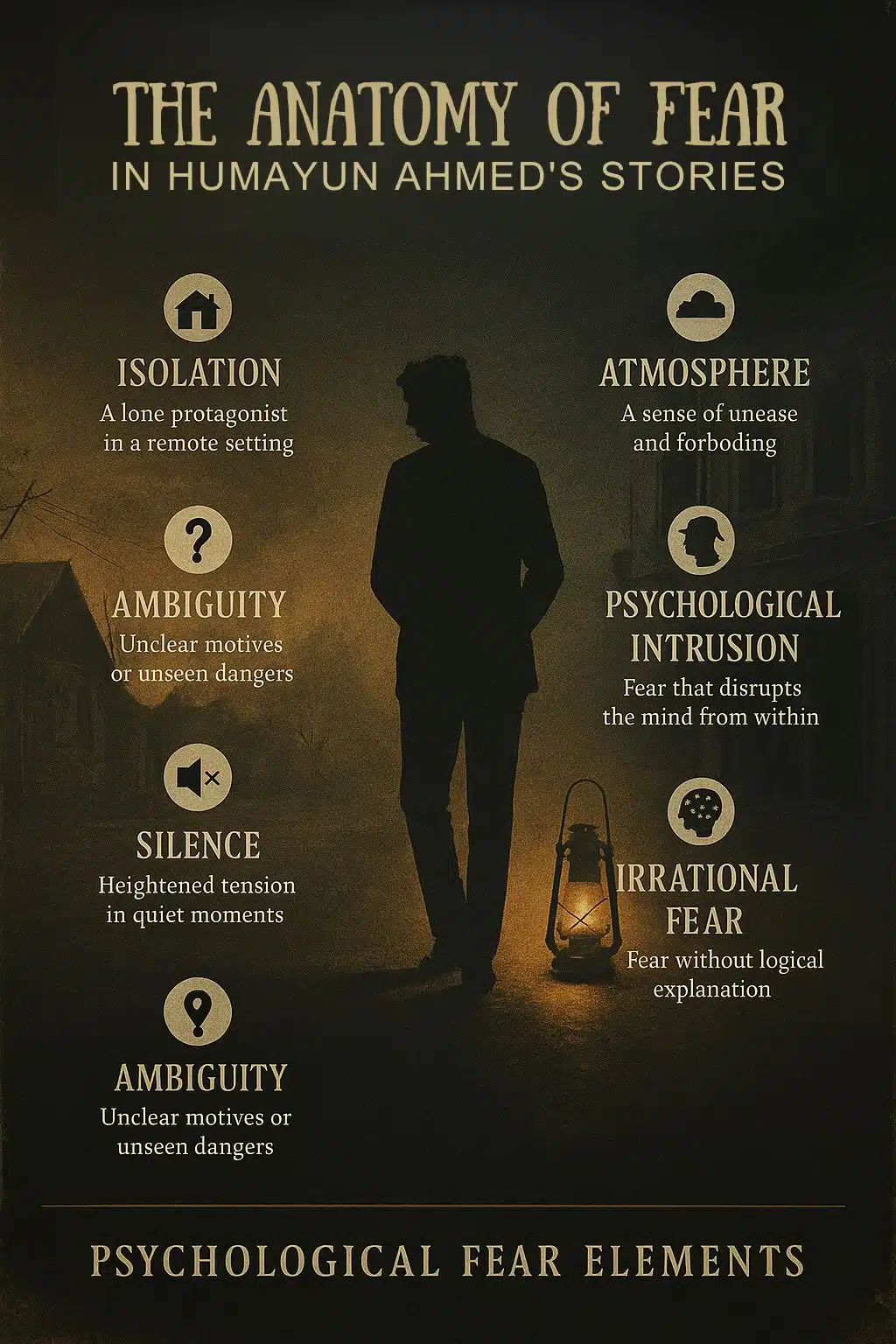
Humayun Ahmed’s horror stands apart because it is not dependent on:
-
folklore,
-
religious myths,
-
formulaic twists,
-
or cheap shocks.
Instead, it is built on:
- Isolation: A village, an abandoned palace, a locked room, an unlit corridor.
- Vulnerability: A rational man who believes nothing supernatural can affect him.
- Slow psychological intrusion: Fear entering the protagonist like a virus.
- Ordinary antagonists: People who appear harmless until you look closer—too close.
- Open-ended terror: The story ends, but the fear doesn’t.
This is the hallmark of global psychological horror. And Humayun Ahmed executed it with the precision of a master.
Humayun Ahmed’s Place in the Horror Canon
If we create a lineage of Bengali horror:
-
Rabindranath gave us philosophical supernaturalism.
-
Tarashankar gave us rural mysticism.
-
Bibhutibhushan gave us haunting realism.
-
Bonoful gave us atmospheric dread.
But Humayun Ahmed gave us psychological terror—modern, minimalistic, and universal.
His horror is closer to King, Poe, Kurosawa, and Carpenter than to traditional Bengali ghost stories. He knew the human mind is darker than a forest, more dangerous than a demon, and more unpredictable than a ghost. Fear is not outside. Fear is inside. And that is where Humayun Ahmed aims.
Final Thoughts: The Smile That Haunts
The final brilliance of “Fear” lies in its last moment—Siraj Uddin’s simple smile. A smile that contains no menace, no threat, and no confession. Just kindness. And that is what makes it horrific.
It is the smile of a man who might be innocent—or might be the most dangerous psychological predator in Bangla fiction. We don’t know. We will never know.
And that is exactly the point. Humayun Ahmed knew that the most terrifying stories are the ones that leave us with unanswered questions, unresolved dread, and the faint suspicion that someone, somewhere, is quietly watching.
That is why Humayun Ahmed remains unrivaled in Bengali horror. It’s not because he frightened us, but rather because he instilled a sense of fear in us.