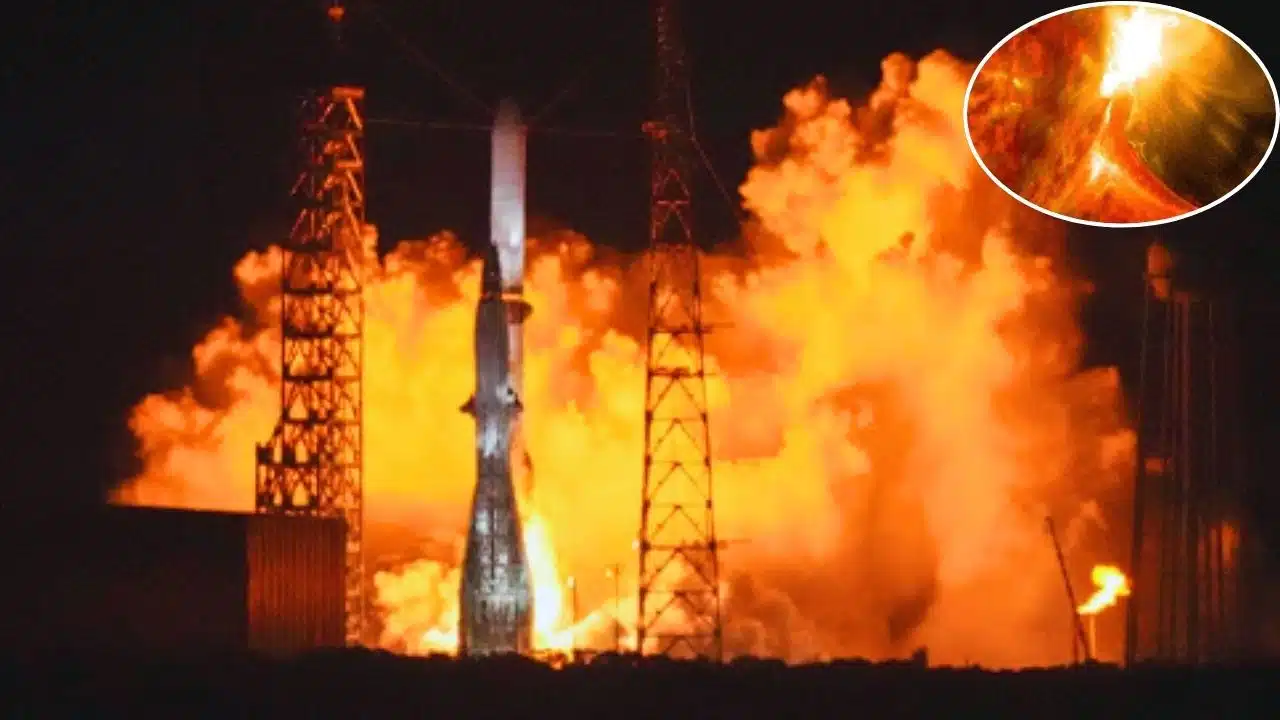
A dramatic solar storm, originating from powerful eruptions on the Sun about 92 million miles away, has once again postponed the launch of Blue Origin’s New Glenn rocket, carrying NASA’s twin ESCAPADE spacecraft toward Mars. This decision by NASA underscores the real threats space weather poses to sensitive satellite electronics, ensuring the mission’s success despite the frustration of repeated delays. The event, unfolding in mid-November 2025, not only lit up night skies with auroras but also highlights the delicate balance between solar activity and human space ambitions.
Blue Origin, the innovative space venture founded by Amazon billionaire Jeff Bezos in 2000, has been gearing up for this pivotal second flight of its flagship New Glenn rocket. Standing at an impressive 321 feet tall—nearly as tall as the Statue of Liberty stacked on its side—the two-stage vehicle is designed for heavy-lift capabilities, capable of deploying up to 45 metric tons to low Earth orbit. This mission, dubbed NG-2, marks a crucial step for Blue Origin in proving the rocket’s reliability after its debut flight in January 2025, which successfully orbited a payload but failed to recover the first-stage booster.
The payload in question is NASA’s ESCAPADE mission, an acronym for Escape and Plasma Acceleration and Dynamics Explorers. Developed by Rocket Lab in California for under $80 million, the twin small satellites—each about the size of a microwave—are the agency’s first dedicated Mars probes in over five years. Once in orbit around the Red Planet, they will monitor how solar wind strips away atmospheric particles, offering insights into why Mars lost much of its once-thick atmosphere and became the barren world we observe today. This low-cost, high-science-return effort is led by researchers at the University of California, Berkeley, and builds on NASA’s broader quest to understand planetary habitability.
Originally slated for liftoff on November 9, 2025, from Launch Complex 36 at Cape Canaveral Space Force Station in Florida, the mission faced multiple setbacks even before the solar interference. Heavy rain, lightning risks, and a ground system anomaly scrubbed the first attempt, closing out an 88-minute window amid persistent cumulus clouds that violated FAA launch rules. Blue Origin then targeted November 10, but a temporary U.S. government shutdown imposed FAA restrictions on daytime commercial launches to ease air traffic burdens, forcing further coordination with regulators. By November 11, terrestrial weather cleared, but the solar storm took center stage, leading to the latest scrub on November 12.
In an official update on X, Blue Origin stated”New Glenn is ready to launch. However, due to highly elevated solar activity and its potential effects on the ESCAPADE spacecraft, NASA is postponing launch until space weather conditions improve. We are currently assessing opportunities to establish our next launch window based on forecasted space weather and range availability.” With a packed schedule ahead—including United Launch Alliance’s Atlas V on November 13 and multiple SpaceX Falcon 9 flights—the next viable slot might not open until the weekend of November 15-16, pending range clearance from Space Launch Delta 45.
This launch holds extra significance for Blue Origin’s future. The company aims to recover the rocket’s first-stage booster, nicknamed “Never Tell Me the Odds” after a Star Wars quote, by landing it on a converted oil barge called Jacklyn positioned about 375 miles offshore in the Atlantic Ocean. Success here would validate the reusability that could lower costs and compete directly with SpaceX’s Falcon 9, which has routinely recovered boosters since 2015. Blue Origin envisions New Glenn flying up to 25 times per booster, supporting missions like deploying Amazon’s Project Kuiper internet satellites, lunar landings with the Blue Moon lander, and even crewed Artemis program contributions if NASA’s recent contract reviews open doors.
Why Space Weather Matters for Rocket Launches?
While earthly weather like rain or wind often delays launches, space weather from solar events is a rarer but equally disruptive force that mission planners must navigate carefully. Geomagnetic storms can inject high-energy particles into the Van Allen radiation belts, increasing risks during a rocket’s vulnerable ascent through the atmosphere. For ESCAPADE, the primary worry is solar energetic particles—protons and electrons accelerated to near-light speeds—that could corrupt data systems, fry sensors, or cause power fluctuations in the spacecraft’s solar arrays and batteries.
Historical precedents show this isn’t unprecedented. In January 2014, Orbital ATK (now Northrop Grumman) delayed an Antares resupply mission to the International Space Station by 24 hours due to a moderate solar storm that heightened radiation levels, potentially endangering the Cygnus cargo craft’s avionics. Fast-forward to February 2022, when SpaceX lost 38 of 49 Starlink satellites shortly after deployment; a G1 minor geomagnetic storm expanded Earth’s upper atmosphere, creating drag that deorbited the low-flying constellation despite no direct particle damage. More recently, in early 2023, SpaceX paused a Falcon 9 launch carrying a national security payload for several hours, waiting for radiation fluxes to subside as measured by onboard monitors.
Unlike those cases, ESCAPADE’s deep-space trajectory avoids low-Earth orbit drag issues, but the particles remain a threat. NASA’s decision reflects rigorous risk assessment the probes’ instruments, including plasma analyzers and magnetometers, are tuned to study solar wind at Mars, making them ironically vulnerable to the very phenomena they’ll investigate. Blue Origin’s New Glenn incorporates some shielding, but launching during peak storm activity could exceed safe thresholds, as confirmed by real-time data from NOAA’s satellite network.
Adding to the complexity, this mission also carries a secondary payload: a telemetry experiment from Viasat, sponsored by NASA’s Communications Services Project. This tech demo tests advanced radio systems for future deep-space relays, further emphasizing the need for a radiation-quiet environment to gather clean baseline data. Delays like this, while costly—estimated at millions per day in holding patterns—prioritize long-term mission integrity over rushed timelines.
New Glenn’s path to operational status includes military certification under the U.S. Space Force’s National Security Space Launch program. Selected alongside SpaceX and United Launch Alliance in April 2025 for up to 54 missions from 2027-2032, Blue Origin needs two successful flights to qualify for contracts potentially worth billions. This solar-induced holdup tests not just hardware but also the company’s resilience in a competitive landscape dominated by SpaceX’s proven track record.
The Solar Eruptions Behind the Storm
At the heart of this disruption is the Sun’s dynamic behavior during its solar maximum, the peak of its 11-year activity cycle that began ramping up in 2024. Coronal mass ejections (CMEs) are the culprits enormous bubbles of plasma—hot, charged gas—expelled from the Sun’s outer atmosphere, or corona, at speeds exceeding 1 million miles per hour. Each CME can span hundreds of thousands of miles, carrying billions of tons of material laced with a tangled magnetic field.
The sequence began early on November 11, 2025, when Active Region 4274—a sprawling sunspot cluster larger than Earth—unleashed an X5.1-class solar flare, the most intense of the year. Flares release pent-up magnetic energy in bursts of X-rays and ultraviolet light, but this one was paired with a CME racing at 1,500 kilometers per second. Two preceding CMEs from November 9-10 arrived first, merging into a “cannibal” event where the faster one overtakes the slower, intensifying the overall impact.
NOAA’s Space Weather Prediction Center (SWPC) in Boulder, Colorado, tracked the progression using the Deep Space Climate Observatory (DSCOVR) satellite at the L1 Lagrange point, about a million miles sunward. This vantage provides 15-60 minutes of advance notice as solar wind sensors detect density spikes, speed surges, and magnetic field orientations. Forecaster Shawn Dahl described the first two waves as “profoundly stronger than we anticipated,” exceeding models that predicted G3 (strong) conditions but delivering G4 (severe) effects instead.
The lead CME, the most energetic, bridged the 93-million-mile void (Earth’s average distance from the Sun) in under 48 hours, slamming into our magnetosphere around midday on November 12. Its southward-oriented magnetic field—key for storm potency—clashed with Earth’s northward field, opening pathways for particles to funnel toward the poles. This triggers substorms: rapid magnetosphere compressions that accelerate electrons and protons, some reaching energies over 100 mega-electron volts.
SWPC issued a G4 watch on November 10, escalating to confirmed storming by November 11, with a 10% chance of G5 (extreme) levels not seen since the 2003 Halloween storms. Models like the WSA-ENLIL simulate these ejections’ paths, factoring in solar rotation and deflection by the heliosphere, but variability remains high—storms can weaken en route or gain strength from interactions.
Stunning Auroras and Real-World Impacts
The storm’s most visible spectacle has been the auroras, or northern lights, dancing across unusually low latitudes. On November 11 evening, charged particles bombarded oxygen and nitrogen in the upper atmosphere (80-500 km altitude), exciting them to emit green, red, and purple hues. Sightings stretched from Alaska to Mexico, with reports from Florida’s beaches and even Puerto Rico, thanks to the storm’s strength pushing the auroral oval equatorward.
Another vivid display is forecast for November 12-13 nights as the main CME peaks, potentially rivaling the May 2024 global aurora event. Photographers and skywatchers in mid-latitudes should look north after dark, away from city lights, for the best views—binoculars enhance faint structures like coronal rays.
Beneath the beauty lie practical challenges. G4 storms induce geomagnetically induced currents (GICs) in long conductors like power lines and pipelines, risking transformer overloads and blackouts—as in the 1989 Quebec event that left 6 million powerless for hours. GPS signals degrade by up to 10 meters in accuracy due to ionospheric scintillation, affecting aviation, farming tractors, and ride-sharing apps reliant on precise positioning.
Satellite operators face surface charging, where particle buildup arcs across insulators, potentially shorting solar panels or attitude control thrusters. High-altitude aircraft on polar routes may see increased radiation exposure for passengers and crew, prompting FAA advisories. Radio amateurs and aviators report blackouts on HF bands (3-30 MHz), as the D-layer ionizes and absorbs signals.
The European Space Agency (ESA) is actively monitoring via its Vigil mission precursors, confirming no immediate astronaut risks on the ISS but recommending extra shielding passes. Power grid operators in vulnerable regions like Scandinavia and Canada are on alert, implementing voltage regulation to mitigate surges.
Predicting these storms’ nuances is an evolving science. While SWPC’s alerts have improved response times, the inherent chaos of solar physics—turbulent winds, filament eruptions—means surprises like this “cannibal” merger occur. As solar maximum continues through 2025, expect more activity, driving investments in resilient tech from hardened satellites to AI-enhanced forecasting. This blend of cosmic drama and technological caution reminds us of our vulnerability in space, yet it also fuels progress missions like ESCAPADE will help decode these forces, safeguarding future explorations from Earth to Mars.