Have you felt lost in the rush of smart machines? You spot bots at airports, stores, and labs, yet you cannot track which firms drive progress. You wish you knew which names truly matter in AI, machine learning, and automation.
Here is a fact, Hong Kong tops Asia as an innovation and technology ecosystem for three straight years. The tech park and the science and tech university back big data analytics, AI, and IoT research.
This list of 12 Hong Kong Robotics Companies Making Global Impact shows how they use machine learning, predictive analysis, and automation to boost the digital economy. You will see how virtual human labs and warehouse robot firms make a mark.
Ready to meet the innovators?
Key Takeaways
- HKSTP launched the Elite Programme in 2019. It hosts 24 firms from Hong Kong and overseas. Those firms now serve 16 markets on six continents. Founders pledged 1,200 jobs by 2027. The Elite Global Inno Day on Nov 14, 2024 drew over 200 investors and partners.
- HKUST, HKU, and CUHK rank in QS 2025 top 20 for data science and AI. The HKUST Biomedical Robotics Lab builds surgical bots and rehab bots. Digital Domain used Masquerade 2.0 and Charlatan in 1,000 visual effects shots. It invested HK$204 million to grow local AI labs.
- FJDynamics ships farm and runway bots to over 100 markets. Its runway markers hit 2 cm precision and cut paint time by 70%. Geek+ deployed 56,000 warehouse robots that picked 10 billion items and drove 175 million km. These bots raised pick rates by 250% and reached 99.99% accuracy.
- Financial firms adopted generative AI at 38% in 2023, 12 points above the global average. LifeSparrow scans 10,000 images in under two hours at 97% accuracy. Roborn uses 5G to cut video lag below 10 ms for telepresence bots. These trends highlight strong AI, IoT, and 5G growth in Hong Kong.
Key Drivers of Hong Kong’s Robotics Ecosystem
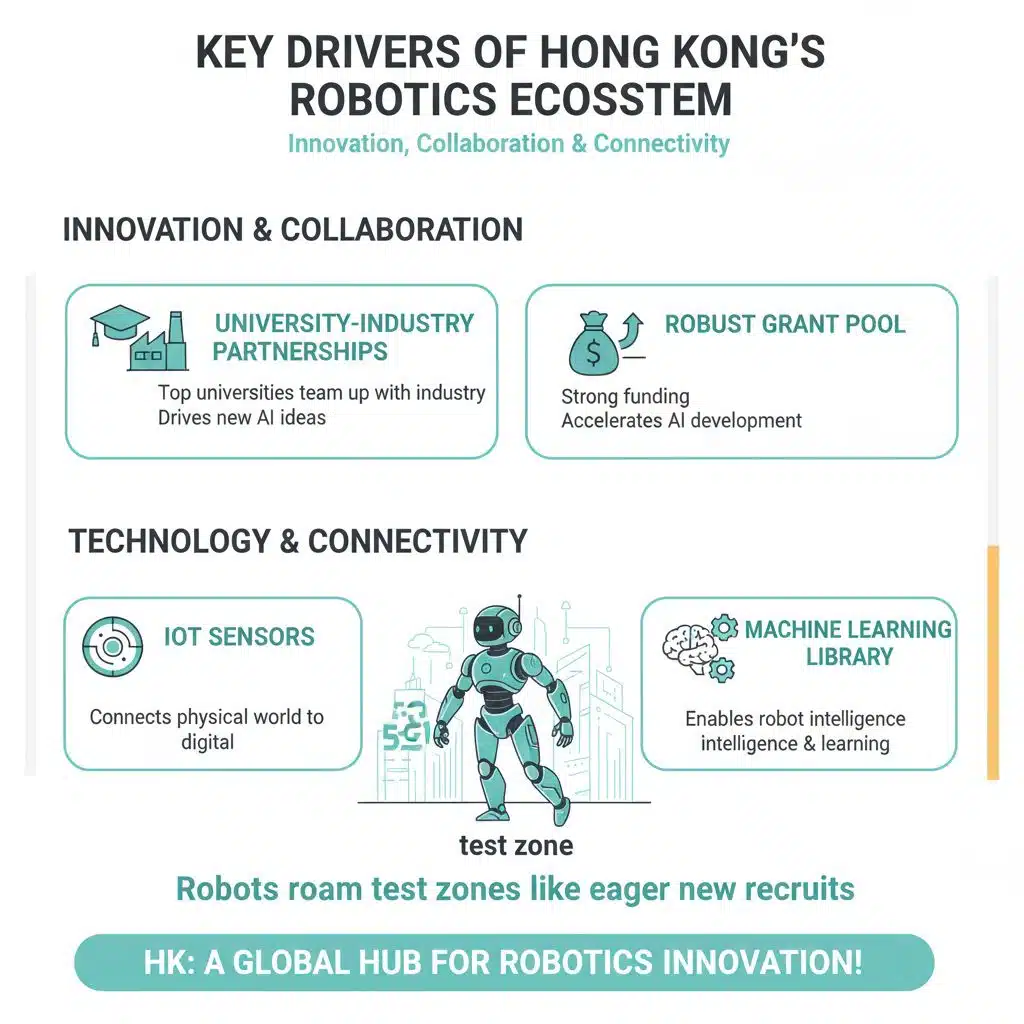
Top universities team up with industry, and a strong grant pool drives new AI ideas.
Local teams link IoT sensors, a 5G network and a machine learning library into robots that roam test zones like eager new recruits.
What research clusters and programs boost Hong Kong robotics growth?
HKSTP launched the Elite Programme in 2019 to boost Hong Kong’s innovation and technology ecosystem. The initiative hosts 24 active companies, 13 from Hong Kong, 11 from overseas.
These ventures cover AI, mechanical assistants, life science sensors, health tech, e-commerce and digital marketing. They now serve 16 markets on six continents. Founders pledged more than 1,200 local jobs over three years.
HKSTP upgraded labs, research clusters and living labs. It also expanded funding, industry partnerships, research collaboration and talent recruitment.
Over 200 investors and partners attended Elite Global Inno Day on November 14, 2024. The showcase linked the Hong Kong University of Science and Technology, Greater Bay Area firms and global capitals.
Start-ups demoed machine learning tools, IoT platforms and 5G network pilots. They used big data analytics and virtual replicas to improve obstacle avoidance. This living lab helps test smart sensors for airside operations and autonomous transport in real airports.
These programs drive growth in robotics, AI and automation across Hong Kong.
How do universities and industries collaborate in robotics innovation?
Three top schools, HKUST, HKU, and CUHK, rank in the 2025 QS World University Rankings top 20 for data science and AI. Doctor Dennis Lo inspired health data labs with his NIPT test that helps about 10 million mothers annually.
The HKUST Biomedical Robotics Lab builds surgical bots for patient care. It partners with local hospitals and startup teams. Professors and engineers share labs and grants in the innovation and technology (i&t) ecosystem.
Industry funders back student projects on machine learning and generative AI. This mix of academic skills and real needs speeds up new robot tools.
Digital Domain teams with Plaza Premium Group to make AI concierges for airport lounges. Passengers at Hong Kong International Airport can talk to virtual hosts. FJDynamics works with an international theme park group to build autonomous lawn-mowing robots.
Geek+ and Intel co-design the Vision Only Robot Solution for warehouse visual navigation. Teams at Digital Domain will expand R&D to push AI tools in entertainment, finance, education, and healthcare.
This mix shows how research labs meet industry needs. It proves Hong Kong can lead in smart robotics and automation.
What are the latest trends in AI, automation, and IoT integration?
Financial companies in Hong Kong adopted generative AI at a rate of 38 percent in 2023, ahead of the global average by 12 points. The film studio fuses machine learning into production with Masquerade 2.0 and Charlatan.
A real-time cloud platform named Momentum Cloud drives virtual human control. LifeSparrow Solutions trims rescue time by scanning ten thousand images in under two hours with ninety-seven percent accuracy.
HKUST teams push artificial intelligence, edge computing, and IoT sensors for smarter machines.
Logistics outfit tests a Vision Only Robot solution with Intel chips for visual navigation in warehouses. A retailer uses one hundred forty-five bots to pack sixty thousand orders per day.
Engineers employ five G networks to stream live video and steer service robots. Developers link sensors, cloud computing, and machine vision to craft smarter devices. Labs at schools in top QS world university rankings join industry to boost IoT integration.
12 Hong Kong Robotics Companies Transforming the World
Meet a dozen innovators who deploy machine learning, IoT, 5G telepresence, and digital twins to shake up logistics, farming, and healthcare. They mix HKUST labs, cloud-based neural nets, collaborative arms, and self-driving carts to speed tasks, trim mistakes, and spawn fresh ideas.
What does Digital Domain do in AI and virtual humans?
Digital Domain has made visual magic for more than 350 films, from Titanic to Avengers: Endgame. It earned US$2.8 billion after Avengers: Endgame in box office figures and fame. The studio uses machine learning with Masquerade 2.0 and Charlatan to craft nearly 1,000 visual effects shots for She-Hulk: Attorney at Law.
The company invested HK$204 million in hong kong’s innovation and technology (i&t) ecosystem to expand sustainable technology and AI development.
CEO William Wong plans to apply those AI skills to virtual humans and immersive experiences. Momentum Cloud gives users real-time control of digital avatars. The team also joined Plaza Premium Group to launch an airport lounge AI concierge in the Middle East, with a global rollout on the horizon.
How does FJDynamics advance smart agriculture and automation?
FJDynamics builds robots for farms and runways. GPS modules, AI algorithms, and machine learning help map soil and plant health. Over seven years, the company shipped solutions to more than 100 markets.
CFO Kiki Zhang says they aim to make robotics low cost. Teams tap Hong Kong’s strategic location and innovation and technology (i&t) ecosystem for global expansion. They cut carbon footprints and support sustainable development in agriculture.
Autonomous line marking robots set paint at Hong Kong International Airport. They served the new three-runway system, which opened in November 2024 and handles 120 million passengers a year.
Those bots hit 2cm marking precision and slash paint time by up to 70%. Engineers also craft mower robots with an international theme park group, to trim grass with similar autonomy.
These tools ease labor shortages and increase aviation safety and occupational health on fields and tarmacs.
What robotics solutions does Geek+ offer for logistics?
Geek+ deploys fleets of logistics robots and smart software in over 40 countries for 800 clients. The brand rolled out 56,000 units in warehouses worldwide; in 2022 they picked 10 billion items and logged 175 million kilometers.
The bots map aisles with computer vision and learn routes with machine learning; they boost picking rates by 250% and hit 99.99% accuracy. This system taps cloud servers and inventory platforms; it saves 16 million kWh and trims 140,000 tonnes of carbon.
Enterprises in the Guangdong-Hong Kong-Macao Greater Bay Area and beyond trust the solution. Walmart saw productivity climb from 149 to 533 pieces per person per hour after robots joined its ranks.
YesAsia upped its picking rate by 300%, handling 60,000 orders a day with 145 bots. The setup links to transport hubs, seaports, and international airports. That network joins Hong Kong’s innovation and technology (i&t) ecosystem, with tests at the hong kong university of science and technology (hkust), a top school by quacquarelli symonds.
How does Hai Robotics innovate warehouse automation?
Hai Robotics builds fleets of autonomous mobile robots to speed order picking. Their robots use IoT sensors and a vision system to map shelves. They link to WMS via cloud computing.
A machine learning engine optimizes routes like a choreographed dance.
Engineers code robots with ROS and Python for smooth movement. Teams test with digital twins before live runs. This approach cuts labor cost by 30 percent and boosts throughput. Hong Kong’s innovation and technology ecosystem fuels their business expansion into global market segments.
What robotics technologies does the HK Center for Construction Robotics develop?
HK Center for Construction Robotics builds machines that act as extra hands on job sites. It teams up with FJ Dynamics International Limited to merge robotics and automation in construction and agriculture.
The team crafts autonomous vehicles to map sites, mix concrete, and paint guides. One model grooves runways at HKIA, using sensors, machine learning, and IoT to draw precise lines.
Engineers aim to cut risks and trim costs, boosting safety on steep scaffolds and dusty trenches. Trials prove these bots speed up mapping and marking, freeing crews to focus on skilled labor.
The tech links to Hong Kong’s innovation and technology (i&t) ecosystem, taps its strategic location, and supports growth in the construction sector.
What medical robots are created by the HKUST Biomedical Robotics Lab?
Researchers at HKUST Biomedical Robotics Lab craft a flexible robot to guide stents through tiny vessels. They blend machine learning and 3D imaging to boost precision. The device slides through curves in arteries like a small fish weaving a reef maze.
It cuts procedure time and lowers patient trauma.
Another project uses a rehab bot to help stroke patients regain arm strength. Sensors and ultrasound feedback track every joint movement. Patients perform tasks like stacking blocks on a touch screen game.
The lab logs all data under Hong Kong’s personal data (privacy) ordinance. The team posts results on https://hkust.edu.hk/ and highlights life and health tech in the i&t ecosystem, and HKUST’s spot in qs world university rankings.
How does Roborn utilize 5G in telepresence and service robots?
Roborn pairs 5G with remote presence bots to give crisp video. Low-latency links let operators move units across distant sites. High-speed data flow fuels machine learning and computer vision tasks on its service automatons.
5G streams protect communications with strong cybersecurity. That move taps Hong Kong’s innovation and technology (i&t) ecosystem.
Widespread coverage lets automatons roam factories, malls, and transit hubs. Operators see live feeds with less than 10 millisecond lag. Hands-free units upload performance stats via Internet of Things and edge computing modules.
Hong Kong labs can run risk assessments on code, test patches, and manage data privacy with cloud platforms. Roborn charts a path to low-cost, high-yield service automata.
How does Imsight Medical Technology combine AI and robotics in medical imaging?
Imsight uses machine learning to boost imaging analysis. The AI runs on MRI, CT and X-ray scans. It spots tiny tissue shifts that radiologists can miss. Neural networks reveal hidden patterns in organs, speeding up diagnosis.
The company fits robotic arms to move probes with pinpoint accuracy, slicing human error. Robots align imaging devices to exact angles, speeding scans. Doctors get results faster and can act on time.
Its strategic location in Hong Kong taps into life and health tech talent. The setup boosts occupational safety and health, cuts costs, and lifts return on investment within Hong Kong’s innovation and technology (i&t) ecosystem.
What autonomous delivery robots does Rice Robotics develop?
Rice Robotics builds small wheeled bots that zip through hong kong sidewalks. They use machine learning and visual processing to map each block. The bots latch parcels or snacks and roll at up to four miles per hour.
Their design cuts last-mile time in tight urban zones and boosts transportation efficiency in the city’s innovation and technology (i&t) ecosystem.
They ship models overseas, testing in Europe, Asia, and North America. They link with tech startups and walmart’s pilot teams. They adapt to local consumer preferences and test new routes.
Their global reach taps the city’s strategic location and sparks international science exchanges.
How does Shadow Factory use interactive robotics in entertainment and retail?
Robots roam store aisles, greet customers, and show products with bright screens. They learn from machine learning models to match consumer behavior and boost sales. Shadow Factory’s bots sort shelves, track stock, and free staff for other tasks.
They leap onto stage at theme parks and dance with guests, creating immersive shows that wow crowds.
HKSTP grants fuel labs in Hong Kong’s innovation and technology ecosystem. Shadow Factory grabs space at Elite Global Inno Day to demo its interactive robotics. Attendees test new AI, sensors, and IoT tools up close.
Investors, QS world university rankings scholars, and life and health tech experts join the fun.
What service and delivery robots does Rice Robotics provide for smart cities?
Rice Robotics offers indoor and outdoor delivery machines for smart cities. The indoor model, Carry, navigates halls with LiDAR and machine learning. The outdoor unit, Roam, maneuvers sidewalks for food and parcel drops.
Each unit uses IoT sensors and maps to avoid obstacles.
They serve hong kong pilots on electric routes. They cut emissions and follow environmental policies with an environmentally-friendly design. They help retailers and logistics firms boost business expansion.
They fit the city’s strategic location and innovation and technology (i&t) ecosystem.
What role does ABB Hong Kong play in industrial and collaborative robotics?
ABB Hong Kong drives factory floors to new levels of automation. The firm deploys industrial robots and cobots to boost efficiency in manufacturing, logistics, and life and health tech.
It teams with local startups and research centres to spark new methodologies and AI training. HKSTP feeds this effort with labs, funds, and space in the innovation and technology i&t ecosystem.
Such support lifts the region’s robotics growth rate.
The company hunts global markets to share its RobotStudio tool and cobot platforms. It works under the HKSTP Elite programme to launch tech ventures that create new jobs. HR scouts tap talent from top QS world university rankings campuses.
Trainers coach recruits in robotics methodologies and safe operations. These steps cement Hong Kong’s strategic location as a hub for business expansion and global collaboration.
Market Trends and Challenges in Hong Kong Robotics

Hong Kong firms use IoT sensors, cloud platforms, and vision systems to power automation, but they face a machine learning talent gap and slow policy shifts—read on.
How do startups and global giants compete and collaborate in Hong Kong?
Local startups chase growth in a market packed with giants. The HKSTP Elite Programme backed 42 companies for global expansion. It sparked unicorns and listed firms. Out of 24 Elite firms active by November 14, 2024, 12 boast international teams.
Seventeen Elite firms pitched at Elite Global Inno Day. Startups tap sensors, computer vision, and machine learning to challenge big players in cloud computing. They use IoT and 5G to boost automation and delivery bots.
Global firms share lab space and fund programs at top schools on the qs world university rankings. Geek+ links with Intel on the Vision Only Robot Solution for logistics. Digital Domain teams up on virtual humans in AI labs.
FJDynamics joins forces with big farms to roll out smart agri bots. These ties fuel the innovation and technology (i&t) ecosystem. They spark life and health tech breakthroughs and use the city’s strategic location for business expansion.
What sectors apply robotics in Hong Kong, such as construction and healthcare?
FJDynamics sends quadcopter UAVs and automated guided vehicles (AGVs) to handle tasks at HKIA, mark sports fields, and service infrastructure. BSF Innovation turns food waste into eco-bricks, cutting greenhouse gases by more than 60 percent.
RHT Industries crafts autonomous air filtration units for homes and construction zones. Workers use 3D scanning, six-axis industrial arms, and additive manufacturing to inspect and fix buildings.
HKUST Biomedical Robotics Lab, ranked high in QS world university rankings, taps Hong Kong’s strategic location to test laparoscopic systems and lower-limb exosuits. b-ONE Ortho blends machine learning, advanced materials, and SCARA robots to craft custom braces and drive the city’s innovation and technology (i&t) ecosystem.
Immuno Cure runs robotic pipetting stations for immunotherapy and vaccine trials in life and health tech. Imsight Medical uses convolutional neural networks for image diagnostics, speeding up scans with AI.
What opportunities exist for talent development and sustainable robotics?
HKSTP launched labs and growth hubs. It boosts talent recruitment, infrastructure, and business expansion. This hub hosts more than 2,300 tech firms, fueling the innovation and technology (i&t) ecosystem.
QS world university rankings attract top students to labs in the digital domain. The Elite Programme plans 1,200 jobs by 2027, shaping more engineers in Hong Kong.
Research teams use machine learning and sensor networks to cut energy use. Ecoinno makes plant-based, biodegradable parts for greener machines. LifeSparrow Solutions tested its AI system on 10,000 SAR scans at 97 percent accuracy, advancing life and health tech.
Reports from the world bank cite Hong Kong’s strategic location and tax perks for startups. Groups share code on GitHub and build models on simulation platforms to craft low-carbon bots.
What challenges affect robotics funding, adoption, and regulations in Hong Kong?
Local firms struggle with hefty R&D costs. Digital Domain invested HK$204 million in local AI labs. FJDynamics and BSF Innovation need cash for green bots. QS World University Rankings lists HKU and HKUST among the top.
The Times Higher Education backs local sciences and tech labs. Hong Kong’s strategic location draws regional funders, yet labs still lack deep pockets. Patent laws force teams to hire IP experts.
Government innovation and technology (i&t) ecosystem grants come slow due to red tape. Startups eye business expansion abroad, yet fierce giants block market share.
Medical and airport robots face slow approvals. HKIA needs precise runway marking bots. Regulators test sensor arrays on cookie packers that seal bags along perforations. IoT makers face vague rules on data and privacy.
Banks adopted generative AI at 38 percent in 2023, yet block new service bots in life and health tech. Logistics users demand clear IP rules, fearing patent theft abroad. 5G telepresence and machine learning robots lack formal codes.
Officials plan new safety testing and data rights strategies.
Takeaways: The Future of Robotics Innovation from Hong Kong
Hong Kong’s science parks backed labs and startups to spin gold in AI and robotics. A visual effects studio showed off machine learning in action on the big screen. An agtech innovator grew crops with smart tractors.
Logistics experts sent robotic arms down warehouse aisles on IoT integration grids. A medtech lab linked tiny surgical bots to a 5G network. Teams also built vivid digital twin models to train bots fast.
This mix of tools and concepts will ripple worldwide. New bots and ideas will spark fresh change near and far.
FAQs on Hong Kong Robotics Companies Making Global Impact
1. What makes hong kong a go-to spot for robotics innovation?
Hong Kong sits at a strategic location, links key trade lanes, hosts top schools in QS world university rankings, and fuels a strong innovation and technology (i&t) ecosystem.
2. How do these firms tap machine learning and the digital domain?
They train bots with machine learning. Then they let them roam in the digital domain like kids in a candy store. The bots sort data, learn patterns, and adapt fast.
3. How do robotics groups push life and health tech forward?
They build bots for life and health tech needs. These devices can scan patients, hand out meds, or help in surgery rooms. This mix of care and code saves time and lives.
Yes, they drop cookies on their sites. This shows how users click and what pages they like. They use that info to shape new tools, fuel business expansion, and fine-tune services.