
The United States federal criminal justice system represents a distinct and formidable legal arena. Governed by its own set of rules, procedures, and prosecutorial bodies, it can differ significantly from state-level courts. Individuals facing federal charges encounter a vast and powerful adversary: the U.S. government. With immense resources, specialized law enforcement agencies, and highly experienced prosecutors, the federal system is designed to secure convictions.
Consequently, mounting an effective defense requires navigating a complex web of unique legal challenges that demand specialized knowledge and strategic foresight. Understanding these key challenges is the first step toward building a robust defense.
Read on to learn the key challenges in federal crime defense.
The Immense Resources of the Federal Government
Resource disparity is one of the most daunting aspects of a federal criminal case. Federal agencies such as the Federal Bureau of Investigation (FBI), Drug Enforcement Administration (DEA), Homeland Security Investigations (HSI), and the Internal Revenue Service (IRS) have extensive funding, advanced technology, and specialized personnel. These agencies can conduct lengthy, in-depth investigations, utilizing sophisticated surveillance techniques, forensic accounting, wiretaps, and confidential informants.
This investigative power means that prosecutors have typically assembled a voluminous amount of evidence by the time an indictment is handed down. The defense team must then review thousands, sometimes hundreds of thousands, of pages of documents, financial records, and digital evidence, which can be an incredibly time-intensive process.
Hence, leveling this playing field requires a defense attorney with the experience, manpower, and financial resources to meticulously dissect the government’s case, identify weaknesses, and challenge the methods used to gather evidence. For those accused, securing expert representation is a critical necessity. For instance, individuals typically seek a proficient legal defense for federal crimes in California or similar locations to navigate this intricate and high-stakes landscape.
Complex Federal Statutes and Mandatory Minimum Sentences
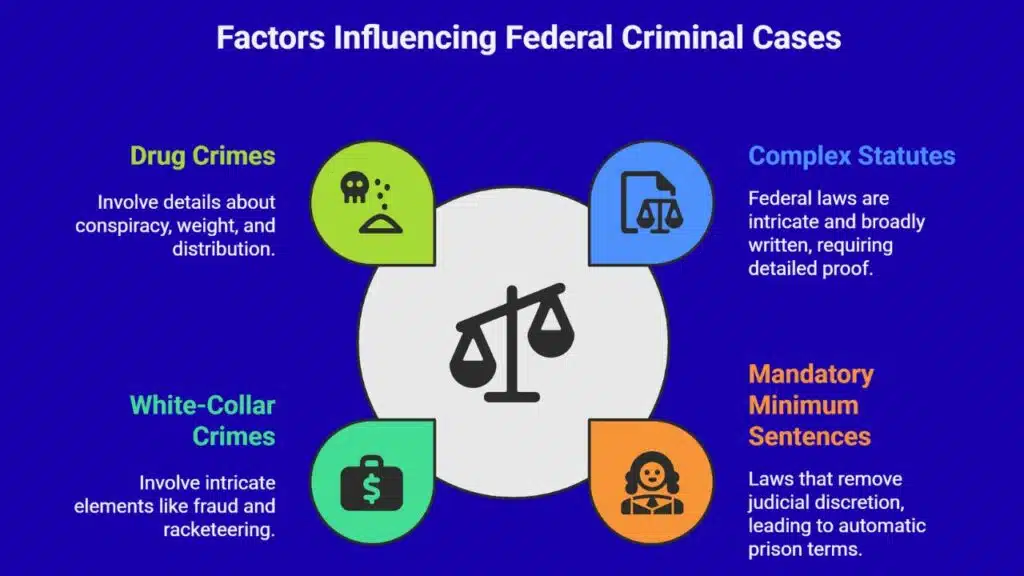
Federal criminal statutes are exceptionally complex and broadly written. Laws concerning white-collar crimes like wire fraud, mail fraud, and racketeering (RICO) involve intricate elements that the government must prove beyond a reasonable doubt. Similarly, drug crimes are not simply about possession but involve intricate details about conspiracy, drug weight, and distribution networks.
A particularly severe challenge is the prevalence of mandatory minimum sentences. Enacted by Congress, these laws can strip judges of their traditional discretion in sentencing for certain offenses, particularly those involving drugs or firearms. A conviction on a charge carrying a mandatory minimum means an automatic prison term, often measured in years or decades. This can drastically increase the stakes of a case, making the avoidance of conviction at trial or the negotiation of a favorable plea bargain absolutely paramount.
The Federal Sentencing Guidelines
Judges must consult the U.S. Federal Sentencing Guidelines even when a mandatory minimum does not apply. These complex rules calculate a recommended sentencing range based on the offense level and the defendant’s criminal history. While the Supreme Court has ruled the Guidelines are advisory rather than mandatory, judges still heavily rely on them.
The calculation process is highly technical, involving various enhancements and adjustments that can dramatically increase a sentence. Factors such as the defendant’s role in the offense (e.g., being deemed a “leader” or “organizer”), the amount of financial loss in a fraud case, or the brandishing of a weapon can all add years to a guidelines range. A skilled defense attorney must be an expert in arguing against these enhancements and presenting mitigating factors to persuade a judge to impose a sentence below the recommended guidelines range.
The Grand Jury and Indictment Process
Federal prosecutions formally begin with an indictment issued by a grand jury. This is a secretive proceeding where only the prosecution presents evidence. The defense has no right to be present, cross-examine witnesses, or present exculpatory evidence. The standard for an indictment is also much lower than the “beyond a reasonable doubt” standard required for a conviction at trial. This means the prosecutors need only show probable cause that a crime was committed and the defendant committed it.
This one-sided process means it’s exceedingly rare for a grand jury not to return an indictment. Therefore, the defense’s challenge is often reactive: analyzing the indictment for legal deficiencies and preparing to challenge its sufficiency through pre-trial motions.
The Plea Bargain Dilemma
Most federal criminal cases are resolved through plea bargains rather than trials. The government uses the threat of severe mandatory minimum sentences and lengthy guidelines calculations to pressure defendants into pleading guilty, typically to secure a lesser charge or a recommendation for a reduced sentence. This can create an immense strategic challenge for the defense.
Furthermore, accepting a plea can provide certainty but requires surrendering fundamental rights, including the right to a trial. Going to trial risks a much harsher sentence if convicted, a penalty known as the “trial tax.” Evaluating the strength of the government’s evidence, the potential sentencing exposure, and the client’s objectives to make an informed decision on whether to plead or proceed to trial is one of the most critical functions of a federal defense attorney.
The “Beyond a Reasonable Doubt” Standard at Trial

If a case proceeds to trial, the government must prove every element of the charged offense beyond a reasonable doubt. While this is the highest standard of proof in the American legal system, overcoming the narrative and evidence presented by federal prosecutors is a monumental task.
Defense strategy involves meticulous cross-examination of government witnesses, challenging the admissibility of evidence through pre-trial motions like motions to suppress illegally obtained evidence, and presenting a compelling counter-narrative to the jury. Effective trial advocacy requires an attorney who is a skilled litigator and deeply familiar with federal evidence rules and courtroom procedures.
Final Thoughts
Defending against federal charges is a battle fought on numerous fronts. Each stage presents unique and severe challenges from the initial investigation to the final sentencing hearing. With the information mentioned above in mind, the combination of aggressive prosecution, complex laws, and harsh penalties can create an environment where the guidance of an attorney specializing in federal practice is indispensable for protecting one’s rights and future.