Substance use is rife throughout the world. It’s a global issue. Though there are differences between countries and continents around particular substances used, there are common main issues that repeatedly come to the fore.
Supporting people into treatment is challenging for varying reasons. This must be reflected on. Below, differences in substance use and approaches to treatment are highlighted.
The Scope of the Crisis: Global Stats and Trends
In 2024, the World Health Organisation perfectly summed up the gravity of addiction in its stats. It reported, “2.6 million deaths per year were attributable to alcohol consumption… and 0.6 million deaths to psychoactive drug use.” It went on to inform how many more men are dying in these figures; 2 million men linked to alcohol and 0.4 million linked to drugs.
Substance-related deaths only reflect a small part of the problem. In 2017, the United Nations reported that “200 million people… are addicted to illegal drugs”. Cannabis was the most widely used (144 million), followed by amphetamines (29 million), cocaine (14 million), then opiates (13.5 million).
As is to be expected, alcohol is the most widely used substance in the world, likely due to its legal status and accessibility.
Throughout the world, there are huge societal impacts and these are seen more noticeably in low socioeconomic environments.
Regional Perspectives
1. North America
One study highlighted how “Deaths of Despair”, those related to drugs, alcohol, alcohol-related liver disease, poisoning, and suicide, are behind the “largest increase in mortality rates” among younger generations. They’re also more prevalent among lower socioeconomic backgrounds. Mortality rates are higher in the US than Canada though both alcohol and the opioid crisis have resulted in significant impact on younger deaths.
As is common throughout the world, men drink more than women and death rates are higher for them. Fentanyl and heroin use is a huge problem in many communities including the middle-classes due to the opioid crisis following the increase of opioid prescriptions in the 1990s.
Outreach teams have a high presence, especially in communities hit by the opioid crisis. Many staff are trained to administer opioid-overdose reversing medication.
2. Europe
In Europe, there are significant differences between countries in relation to mortalities as a result of substance use as well as substances most commonly used.
The EU’s standardised death rate in 2020 was 3.6 deaths per 100,000 people. Some countries were remarkably higher than this figure such as Slovenia (17.3 deaths per 100,000) Poland (10.1 per 100,000), and Denmark (7.3). Countries that came in under the average were Greece, Italy, and Malta (0.4 deaths per 100,000 people).
Interestingly, in 2024 Spain had a low death rate associated with substances in comparison to other EU countries, but had the highest estimate of adults using illicit drugs in the last year (14.5%). The Netherlands came in second (13.7%).
Cocaine use has been on the increase over the last fifteen years. The Dutch and French used the most in Europe (2.7%) and they were followed by Spain and Ireland.
Alongside all the substance use, Europe is at the forefront when it comes to leading harm reduction interventions. The Netherlands operated the first needle exchange in the 1980s. Needle and syringe exchanges are one of the most cost-effective health interventions.
Another approach to substance use that has been successful has been demonstrated by Portugal, a country which decriminalised drug use in 2001. Following this, there’s been a reduction in overdoses, HIV infection and drug-related crime.
3. Asia
Unlike other continents, there are many countries in Asia who have incredibly strict penalties for drug-related behaviours. It’s very much criminalised in this part of the world and many countries have a death penalty for trafficking drugs.
South East Asia is known for trafficking crystal meth out of the region. In 2022, there was reportedly a 30% rise in methamphetamine use. In Northern Thailand, there were even reports of monks being tested positive for crystal meth.
Interestingly, women in particular in South Asian cultures (Bangladesh, India, and Pakistan) “are seen as the keepers of the izzat (family honour)” and drinking alcohol is viewed as jeopardising family honour as well as their own health.
Private alcohol rehab clinics exist, but accessing them can be a problem, especially for those in rural communities.
4. Africa
Africa is a major exporter of cannabis and also linked to the transit and repackaging of cocaine and smuggling heroin. Though alcohol is the most widely used substance, these other three are used, too. Cannabis is used by 5.2% of the West African population and by 13.5% of Central Africa. It’s reported that, amphetamines and benzodiazepines are also on the increase.
Though these figures exist, it’s acknowledged that there’s a general lack of information on drug use meaning the full extent of the problem isn’t fully understood.
Looking at different countries on the continent reveals varying use. In Uganda, there are many reports of child substance users in refugee populations. In relation to all ages, in Ethiopia, and the north in general, khat is popular. In Nigeria, psychoactive mixtures, including cannabis, codeine, and ethanol, are common. In South Africa “Nyaope”, a low-grade heroin is used. In Zimbabwe glue and cough syrups are more common.
Sadly, one study reported that the “treatment gap for substance use disorders in Africa is as high as 87%”. The need is high, but treatment resources simply don’t exist in the capacity required.
5. Latin America
Mexico, Guatemala, Columbia, and Peru are some of the major producers of global heroin . That being said, there’s an enormous lack of information about use and behaviours, and the information there, isn’t necessarily reflective of reality.
The United Nations reported that 1.6 million people have HIV in Latin America. Injectable drug use has increased in particular in Argentina and Brazil over the last 40 years, though cocaine and its derivatives are more widely used. In Mexico, 98% of intravenous drug users are said to have Hepatitis C.
As seen in Asia, addiction is viewed more negatively in women than it is in men.
There are treatment facilities in Latin America. Mexico has 254, the Dominican Republic has 60, Ecuador has 42, Bolivia has 14, Panama has 9 and Guatemala has 6.
Considering that substance use and poverty usually go hand-in-hand, and the size of the continent, it’s natural to assume that more treatment facilities would be beneficial.
Common Challenges Across Cultures
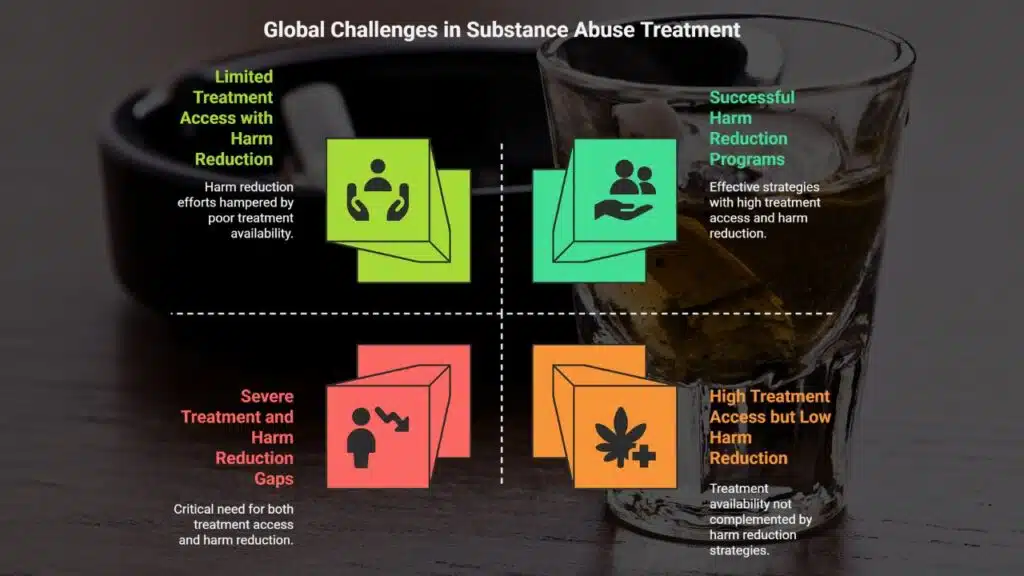
A common challenge in substance abuse and recovery across the globe is access to treatment. Whether due to lack of availability of resources, lack of education and awareness, the stigma of being seen publicly as having a problem etc. the barriers are high.
The United Nations reported that 23% of “people who use heroin will become dependent. This is the second highest rate of dependence after nicotine (32%) and substantially higher than the equivalent rates for alcohol (15%), cocaine (15%), amphetamine (11%) and cannabis (9%)”.
No matter where a person lives in the world, addiction will always exist and without the funding and resources to treat it, the situation doesn’t seem set to change. What has been successful in some countries, harm reduction interventions and decriminalisation, hasn’t spread out. This is unfortunate, considering both cost-effectiveness and the associated improvement in people’s health outcomes.
Concluding comments
While addiction will always be a problem, there are key factors that make a difference to individuals as well as communities becoming healthier. Education and awareness is crucial. Understanding who is affected and how sheds light on the grand picture. Governmental policies have a great impact for change as seen in countries where harm reduction and decriminalisation are employed.
As a globe, countries working together to improve outcomes is essential to improving global health as a community.