
Adam Conover, best known for his role as the skeptical and informative host of Adam Ruins Everything and the Netflix docu-comedy The G Word, has long built a career on breaking down complex issues and exposing societal misconceptions. His sharp, often humorous critiques of government, technology, healthcare, and corporate culture have earned him a loyal following of viewers who trust his investigative lens.
That’s why fans were shocked when Conover recently released a sponsored video appearing to endorse Worldcoin, a cryptocurrency project founded by OpenAI CEO Sam Altman. Worldcoin has drawn global attention and controversy for using its futuristic iris-scanning device called the Orb to collect biometric data in exchange for giving users crypto tokens. The Orb is marketed as a way to establish “proof of personhood” to distinguish humans from AI online, but critics have raised serious privacy and ethical concerns.
In the now-deleted sponsored video, Conover was seen demonstrating the Orb and explaining how it works, all while taking a seemingly neutral or even mildly favorable tone toward the technology. Although he emphasized that viewers should “make up their own minds,” many interpreted the video as a tacit endorsement, especially given the lack of any direct critique—a stark contrast to his usual tone of critical skepticism.
The Backlash Was Swift and Fierce
Almost immediately after the video went live, Conover faced backlash across social media and YouTube. Longtime fans accused him of abandoning his core principles in exchange for a corporate paycheck. Notably, science advocate and skeptic Rebecca Watson released a video sharply criticizing Conover’s apparent support of the Orb, highlighting the ethical and technological red flags that Worldcoin raises.
Worldcoin’s biometric approach has been heavily scrutinized. Critics from privacy watchdogs and researchers alike have argued that storing people’s iris data—even in hashed form—opens up new avenues for abuse, surveillance, and digital exclusion. Some also questioned the transparency of Worldcoin’s operations, especially in how it targets lower-income regions in Africa and Asia to build its global user base.
Adam Conover Responds: “I Was Humiliated. I Made a Huge Mistake.”
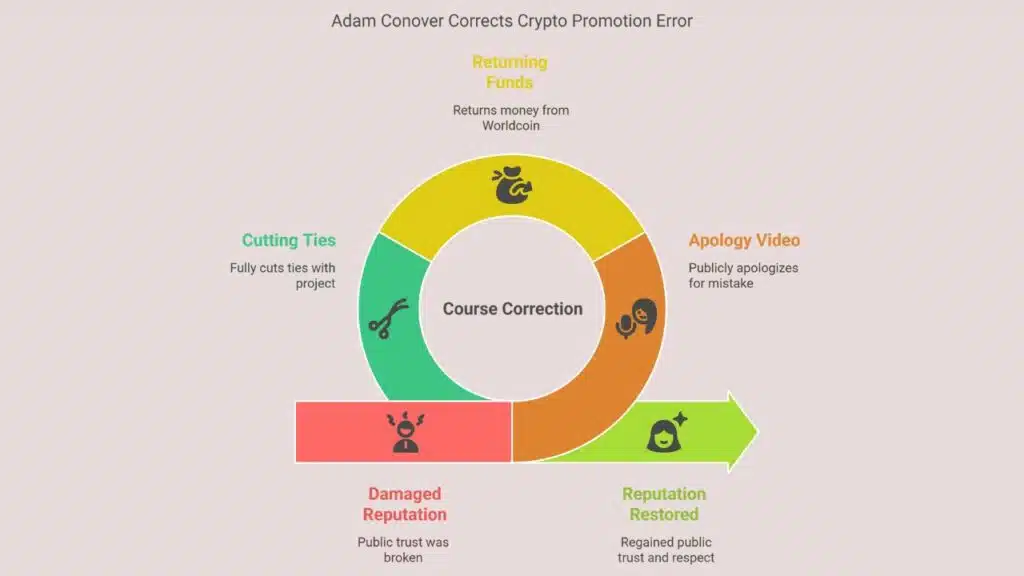
In response to the backlash, Adam Conover posted a new video titled “Why I Became a Crypto Shill” on his social platforms. In the video, he offers a full apology, explains his thought process, and admits that he deeply regrets taking part in the sponsored content.
“I’m humiliated,” Conover said candidly. “I took their easy money. I rationalized that I could take their sponsorship and still be critical, but that was a delusion.”
He said that he initially believed he could outsmart the system—that he could make a satirical or lightly critical video while still fulfilling the sponsorship contract. His hope was to insert subtle hints that would encourage viewers to see Worldcoin’s flaws for themselves. However, he now acknowledges that this attempt fell flat and failed to live up to the standards that his audience expects from him.
In a rare move among internet influencers, Conover stated that he is returning the money he received from Worldcoin and fully cutting ties with the project. He also thanked critics who called him out for his actions.
“Your anger and disappointment were warranted,” he said. “I let you down, and I let myself down.”
From Apology to Analysis: “Adam Ruins Worldcoin”
True to form, Conover didn’t just stop at an apology. He transformed the remaining portion of his video into a takedown of Worldcoin itself, returning to the familiar tone of his Adam Ruins Everything days. Using researched examples, Conover pointed out the dangers of centralized biometric data collection, the exploitation of marginalized communities, and the false promises of decentralized utopias promoted by crypto evangelists.
He criticized the core assumption behind Worldcoin—that everyone should scan their eyeballs for the sake of being recognized as a “real human” on the internet—as “a dystopian solution to a problem created by the tech industry itself.”
Referencing reporting from MIT Technology Review, Wired, and EFF (Electronic Frontier Foundation), he explained how Worldcoin’s tactics have been flagged by multiple global organizations for ethical lapses, including misleading consent practices and inadequate data security measures in several countries. Even regulators in Kenya, one of Worldcoin’s largest early testing grounds, suspended operations over data privacy concerns.
Why This Matters: Lessons for Influencers and the Tech Industry
Conover’s public misstep and subsequent course correction raise broader questions about the role of influencers in promoting emerging technologies, especially those with significant ethical and societal implications. As influencers continue to take on the mantle of independent journalism, audiences increasingly hold them to the same standards of transparency, accuracy, and moral responsibility.
The apology was received with mixed reactions. Some praised Conover for owning up to his mistake in a detailed and sincere way—much more so than the average influencer apology video. Others, however, noted that the original decision to align with a project like Worldcoin shows a lapse in judgment that cannot be fully undone by remorse.
A Cautionary Tale in the Age of Sponsored Content
This episode serves as a reminder that even the most principled public figures are vulnerable to the allure of financial incentives, especially in an era when traditional media opportunities are drying up. It also underlines the importance of thorough due diligence before agreeing to represent any brand, particularly those operating at the intersection of tech, finance, and personal privacy.
As Adam Conover rebuilds trust with his audience, he joins a growing list of creators learning—in real time—the weight of their influence and the need to wield it responsibly.