
Legendary singer-songwriter Billy Joel, 76, has revealed that he’s been diagnosed with a rare brain condition known as Normal Pressure Hydrocephalus (NPH). The news, confirmed in a statement posted on his official Instagram account, explains that the condition has negatively affected his balance, vision, and hearing—especially while performing live. As a result, Joel has canceled or postponed his concert commitments.
While NPH may sound frightening, medical experts emphasize that this condition is often treatable and in some cases reversible, particularly if it is diagnosed early. Joel’s openness about his diagnosis is drawing attention to a disorder that is frequently misunderstood, underdiagnosed, and sometimes mistaken for irreversible dementia.
What Is Normal Pressure Hydrocephalus (NPH)?
Normal Pressure Hydrocephalus is a neurological disorder characterized by the abnormal buildup of cerebrospinal fluid (CSF) within the brain’s ventricles (fluid-filled cavities). Despite the term “normal pressure,” the accumulation causes increased pressure on the brain tissue, which can disrupt the brain’s function—even if the CSF pressure measured by standard methods appears within normal range.
Under typical conditions, cerebrospinal fluid continuously circulates through the brain and spinal cord, serving as a cushion and helping to deliver nutrients and remove waste. In NPH, this circulation becomes impaired, and fluid accumulates abnormally, leading to enlarged ventricles and progressive symptoms.
According to Cleveland Clinic, NPH is rare but not unheard of, particularly in older adults, with an estimated 5.9% prevalence among individuals over age 80. It usually presents in people aged 60 and older, but symptoms can sometimes appear earlier.
Why Does It Happen?
The exact cause of NPH is not always known. In many cases, doctors cannot identify a clear reason why CSF accumulates. However, NPH can be classified into two main types:
- Idiopathic NPH – Occurs without a known cause. This is the most common form in older adults.
- Secondary NPH – Can result from events such as brain injury, brain surgery, meningitis, stroke, or hemorrhage that disrupt CSF absorption or flow.
Doctors emphasize that activities like performing concerts or exposure to loud music do not cause NPH, even though symptoms may become more noticeable under physical stress, such as the demands of touring.
Recognizing the Symptoms: “Wet, Wobbly, and Weird”
The classic symptoms of NPH are often remembered through the phrase:
“Wet, Wobbly, and Weird.”
1. Wet – Urinary Incontinence
Patients often experience a loss of bladder control, frequent urination, or a sudden urge to urinate. This symptom can range from mild inconvenience to significant incontinence.
2. Wobbly – Gait Disturbance
This is typically the earliest and most noticeable symptom. Patients may walk slowly, with feet wide apart and shuffling. It often resembles Parkinsonian gait, and some may describe it as feeling like their feet are “stuck to the floor.” This symptom increases the risk of stumbling and falling.
3. Weird – Cognitive Changes
NPH can lead to confusion, memory loss, slowed thinking, and difficulties with problem-solving. These symptoms are often mistaken for Alzheimer’s disease or other forms of dementia.
Additional Signs:
- Difficulty concentrating or following conversations
- Mood changes or apathy
- Difficulty multitasking
Unlike Alzheimer’s, however, NPH-related cognitive decline may improve with treatment, making early diagnosis crucial.
How Is NPH Diagnosed?
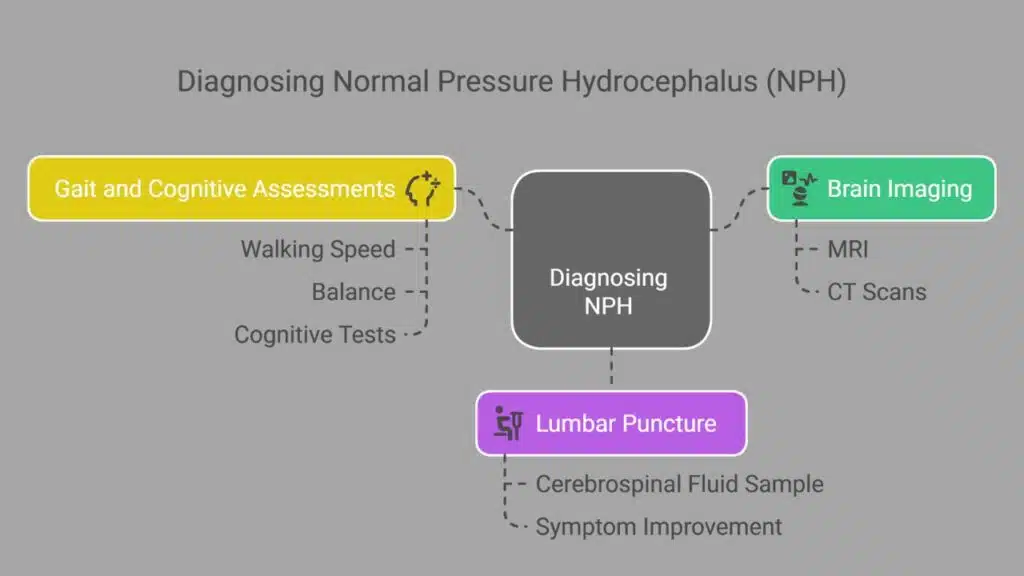
Diagnosing NPH involves a comprehensive neurological evaluation, including imaging and physical exams. Here’s what’s typically involved:
Brain Imaging
- MRI (Magnetic Resonance Imaging) or CT (Computed Tomography) scans are used to detect enlarged ventricles, which are a hallmark of NPH.
- Imaging also helps rule out other conditions like tumors or stroke.
Lumbar Puncture (Spinal Tap)
- A lumbar puncture allows doctors to drain a sample of cerebrospinal fluid to relieve pressure and evaluate symptom changes.
- If a patient’s symptoms (especially walking or cognition) improve after the spinal tap, this is a strong indicator of NPH.
Gait and Cognitive Assessments
- Walking speed, balance, and reaction time are often tested before and after the spinal tap to document changes.
- Neuropsychological evaluations may be conducted to assess memory, executive function, and attention span.
Treatment: A Reversible Form of Dementia
What makes NPH distinct from other neurodegenerative conditions is that it is potentially treatable—even reversible—if diagnosed early.
Surgical Treatment – Ventriculoperitoneal (VP) Shunt
The most common treatment involves placing a VP shunt—a thin, flexible tube that redirects excess fluid from the brain’s ventricles into the abdominal cavity, where it can be absorbed and eliminated naturally.
- The procedure is typically done by a neurosurgeon.
- Once the shunt is placed, many patients experience marked improvements in mobility and mental function, sometimes within days or weeks.
- Follow-up care is essential to adjust the shunt settings and monitor for complications like infection, over-drainage, or blockage.
Medication – Acetazolamide
In some cases, especially where surgery is not possible, the diuretic drug acetazolamide may be prescribed. It works by reducing CSF production in the brain, though it’s less effective than surgery and doesn’t work for all patients.
Physical Therapy
Physical therapy plays a key role in helping patients regain strength, stability, and coordination, especially after surgical treatment. As mentioned in Joel’s statement, he is currently undergoing specialized physical therapy, though further details were not shared.
Importance of Timely Diagnosis
Dr. Wajd Al-Holou, a neurosurgeon at the University of Michigan Health, stresses that delayed diagnosis can lead to permanent brain damage. The longer the condition goes untreated, the more damage is caused by the pressure on the brain.
If someone notices early signs—like difficulty walking, forgetfulness, or incontinence—they should consult a primary care physician or neurologist for further evaluation.
“Patients often come in worried about Alzheimer’s or Parkinson’s, and we sometimes find it’s NPH—something that can actually be improved,” said Dr. Vikram Udani, a San Diego-based neurosurgeon.
Billy Joel’s Outlook and Public Awareness
While Billy Joel hasn’t confirmed whether he will undergo surgery, his public disclosure is already raising awareness about a condition that many people—and even doctors—may overlook.
His current plan, according to his official social media post, involves specific physical therapy aimed at improving his balance and coordination. Fans and medical professionals alike are hopeful that his early diagnosis and access to care will yield positive results.
Hope Through Awareness and Early Action
Normal pressure hydrocephalus is often described as a “treatable form of dementia”—a rare case where timely diagnosis can dramatically improve outcomes. With the right treatment, many patients regain their independence, mobility, and mental clarity.
Billy Joel’s case highlights the importance of recognizing the signs early and seeking proper medical evaluation. If you or a loved one shows symptoms like difficulty walking, memory changes, or bladder problems, don’t dismiss them as just “getting older.” Instead, consult a neurologist to rule out or confirm conditions like NPH, which—unlike Alzheimer’s—can often be reversed.
The Information is Collected from NBC News and Rolling Stone.