Making a video game is tough. Sending it out to players worldwide can be even harder. Many developers miss one key step—game localization. Without it, your game could confuse or even upset players in new regions.
Game localization isn’t just about translating words. It means changing the game’s content to fit different languages and cultures. This blog will explain how the process works and tackle common problems like dealing with fragmented data or cultural misunderstandings.
Ready to learn? Keep reading!
Key Takeaways
- Game localization helps games reach global markets by adapting language and culture. It boosts player experience and trust, increasing sales worldwide.
- The localization market was worth $1.5 billion in 2021 and may grow to $2.5 billion by 2027. Franchises like Super Mario Kart succeeded due to regional adaptations.
- Common challenges include high costs from late planning, fragmented data slowing work, and cultural mismatches causing errors or delays. Tools like Gridly fix these issues by organizing all content in one system.
- A solid localization process includes market research, skilled translators, cultural adaptation, quality assurance (LQA), and the right tools for handling languages like Arabic or Chinese efficiently.
- AI-powered tools paired with human translators improve speed while keeping translations accurate. Player feedback ensures games feel personal across different regions.
Why Game Localization is Essential for Global Success
Game localization opens doors to more players. Translating and adapting in-game content lets developers reach new target markets. For example, the video game industry grew its audience by localizing titles like *Arena of Valor* for multiple languages.
Offering games in a player’s native language improves their experience and builds trust.
Localized games boost revenue too. The global localization market was worth $1.5 billion in 2021 and may hit $2.5 billion by 2027. Popular franchises like *Super Mario Kart* thrived because they adapted to regional cultures, increasing sales worldwide.
Small details, such as addressing cultural references or language nuances, strengthen brand image globally while improving satisfaction among diverse gamers!
Key Challenges in Game Localization
Game localization is more than just swapping words between languages. It faces hurdles like messy data and keeping translations true to the game’s spirit.
Treating Localization as an Afterthought
Ignoring localization early can wreck a project’s budget. Costs rise fast if game developers try to squeeze localization into the final stages. Delays also pile up, stretching the timeline and pushing back launches.
For example, skipping localization planning upfront may lead to reworking in-game content later. This means combing through source language files again or fixing cultural mismatches for target markets like Spanish-speaking gamers.
Games built without considering right-to-left languages often need extra adjustments, which adds more expenses and time to development cycles. Starting strong with a localization plan avoids these headaches and saves money in the long run.
Managing Fragmented Data
Fragmented data slows down game localization. Jumping between tools creates errors and wastes time. Translation memory or in-game content gets lost in the shuffle. This causes delays that hurt a game’s launch timeline.
Unified software like Gridly fixes this problem. It stores all data in one place, saving hours of work for teams. Game developers can easily access phrases, translation memories, or regional adaptations without hassle.
Teams stay organized while targeting markets faster and cleaner.
Ensuring Proper Localization Quality Assurance (LQA)
Testing must check for errors in translations and cultural blunders. Tools for localization quality assurance (LQA) help spot mistakes like broken text, missing files, or odd meanings.
For example, right-to-left languages need extra care to display correctly.
Without proper LQA, players may face text that feels awkward or wrong. Regular checks catch problems early and protect the game’s image. Games like “Honor of Kings” rely on such steps to stay popular worldwide.
The Game Localization Process: Step-by-Step
Turning a game into something players love, no matter their language, takes smart planning and sharp tools—learn how each step shapes the journey!
Analyzing Target Markets and Preparing a Launch Plan
Pick the right target markets first. Study gaming culture and player habits in each region. Use market research for insights about languages, popular genres, and spending behavior.
For example, China loves multiplayer online battle arenas but has strict content rules.
Decide between a global launch or staggered releases. Some countries might need extra time for adapting to local laws or cultural elements like nudity censorship. Prepare a localization plan early.
This avoids rushed fixes later on and saves both money and effort.
Choosing the Right Localization Management Tools
Localization tools make game translation easier. They help detect character limits, manage terminology, and track changes. Tools like Gridly handle in-game content smoothly. They organize files and simplify workflows for teams.
Pick software that supports many file types like XML or UTF-16. A good system works with right-to-left languages too. This keeps the localization process fast and error-free, saving both time and money for developers.
Extracting Content for Translation
Game developers must sort all in-game content before translation. Text, visuals, and legal documents need clear organization. Tools like Gridly simplify this step by managing assets in one place.
A well-sorted database reduces errors and saves time.
Developers should focus on adaptable formats like XLIFF or CSV files for export. These formats work with Translation Management Systems (TMS). Proper extraction ensures nothing gets lost or scrambled during localization efforts.
Creating a Comprehensive Localization Kit
A localization kit is like a treasure map for translators. It includes everything needed to translate in-game content well. Developers add glossaries, style guides, term bases, and cultural notes.
This helps linguists avoid ambiguities and stay consistent with terminology.
The kit also has instructions on handling bidirectional text or right-to-left languages like Arabic. Screenshots and context are often attached to clarify game scenarios. Tools such as computer-assisted translation (CAT) systems may be included too.
A strong localization plan starts with a complete kit that supports smooth workflows for the entire team.
Building a Skilled Localization Team
Start with gamer-translators who understand gaming culture. They know the language and how players think. Include editors to polish translations, keeping terms consistent across all languages.
Testers play in target languages, spotting any bugs or awkward phrases.
Use managers to guide and track progress. Provide tools like a translation management system (TMS) for smooth communication. Let translators play the game before they work on its in-game content—this helps them adapt cultural references better, like Princess Peach or Bowser’s roles in games from Nintendo of America.
Every role matters to hit your localization timeline without errors.
Adapting Content for Cultural Relevance
Content must fit the gaming culture of each target market. Violence, nudity, or religious symbols may upset some audiences. For example, games in Japan may tone down graphic scenes compared to Western versions.
Historical details might also need changes to avoid offending local sensitivities.
Regional adaptation goes beyond translation. Use local idioms and jokes that players understand. In right-to-left languages like Arabic, adjust layouts for proper reading direction.
Even small cultural references can make the game feel relatable or distant for the audience.
Conducting Localization Testing and QA
Test every part of the game. Check in-game content, text, audio, and visuals for errors. Review cultural references carefully to avoid mistakes.
Make sure translations fit right-to-left languages like Arabic. Test game engines for smooth performance across all regions. Protect quality with strong localization quality assurance (LQA) protocols at every step.
Implementing Localization-Friendly Development Practices
Use Unicode standards to support all languages. Keep your code clean and ready for translations. Externalize strings, so translators can work without touching the core code.
Plan user interfaces (UI) with room for text expansion. Some languages need up to 35% more space than English. Test right-to-left layouts early if targeting these markets.
Best Practices for Successful Game Localization
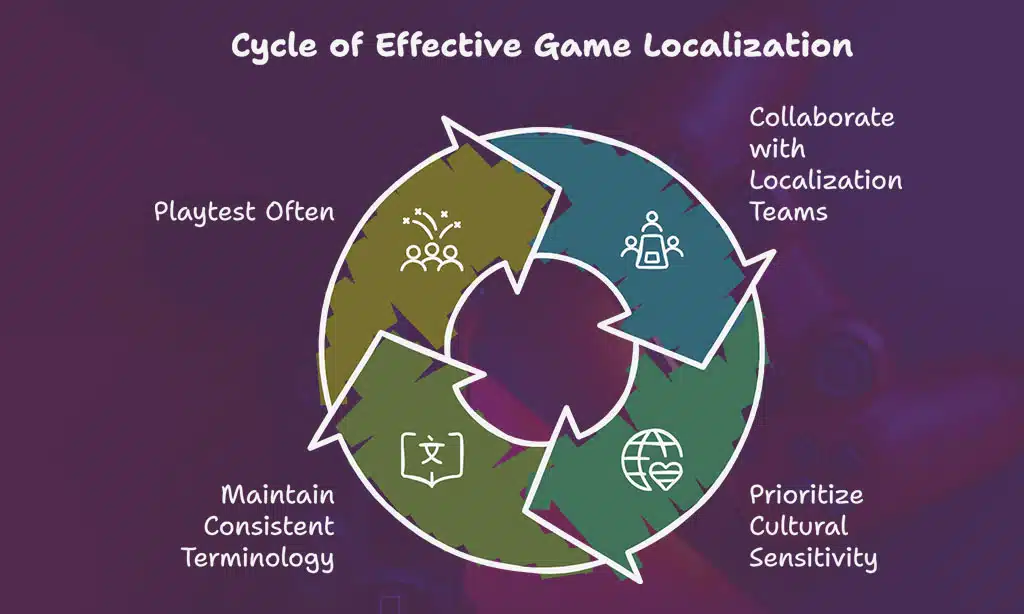
Start with skilled translators, respect local cultures, and playtest often to connect with players worldwide.
Collaborating with Experienced Localization Teams
Working with skilled localization teams boosts the entire process. They catch cultural nuances, avoid basic translation mistakes, and speed up workflows. Experts know how to handle regional adaptation for better player experiences across target markets.
Unified tools like Gridly simplify collaboration. These tools allow real-time updates, task tracking, and smooth communication between developers and translators. Strong teamwork ensures higher quality in-game content while sticking to the localization timeline.
Prioritizing Cultural Sensitivity
Game developers must adapt content to fit regional values. For example, Japan often censors heavy violence, while the Middle East restricts some religious imagery. Changing in-game content like symbols or storylines helps avoid offending players.
Small tweaks can make a big difference in acceptance.
Cultural references need careful handling too. Humor, slang, and idioms don’t always translate well. What’s funny in one culture may confuse or upset another audience. Using a skilled localization team ensures content feels natural for each region’s target markets.
Maintaining Consistent Terminology Across Languages
Keeping words consistent helps players understand the game. Different translators working on the same project might use different terms, causing confusion. For instance, if “health potion” is sometimes called “life drink,” it throws players off.
Using a translation management system (TMS) ensures uniformity across all languages. It stores terms and phrases in one place for easy reference. This keeps key in-game content clear, whether it’s menu options or story text.
Accurate terminology makes a smoother gaming experience for everyone worldwide!
Future Trends in Game Localization
Game localization is changing fast, with new tech leading the way. Exciting tools promise to make translations smarter and faster than ever.
AI and Machine Translation Integration
AI speeds up the localization process. Machine translation, like Google Translate or DeepL, handles large chunks of content quickly. It cuts costs and delivers results fast but misses context and emotion.
Video game industry leaders often pair AI tools with human translators to fix errors in slang, humor, or cultural references.
PEMT (post-editing machine translation) improves quality without wasting time. For example, a translator reviews text from AI for accuracy. This balance helps adapt in-game content for global audiences while keeping budgets low.
Using AI smartly can reduce the localization timeline significantly.
Increased Focus on Player-Centric Localization
Players want games that feel personal. Game developers now create localizations to match player preferences, speech patterns, and cultural references. For example, titles like Nintendo’s games often tweak humor or idioms for different regions.
This creates a deeper connection for users.
Professional localization teams also focus on feedback from the gaming community. By adapting in-game content based on player input, they improve satisfaction while reducing errors seen with community translation alone.
This approach balances high-quality game translation with what players truly enjoy.
Takeaways
Game localization is like opening a door to new worlds. It helps games reach players everywhere by speaking their language and culture. By following smart steps, using the right tools, and respecting cultural differences, developers can win big in global markets.
The process may be tricky, but with care and teamwork, success is within reach. Games that feel local will always build stronger connections with fans worldwide.
FAQs
1. What is video game localization?
Video game localization is adapting a game for different target markets. It includes translating text, adjusting cultural references, and ensuring regional adaptation for the target audience.
2. How does the localization process work?
The localization process starts with creating a localization plan and preparing a localization kit. The team then works on translation, dubbing, and adapting in-game content to fit gaming culture in each region.
3. Who handles game localization?
A dedicated team manages it. This includes translators, editors, cultural experts, and quality assurance testers who follow industry practices to maintain accuracy throughout the workflow.
4. What are some challenges in game localization?
Challenges include handling right-to-left languages, preserving narrative flow during translation, addressing cultural differences like idioms or jokes, and managing tight timelines within the video game industry.
5. Why is Localization Quality Assurance (LQA) important?
LQA ensures that translated content fits seamlessly into games without breaking functionality or meaning—testing everything from software localization to user experience.
6. What tools help with video game translation?
Tools like Translation Management Systems (TMS), specialized software for literary translation tasks, and other advanced technologies streamline workflows while improving efficiency across projects.