In a bold move to maintain its dominance in the competitive AI landscape, OpenAI has announced the release of two groundbreaking artificial intelligence models—o3 and o4-mini—that the company claims are its most capable reasoning systems to date. Alongside these proprietary models, OpenAI has also released Codex CLI, an open-source coding assistant designed to work with developers’ local tools. The announcements come as part of OpenAI’s broader strategy to innovate aggressively in response to growing pressure from international and domestic competitors.
What Are o3 and o4-mini? The Most Advanced “Reasoning” Models from OpenAI
The o3 model is being described as OpenAI’s flagship reasoning system—a significant upgrade over previous models like o1 and o3-mini. It reportedly uses ten times more compute power than its predecessor during training and introduces a host of new features that move AI capabilities closer to autonomous intelligence.
Key Capabilities of o3:
-
Autonomous Tool Use: One of o3’s most distinctive traits is its ability to independently decide when and how to use external tools such as web browsers, code interpreters, and image generators. Unlike traditional AI systems that rely entirely on user prompts for each action, o3 can analyze a task and determine which tools to activate to solve it more effectively.
-
Visual Reasoning: OpenAI says that o3 can now understand and reason directly from images, diagrams, and even blurry or low-quality photographs. In internal demonstrations, o3 successfully analyzed a 2015 physics research poster from a photo and autonomously searched the web for more recent publications on the topic, comparing outcomes without any user prompt to do so.
-
Multimodal Capabilities: Beyond images, o3 can also handle code, written documents, and perform real-time computations using tools like Python. This makes it ideal for users across sectors like science, education, finance, and software engineering.
-
Language Intelligence with Step-by-Step Reasoning: Like its predecessor o3-mini, o3 excels in step-by-step, “chain of thought” reasoning. But it now combines this with a deeper sense of context, allowing it to switch between fast, intuitive responses and slow, deliberative thinking depending on the task.
According to OpenAI President Greg Brockman, this is the first time their models have been capable of generating “legitimately good and useful novel ideas,” a strong indicator that the company sees this as more than an incremental upgrade—it’s a potential game-changer.
o4-mini: Lightweight, Yet Powerful
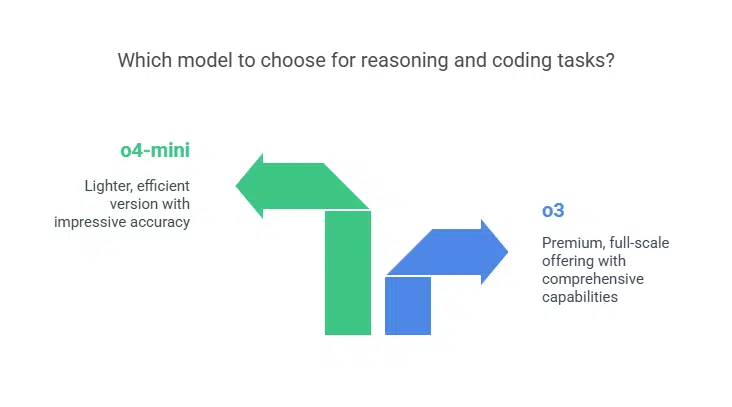
While o3 is positioned as the premium, full-scale offering, o4-mini is a lighter and more efficient version designed to deliver top-tier performance with lower computational overhead. It may not have the full capabilities of o3, but it still handles most reasoning and coding tasks with impressive accuracy, making it suitable for smaller organizations or applications with limited compute access.
OpenAI has optimized o4-mini to work across devices with lower memory and GPU requirements, and it reportedly performs better than older models like o3-mini on several internal benchmarks.
Codex CLI: First Major Open-Source Release Since 2019
Perhaps the most surprising announcement was the unveiling of Codex CLI, a new open-source AI coding assistant that developers can run directly on their machines. This marks OpenAI’s return to open-source development after years of primarily offering closed, proprietary tools.
How Codex CLI Works:
-
Runs Locally, Connects to the Cloud: While Codex CLI operates on a local device, it securely connects to OpenAI’s o3 and o4-mini models in the cloud for reasoning tasks. This hybrid setup allows it to combine the power of cloud-based AI with the flexibility of local tools.
-
Tool-Aware AI: Codex CLI goes beyond traditional code completion—it understands the full development environment and can decide when to use tools like package managers, databases, or APIs. It can execute complex tasks without being micro-managed by the user.
-
More Than Just Code: The AI can handle tasks like debugging, documentation generation, performance profiling, and even deployment steps by combining multiple tools in an automated workflow.
To promote widespread adoption and innovation around this new tool, OpenAI announced a $1 million fund, which will offer $25,000 in API credits to select projects that showcase innovative use cases of Codex CLI.
This move also reflects OpenAI’s effort to appeal to developers who have increasingly turned to open-source AI models like Meta’s LLaMA, Mistral, or China’s DeepSeek, which offer greater customization and cost savings.
Competitive Pressure from China, Google, and Anthropic
The release of o3 and o4-mini comes at a pivotal time for OpenAI, which is facing intensified global competition from both open-source and proprietary AI model developers.
-
In China, the AI startup DeepSeek released its R1 model, an open-source system capable of step-by-step reasoning—something previously considered unique to proprietary Western models like OpenAI’s.
-
Anthropic, an American rival founded by former OpenAI employees, has gained attention with its Claude models, which can intelligently switch between fast “gut instinct” responses and logical, multi-step answers. Their Claude 3 family of models, especially Claude 3 Opus, is already used in enterprises and reportedly offers reasoning abilities on par with GPT-4.
-
Last month, Google launched Gemini 2.5 Pro, a powerful update that outperformed OpenAI’s o3-mini in several benchmarks, especially in reasoning-related tasks.
These competitors have raised the bar for what AI models can and should do. OpenAI’s new releases appear to be a direct response, designed to reclaim the narrative that OpenAI is still at the cutting edge of AI development.
Availability and Integration
Both o3 and o4-mini are now available to:
-
ChatGPT Plus and Pro users
-
Teams subscribers
-
Enterprise users via API access
They have also been integrated into GitHub Copilot, offering enhanced coding capabilities to Pro, Business, and Enterprise GitHub users.
In addition, OpenAI is gradually retiring older models such as o1, o3-mini, and o3-mini-high from advanced user plans to streamline its product offerings around its most capable models.
Ethics, Safety, and Future Outlook
OpenAI stated that both o3 and o4-mini have been evaluated using the company’s Preparedness Framework, a risk management and AI safety model introduced in 2023. This framework assesses potential risks, misuse scenarios, and the societal impact of highly autonomous systems.
Although OpenAI has not yet allowed third-party independent researchers to verify its benchmark claims for o3 and o4-mini, the company has indicated that transparency around safety evaluations will improve in the future.
Looking ahead, OpenAI is also working on GPT-4.1, the next evolution of its general-purpose language model, which Codex CLI is expected to support soon.
OpenAI Aims to Lead the Next Phase of AI Evolution
With the launch of o3, o4-mini, and Codex CLI, OpenAI is making a clear statement: it intends to lead the AI race not just in language understanding but also in visual reasoning, software automation, and developer tools. By combining proprietary intelligence with open-source flexibility, the company is betting on a hybrid strategy to counter both enterprise rivals and community-driven open models.
While competitors like Anthropic, Google, and DeepSeek continue to innovate rapidly, OpenAI’s new releases show that it’s ready to compete on every front—whether in reasoning, autonomy, or accessibility.