Artificial intelligence (AI) is transforming industries, and journalism is no exception. As news consumption changes, many readers feel overwhelmed by the flood of content online. Questions about credibility, personalization, and efficiency in delivering news are growing louder.
AI offers promising solutions to these challenges. Tools like generative AI and large language models (LLMs) enable faster reporting, create customized content for audiences, and even combat misinformation effectively.
These technologies are redefining how journalists create stories and connect with their readers.
In this blog post on “Future Trends Of AI In Journalism,” we’ll examine seven major predictions shaping its future. Stay engaged—this could alter how you view the news forever!
AI-Enhanced Automation in News Production
AI boosts automation in news production by transforming complex tasks into faster workflows. Automated transcription tools, like speech-to-text software, streamline interviews for reporters.
Large language models (LLMs) such as GPT-4 craft summaries and headlines within seconds, reducing routine workloads. Newsrooms often rely on AI-driven web crawlers to scan databases and social media platforms for trending topics.
Generative AI technologies create real-time updates for sports or breaking stories with minimal human input. Tools powered by machine learning support copy-editing processes, improving grammar and metadata tagging accuracy.
This digital revolution allows newspapers to distribute content across mediums customized for specific audiences faster than before.
Personalizing News Delivery with AI Technologies
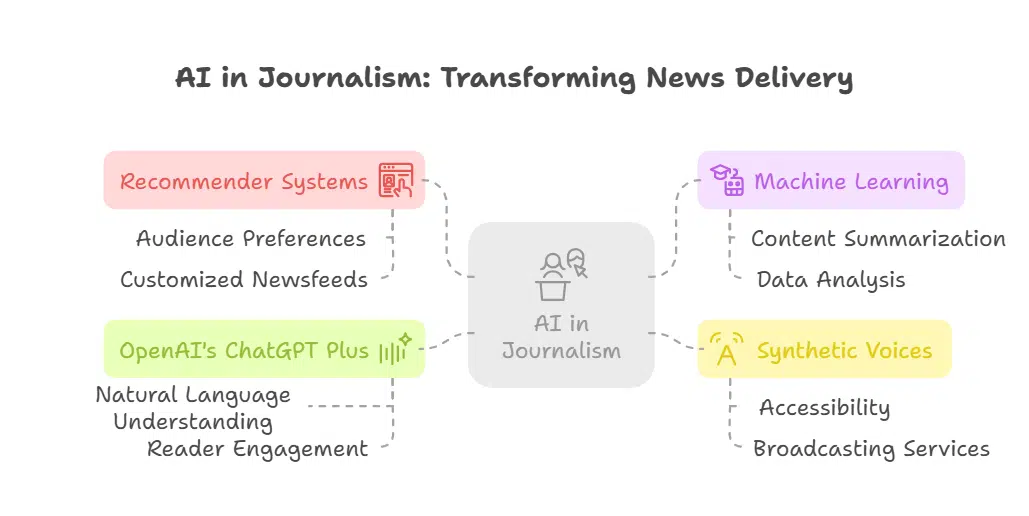
AI tools in journalism reshape how news reaches audiences. Recommender systems now analyze audience preferences to deliver customized newsfeeds on platforms like Instagram and personalized news apps.
These systems sift through big data, enabling news organizations to offer focused updates, short video formats, or live streams for specific demographics.
Media outlets employ machine learning algorithms to summarize content efficiently. Tools like synthetic voices provide text-to-audio conversions, improving accessibility for listeners using phones or broadcasting services.
Companies such as OpenAI’s ChatGPT Plus enhance engagement by integrating natural language understanding into content creation. These innovations allow stronger connections with readers while maintaining a competitive advantage in the information landscape.
AI’s Role in Detecting and Countering Fake News
Artificial intelligence can analyze vast amounts of data to flag misinformation quickly. Machine learning algorithms detect patterns, uncover sources, and identify deepfake technology in videos or images.
Tools like Bing Chat or other large language models (LLMs) help filter suspicious content before it spreads.
News organizations use AI-powered systems to verify facts and evaluate the reliability of news stories. This helps combat the echo chamber effect caused by false information circulating online.
These tools strengthen public interest journalism by focusing on accuracy and rationality within the information ecosystem.
AI Integration within Modern Newsroom Operations
News organizations increasingly rely on AI tools in journalism to boost efficiency. Automated transcription streamlines interviews, while machine learning aids content curation. Large language models (LLMs) provide faster ways to summarize news articles and generate reports.
Tech giants develop tools that support editors by suggesting headlines or correcting errors in drafts.
AI-powered systems are reshaping newsroom workflows. Platforms such as Perplexity.ai enhance research processes by analyzing vast data sets in seconds. Start-ups focus on creating personalized content for targeted audiences through AI-driven recommendations on news portals and apps.
These innovations reduce time spent on repetitive tasks, allowing newspaper journalists to focus more on producing quality stories for public interest journalism efforts.
Leveraging AI for In-depth Data Journalism
AI tools in journalism are transforming data analysis. Reporters now use machine learning to process large datasets quickly, uncovering hidden trends and connections. For example, large language models (LLMs) assist journalists by extracting insights from unstructured data like emails or reports.
Media outlets, such as the Tow Center for Digital Journalism and Columbia Journalism Investigations, apply these tools to investigate topics like public interest journalism.
Artificial intelligence enhances efficiency in investigative reporting. Automated transcription speeds up interviews while algorithms generate visualizations of complex information.
News organizations increasingly rely on AI to deliver content that resonates with audience preferences. This innovation helps address growing demands for accurate and thorough reporting within the fast-paced news industry.
Artificial intelligence is reshaping newsrooms but raises ethical concerns. Biases in AI models can skew the information ecosystem, impacting public opinion and trust. For instance, large language models may unintentionally spread misinformation if not trained on diverse or credible data.
News organizations must carefully evaluate these technologies before deploying them.
Generative artificial intelligence also challenges authenticity. Deepfake technology allows bad actors to create fake videos or audio that could manipulate mass communication. Public interest journalism faces risks of AI-generated content being misused to distort facts.
Reporters sans frontières has called for stricter regulations to address these issues while maintaining freedom of the press.
Proliferation of AI-Created Media in the News Industry

AI-generated content is reshaping the news industry. News organizations now use large language models (LLMs) to create articles, summaries, and even real-time updates. AI bots deliver sports scores and breaking news faster than human journalists.
Text-to-audio tools allow readers to consume stories on-the-go, while AI-driven recommendations align with audience preferences.
Short-form videos and live streaming are gaining traction due to artificial intelligence innovation. Some publishers focus on producing highly personalized formats for specific audiences through apps or websites.
This shift helps brands stay relevant in a competitive information ecosystem dominated by online aggregators like social media platforms.
AI Innovations in Audience Interaction and Engagement
AI-driven tools are transforming how audiences interact with content in the news industry. Features like text-to-audio conversion make consuming news more accessible, while AI-powered summarization delivers concise updates customized to audience preferences.
With innovations such as live streaming and short video formats, platforms enhance engagement by catering to audience attention spans. News apps now focus on specific subscribers or niche groups, personalizing experiences further.
Interactive chatbots and virtual assistants make information retrieval easier for users. These systems deliver up-to-date sports results or breaking news instantly, improving user satisfaction.
Machine learning models analyze signals from subscriber activity to refine personalized recommendations on blogs or broadcasts. As 2024 approaches, these advancements will continue fostering innovation in journalism’s approach to engaging audiences effectively.
The Continuing Relevance of Human Journalists Amidst AI Advancements
Human journalists bring context and critical thinking that artificial intelligence models cannot replicate. While AI tools in journalism streamline workflows and generate content, they often struggle with nuances like cultural sensitivity, ethical judgment, and verifying sources.
For instance, foundation models may accelerate data analysis but risk spreading biases or misinformation without human oversight.
Journalists play a key role in public interest journalism by prioritizing accuracy over speed. Unlike machine learning systems dependent on pre-existing datasets, humans adapt dynamically to new information ecosystems or societal shifts.
News organizations like Axel Springer continue integrating AI alongside human expertise rather than replacing it entirely. This blend ensures credibility while leveraging innovation in journalism for efficiency.
AI Innovations in Journalism Education
Educational programs now use artificial intelligence tools like automated transcription and data journalism software. These systems help students analyze complex information with ease.
Large language models (LLMs) assist learners in generating story drafts, improving grammar, and summarizing content quickly.
AI-driven modules also teach biases in AI to future journalists. Institutions incorporate machine learning concepts to enhance the understanding of ethical considerations. The focus shifts toward preparing students for innovation in journalism by using open-source technologies and interactive simulations.
Takeaways
Artificial intelligence is reshaping journalism at a rapid pace. From personalized news to AI-driven content creation, the possibilities are vast. News organizations will adapt by blending technology with human expertise.
While efficiency grows, ethical discussions remain critical for responsible use. The future of AI in journalism holds incredible promise for both creators and audiences alike.
FAQs on Future Trends Of AI In Journalism
1. How is artificial intelligence (AI) changing journalism?
AI is transforming the news industry by automating tasks like transcription, enabling data journalism, and using large language models to create AI-generated content.
2. What role will personalization play in the future of AI in journalism?
Personalization will help news organizations tailor content to audience preferences, improving engagement while reshaping how people consume information on the internet.
3. Can AI tools address biases in journalism?
While AI tools can streamline processes, biases in AI systems remain a challenge. Careful evaluation and change management are needed to ensure fair reporting that serves public interest journalism.
4. How might deepfake technology affect the information ecosystem?
Deepfake technology could disrupt trust by producing highly realistic but false artefacts like lip-synced videos or manipulated television clips, requiring stronger verification methods from journalists.
5. What innovations are expected with machine learning in journalism?
Machine learning may enhance automated transcription, improve schema for organizing data stories, and support innovation in storytelling formats within news organizations.
6. Will gatekeepers lose relevance due to AI advancements?
As transformer architecture enables more advanced automation and personalisation, traditional gatekeepers may face reduced control over what audiences access online through googling or other platforms.