Your two-year-old can’t point to a 4 yet, and you want to know if that is a problem. So, how many numbers should a toddler recognize? Fewer than most parents think. Many toddlers recognize no written numbers at all, and that is normal. The CDC’s milestone checklist doesn’t ask children to name written numbers until age 5, and even then, only a few.
I’m the Chief Technical Advisor at Edutorial, the team behind the kids’ app Alphabet Magic: Trace & Phonics. I also watched my nephew Zayan start numbers late and then move ahead fast. This guide mixes what the research says with what I saw up close.
How Many Numbers Should a Toddler Recognize? The Short Answer
Here is the plain answer by age:
- Under 2: Nothing is expected.
- Around 2: Many toddlers can say number words in order. Even 2-year-olds can often recite the count list, frequently to 10 or higher. Most don’t know what the words mean yet.
- 2½ to 4: Kids slowly learn what “one,” “two,” and “three” actually mean.
- By 5: The CDC lists counting to 10 and naming numbers between 1 and 5 when a parent points to them as 5-year milestones.
So a toddler who can name one or two written numbers is doing fine. A toddler who knows 1 to 10 on sight is ahead of the checklist.
Saying Numbers vs. Knowing Numbers: Three Different Skills
Parents often mix up three skills.
- Counting out loud: This is reciting, like a song. It comes first.
- Knowing amounts: This means “three” stands for three things. Researchers find this develops gradually, usually over about two years, between ages 2½ and 4. Children first learn the meaning of “one,” then “two,” and so on, until they know the first three or four number words. Then comes a big step. Somewhere between 3½ and 5, children start using counting to hand over larger sets correctly.
- Recognizing written numbers: This means seeing “7” and saying “seven.” It usually comes last.
You can check which stage your child is in with a simple game. Put some blocks on the floor and ask, “Can you give me two?” If your child counts to 10 out loud but hands you a random pile, they are reciting, not counting yet. That is a normal stage, not a warning sign.
Numbers by Age: What Is Typical From 2 to 5
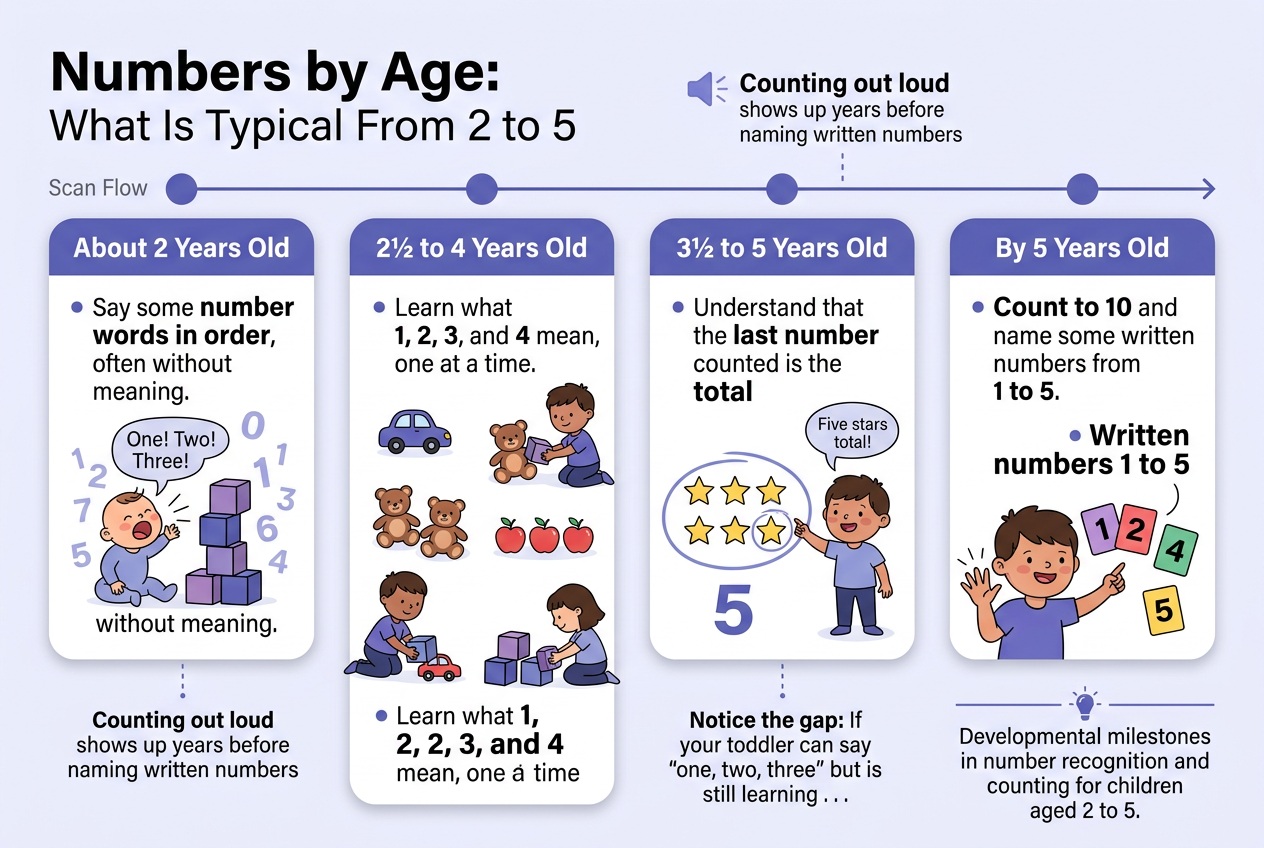
This table shows the usual order. Use it as a rough map, not a test.
| Age | What most kids can do with numbers |
|---|---|
| About 2 | Say some number of words in order, often without meaning. |
| 2½ to 4 | Learn what 1, 2, 3, and 4 mean, one at a time. |
| 3½ to 5 | Understand that the last number counted is the total. |
| By 5 | Count to 10 and name some written numbers from 1 to 5. |
Notice the gap. Counting out loud shows up years before naming written numbers. If your toddler can say “one, two, three” but can’t read a “3,” they are right on track.
What Zayan Taught Me About Late Number Starts
Zayan didn’t say any numbers until he was three and a half. By toddler standards, that looked late. I remember the family worrying about it.
Then things moved quickly. Soon after he started, he could recognize numbers from 1 to 20. Now he is five, and he counts from 1 to 30. He picks out numbers in picture books and on pictures without trouble. The CDC’s 5-year checklist asks for counting to 10 and naming some numbers from 1 to 5. He is well past both.
My takeaway: the age a child starts told me very little about where he would land.
Books and pictures are where Zayan recognizes numbers best. That matches research too. One study found that rich, meaningful counting books led to bigger gains in number understanding than sparse ones.
Why He Skips 17, 29, and 43
Zayan still skips three numbers almost every time. Each skip has a likely reason.
17. English teen numbers are odd. We say “seventeen,” not “ten-seven.” In English, the numbers up to 20 have to be memorized, and the patterns only become clear above 30. Kids who speak languages with regular number words have it easier. In languages like Cantonese, where 11 to 99 follow simple rules, children count higher and make fewer errors than same-age English learners.
29. This is the most common stumble there is. The most frequent counting error for 4- and 5-year-olds is stopping at decade changes like 29, 39, or 49. The child has to remember that “thirty” comes next, and nothing in the word “twenty-nine” helps.
43. This one is harder to explain. It isn’t a decade change. Researchers note that kids who slip at spots near a decade change, like 32, often can’t keep going, which suggests that part of their count is memorized rather than built by a rule. My guess is that Zayan’s counting past 30 is still mostly memory. That usually sorts itself out with time.
When he skips, I don’t make him start over. I say the missing number and let him carry on. Asking “What comes after 28?” works better than correcting the whole count.
How to Help a Toddler Learn Numbers Without Pressure
You don’t need flashcard drills. Short, everyday moments do more.
- Count real things. The CDC suggests counting simple things like fingers, toys, or bananas to help children learn about numbers.
- Ask for amounts. “Can you get me two spoons?” builds meaning, not just memory.
- Point out numbers in the wild. House numbers, lift buttons, clocks, and page numbers are free practice.
- Pick counting books with real pictures. Busy, colorful scenes give kids more to count.
- Keep it short. The CDC notes that most 5-year-olds pay attention for 5 to 10 minutes during activities. A toddler’s limit is shorter. Stop while it’s still fun.
Letter hunts worked well for Zayan when he learned the alphabet. A number hunt is the same game: “Find a 5 on this page.” Many of the alphabet learning games for kids we’ve covered work for numbers if you swap letters for digits.
Where Apps Fit in a Toddler’s Number Learning
Screens are a small part of the picture for kids under 3. The American Academy of Pediatrics discourages media use for children under 18 months, except video chatting. For ages 18 to 24 months, it advises high-quality content and no solo use. For ages 2 to 5, it suggests limiting screen time to one hour a day of high-quality programming.
I’ll be honest about our own app. Alphabet Magic teaches letters, not numbers. It has uppercase and lowercase tracing, letter matching, and phonics games. It’s ad-free and rated 4+ on the App Store, so it’s built for preschoolers more than toddlers.
Still, there is overlap. Tracing a 7 uses the same hand control as tracing an A. If you’re unsure when to start that kind of practice, our guide on when kids should start tracing letters applies to numbers too. And if you’re comparing learning apps in general, see our list of apps for kids learning English.
For toddlers and numbers, my view is simple: real objects first, screens later, and always with an adult nearby.
When a Toddler’s Number Skills Need a Doctor’s Look
Number recognition isn’t on the CDC’s toddler checklists, so missing it alone usually isn’t a concern. Look at the bigger picture instead: talking, playing, and following simple directions.
The CDC advises parents to talk with their child’s doctor and ask about developmental screening if the child isn’t meeting milestones, has lost skills, or if they have other concerns. You know your child best. If something feels off, ask.
Final Thoughts on How Many Numbers a Toddler Should Recognize
So, how many numbers should a toddler recognize? Often none, and a few is a good sign. What matters more at this age is hearing number words, counting real things, and slowly learning that “three” means three.
Zayan started late and still skips 17, 29, and 43. He is also ahead of every number milestone for his age. This week, try one thing: ask your toddler to hand you two of something. Their answer will tell you more than any flashcard.