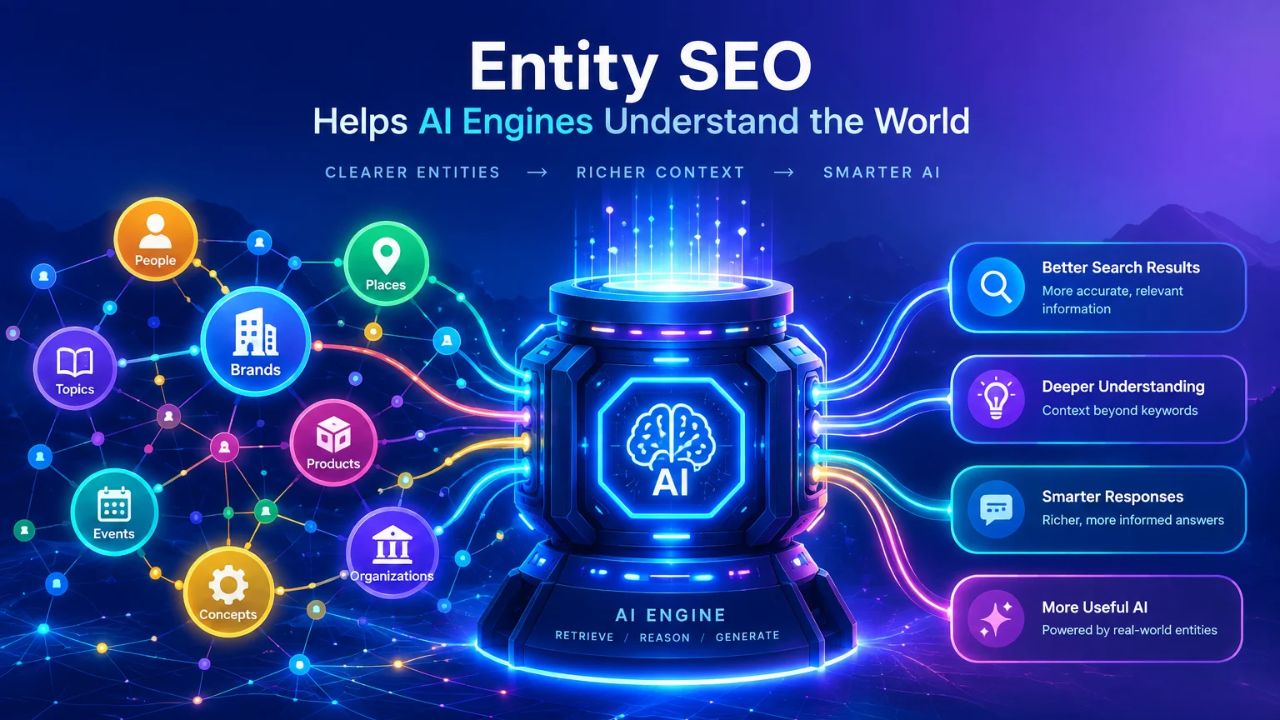
AI engines don’t read your page the way a person does. They try to work out who you are, what you do, and whether other sources agree. That is how entity SEO helps AI engines: it gives them one clear, consistent picture of you as a real person or brand. With that picture, they can match you to the right questions and trust you enough to mention you.
I’ve worked as an SEO content writer and SEO specialist for 10 years. For most of that time, SEO came down to one question: do we rank? Now there is a second one: does the AI answer know who we are? This guide covers what entity SEO is, what it can and can’t do for AI visibility, and the steps I use to build it.
What Entity SEO Means for AI Engines
An entity is a thing with a clear identity. It can be a person, a company, a product, a place, or an idea.
Google made this shift official in 2012 with the Knowledge Graph, announced under the phrase “things, not strings.” Google’s own example was the Taj Mahal. A search for it could mean the monument or the musician, and the Knowledge Graph let Google tell the two apart. That database kept growing. By May 2020, it held 500 billion facts on 5 billion entities.
Keyword SEO asks, “Which words on this page match the search?” Entity SEO asks, “Which real thing is this page about, and do we trust what it says?”
For AI engines, the second question matters more. They build answers from facts about things, and they need to know which “thing” each fact belongs to. If you want the full basics first, read our guide to mastering entity SEO.
How Entity SEO Helps AI Engines Understand You
Entity SEO does three jobs for an AI engine.
- It tells the engine who you are: A clear name, role, and topic let the engine separate you from anyone with a similar name.
- It lets the engine check you: AI engines compare what your site says with what other sites say. When the facts line up, the engine can be more confident. When they clash, it may skip you or get you wrong.
- It makes you easy to pull into answers: When your name is tied to a topic across many trusted pages, you become a natural fit for questions on that topic.
What do the search engines themselves say? Microsoft has been the clearest. At SMX Munich, Fabrice Canel, Principal Product Manager at Microsoft Bing, said schema markup helps Microsoft’s LLMs understand content.
Google is more careful. Its documentation says a page only needs to be indexed and eligible to show with a snippet to appear as a supporting link in AI Overviews or AI Mode, with no extra technical requirements and no special schema.org markup needed. It also lists making sure your structured data matches the visible text on the page as a good practice.
Independent tests add a reality check. An Ahrefs study of 1,885 pages that added JSON-LD schema found no meaningful citation lift in Google AI Overviews, AI Mode, or ChatGPT.
My reading after 10 years: schema and entity work help machines understand you. They don’t force a machine to cite you. Neil Patel’s roadmap for AI search puts it the right way. His first step is “Clean structure, schema, and entity optimization so AI understands your content.” Notice the word understands. That is the job. Citations come from understanding plus trust plus useful content.
My LinkedIn Result: Entity SEO in an AI Engine Answer
Here is a real example from my own work.
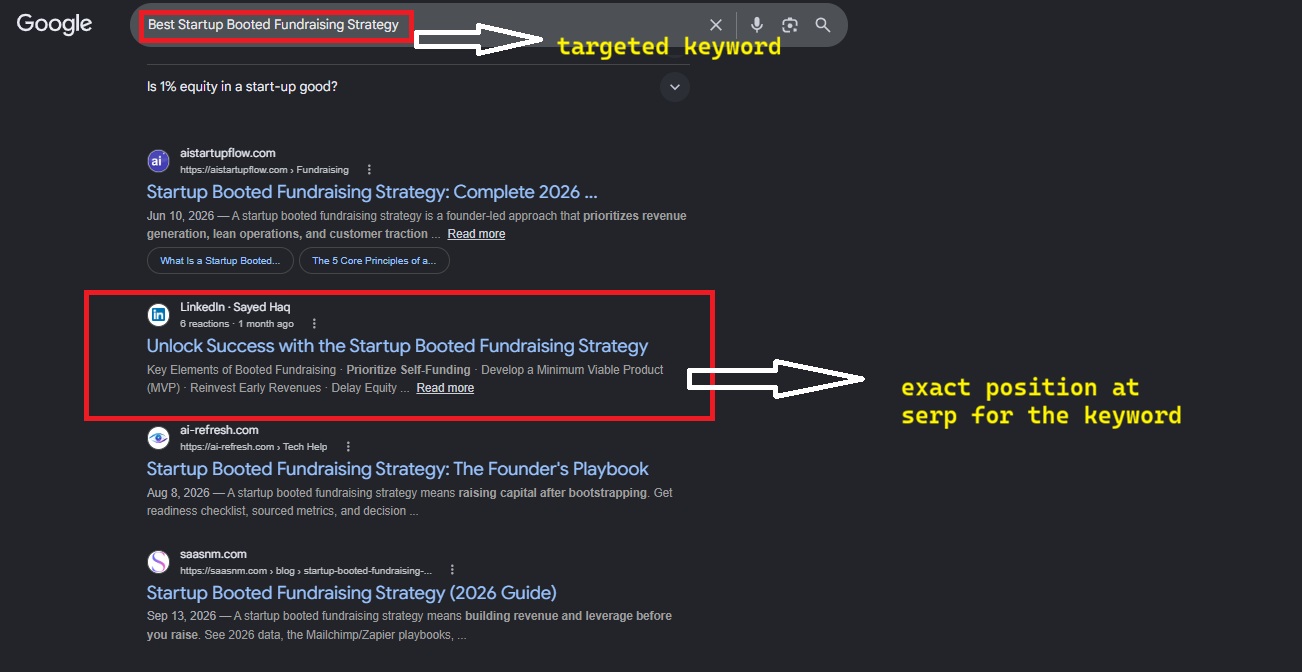
I published a LinkedIn article on startup fundraising strategy under my name, Sayed Haq. For the search “best startup booted fundraising strategy,” it now ranks at the top of Google’s results and shows up in the AI Overview.
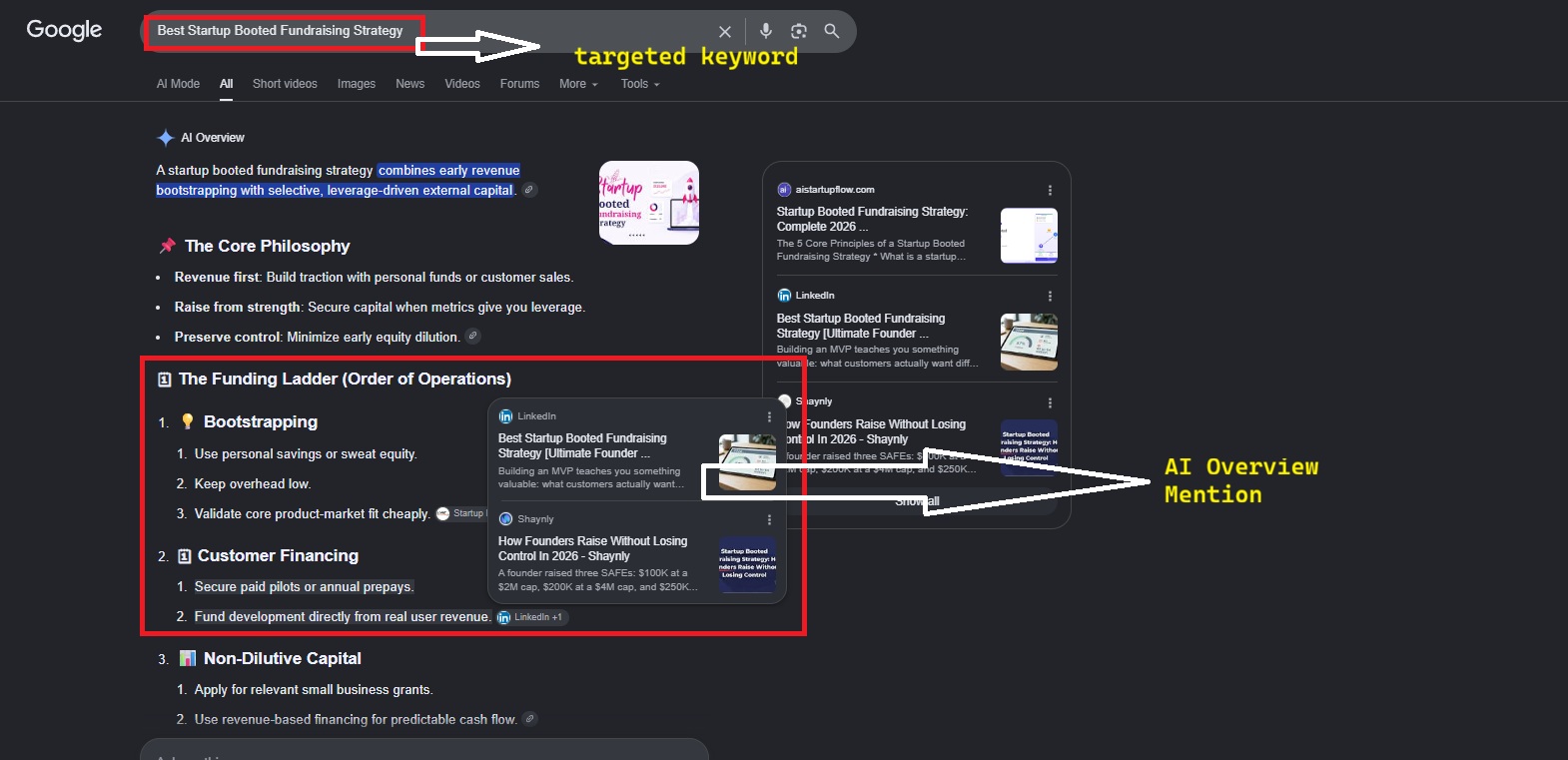
For this piece, I used the person schema to define me as the author. That gave Google a clear link between the article and one real, named person.
I want to be honest about what I can and can’t prove. I can’t separate how much of this result came from the schema and how much came from LinkedIn itself. LinkedIn is a well-known entity with a lot of trust. An article there, tied to a real person’s profile, starts with an advantage.
That is actually the lesson. Entity SEO works in layers:
- A real, named author with a profile the engine can check
- A platform the engine already knows and trusts
- Markup that states the author relationship clearly
No single layer did the work. Together, they gave the AI engine a simple story: this person wrote this piece on this topic, and the source is reliable.
How to Use Entity SEO So AI Engines Recognize You
These are the steps I follow, in the order I’d do them.
1. Pick one name and one description: Use the exact same name on your website, LinkedIn, author bios, and directory listings. Write a one-line description of who you are and what you cover. Reuse it everywhere. Small differences, like a middle name on one site and a nickname on another, make the engine’s job harder.
2. Build one “home” page for the entity: For a brand, this is your About page. For a person, it’s an author page. List your name, role, main topics, credentials, and links to your other profiles. This page becomes the reference point for everything else.
3. Add Person or Organization schema with sameAs links: The sameAs property tells engines that your LinkedIn, X, YouTube, or Wikidata profiles are all the same entity. A simple person example:
json
{
“@context”: “https://schema.org”,
“@type”: “Person”,
“name”: “Your Name”,
“jobTitle”: “SEO Specialist”,
“url”: “https://yoursite.com/author/your-name/”,
“sameAs”: [
“https://www.linkedin.com/in/your-profile/”,
“https://x.com/yourhandle”
]
}
Only mark up facts that also appear on the page. If the schema says you’re a “Head of SEO” and the page says “Content Writer,” you’ve created the exact confusion you were trying to fix.
4. Earn mentions on sites AI engines already trust: Your own site can only say so much about you. Engines look for other sources that agree. Nathan Gotch makes a point here that many people miss: “Earning a citation does NOT guarantee brand mentions in AI answers.” In his view, your brand needs to show up in many places. Neil Patel’s advice points the same way: visibility now reaches beyond Google into LinkedIn, Reddit, YouTube, and even Wikipedia. My LinkedIn result fits this pattern.
5. Build topic clusters around your core subjects: If you want AI engines to link your name to a topic, publish several connected pieces on it and link them together. One article is a data point. Ten linked articles form a pattern. Our guide on generative AI for SEO covers how to plan clusters without cutting corners on quality.
6. Keep your facts fresh: Canel also pointed out that “Gen AIs value fresh content in particular,” partly as a way to check their training data, and he recommended the IndexNow API to push updates as they happen. Update your author page and bios when your role or focus changes.
7. Ask the AI engines about yourself: Type “Who is [your name]?” or “What is [your brand]?” into ChatGPT, Gemini, Perplexity, and Copilot. Write down what they get wrong. Then find where the wrong fact likely came from, such as an old bio or a directory listing, and fix it at the source.
Entity SEO Mistakes That Confuse AI Engines
Most entity problems I see are small and fixable. These cause the most trouble:
- Schema that doesn’t match the page: Markup should describe what users can see. Hidden or inflated claims work against you.
- Several versions of one name: “Sayed Haq” on one site and a longer version on another can look like two people to a machine unless you connect them.
sameAslinks to empty profiles: An abandoned account with no bio adds nothing. Link only to profiles you keep updated.- Treating schema as a shortcut: As the Ahrefs test showed, markup alone didn’t move AI citations. It supports good content. It doesn’t replace it.
- Thin author pages: One line and a photo gives an engine nothing to check. Add your background, topics, and proof of work.
AI search will keep changing. For a wider view of where it’s going, see our piece on AI in SEO and the future of search optimization.
Final Thoughts: How Entity SEO Helps AI Engines Trust You
The simplest way to explain how entity SEO helps AI engines is this: it removes guesswork. When your name, facts, and topics line up across your site and the wider web, an AI engine can recognize you, check you, and connect you to the right questions.
Schema helps, but it is one layer. A real identity, a trusted platform, consistent facts, and useful content do the rest. Start small this week. Search your name or brand in three AI tools, and write down every fact they get wrong. That list is your entity SEO to-do list.