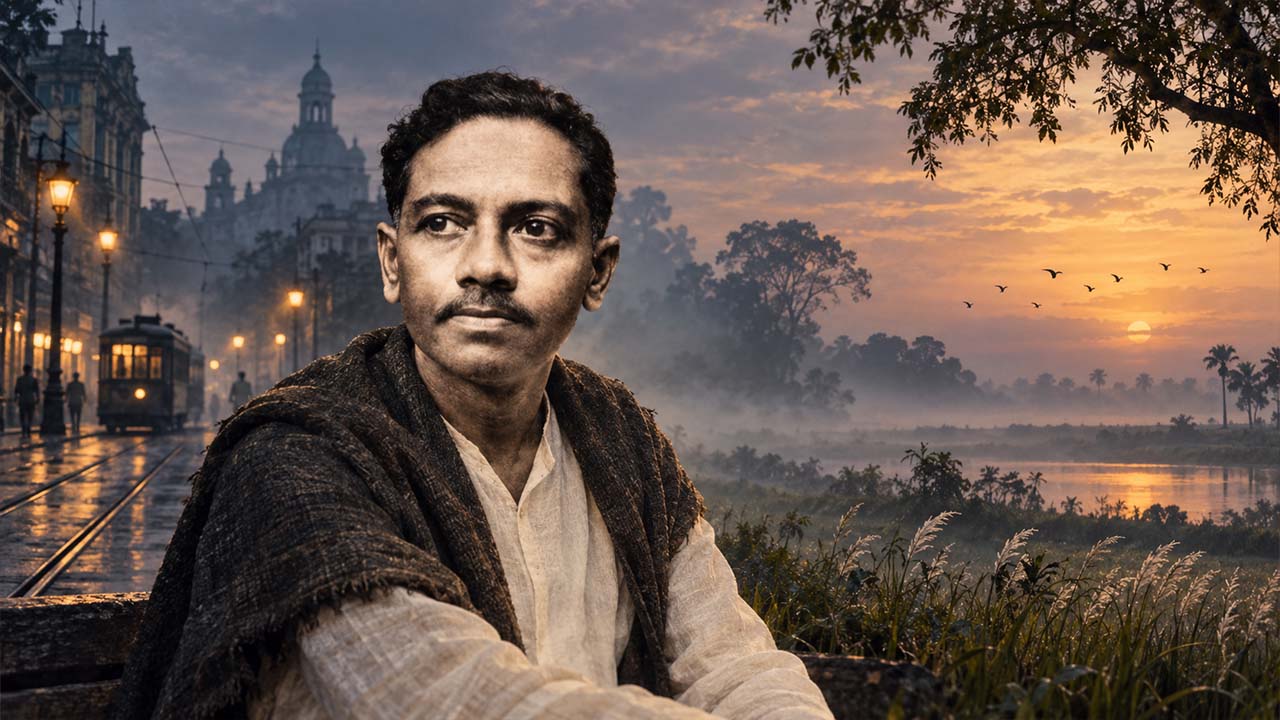
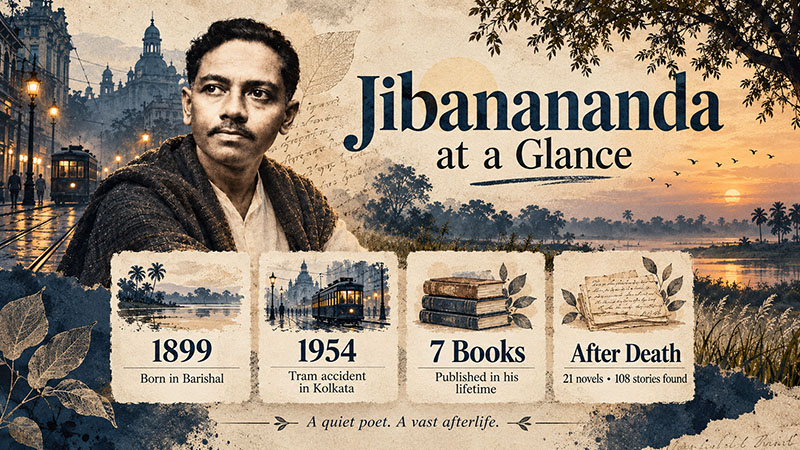
Jibanananda Das died on October 22, 1954, in a Kolkata hospital. Eight days before, a tram had hit him near Deshapriya Park. Today marks 72 years after Jibanananda Das left us. I still keep his poems close for one simple reason: when the city gets too loud, he is the poet who helps me hear again.
Most anniversary stories repeat the same few lines. He was born in Barishal, he wrote “Banalata Sen,” and he died under a tram. All of that is true, but it leaves out the parts that matter most to me: who stood by him at the end, how much of his work almost never reached us, and why a poet best known for village fields also belongs to our crowded cities.
The Evening Walk That Ended It All
On the evening of October 14, 1954, Jibanananda was coming back from his usual evening walk. He was crossing a road near Deshapriya Park in Kolkata when a tram struck him. He was badly hurt and taken to Shambhunath Pandit Hospital. He lived for eight more days and died on October 22, at the age of 55.
One detail from those days has stayed with me. Sajanikanta Das, one of his harshest critics, worked hard to get him the best treatment. A young poet named Bhumendra Guha was among the admirers who kept watch by his bed. Even 72 years after Jibanananda Das died, I find that moving. The man who mocked his poems in print still could not stand by while he suffered.
The trams that once filled Kolkata are mostly gone now too. In 2026, only two tram routes still run in the city. When I think about him, I think about that slow machine crossing a busy road and about a quiet man who was thinking about something else.
Seven Books in His Life, a Trunk Full of Work After It
During his lifetime, Jibanananda published only seven books of poems. The first was Jhara Palak in 1927. His life was hard. He lost his teaching job at City College in Kolkata in 1928. He taught for years at Brajamohan College in Barishal, then moved to Kolkata after the Partition of 1947. Money was always short, and steady work was rare.
But he never stopped writing. He kept his notebooks in trunks and showed them to very few people. His younger sister, Sucharita, was one of the few allowed to read them. After his death, those trunks turned out to hold 21 novels, 108 short stories, and a huge number of poems nobody had seen.
Much of what we love today came from those trunks:
- Rupasi Bangla, his sonnets about rural Bengal, was published in 1957, three years after his death.
- Malyaban (1973) and Sutirtha (1977), two of his best-known novels, came out decades later.
- His complete works were later collected in twelve volumes called Jibanananda Samagra, edited by Debesh Ray, in the 1980s and 1990s.
Bhumendra Guha, the young man who sat by his hospital bed, became a well-respected doctor. He spent much of his later life reading Jibanananda’s tiny, crowded handwriting with a magnifying glass, page by page.
The honors came late as well. Banalata Sen won the Rabindra Memorial Award in 1953. Shrestha Kavita won the Sahitya Akademi Award in 1955, a year after he died.
So when we talk about his legacy 72 years after Jibanananda Das died, we are mostly talking about work he never saw printed. That should make us ask an uncomfortable question: which quiet writers around us today are we ignoring until it is too late?
He Was a City Poet
In Bangladesh, we call him Rupashi Banglar Kobi, the poet of beautiful Bengal. The name fits. No one wrote about rivers, owls, rice fields, and the misty Kartik season the way he did. But I think the label tells only half the story.
Jibanananda lived much of his adult life in Kolkata, and the city is all over his poems. Banglapedia notes something his fans often forget: unlike Tagore, he wrote about the loneliness, sadness, and frustration of modern city life. He wrote a long poem about the 1946 riots in Kolkata. His poem “Aat Bochor Ager Ekdin” (“One Day Eight Years Ago”) is about a man who seemed to have everything he needed and still could not find peace.
Even “Banalata Sen” is not really a pretty nature poem. Its speaker is a deeply tired traveler. He has wandered for ages through history and finds rest only for a short moment in one woman’s face. That is a city feeling: worn out, far from home, hungry for one quiet moment.
In his own time, many critics called his poems confusing, strange, or even indecent. Readers took years to catch up. Now, 72 years after Jibanananda Das died, his loneliness reads less like a strange mood and more like an ordinary weekday in a big city.
Why I Reach for Him When Dhaka Gets Too Loud
Last year, I wrote about why Jibanananda Das still matters in an age of noise. This year I want to be more personal about it.
Dhaka does not let you think. Horns, construction, phones, and arguments over traffic all fill the same street. Most days I am part of that noise. On bad days, I reach for a Jibanananda poem the way some people reach for tea.
His poems do not tell me to run away to a village. That is the mistake I made when I first read him. I thought he was selling a dream of escape. Reading him again as an adult, I see something else. He shows a tired person in a crowded world who still stops to notice one small thing: a kite circling in the afternoon, wet grass, the light on an old wall. He does not fix the noise. He shows me that my attention still belongs to me.
That is why I still read him 72 years after Jibanananda Das died. He is not a poet of the past to me. He is the poet for the moment right after a long, loud day, when you finally sit down and the world goes quiet enough to look at.
Where to Start Reading Him

If you have never read him or have not read him since school, here is a simple path.
If you read Bengali:
- Start with “Banalata Sen.” It is short, and you can read it many times.
- Move to the sonnets of Rupasi Bangla, including “Abar Ashibo Phire,” where he promises to return to Bengal’s rivers and fields as a bird.
- Then try “Bodh” from Dhushar Pandulipi. It is about a feeling he cannot escape, and many readers believe that feeling is the urge to write itself.
- Finally, read the novel Malyaban. It shows you the darker, more private writer behind the poems.
If you read English:
- Fakrul Alam, Jibanananda Das: Selected Poems (1999). A strong first book, with notes that explain Bengali words.
- Clinton B. Seely, A Poet Apart. The best known life story of the poet in English.
- Joe Winter, Naked Lonely Hand (2003). A British poet’s careful versions.
- Chidananda Dasgupta, Selected Poems (Penguin, 2006).
One tip: read two English versions of “Banalata Sen” side by side. Translators do not even agree on the tense of the very first line. Jibanananda translated the poem himself, too, and his version differs from both. Seeing those small differences teaches you more about his voice than any summary can, even 72 years after Jibanananda Das wrote his last line.
How Barishal Still Remembers Him
He was born in Barishal on February 17, 1899, and the city has not forgotten him. Every October 22, local writers’ groups lay flowers at his memorial on Kobi Jibanananda Das Road. Events are also held at Brajamohan College, where he once taught.
The University of Barishal has a Jibanananda Das Research Center, which held an international seminar for his 71st death anniversary in 2025. If you live nearby, check local listings this week. That is where you can still hear his poems read aloud by people who share his accent, 72 years after Jibanananda Das last walked those streets.
Final Thoughts
It has been 72 years after Jibanananda Das died, and he is more widely read now than he ever was while alive. That is both beautiful and a little sad. He did not get the readers he deserved in his lifetime, but he has them now.
My suggestion for this Thursday is simple. Turn off one screen. Pick one poem, “Banalata Sen” if you are unsure, and read it slowly, out loud if you can. Do not try to understand all of it. Just notice what it makes you see.
Frequently Asked Questions (FAQs)
When did Jibanananda Das die?
He died on October 22, 1954, in Kolkata. A tram hit him near Deshapriya Park on October 14, and he passed away eight days later in Shambhunath Pandit Hospital. He was 55.
What is Jibanananda Das’s most famous poem?
“Banalata Sen” is his best known poem. The book of the same name won the Rabindra Memorial Award in 1953.
How much of his work was published after his death?
A great deal. Only seven books of his poems came out while he was alive. After his death, 21 novels, 108 short stories, and many poems were found in his trunks, including the poems of Rupasi Bangla, published in 1957.
Which English translation should I read first?
Fakrul Alam’s Jibanananda Das: Selected Poems is a good first choice because it includes helpful notes. Clinton B. Seely’s A Poet Apart is the best place to learn about his life.