

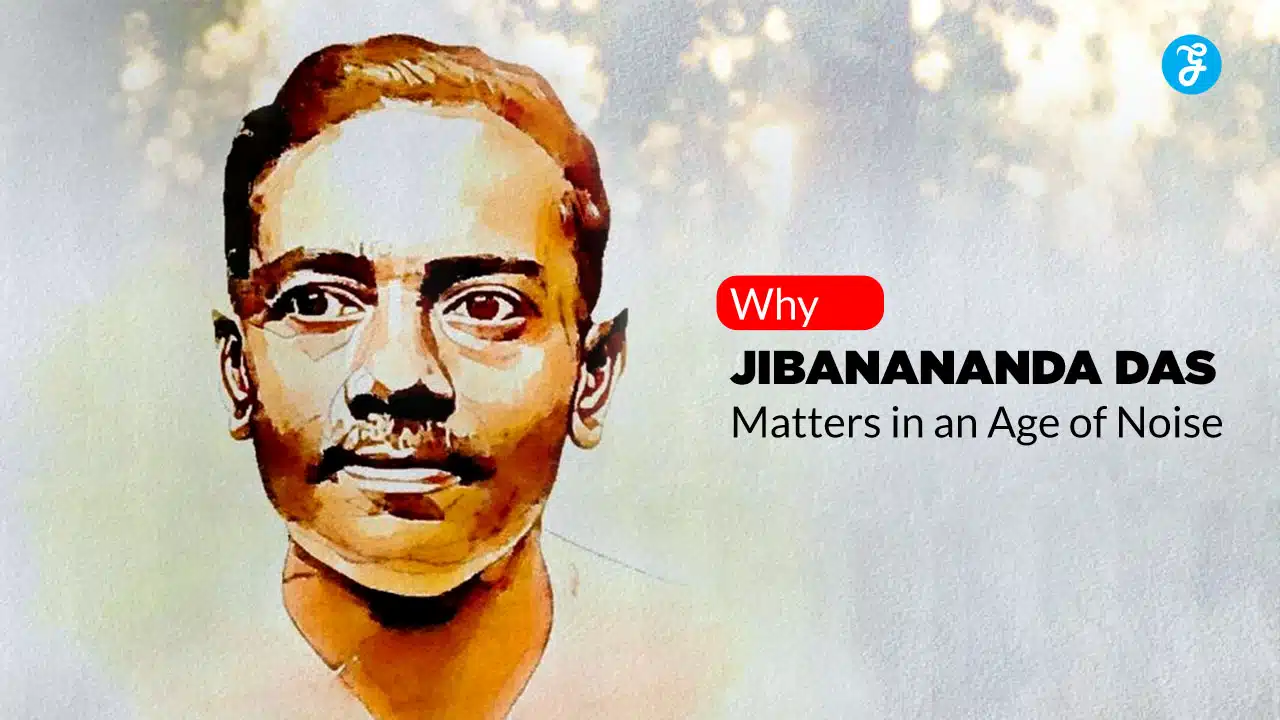
In a world that scrolls, swipes, and shouts, silence has become subversive. Seventy-one years after his accidental death under a Calcutta tram, Jibanananda Das remains the poet who never raised his voice—yet continues to echo through the conscience of Bengal.
While others sought applause in the storm of nationalism or romantic optimism, Jibanananda preferred twilight. He wrote not for the crowds of his century, but for the quiet future that would finally be ready to hear him. In 2025—an age of algorithmic noise—that future has arrived.
The World He Inherited: Bengal Between Empires
Born in 1899 in Barisal, now in Bangladesh, Jibanananda grew up amid Bengal’s cultural ferment. The late-colonial landscape was both luminous and anxious: Tagore’s songs filled the air, yet the political soil trembled under partition, modernity, and empire.
Educated in English literature, Jibanananda absorbed both Wordsworth’s pastoral gaze and Eliot’s fragmentation, but he refused imitation. Instead, he turned inward—making solitude his homeland. Where Tagore envisioned harmony between man and cosmos, Jibanananda confronted dissonance: the erosion of identity, the ache of exile, and the whisper of extinction.
To understand his world is to sense a civilization caught between the lyrical and the lost—and a poet who chose to speak softly against that turbulence.
The Quiet Modernist: Redefining the Modern Bengali Voice
Modernism arrived in Europe through shock and speed. In Bengal, it arrived through Jibanananda’s stillness. His quiet modernism did not depend on manifestos or metaphors of machinery. It emerged in the spaces between words—in ellipses, pauses, and haunting images that resisted resolution.
He wrote of time as circular, of desire as memory, and of existence as recurrence. His syntax fractured traditional Bengali rhythm; his metaphors dissolved boundaries between dream and daylight. This was not rebellion through noise, but through nuance.
To read Jibanananda is to experience a modernism of introspection—where the self is not declared but discovered.
The Poetics of Silence—Nature, Time, and the Self

No Bengali poet has rendered nature with such psychological intimacy. In Rupasi Bangla, rivers are veins of memory; the owl, the fog, and the moonlight become extensions of the self. Nature in his verse does not console—it mirrors consciousness.
His most famous poem, Banalata Sen, begins:
“Thousands of years I have walked the paths of this earth…”
The line collapses history into a single breath. Time becomes tactile; centuries feel personal.
Three motifs define his inner architecture:
-
Nature as consciousness: the world is not scenery but sentience.
-
Time as recursion: every moment echoes a thousand before it.
-
Solitude as vision: silence is not emptiness but clarity.
Reading him slows the pulse. His words demand attention—a counter-rhythm to the modern world’s acceleration.
Between Two Worlds—Tagore, Eliot, and Jibanananda
To grasp his genius, one must position him between the two suns of his era: Tagore and Eliot. Tagore sang of divine harmony; Eliot mapped spiritual desolation. Jibanananda walked the dim corridor between them—carrying the inheritance of both, yet belonging to neither.
If Tagore’s Bengal was illuminated by the morning light of faith, Jibanananda’s was the evening shadow—contemplative, ambiguous, human. Like Eliot, he felt the fracture of civilization, but unlike Eliot’s urban despair, Jibanananda’s melancholy was rooted in soil and memory. His modernism was rural, elemental, and introspective—a distinctly Bengali response to global uncertainty.
In that synthesis lies his originality: the East’s meditative depth meeting the West’s fractured modernity.
The Exile Within—Alienation as Aesthetic
Jibanananda was perpetually displaced—from institutions, from peers, and from readers who often misunderstood him. He struggled to publish; his language was deemed obscure, his imagery too inward. Yet that very alienation became his aesthetic.
While the public sphere demanded slogans, he wrote of “silent fields after rain” and of “the smell of earth where no one comes.” His isolation was philosophical: a rebellion against both colonial conformity and nationalist clamor.
In retrospect, his marginality was prophetic. The 21st century has turned solitude into the rarest luxury—one he possessed long before it became fashionable to seek it.
Rediscovering the Poet in the 21st Century
Today, Jibanananda’s work thrives in translation and digital rediscovery. Scholars like Clinton B. Seely and Fakrul Alam have carried his voice into global academia, while new generations in Bangladesh and India read him on smartphones, Instagram reels, and university syllabi.
In an age of self-promotion, his refusal to perform feels radical. His poetry invites reflection, not reaction. It teaches readers to inhabit stillness—to resist the algorithmic compulsion to respond.
This is why he matters now: Jibanananda’s poetry models a slower cognition, a form of attention that modern life has all but erased. He reminds us that meaning is not produced by noise but by noticing.
Lessons from the Quiet Modernist
Beneath the mist and metaphor, Jibanananda offers enduring lessons for contemporary minds:
-
Silence is a form of intelligence. In a culture of constant speech, restraint signals depth.
-
Beauty demands patience. His imagery unfolds like dusk—invisible to the hurried observer.
-
Modernity requires introspection. True progress is internal, not mechanical.
-
Belonging is fluid. The poet of exile teaches us to find home within memory, not geography.
For leaders, creators, and thinkers navigating the noise of 2025, Jibanananda provides a framework of attention—one that values ambiguity, empathy, and pause over performance.
Takeaways
When Jibanananda Das died in 1954, few recognized the magnitude of his work. Yet like the rivers he loved, his words found their own course—resurfacing, reshaping, enduring.
Today, his footsteps are audible again: in classrooms, in translations, and in the silent moments when readers turn away from screens. He remains, as ever, the quiet modernist—reminding us that art’s deepest power lies not in how loudly it speaks, but in how deeply it listens.
“I have seen the dark face of Bengal’s moonlight —
and in that darkness, I found my own reflection.”
























