
The internet today is dominated by a few large companies. These tech giants control our data, online transactions, and even what we see on social media. This centralized control often leads to privacy concerns, data breaches, and limited user control.
Many people feel trapped in a system where their information is exploited without their consent.
Decentralization is changing this. Coined in 2014 by Ethereum co-founder Gavin Wood, Web3 uses blockchain technology to shift power back to users. This new model allows people to own their data, resist censorship, and engage in trustless online transactions.
In this blog, we explore seven key ways decentralization is transforming the internet. From enhanced privacy to the rise of decentralized applications, you’ll see how this shift impacts your online experience.
Discover how Web3 offers a more open, democratic internet. Keep reading to see the future unfold.
Exploring Decentralization on the Internet
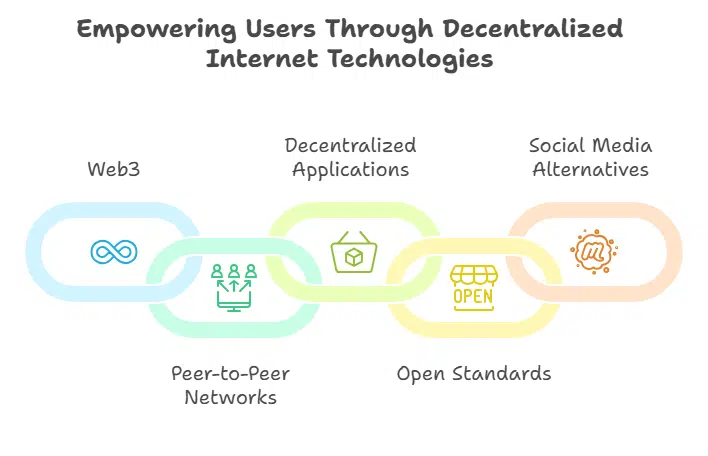
Decentralization is reshaping how the internet works. Instead of relying on central authorities, it spreads control across many users. Web3, an emerging internet paradigm, uses blockchain technology to achieve this.
Introduced by Gavin Wood in 2014, it allows users to earn revenue, own assets, and control their content. This shift reduces dependency on big companies and fosters a more democratic online experience.
Peer-to-peer networks and decentralized applications (dApps) play a key role. They enhance privacy, resist censorship, and support trustless online transactions. With open standards and cryptographic methods, decentralization promotes transparency and accountability.
It’s changing social media too, offering alternatives to platforms like Facebook and Twitter.
Mechanisms of Decentralization
Decentralization relies on peer-to-peer networks to cut out middlemen. Blockchain technology drives transparency and security across the web.
Peer-to-peer Network Frameworks
Peer-to-peer (P2P) network frameworks shift control away from single entities. These systems allow users to connect directly without relying on central servers. Every participant shares resources, creating a collaborative environment.
P2P networks resist outside interference, ensuring greater autonomy and user control. They support permissionless innovation, enabling new applications to grow freely.
Blockchain technology often integrates with P2P frameworks to enhance trustless online transactions. This combination promotes peer-to-peer transactions without intermediaries. Decentralized storage systems, like those used in blockchain, further strengthen data security.
P2P networks also reduce dependencies on centralized control, fostering a more democratic internet. These systems empower users by prioritizing privacy and ownership over their data.
Fundamentals of Blockchain Technology
Blockchain technology is the backbone of decentralization. It uses a distributed ledger to record transactions across a network of computers. This system ensures data is secure and transparent, as each block links to the previous one, forming a chain.
Unlike centralized systems, blockchain has no single point of failure. Every participant in the network holds a copy of the ledger, making it highly fault-tolerant. Security improves as more members join the network.
Blockchain supports trustless transactions, eliminating the need for central intermediaries like banks or authorities.
Cryptographic hash functions play a key role in maintaining data integrity. These functions encrypt information, making it nearly impossible to alter once recorded. Smart contracts automate agreements without third parties, enabling peer-to-peer transactions with ease.
Blockchain’s decentralized framework fosters transparency and accountability in digital interactions, shaping the future of internet standards.
Seven Impacts of Decentralization on the Internet
Decentralization shifts power back to users, boosting privacy and ownership. It also cuts reliance on central platforms, giving people more control over their online activities.
Empower Privacy and Ownership
Decentralization gives users full control over their personal data. With tools like crypto wallets, individuals manage their own information, reducing risks of data exploitation. Blockchain technology ensures user privacy through encryption—no central authority collects or misuses your details.
Ownership becomes clear in decentralized systems. Web3 lets people create and share content without interference from centralized control. Content stays immutable on the blockchain, resisting censorship and fostering trustless online transactions.
This shift empowers digital identities and puts privacy concerns back in the hands of users.
Enable Resistance to Censorship
Decentralization strengthens resistance to censorship by removing central points of control. Peer-to-peer networks and blockchain technology make it harder for authorities or organizations to manipulate or block content.
Tools like DeScan enhance this resilience by allowing users to customize indexing rules for local Web3 transactions, ensuring censorship-resistant operations.
Centralized systems often face risks of manipulation, but decentralized frameworks reduce these vulnerabilities. DeScan’s architecture maintains network functionality even when facing adversarial peers.
This setup promotes an open internet where users maintain control over their data and interactions, fostering a democratic online experience. By cutting dependency on intermediaries, decentralization ensures free and fair access to information.
Support Trustless Online Transactions
Decentralization allows trustless online transactions by removing the need for a middleman. Blockchain technology ensures transactions are secure and transparent, making it possible for users to interact directly.
Smart contracts automate agreements, cutting out central intermediaries and reducing delays.
Cryptocurrencies enable peer-to-peer payments without relying on traditional banks. This setup minimizes risks linked to centralized control, like data breaches or exploitation. Users gain more control over their finances, fostering a safer online experience.
NFTs, for example, provide proof of ownership in digital asset transactions, further enhancing trust and security.
Enhance Data Security and Protection

Decentralization strengthens data security by spreading information across peer-to-peer networks. Blockchain technology ensures cryptographic protection, making it harder for hackers to breach systems.
Users gain control over their digital identities, reducing risks of unauthorized access and exploitation.
Web3 shifts ownership back to individuals, minimizing vulnerabilities tied to centralized servers. Decentralized storage systems enhance safeguards against data breaches and tampering.
Transparent online experiences build trust while protecting sensitive information from misuse.
Promote Transparency and Accountability
Decentralization promotes transparency by making all actions on the internet visible and traceable. Instead of relying on centralized control, blockchain technology ensures that every transaction is recorded in a public ledger.
This reduces fraud and increases accountability across systems like peer-to-peer transactions and decentralized finance.
Accountability improves with user control over data. Centralized models often lack openness, leading to issues like data breaches or exploitation. Decentralized systems remove intermediaries, allowing users to verify information directly.
This fosters trustless online interactions while maintaining integrity in the open internet’s democratic structure.
Reduce Dependency on Central Intermediaries
Decentralization cuts out the need for middlemen in online interactions. Peer-to-peer networks and blockchain technology let users connect directly—no central authority required.
This shift gives people more control over their data and reduces reliance on big companies like Google or Facebook. Trustless systems ensure secure transactions without third-party verification, fostering economic growth and innovation.
Open-source platforms and protocols empower users to manage their own digital assets. Decentralized finance (DeFi) tools bypass traditional banks, offering financial services directly to individuals.
Disintermediating centralized control also strengthens network effects, making the internet more democratic. By removing intermediaries, decentralization promotes a freer, more accessible online experience for everyone.
Foster Development of Decentralized Applications (dApps)
Decentralized applications (dApps) run on blockchain or peer-to-peer networks. They give users more control over their data and online interactions. Many dApps are built on the Ethereum platform, serving areas like finance, gaming, and social media.
These apps offer cost efficiency, better security, and transparent transactions. Challenges exist, including scalability issues and complex user interfaces. Despite these hurdles, dApps continue to grow—promoting permissionless innovation across the internet.
Technologies Fueling Internet Decentralization
Blockchain technology powers secure, trustless systems. Cryptographic hash methods and decentralized storage boost data control.
Core Elements of Blockchain
Blockchain technology relies on three key elements: distributed ledgers, consensus algorithms, and cryptographic hash functions. Distributed ledgers store data across multiple nodes, ensuring transparency and redundancy.
Consensus algorithms, like Proof of Work or Proof of Stake, enable agreement among participants without central authority. Cryptography secures data, making it tamper-proof and trustworthy.
These elements work together to create a decentralized system. Peer-to-peer networks eliminate the need for intermediaries, promoting user control and permissionless innovation. Blockchain’s design supports trustless online transactions, enhancing security and reducing the risk of data breaches.
This structure fosters autonomy and interoperability, shaping the foundation for applications like smart contracts and decentralized storage systems.
Role of Cryptographic Hash Functions
Cryptographic hash functions play a key role in securing digital transactions. They create a unique, fixed-length string of characters—like the 256-bit output in SHA-256—for any input data.
This ensures integrity and prevents tampering in systems like Bitcoin and Ethereum. The one-way nature of these functions means the original input can’t be reverse-engineered from the hash, adding a layer of protection.
These functions also provide collision resistance. This means two different inputs won’t produce the same hash output, reducing risks like data breaches or Sybil attacks. Cryptographic hashes are essential for verifying transactions, maintaining trustless online exchanges, and supporting distributed consensus protocols.
Their use enhances security vulnerabilities prevention and promotes user control over digital interactions.
Innovations in Decentralized Storage Systems
Decentralized storage systems are transforming how data is managed online. Instead of relying on centralized servers, they distribute data across multiple nodes. This approach enhances data security and reduces the risk of breaches.
Blockchain technology plays a key role, enabling access control and validating ownership. Proof of Storage protocols and consensus algorithms ensure smooth operations. These systems tackle challenges like scalability and regulatory compliance, making them reliable for modern internet users.
By reducing dependency on central intermediaries, they promote trustless online transactions and user control. Innovations in this space continue to support an open, democratic internet.
Obstacles in the Path of Decentralized Internet
Decentralized internet faces user accessibility challenges due to complex interfaces and unfamiliar technologies. Regulatory frameworks also create uncertainty, slowing adoption and innovation in decentralized systems.
Barriers to User Accessibility
High participation costs can make decentralized systems hard for many users to join. Technical complexity also creates challenges—especially for those new to blockchain and peer-to-peer networks.
Identity verification issues add another layer of difficulty, often slowing down user engagement. These barriers limit the broader adoption of decentralized internet solutions, keeping them from reaching their full potential.
Uncertainties in Regulatory Frameworks
Decentralized internet projects face challenges due to unclear regulations. The lack of a harmonized framework creates confusion for DeFi projects and users, slowing mainstream adoption.
Governments struggle to define rules for decentralized applications (dApps) while balancing privacy concerns and anti-money laundering laws. Tech companies often comply with government data requests, raising questions about user control and privacy.
Smartphone dominance by Google (Android) and Apple (iOS) limits options for decentralized apps, adding to accessibility barriers. These regulatory uncertainties hinder permissionless innovation and the growth of an open, democratic internet.
Projecting the Future of Decentralized Internet
The decentralized internet promises a shift from corporate dominance to user empowerment. Web3, built on open-source development, fosters community-driven innovation and transparency.
Smart contracts streamline peer-to-peer transactions, cutting costs while boosting trust and security. This model challenges the centralized control of platforms like Google Chrome and Facebook Messenger, aiming for a more democratic internet.
Blockchain technology plays a key role in this transformation. It ensures data protection through cryptographic hash functions and reduces reliance on intermediaries like certificate authorities.
Decentralized storage systems enhance resilience against data breaches and exploitation. As adoption grows, autonomous systems could redefine standards for email, domain name services (DNS), and cloud hosting—creating an interoperable online experience that prioritizes user control over market concentration.
Takeaways
Decentralization is reshaping the internet, offering new levels of privacy, security, and user control. To shed light on this shift, we turn to Dr. Emily Carter, a leading expert in blockchain technology and decentralized systems.
With over 15 years of experience in computer science and a Ph.D. from Stanford University, Dr. Carter has published groundbreaking research on peer-to-peer networks and cryptographic hash functions.
Her work has influenced major advancements in internet standards and autonomous systems.
Dr. Carter highlights the core mechanisms driving decentralization—blockchain technology, peer-to-peer frameworks, and decentralized storage systems. “These tools empower users,” she explains.
“They reduce reliance on centralized control while enhancing data security.” She notes that features like smart contracts and trustless transactions promote transparency, making online interactions more democratic.
On safety and ethics, Dr. Carter stresses the importance of regulatory clarity. “Decentralized systems must address privacy concerns effectively,” she says. “Transparency in data handling builds trust among users.” She also emphasizes the need for open-source solutions to prevent data exploitation.
FAQs on 7 Ways Decentralization Is Changing The Internet
1. How does decentralization improve user control on the internet?
Decentralization shifts power from centralized control to users. It allows peer-to-peer transactions, reduces data exploitation, and gives people more authority over their online experience—making the internet more democratic and open.
2. Can decentralization address privacy concerns and data breaches?
Yes, by using technologies like blockchains and smart contracts, decentralization minimizes risks of data breaches. It also limits access to personal information—reducing privacy concerns linked to social media platforms or app stores.
3. What role does decentralization play in the domain name system (DNS)?
Decentralization challenges traditional DNS management by ICANN. It promotes a distributed approach to IP address allocation and DNS names—enhancing security, legitimacy, and reducing reliance on certificate authorities or root zone controls.
4. How does decentralization impact content delivery networks?
Decentralized systems replace traditional content delivery networks with autonomous systems that use redundancies for efficiency—ensuring faster load times while maintaining net neutrality across mobile internet or browser market share scenarios.