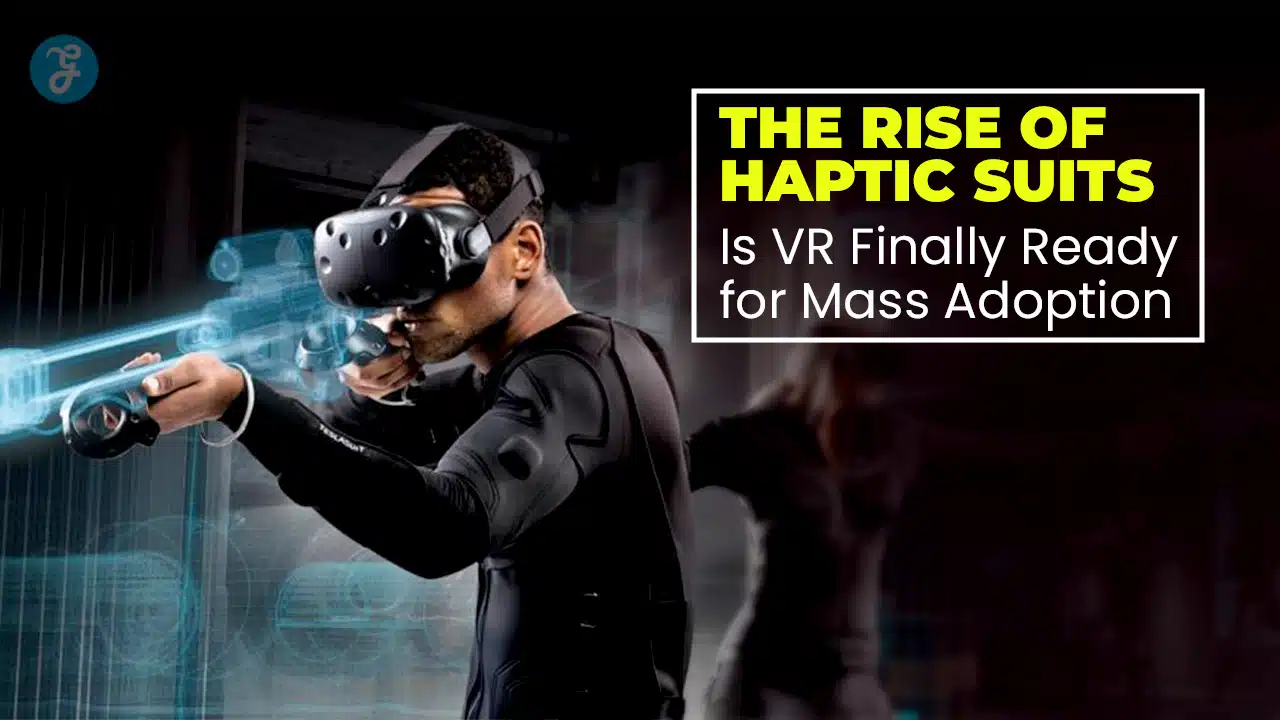
VR has improved in all the obvious ways. Headsets look sharper. Tracking feels smoother. Controllers are smarter. Yet most VR still misses one thing you notice right away: your body does not feel the world you see.
That gap is why the VR haptic suit is getting so much attention. Instead of vibrating in your hands only, haptics spread touch cues across your chest, back, shoulders, and sometimes arms and legs. In the best moments, it makes VR feel less like watching a world and more like standing inside it.
But is this the breakthrough that pushes VR into everyday life? Or is it another premium add-on that stays popular with enthusiasts, VR arcades, and training labs?
The honest answer sits in the details. Mass adoption depends on comfort, content support, setup time, and price. It also depends on whether haptics solves a real problem for average users, not just a fun one.
What Is A Haptic Suit In VR?
A haptic suit is wearable gear that produces physical feedback in response to digital events. In VR, it aims to translate actions like impacts, recoil, movement, or environmental cues into sensations you feel on your body.
Most consumer products marketed as “suits” are not head-to-toe outfits. Many are torso-first systems, such as vests, with optional add-ons. Full-body systems exist, but they are more common in enterprise settings, where budgets and maintenance are easier to justify.
What A Haptic Suit Can Simulate Well
-
Direction and location of an event (front vs back, left vs right)
-
Impact cues (getting hit, explosions, recoil)
-
Movement rhythms (footsteps, heartbeat, pulsing effects)
-
Alerts and signals (warnings, proximity cues)
What Still Feels Hard
-
True resistance and force (being pushed back)
-
Weight and inertia (lifting a heavy object)
-
Fine surface texture (fabric, water droplets, grain)
Even when the feedback is “just vibration,” it can still feel surprisingly convincing if it is placed and timed well.
| Key Point | What It Means For Readers |
|---|---|
| Haptic suits add body feedback | VR feels more embodied than controller-only rumble |
| Most consumer “suits” are vests | Entry cost and comfort are usually better than full-body |
| Best at directional cues | Helps gameplay and training where awareness matters |
| Struggles with true force | Still not the same as real-world physics |
How Haptic Suits Work In Plain English
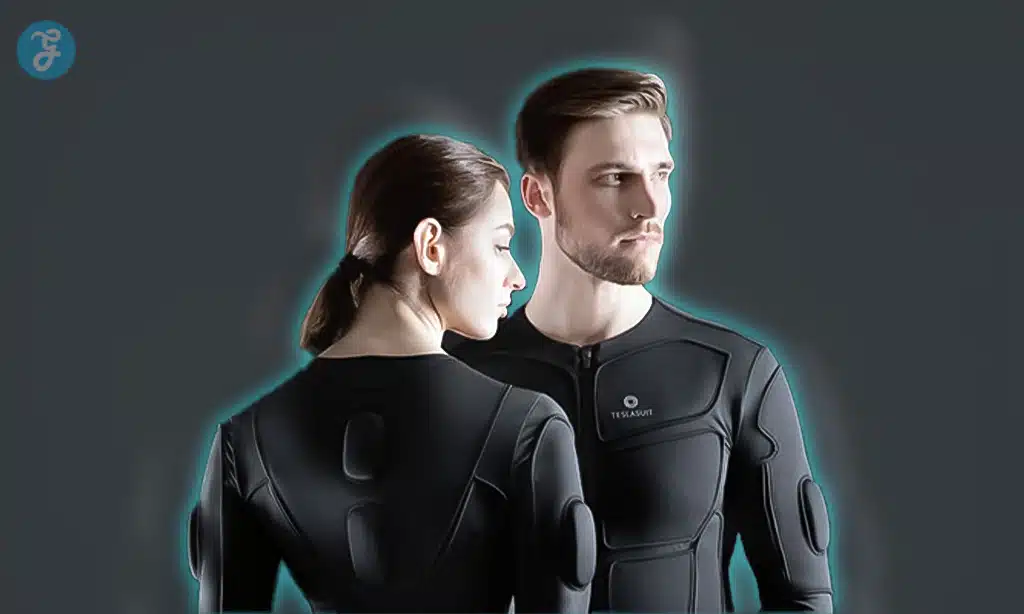
Most systems combine wearable hardware, a control module, and software that maps VR events to the body.
The Hardware Layer
-
Actuators placed around the torso or limbs (often vibrotactile motors)
-
Battery and wireless connection (common in consumer gear)
-
A garment that keeps actuators close to your body
The Software Layer
-
Native game integrations (best experience when supported)
-
Profiles that map different events to different body zones
-
Universal modes, sometimes using audio-to-haptics for broader coverage
One major consumer example is bHaptics, which states that more than 250 SteamVR and Oculus Quest titles provide native support for its TactSuit ecosystem.
Why Latency And Fit Matter
Haptics is timing-sensitive. If you see a hit and feel it late, your brain flags it as “off.” Fit matters too. A loose vest dulls sensation and makes location cues less clear. This is one reason haptics can feel amazing in a demo and less impressive at home if the fit is not right.
| Key Point | Why It Matters |
|---|---|
| Actuators create sensations | Determines realism and comfort |
| Native integration is best | More precise than generic feedback |
| Fit affects accuracy | Loose gear weakens cues and immersion |
| Latency breaks presence | Bad timing makes haptics feel fake |
VR Haptic Suit Benefits: What Actually Improves In VR
This is where hype meets reality. Haptics can be a game-changer, but only in certain situations.
Where Haptics Feels Like A Real Upgrade
-
Shooters: you feel direction and impact zones
-
Rhythm and action games: synced body pulses boost intensity
-
Horror: subtle cues can increase tension
-
Competitive play: faster awareness of what hit you and where
Where It Often Feels Less Useful
-
Slow puzzle games that do not rely on body cues
-
Social VR hangouts where comfort matters more than feedback
-
Experiences with weak or generic haptic mappings
The best value is not “more vibration.” It is better information. When haptics tells your body something your eyes cannot process fast enough, it earns its place.
| Benefit | What You Feel | Best For |
|---|---|---|
| Directional impact | Left/right/front/back hit cues | Shooters, action |
| Recoil simulation | Shoulder or chest pulses | Weapons-based games |
| Environmental cues | Shockwaves, alerts | Horror, survival |
| Rhythm mapping | Beat synced to torso | Music and fitness VR |
Market Momentum: Adoption Signals And Real Numbers
Haptics is growing partly because VR itself has a stable base. One useful indicator is Valve’s Steam Hardware & Software Survey, which tracks VR headset usage among Steam users.
For December 2025, Steam reports 1.64% of Steam users have VR headsets, and it breaks down headset share across devices.
In the same dataset, Meta Quest 3 is listed at 27.58% of SteamVR headset share, ahead of Oculus Quest 2 at 24.84%, with Valve Index at 13.35%.
This matters for haptics because accessories thrive when there is a large enough base of active VR users and consistent content releases.
On the broader haptics side, Grand View Research estimates the global haptic devices market at USD 4.781 billion in 2023, projecting USD 13.741 billion by 2030 (with strong growth attributed in part to gaming and entertainment demand).
MarketsandMarkets projects the haptic technology market reaching USD 8.21 billion by 2030 from USD 6.61 billion in 2025.
These figures are not “haptic suits only,” but they show a strong trend: touch feedback is becoming a bigger business across devices, not just in VR.
| Data Point | What It Suggests | Source |
|---|---|---|
| 1.64% of Steam users have VR headsets (Dec 2025) | VR is a niche, but measurable and persistent | Valve Steam Survey |
| Quest 3 leads SteamVR share at 27.58% | Standalone headsets driving PCVR usage via link/streaming | Valve Steam Survey |
| Haptic devices market projected to 2030 | Broader haptics demand is rising | Grand View Research |
| Haptic tech market forecast (2025–2030) | Industry investment continues | MarketsandMarkets |
The VR Haptic Suit Landscape: Consumer Gear Vs Enterprise Systems
Not all suits chase the same goal.
Consumer-First Systems
Consumer haptics usually targets:
-
Gaming immersion
-
Easy setup
-
Broad title support
bHaptics, for example, highlights native support across 250+ SteamVR and Quest titles, which addresses the biggest consumer fear: “Will this work with my games?”
Enterprise And Training Systems
Enterprise systems often position themselves as more than “feel the hit.” They may add motion capture and biometrics for performance monitoring.
Teslasuit describes its product as a “human-to-digital interface” with full-body haptics, full-body motion capture, and biometric sensors.
That kind of feature set fits training, simulation, and research, where data capture matters.
| Segment | Typical Buyer | What They Care About | Example Evidence |
|---|---|---|---|
| Consumer | Gamers, creators | Comfort, price, native game support | bHaptics 250+ supported titles |
| Enterprise | Training teams, labs | Outcomes, data, repeatable setups | Teslasuit motion + biometrics |
| Location-based | VR arcades | Staff fitting, durability, wow factor | LBVR market focus on immersive tech |
Use Cases Beyond Gaming: Where Mass Adoption May Start First
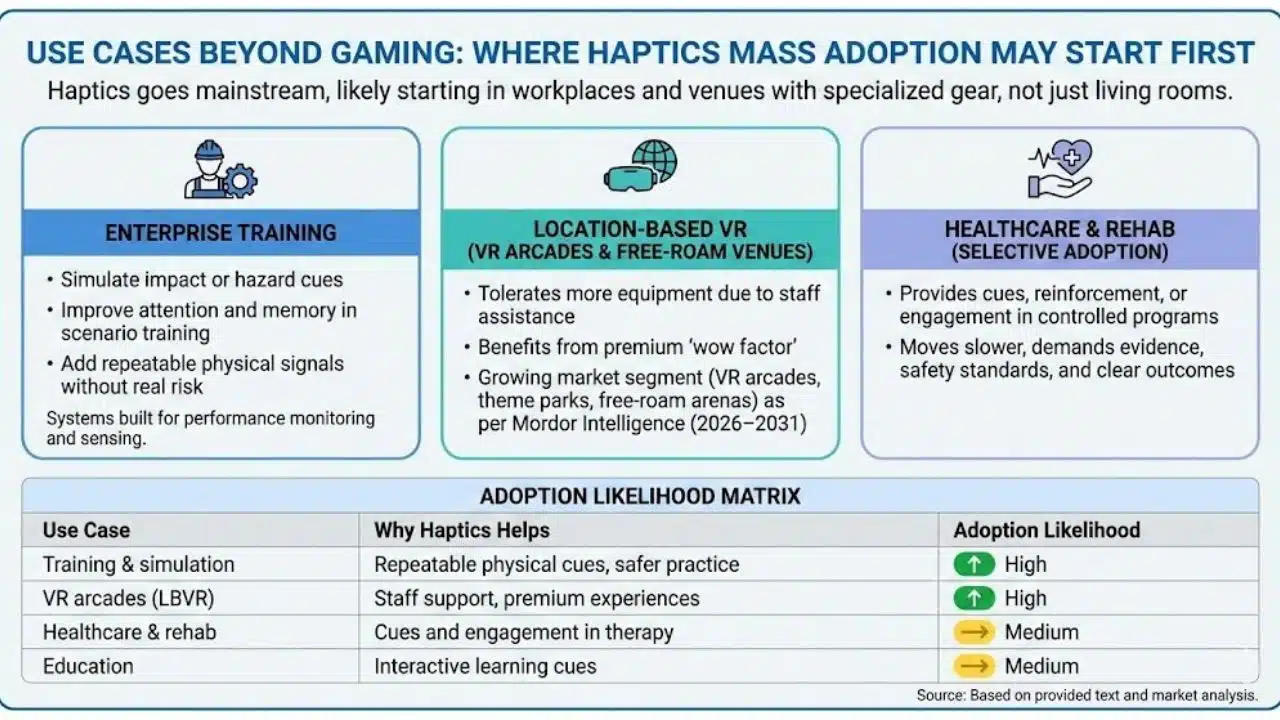
If haptics goes mainstream, it might not start in living rooms. It might start in workplaces and venues where people expect extra gear.
Enterprise Training
Haptics can:
-
Simulate impact or hazard cues
-
Improve attention and memory in scenario training
-
Add repeatable physical signals without real risk
Systems positioned around performance monitoring and sensing are built for this kind of use.
Location-Based VR (VR Arcades And Free-Roam Venues)
Location-based VR often tolerates more equipment because staff can help. It also benefits from premium “wow factor.”
Mordor Intelligence highlights location-based VR as a growing market segment with categories like VR arcades, theme parks, and free-roam arenas in its 2026–2031 coverage.
Healthcare And Rehab (Selective Adoption)
In controlled programs, haptics can provide cues, reinforcement, or engagement. This area tends to move slower because it demands evidence, safety standards, and clear outcomes.
| Use Case | Why Haptics Helps | Adoption Likelihood |
|---|---|---|
| Training & simulation | Repeatable physical cues, safer practice | High |
| VR arcades (LBVR) | Staff support, premium experiences | High |
| Healthcare & rehab | Cues and engagement in therapy | Medium (evidence-driven) |
| Education | Interactive learning cues | Medium |
What’s Blocking Mass Adoption Right Now
This is the section most marketing pages avoid. These barriers decide whether the VR haptic suit becomes normal or stays niche.
1) Price And Total Setup Cost
A suit is not bought in isolation. Many consumers compare it against:
-
A better headset
-
A GPU upgrade
-
More VR games
-
Comfort accessories
If haptics costs “almost as much as a headset,” most people pause.
2) Comfort, Heat, And Hygiene
Wearables trap heat. Sweat happens. Cleaning is work. Shared use becomes awkward. These are small issues for enthusiasts, but big issues for mainstream buyers.
3) Content Fragmentation
Native integrations are powerful, but not universal. Even when a device has broad support, many popular titles still rely on profiles, mods, or generic mappings. bHaptics’ “250+ supported titles” is strong, but it also shows the reality: you need a list, because support is not automatic across everything.
4) Setup And Reliability
Mainstream users expect controller-level simplicity. Pairing, firmware updates, and profile tweaking can quickly become deal-breakers.
| Barrier | What Users Experience | Why It Hurts Adoption |
|---|---|---|
| Price | Hard to justify vs headset upgrades | Adoption stalls beyond enthusiasts |
| Comfort & heat | Shorter sessions, fatigue | People stop using it |
| Hygiene | Cleaning effort | Limits sharing and casual use |
| Content fragmentation | Not all games feel “supported” | Purchase feels risky |
| Setup complexity | Troubleshooting kills momentum | Mainstream drop-off |
Is VR Finally Ready For Mass Adoption With Haptics? A Practical Test
Instead of asking “Is the tech cool?” the better question is: “Does it cross the mainstream threshold?”
Here is a realistic checklist.
What Must Be True For Mainstream
-
Affordable enough to feel like a normal accessory
-
Comfortable for typical session length without overheating
-
Works across most popular titles with minimal setup
-
Easy to buy and easy to size
-
A clear “must-have” experience category that makes it feel necessary
What Is Already True
-
VR has measurable platform momentum. Steam’s survey still shows over 1.6% VR headset presence among Steam users in December 2025.
-
Headsets like Quest 3 lead SteamVR share, suggesting that easier onboarding is shaping usage patterns.
-
Consumer haptics ecosystems have grown their native support libraries past 250 titles, reducing risk for frequent players.
What Is Still Missing
For many buyers, haptics still feels optional. VR itself already asks people to wear a headset. Asking for a second wearable layer is a bigger leap than it sounds.
| Readiness Factor | Current State | What Needs Improvement |
|---|---|---|
| Price | Still premium for many | Lower entry cost and bundles |
| Comfort | Better than early days | Cooler designs, easier cleaning |
| Content support | Strong for some devices | Wider default integration |
| Simplicity | Improving | Fewer steps, fewer apps |
| Killer apps | Not universal | More experiences built around body haptics |
Buying Guide: Who Should Consider A VR Haptic Suit Today
If you are curious, this section keeps the decision simple.
Best Fit Buyers
-
VR enthusiasts who play weekly
-
Shooter, rhythm, and action players
-
Streamers and creators who want stronger reactions
-
VR arcade operators
-
Training teams piloting immersive programs
Quick Checklist Before Buying
-
Your platform: PCVR, Quest standalone, or mixed use
-
Your top games: do they have native support?
-
Comfort: weight, heat, fit range
-
Noise: some actuators can be audible
-
Returns and warranty: important for wearables
| Buyer Type | Should They Buy Now? | Why |
|---|---|---|
| Hardcore VR gamer | Often yes | Uses it enough to justify the setup |
| Casual VR user | Usually wait | Comfort and price friction is high |
| Creator/streamer | Often yes | Adds content value and immersion |
| Arcade operator | Often yes | Premium attraction and guided setup |
| Training team | Strong yes (pilot) | ROI and outcomes can justify cost |
Final Thoughts
The VR haptic suit is not a gimmick. It solves a real sensory gap in VR by adding body-level feedback that controllers cannot deliver. In the right games and scenarios, it boosts immersion and awareness in a way that feels instantly meaningful.
Still, mass adoption depends less on “wow” and more on friction. Price, comfort, hygiene, and content consistency are the real gatekeepers. The market for haptics overall is growing, and VR headset usage remains steady enough on platforms like Steam to support accessory ecosystems.
A realistic path is gradual mainstreaming, starting with enthusiasts, arcades, and enterprise training. If hardware becomes cooler, cheaper, and more plug-and-play, the VR haptic suit could shift from “extra” to “expected.”