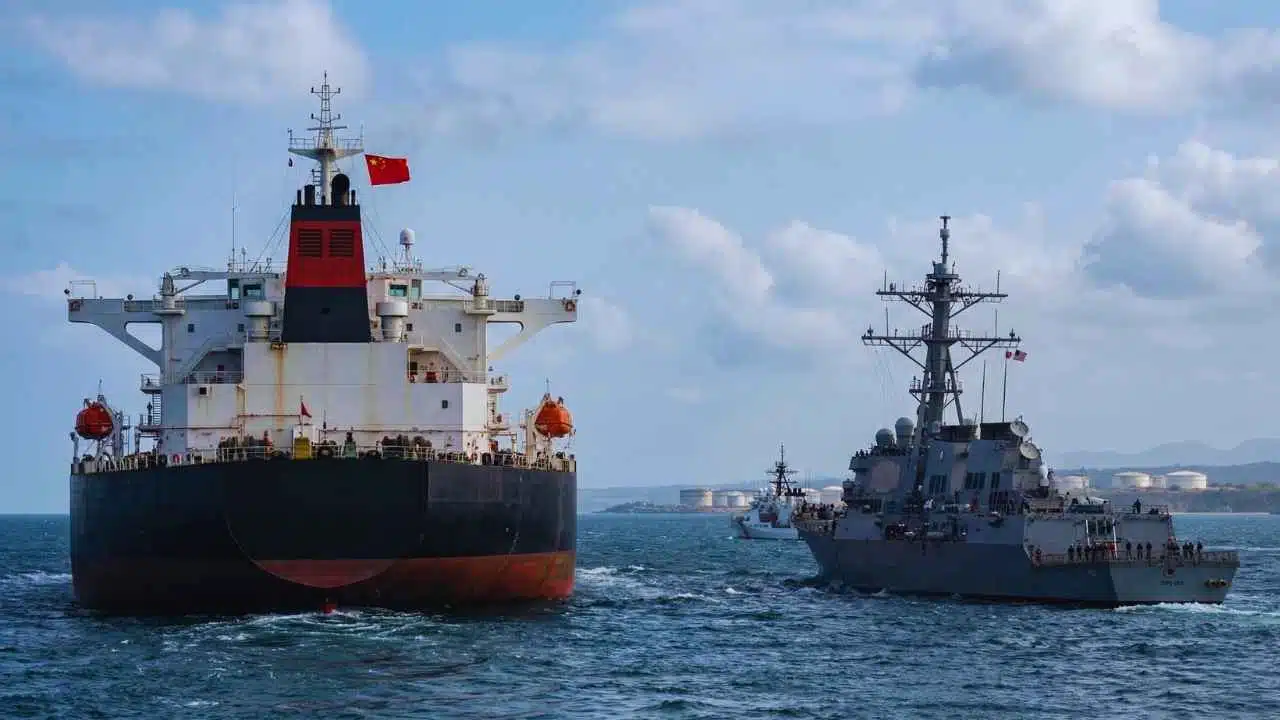
The Venezuela Oil Blockade is squeezing Maduro’s oil lifeline, but ship-tracking data show some China-linked tankers still reach Venezuelan ports, keeping crude trade alive despite U.S. seizures.
What The Venezuela Oil Blockade Is And Why It Escalated Now?
The United States has intensified its pressure campaign on Venezuela by targeting sanctioned oil tankers moving crude in and out of the country. The effort is meant to cut off revenue flows to President Nicolás Maduro’s government by shrinking its ability to export oil, especially to overseas buyers that rely on discounted barrels.
This crackdown is not a general ban on all maritime traffic. It is a sanctions enforcement push aimed at ships, owners, intermediaries, and logistical networks accused of moving Venezuelan crude through covert methods. The approach blends public messaging with legal actions, sanctions designations, and patrol operations in nearby waters.
Venezuela’s oil is central to the stakes. The country holds the world’s largest proven crude oil reserves, much of it extra-heavy crude from the Orinoco Belt. That oil is harder to produce, move, and refine, and it becomes even more dependent on specialized blending and shipping when sanctions limit access to normal market services like insurance, financing, and compliant shipping providers.
At the same time, Venezuela’s export routes have become narrower. A large share of shipments has historically moved to Asia, with China the main end-market. Any disruption in tanker access, port operations, or diluent supplies can quickly translate into fewer exports, rising storage congestion, and production shut-ins.
Key Dates And Milestones
| Date (2025) | What Happened | Why It Matters |
| Nov 26 | A U.S. court authorized a seizure warrant for a crude tanker tied to sanctions enforcement | Set legal groundwork for maritime interdiction |
| Dec 10 | U.S. forces boarded and seized the tanker after it departed Venezuela | Signaled stepped-up, hands-on enforcement |
| Dec 11 | U.S. sanctions expanded to include people, companies, and vessels tied to Venezuela’s oil trade | Increased risk for shipowners, insurers, and brokers |
| Dec 16–17 | A “blockade” message was announced focusing on sanctioned tankers | Raised deterrence pressure and market uncertainty |
| Dec 20–22 | Another tanker interception and diplomatic fallout followed | Pushed the issue into a sharper international dispute |
| Dec 30 | Ship-tracking data showed some tankers still arriving or heading in | Suggested the trade is adapting rather than stopping |
How U.S. Enforcement Works At Sea?
The enforcement playbook relies on a mix of sanctions compliance pressure and physical interdiction.
Sanctions designations can freeze assets under U.S. jurisdiction and restrict U.S. persons from providing services. Even when a ship never docks in the United States, the global shipping ecosystem often touches U.S.-linked services such as dollar transactions, U.S.-connected insurers, or compliance-driven port services. That makes sanctions a powerful tool for discouraging participation.
Seizures and interdictions add another layer. In at least one case, a U.S. court-approved warrant was used to seize a tanker on the high seas after it left Venezuela. Officials described the case as tied to a network accused of sanctions evasion and support for designated foreign terrorist organizations. Whether or not those allegations hold in broader disputes, the operational message is clear: tankers viewed as part of illicit networks may face boarding and seizure.
A critical enforcement marker is shipping transparency. Most commercial vessels use AIS (Automatic Identification System) transponders that broadcast identity and location for safety. Sanctions guidance has highlighted “deceptive practices” that can include disabling AIS, broadcasting inconsistent locations, masking destination data, or using ship-to-ship transfers to obscure cargo origins.
These tactics matter because they create uncertainty for everyone around a shipment: insurers, ship managers, commodity brokers, and ports. If a cargo’s origin or ownership is unclear, a compliant service provider may refuse to participate. That can strand a ship, delay a discharge, or force a trader to offer bigger discounts to compensate for risk.
Vessels And Networks Under Sanctions Pressure
| Vessel | Flag (As Listed) | IMO (As Listed) | Year Built | Why It Drew Attention |
| WHITE CRANE | Panama | 9323429 | 2007 | Linked to oil-sector shipping network under sanctions designations |
| KIARA M | Panama | 9285823 | 2004 | Identified as associated with sanctioned shipping company |
| H. CONSTANCE | Panama | 9237773 | 2002 | Listed in sanctions actions tied to oil movements and deceptive practices |
| LATTAFA | Panama | 9245794 | 2003 | Linked to shipping entity operating in Venezuela’s oil sector |
| MONIQUE | Cook Islands | 9311270 | 2005 | Identified as associated with a sanctioned shipping company |
| TAMIA | Hong Kong (China) | 9315642 | 2006 | Listed as associated with a sanctioned shipping entity |
The practical effect is that even ships that are not physically intercepted can become “toxic” in the market. They may struggle to get insured, to access compliant ports, or to secure routine services such as maintenance, provisioning, or ship management.
Why Some China-Linked Tankers Still Arrive In Venezuela?
Despite tougher enforcement, ship-tracking data and industry reporting indicate that some tankers continue arriving in Venezuela, including ships tied to oil-for-debt arrangements involving China.
This persistence reflects how sanctions-evasion logistics can adapt:
- Intermediaries and layered trading chains can separate the end-buyer from the initial loading arrangements.
- Discount renegotiations can keep buyers engaged even when risk rises.
- Floating storage can act as a pressure valve when exports slow. Instead of moving oil quickly out to sea, PDVSA can keep crude on tankers offshore while waiting for paperwork, safe routes, or willing counterparties.
By late December, a significant backlog had formed near Venezuela’s key export hub at José. Reports described roughly two dozen tankers waiting, with about 16 million barrels stuck on vessels that had not departed. That kind of congestion can force PDVSA to slow loadings or adjust production to avoid running out of storage.
Operational disruptions have also played a role. Reports indicated that cargo operations were slowed by logistical problems and a cyberattack, adding delays precisely when tanker risk and scheduling pressure were rising. When loading and documentation slow down, the number of ships sitting offshore tends to grow, and the cost of moving each barrel increases.
A separate flashpoint involved a tanker interception connected to a China-bound shipment. Officials described an intercepted vessel carrying a large cargo of Venezuelan Merey crude—a heavy grade that is often sold at a discount and is commonly processed by refineries configured for heavier blends. The dispute became diplomatic as China criticized the seizures and Venezuela condemned the action as piracy.
The broader reality is that China remains Venezuela’s most important crude destination, and even partial continuity matters. When sanctions squeeze traditional channels, independent refiners and traders willing to take discounted supply can become the main outlet, especially if supply alternatives are more expensive.
Oil Market And Economic Impact On PDVSA, Chevron, And Buyers
The blockade effort matters because Venezuela’s oil exports are a lifeline for hard currency. Yet the country’s export system is fragile even in stable periods.
Venezuela produces mostly heavy and extra-heavy crude. This oil often needs diluents such as naphtha or light crude to make it transportable and exportable. If Venezuela cannot import enough diluent, it may not be able to blend crude into exportable grades at scale. That creates a chain reaction: lower exports, rising domestic storage stress, and potential production cuts.
Export performance has been volatile. In September 2025, exports averaged about 1.09 million barrels per day, the highest monthly level since early 2020. The rebound was linked to higher output, stock drawdowns, and improved access to blending components. But by October 2025, exports reportedly dropped to around 808,000 barrels per day, with constraints tied to lower inventories and reduced imports of diluents.
The crackdown has also narrowed the “legal” portion of Venezuela-linked exports. Reports suggested that by late December, most exports were largely confined to deliveries connected to Chevron under U.S. authorization, plus smaller petrochemical shipments. This creates a two-track environment: a smaller compliant channel and a larger riskier channel that depends on intermediaries and less transparent shipping.
For the market, the immediate global price impact depends on how many barrels are removed and whether other producers fill the gap. But the risk premium can rise quickly when seizures increase and when ships begin “going dark,” because traders price in the chance that cargoes get stranded or rerouted.
Export And Operational Stress Snapshot
| Metric | What It Signals For The Trade |
| ~1.09 million bpd exports (Sept 2025) | A high-water mark showing capacity when logistics and blending improve |
| ~808,000 bpd exports (Oct 2025) | How quickly exports can fall when inventories and diluents tighten |
| ~24 tankers waiting near José (late Dec 2025) | Congestion that can lead to loading delays and production slowdowns |
| ~16 million barrels stuck on undeparted vessels | Floating storage reliance and heightened risk of forced shut-ins |
| Tight diluent availability | A structural vulnerability for moving extra-heavy crude |
What Comes Next For The Blockade And Global Shipping?
The Venezuela Oil Blockade is tightening the operating space, but it is not a complete stop. Enforcement can reduce volumes sharply, raise costs, and push trade into narrower and riskier channels. Yet the underlying drivers—Venezuela’s need for revenue and buyers’ appetite for discounted heavy crude—create incentives for workarounds.
Several developments are likely to shape the next phase:
- More interdictions or attempted seizures could increase deterrence, especially if shipowners decide the risk outweighs the reward.
- Wider sanctions designations could target additional intermediaries, shipping companies, or service providers, raising compliance walls across the industry.
- Diplomatic escalation could intensify if seizures involve cargoes tied to major buyers, turning a sanctions issue into a broader geopolitical dispute.
- Operational limits inside Venezuela—especially storage constraints and diluent shortages—could force PDVSA to cut production if exports slow too much.
For readers, the key takeaway is that this story is not only about tankers at sea. It is about how modern sanctions reshape global commerce through logistics, insurance, data transparency, and legal pressure—while oil-producing states and buyers keep searching for the next workaround.