
For decades, the Arctic motto was “High North, Low Tension.” It was the one region on Earth where Russia, the US, and Europe cooperated on science and search-and-rescue, largely ignoring the geopolitical storms raging elsewhere. In January 2026, that era is officially dead.
What began in 2019 as a widely ridiculed suggestion by President Donald Trump, to purchase Greenland, has mutated into the most volatile foreign policy, the US Greenland Acquisition Crisis of his second term. As of January 12, 2026, the White House has moved beyond “inquiring” about real estate. The administration is now actively operationalizing a strategy that views Greenland not as a sovereign territory of the Kingdom of Denmark, but as a “distressed asset” essential to American survival.
The US Greenland Acquisition Crisis has paralyzed NATO, panicked the European Union, and triggered a quiet but intense mobilization of Russian and Chinese military assets. This analysis dissects the crisis from every angle: the strategic drivers, the obscure legal loopholes the US is exploiting, the economic shockwaves, and the shadow war already being fought on the ice.
Key Takeaways
- Policy Shift: The US interest in Greenland has escalated from a 2019 “idea” to a 2026 National Security Priority, with the White House refusing to rule out military options to secure the territory.
- Strategic Driver: The move is a direct counter to China’s dominance in Rare Earth Elements (Greenland holds 1.5 million tons) and Russia’s hypersonic threats, which require new missile defense sites on the island.
- Legal Loophole: The US is exploiting the 1951 Defense Treaty to claim the entire island as a “defense area,” bypassing the need for a direct sale from Denmark.
- Alliance Crisis: The standoff has fractured Western unity, with Denmark warning of a NATO crisis and the EU threatening “nuclear” economic sanctions against US tech giants.
- Financial Leverage: The US strategy attempts to “buy” local loyalty by offering a $2 Billion annual development fund directly to Greenland, aiming to outbid the Danish block grant.
The January Surge: A Timeline of Escalation
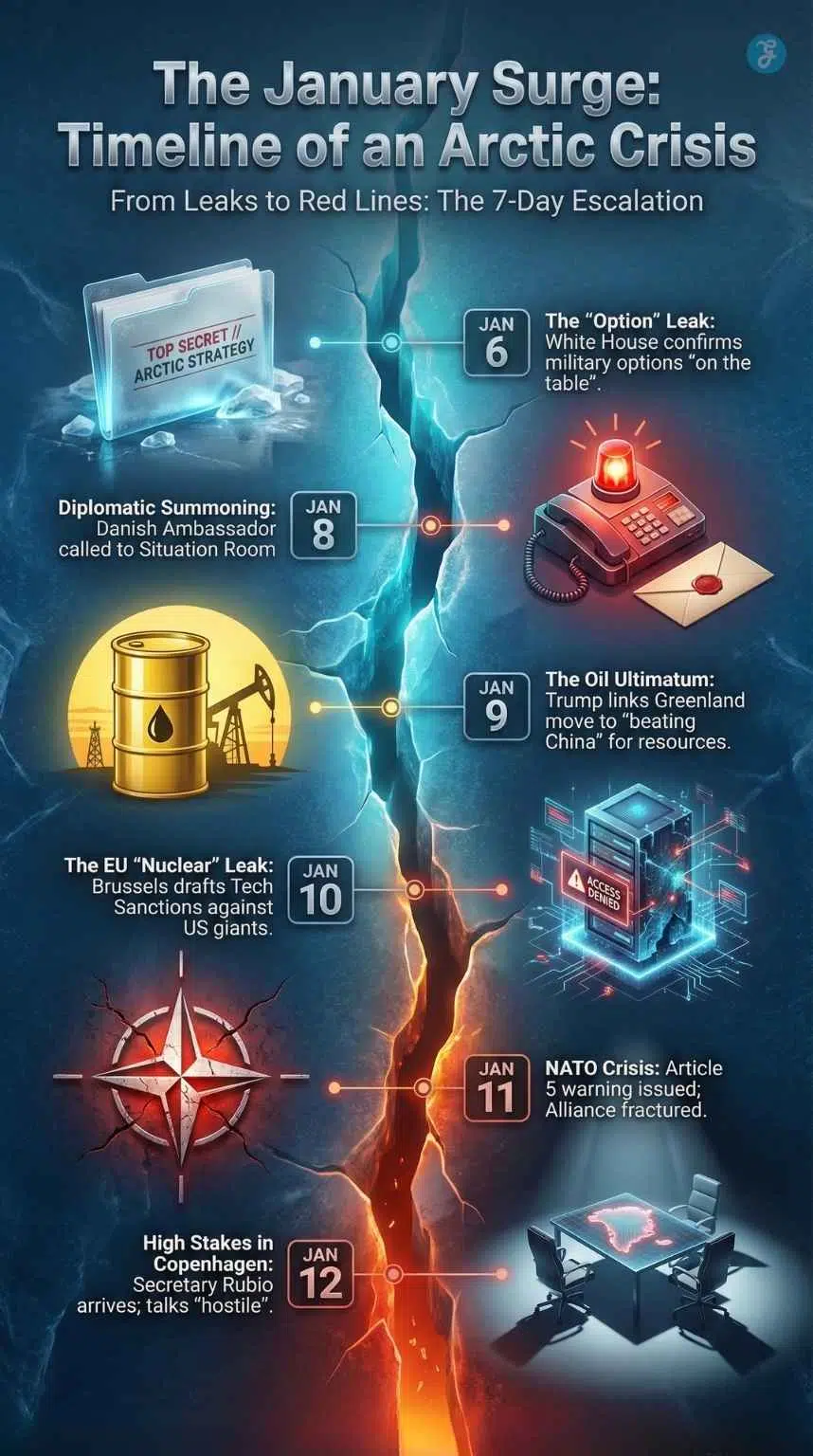
To understand the gravity of the current moment, we must analyze the rapid-fire escalation that has occurred in just the first two weeks of 2026. This wasn’t a slow drift; it was a sudden rupture.
| Date (2026) | Event | Significance |
| January 6 | The “Option” Leak | White House officials confirm “active discussions” regarding Greenland. A spokesperson states that using the US military is “always an option” to secure the territory, citing imminent national security threats. |
| January 8 | Diplomatic Summoning | Secretary of State Marco Rubio summons the Danish Ambassador, demanding immediate talks on “shared sovereignty” arrangements. |
| January 9 | The Oil Ultimatum | In a closed-door meeting with energy executives, President Trump asserts, “We will do something about it [Greenland] whether they like it or not,” framing it as a preemptive move against China. |
| January 10 | The EU “Nuclear” Leak | Brussels insiders leak draft plans for “nuclear option” sanctions targeting US Tech Giants (Meta, Google, Microsoft) if Washington violates Danish sovereignty. |
| January 11 | NATO Crisis | NATO Secretary-General holds an emergency consultation. Denmark warns that hostile action against Greenland triggers Article 5—technically putting the US at war with its own alliance. |
| January 12 | Rubio in Copenhagen | High-stakes talks begin. The atmosphere is described as “hostile” and “unprecedented” between allies. |
This timeline reveals a calculated strategy. The administration is using “escalate to de-escalate” tactics, creating a crisis so severe that Denmark feels forced to negotiate a sale or a lease to avoid a complete diplomatic collapse.
The Legal Battleground: The “1951 Loophole”
A critical missing piece in most coverage is how the US thinks it can legally do this. The US is not relying on a “sale” (which Denmark refuses) but on a weaponized interpretation of an old treaty.
The 1951 Defense of Greenland Agreement
This treaty, signed during the Cold War, gives the US the right to operate “defense areas” in Greenland.
- The US Argument: Washington legal scholars are arguing that modern warfare (hypersonic missiles) makes the entire island a “defense area.” They claim that under Article II, the US has the right to “improve and expand” facilities necessary for mutual defense without explicit new permission if the threat is existential.
- The “De Facto” Annexation: The strategy is not to change the flag overnight, but to expand the US military footprint so aggressively, with new runways, new radar domes, and new ports, that Danish sovereignty becomes purely ceremonial.
The 2009 Self-Government Act
Denmark’s defense relies on this Act, which grants Greenland the right to its own resources and the right to secede—but only through a referendum.
- The Deadlock: Denmark cannot sell Greenland because it doesn’t own it; the Greenlandic people do. But the US argues that the Self-Government Act deals with internal affairs, while defense (and thus the 1951 Treaty) remains a Danish, and by extension NATO responsibility. The US is pitting Greenlandic local law against international treaty obligations.
Strategic Drivers: Why Greenland? Why Now?
Why is the United States willing to risk the cohesion of NATO for an icy island with a population of just 56,000? The answer lies in two critical domains: Resource Security and Geopolitical Geometry.
A. The Rare Earth Race: Breaking the Chinese Chokehold
The modern world, our iPhones, our electric vehicles, our F-35 fighter jets, runs on rare earth elements (REEs). For decades, the West has been asleep at the wheel, allowing China to monopolize the mining and processing of these critical minerals. As of 2025, China controlled roughly 90% of the REE supply chain.
Greenland is the only “Western” solution to this vulnerability.
- The Kvanefjeld Vault: Located in southern Greenland, the Kvanefjeld site is arguably the most strategically important hole in the ground on planet Earth. It contains one of the world’s largest deposits of Neodymium (essential for high-strength permanent magnets in EVs and wind turbines) and Dysprosium (critical for military guidance systems).
- The Volume: Estimates suggest Greenland holds 1.5 million metric tons of rare earth oxides. To put this in perspective, this is enough to supply the entire Western world’s demand for decades, effectively breaking Beijing’s leverage over US manufacturing.
For the Trump administration, this is a binary choice: either the US controls these resources, or China does. Chinese state-owned mining companies have been aggressively courting the Greenlandic government for concessions for years. Washington views this not as business competition, but as a direct encroachment into the Western Hemisphere—a violation of a “Modern Monroe Doctrine.”
Ground Zero: Kvanefjeld vs. Tanbreez
The resource war is not abstract; it is a physical standoff between two specific mountains in Southern Greenland.
- The Chinese Stronghold (Kvanefjeld): This project is the flashpoint. Owned effectively by Energy Transition Minerals (a company with significant Chinese institutional shareholders like Shenghe Resources), it holds the massive uranium and rare earth deposits. It has been stalled since 2021 because the local government banned uranium mining. The US goal is to seize this asset via “Eminent Domain” claims to prevent China from reactivating it.
- The Western Alternative (Tanbreez): Just miles away lies the Tanbreez project. Unlike Kvanefjeld, it is rich in Heavy Rare Earths (critical for defense) but contains negligible uranium. It is owned by Western interests and is fully licensed.
- The Strategy: The US plan involves fast-tracking infrastructure for Tanbreez to flood the market with Western-controlled minerals, while keeping Kvanefjeld under military lock and key to deny it to Beijing.
B. The “Hypersonic” Geography
In the age of hypersonic missiles (which fly at Mach 5+), seconds matter.
- The Pituffik (Thule) Expansion: The US Space Force operates a critical missile warning radar at Pituffik. However, the radar is old. The US wants to install a new “Arctic Shield” interceptor system.
- The Physics: Intercepting a Russian “Avangard” missile is nearly impossible from the continental US. But from Greenland? The geometry works. You can shoot the arrow down before it gains full speed. Greenland is the only piece of land on Earth that offers this “shield geometry” for the North American continent.
The Shadow War: Russia and China Move
While the US and Denmark argue, their adversaries are moving pieces on the board.
Russia: The “Bastion” Defense
- Northern Fleet Mobilization: Intelligence reports confirm that Russia’s Northern Fleet has surged activity at the GIUK Gap (Greenland-Iceland-UK). This is the “Fourth Battle of the Atlantic.” Russian submarines are testing the gap, trying to prove they can slip past NATO defenses while the allies are bickering.
- Nagurskoye Airbase: Russia has fully operationalized its northernmost base, deploying MiG-31 fighters capable of carrying the Kinzhal hypersonic missile. This puts the US Thule base directly in range.
China: The “Science” Trove
- The Polar Silk Road: China has invested billions in ice-class cargo ships to use the Northern Sea Route, bypassing the Suez Canal. They view Greenland as the ultimate logistics hub for this route.
- “Dual-Use” Research: China operates a “research station” in Greenland. Western intelligence believes this station is tracking US submarine movements and mapping the seabed for future fiber-optic cables that Beijing could tap. The US ultimatum is partly driven by a desire to physically evict this Chinese presence.
The “Hard Power” Scenarios: How Could This Happen?
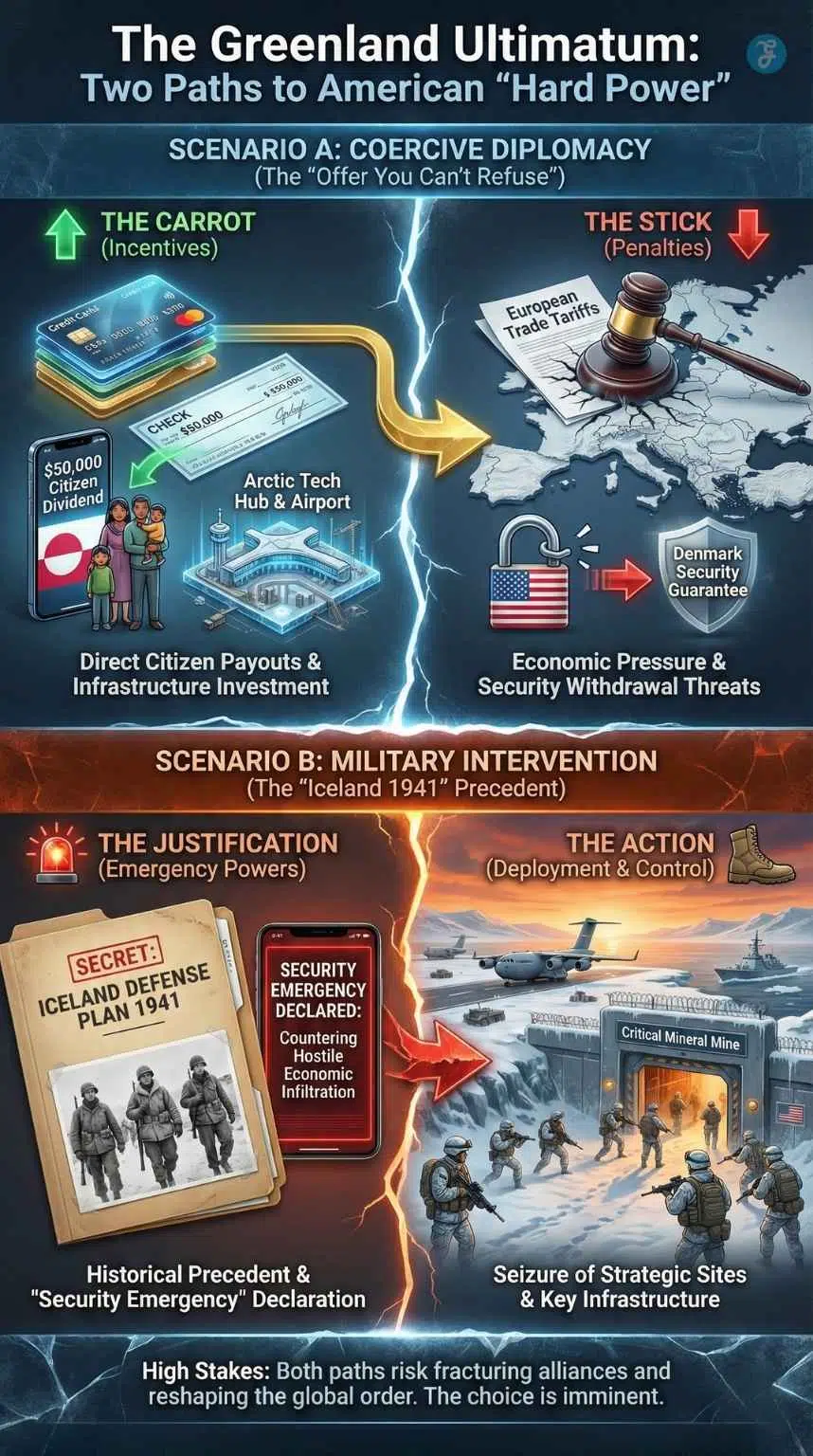
If diplomacy fails, what does a “hostile acquisition” actually look like? Analysts at the Pentagon and think tanks are currently wargaming two primary scenarios.
Scenario A: The “Offer You Can’t Refuse” [Coercive Diplomacy]
This is the most likely initial path. It involves overwhelming economic incentives combined with severe penalties.
- The Carrot: The US offers a “block grant” directly to every Greenlandic citizen. Imagine a check for $50,000 or $100,000 sent to every household, effectively bypassing the Danish government and appealing directly to the populace. The US would promise to eliminate Greenland’s reliance on the annual Danish subsidy ($600M) by replacing it with massive infrastructure investment, new airports, hospitals, and tech hubs.
- The Stick: The US threatens to withdraw security guarantees from Denmark or impose tariffs on European goods. They could also threaten to simply “occupy” the necessary zones for “national security” without formally taking the whole island, creating a de facto annexation.
Scenario B: The “Iceland 1941” Precedent [Military Intervention]
In 1941, the US took over the defense of Iceland from Britain to prevent Nazi Germany from seizing it. The Trump administration is reportedly studying this legal precedent.
- The Justification: The White House could declare that Chinese economic infiltration in Greenland constitutes a “security emergency.” Using the Insurrection Act or emergency war powers, they could deploy Marines to secure key mining sites and airports.
- The Fallout: While militarily easy (Greenland has no army and Denmark has a very small one), politically this is the “Nuclear Scenario.” It would be an invasion of a NATO ally. It would likely shatter the alliance, force European nations to expel US troops, and destroy US credibility globally. However, the fact that the White House has not ruled this out is the primary source of panic in Europe.
The Financial Mathematics of Sovereignty
To understand why the US strategy might actually work, you have to look at the ledger. Greenland’s independence has always been stalled by a single number: 3.9 Billion DKK ($600 Million USD).
This is the annual “Block Grant” Denmark sends to Nuuk. It covers 50% of the Greenlandic government’s budget. For years, the debate has been circular: Greenland cannot afford to be independent without losing this money, but it cannot generate this money without the independence to aggressively mine its resources.
- The “Dividend” Offer: Leaked Treasury Department memos suggest the US is not just offering to match this grant; they are proposing to triple it. The proposed “Arctic Development Fund” is structured at $2 Billion annually for 99 years.
- The Math: This effectively values the “lease” of Greenland at roughly the cost of one B-2 Spirit bomber per year, a rounding error in the US defense budget.
- The Wedge: By offering this funding directly to the Greenlandic Home Rule government, the US is removing the financial leash that binds Nuuk to Copenhagen. They are effectively saying, “You don’t need Denmark to survive. You just need us.”
The Global Backlash: Europe Pushes Back
The European response has been surprisingly unified and ferocious. For the EU, this is not just about defending Denmark; it is about defending the concept of national sovereignty. If the US can buy or seize a territory from a European nation, no border is safe.
The EU’s “Asymmetric Warfare” Plan
The EU cannot fight the US military. Instead, they are preparing to fight the US economy. Leaked documents from Brussels suggest a “Digital Iron Curtain.”
- Targeting Big Tech: The EU is threatening to use the Digital Markets Act (DMA) to levy unprecedented fines or even operational bans on US tech giants like Google, Meta, and Amazon if Washington moves on Greenland. The logic is simple: “If you take our land, we take your market.”
- Asset Freezes: There is discussion of freezing US assets in European banks, a move usually reserved for rogue states like Russia or Iran.
Denmark’s Position: The “Impossible” Corner
Prime Minister Mette Frederiksen is in an agonizing position.
- Domestic Pressure: She cannot sell. The Danish constitution and the 2009 Self-Government Act give the Greenlandic people the right to self-determination. Selling the island over their heads would be illegal and political suicide.
- Alliance Pressure: She cannot fight the US. Denmark’s defense strategy is entirely dependent on NATO and the US umbrella.
- Her Response: “Greenland is not Danish. Greenland is Greenlandic.” By emphasizing Greenland’s autonomy, she is trying to shift the decision to Nuuk (Greenland’s capital), hoping to buy time.
The Institutional Fallout: The Death of the Arctic Council
For thirty years, the Arctic Council has been the governing body of the north, a forum where Russia, the US, and Nordic nations sat at the same table to discuss climate and shipping. That table has now been overturned.
- The Boycott: As of January 12, the Nordic members (Norway, Sweden, Finland, Iceland) have suspended participation in all Council working groups in solidarity with Denmark.
- The Implication: Without the Council, there is no mechanism to manage unintended escalations. If a US destroyer and a Russian icebreaker collide in the fog, there is no longer a direct “red phone” for Arctic de-escalation. The region has moved from a zone of “High North, Low Tension” to a zone of “Zero Governance.”
The Economic Fallout: Markets in Shock
The uncertainty is already bleeding into the global economy.
- Shipping Insurance Spikes: Marine insurers (Lloyds, etc.) have hiked premiums for Arctic routes by 400% in the last week, citing “war risk.” This is impacting LNG (Liquid Natural Gas) shipments from Norway to Europe.
- The “Greenland Premium”: Defense stocks (Lockheed Martin, Raytheon) and Rare Earth mining stocks (MP Materials) have surged. Conversely, Danish sovereign bonds are seeing a sell-off as investors fear a US-EU trade war.
- Fisheries at Risk: Greenland’s economy is 90% fishing. The US proposal includes turning vast swathes of fishing grounds into “naval exclusion zones,” which would destroy the local livelihood.
Domestic US Politics: A Fractured Consensus
In Washington, the “Greenland Question” has created strange bedfellows.
- The “Hawk” Consensus: Surprisingly, some Democrats (like Senator John Fetterman) are quiet, tacitly acknowledging the labor benefits of a mining boom. The “America First” wing of the GOP is fully on board, framing it as the ultimate anti-globalist move.
- The Opposition: The Progressive Caucus and environmentalists are furious. They label the move “Imperialism 2.0.”
- The Budget Fight: Congress controls the purse. The White House is floating a $100 billion “Arctic Security Bill” to fund the acquisition (buyouts for locals, infrastructure). A massive legislative fight is brewing over whether to authorize these funds.
The Human Element: The Battle for Greenlandic Hearts and Minds
We must not forget the 56,000 Inuit citizens. The true battleground is not the landscape, but the psyche of the population.
The Demographic Split
- The Old Guard: Older generations feel a loyalty to Denmark and the Rigsfællesskabet (Commonwealth of the Realm). They fear that US intervention will erode the Nordic welfare model that provides free healthcare and education.
- The Youth: Younger voters are fiercely pro-independence but skeptical of the US. They see the US as a racially turbulent society and fear being treated like Puerto Rico, a territory without rights.
The “Indigenous Factor” and Political Reality
The political landscape is dominated by the Inuit Ataqatigiit (IA) party. They are left-leaning, pro-independence, but strictly anti-mining (specifically uranium).
- The Sovereignty Paradox: Many Greenlanders want independence from Denmark. Paradoxically, US strategists believe this is their “in.” If the US can convince Greenlanders that America will grant them more autonomy and wealth than Denmark, the population might pivot.
- The Trust Deficit: However, the Trump administration’s history with indigenous rights and environmental deregulation makes this a hard sell. Greenlanders fear that US rule would mean turning their pristine home into an industrial mining pit. The cultural disconnect is vast; Greenlanders value community and sustainability, while the US approach is transactional and industrial.
Social Engineering: The “Golden Ticket”
The US is not just negotiating with politicians; it is actively courting the populace with “Soft Power.”
- The Narrative: US diplomats are framing the Danish “Block Grant” as “colonial welfare” that keeps Greenland dependent, while framing the US investment as “business partnership.”
- The Youth Factor: Greenland suffers from high rates of youth unemployment and one of the highest suicide rates in the world (over 80 per 100,000 annually). The US is floating plans for a “Greenland-American Scholarship Initiative,” offering 5,000 full-ride visas to US universities. This is a deliberate attempt to build a pro-American ruling class for the next generation, bypassing the Danish-educated elite that currently runs the country.
- The “Dividend”: Operatives are whispering about “Alaska-style” dividends. If the US offers every Greenlander a guaranteed $50,000/year “Resource Dividend,” the political resistance in Nuuk could crumble under the weight of sheer financial necessity.
Final Thoughts: The Threshold of History
We are standing on a precipice. The US Greenland Acquisition Crisis is not a diplomatic spat; it is a structural break in the world order.
- If the US succeeds: It secures its resource future and missile defense for the next century, but likely destroys NATO and creates a permanent rift with Europe.
- If the US fails: It signals to China and Russia that the Arctic is open for business, potentially leading to a “Scramble for the Pole” that could turn the Cold War hot.
Keep an eye on the “Joint Statement” from the Rubio-Denmark talks. If it mentions “Shared Security Zones,” the US has won. If it mentions “Sovereignty is non-negotiable,” the crisis will escalate to sanctions.