
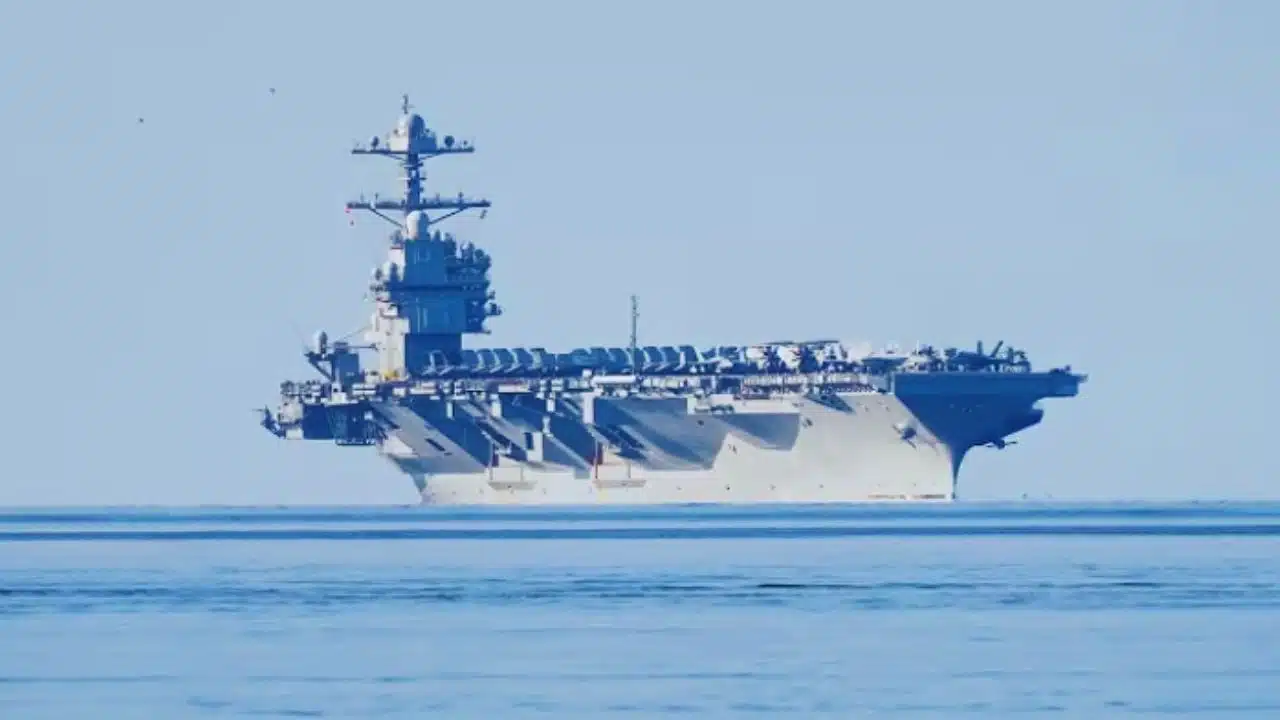
US deploys 15,000 troops near Venezuela, reinforcing Operation Southern Spear in the Caribbean as U.S. forces, led by a carrier strike group, support counter-crime and sanctions enforcement efforts.
What happened and why it matters?
The United States has expanded its military posture in the Caribbean near Venezuela under what U.S. officials describe as Operation Southern Spear—a security effort aimed at disrupting transnational criminal networks, interdicting illicit maritime activity, and enforcing U.S. sanctions.
The development has drawn attention because the new posture is not a quiet, behind-the-scenes operation. It has been paired with visible naval power and a sharper enforcement approach at sea, including actions against vessels accused of moving Venezuelan crude in ways that violate U.S. restrictions.
For Washington, the stated rationale centers on countering drug trafficking, illicit finance, and maritime smuggling routes that feed organized networks. For Venezuela, the same moves are framed as escalation—especially when interdictions target commercial shipping and when high-end U.S. military assets operate close to Venezuelan waters. The result is a fast-moving standoff where law enforcement, sanctions policy, and military deterrence are increasingly intertwined.
The stakes extend beyond U.S.-Venezuela relations. The Caribbean is a corridor for legal trade and energy shipments, and it is also a trafficking route used by criminal groups. When enforcement increases, so do the risks of miscalculation, commercial disruption, and diplomatic fallout—particularly if regional partners feel pressured to take sides or if international bodies become venues for escalating rhetoric.
The U.S. deployment: what’s in the force package and where it’s operating?
U.S. officials have described a reinforced footprint that includes major naval formations operating in and around the Caribbean Sea. Publicly described elements include a carrier strike group and an amphibious ready group with Marines, supported by joint assets already working in the region.
The phrase “15,000 troops” is widely used in public discussion to describe the scale of the U.S. presence when combining personnel assigned across deployed ships, aviation elements, and supporting forces. In practice, exact totals can vary day to day based on ship movements, detachments, and operational rotations. Still, the central point remains: the U.S. has surged enough capacity to conduct sustained surveillance, rapid maritime response, and high-end deterrence while maintaining flexibility to scale up or down.
A key part of this posture is the presence of an aircraft carrier and its air wing. Carrier aviation significantly increases what military planners call “maritime domain awareness”—the ability to find, track, and respond to targets over large areas of ocean. That can translate into faster identification of suspect vessels, quicker dispatch of boarding teams, and broader coverage of trafficking routes.
Key components described by U.S. releases and official statements
| Component | What it adds | Why it changes the picture |
| Carrier Strike Group (aircraft carrier + escorts) | Long-range air operations, persistent surveillance, rapid response capability | Enables a wide-area operational posture and supports interdictions far from shore |
| Carrier Air Wing (multiple squadrons) | Reconnaissance, air patrols, and support for surface operations | Helps detect and track vessels, and provides overhead support if needed |
| Destroyers/escorts | Multi-mission protection and surface presence | Increases ability to monitor shipping lanes and protect high-value assets |
| Amphibious Ready Group + Marine unit | Flexible crisis response and maritime security options | Adds fast-reaction personnel and platforms that can support a range of contingencies |
| Joint/partner coordination mechanisms | Coordination across agencies and services | Improves information sharing and operational tempo for interdiction missions |
This force package matters not only for what it can do, but for what it signals. Even if the mission is framed as counter-crime and sanctions enforcement, the presence of a carrier strike group communicates readiness and deterrence. It can reassure U.S. allies and partners who worry about regional security threats, while also increasing the political pressure on Venezuela’s government by making enforcement more credible.
The tanker seizures and maritime enforcement driving tensions
The most concrete flashpoint has been the U.S. shift from monitoring suspect shipments to active interdiction and seizure activity involving tankers accused of moving Venezuelan crude in violation of U.S. rules.
In one high-profile case, U.S. authorities obtained a legal warrant to seize a tanker and later carried out an operation involving the U.S. Coast Guard boarding and taking control of the vessel after it had departed Venezuela and entered the high seas. U.S. officials have presented this as a law-enforcement action supported by sanctions policy and court authorization.
These operations are complex. Boarding a large tanker at sea requires specialized teams, careful coordination, and—often—overwatch and communication support to manage safety risks. When tankers are moving, the window to act can be narrow. That is one reason U.S. officials have highlighted the importance of additional assets and trained personnel. The more boardings increase, the more stress falls on specialized units and the logistics chain that supports them.
This enforcement activity also has broader implications:
- Commercial risk: Shipping companies may reassess routes, insurance premiums can rise, and operators may become more cautious about cargo origins, ship registries, and contractual obligations.
- Political risk: Venezuela argues that aggressive interdictions resemble a blockade or piracy, while the U.S. frames them as lawful enforcement actions tied to sanctions and criminal investigations.
- Escalation risk: Each boarding creates a new point of friction—particularly if any incident results in injuries, property damage, or contested jurisdictional claims.
Enforcement milestones highlighted publicly
| Date (2025) | Event | Why it’s significant |
| Mid-November | Major U.S. naval assets begin operating in the Caribbean | Marks the visible reinforcement of the mission’s deterrence and surveillance power |
| Late November | U.S. court action authorizes a tanker seizure | Provides the legal basis for a seizure operation under U.S. law |
| Early-to-mid December | Coast Guard boarding and seizure operation conducted at sea | Signals the operational move from monitoring to direct interdiction |
| Late December | U.S. officials describe continued pursuit of additional vessels | Suggests the interdiction campaign may continue rather than end with a single case |
Venezuela has responded with political and legal measures of its own, including domestic legislation designed to punish individuals tied to actions that disrupt maritime commerce. From Caracas’ perspective, such laws aim to deter cooperation with seizures and to frame the situation as an assault on national sovereignty and economic survival.
From Washington’s perspective, interdiction pressure is intended to disrupt networks, raise costs for sanctions evasion, and reduce the flow of resources that U.S. officials say support illicit activity and corruption.
International reaction, legal arguments, and regional fallout
As tensions have grown, the dispute has increasingly played out in diplomatic settings, including international institutions where major powers can shape narratives about legality and escalation.
The legal debate has several layers:
- Sanctions enforcement vs. the law of the sea: The U.S. argues that its actions are grounded in domestic legal authority and sanctions enforcement, supported by court processes in specific cases. Critics question how far a national sanctions regime can be enforced on the high seas without creating precedents that other states could copy for less legitimate aims.
- Self-defense and security framing: U.S. officials have tied the mission to countering transnational criminal organizations and threats to regional stability. Opponents argue that the situation does not meet the threshold for broader military justification and that enforcement actions blur the line between policing and conflict.
- Sovereignty and economic coercion: Venezuela and sympathetic states characterize the pressure campaign as coercive and destabilizing, especially if it affects a major source of national revenue.
Regional governments are caught in the middle. Many Caribbean and Latin American states want effective counter-trafficking cooperation, but they also want to avoid becoming staging grounds for escalation. Port access, refueling permissions, intelligence cooperation, and public messaging can all become politically sensitive decisions.
For residents of the region and for commercial operators, the practical concerns are immediate: more inspections can mean delays; more tension can mean higher insurance costs; and more military activity can heighten anxiety even if no shots are fired.
What happens next: scenarios to watch and practical takeaways?
The next phase depends on whether Operation Southern Spear remains primarily a targeted enforcement surge—or evolves into a longer, broader pressure campaign.
Signals that the operation is intensifying
- Additional interdiction actions against tankers or shipping networks tied to Venezuelan crude.
- More public references to expanding resources for boarding teams and maritime enforcement.
- New sanctions announcements or legal actions linked to shipping, financial intermediaries, or logistics firms.
- Sustained presence of high-end naval assets for longer than a short surge window.
Signals that the operation is stabilizing
- A slowdown in new interdictions and a shift toward monitoring rather than boarding.
- Increased regional diplomatic engagement, including confidence-building measures around maritime safety.
- Clearer operational boundaries and messaging designed to reduce the chance of misinterpretation.
Risk factors
- Miscalculation at sea: Even routine boarding operations carry risk when crews are stressed and political tension is high.
- Domestic political escalation: Laws and rhetoric on either side can narrow the space for compromise.
- Broader geopolitical competition: When major powers weigh in, disputes can become harder to de-escalate.
Practical takeaways
- The headline figure—US deploys 15,000 troops near Venezuela—captures the scale of a posture that is large enough to sustain surveillance, interdiction support, and deterrence simultaneously.
- The most consequential shift is not simply troop numbers, but the operationalization of enforcement through tanker seizures and active pursuit of additional vessels.
- Diplomatic arenas are now central. How governments describe legality and intent will shape whether regional partners cooperate, distance themselves, or push for mediation.
Ultimately, this is a test of how far maritime enforcement can go before it is seen—rightly or wrongly—as a quasi-blockade. If interdictions expand, the pressure on Venezuela’s economy could deepen. If they slow, Washington may seek other ways to sustain leverage. Either way, the next few weeks will likely bring more legal maneuvering, diplomatic messaging, and close monitoring of ship movements across the Caribbean.