

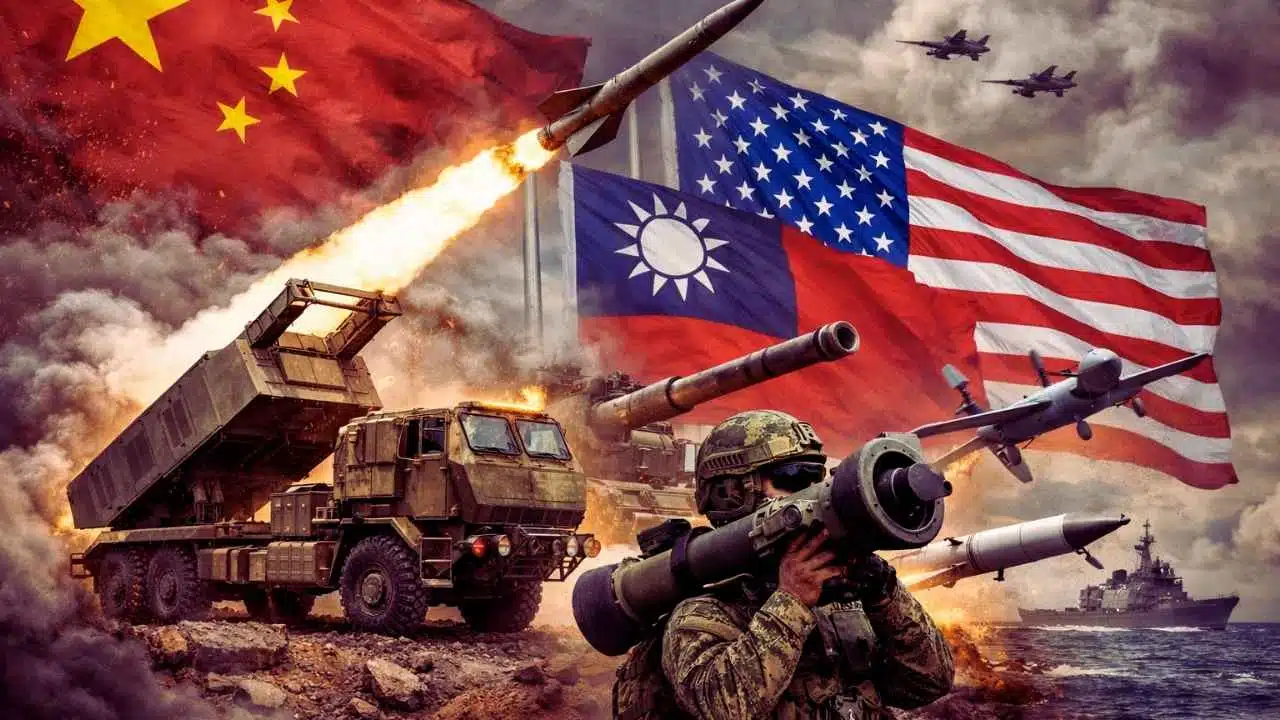
China condemned a US arms sale to Taiwan after Washington approved eight potential defense deals worth about $11.1–$11.15 billion on Dec. 17, 2025, covering rockets, artillery, drones, missiles, and support—raising cross-strait tensions.
The $11.1B US arms sale to Taiwan: what was approved and what each item does?
The latest US arms sale to Taiwan is not a single weapons transfer. It is eight separate, notified cases under the US Foreign Military Sales process. Together, they add up to roughly $11.1–$11.15 billion, depending on how totals are rounded across cases.
The package combines long-range precision rockets, mobile artillery, loitering munitions (strike drones), anti-armor missiles, networking software, and sustainment support for existing systems. That mix matters because it strengthens Taiwan’s ability to fight in dispersed, fast-moving ways rather than relying only on a few large and vulnerable platforms.
The two biggest pieces—HIMARS and M109A7 self-propelled howitzers—account for the majority of the total value. The rest focuses on drones, missiles, connectivity, and maintenance support that keeps units operational in a crisis.
Breakdown of the eight notified cases (Dec. 17, 2025)
| Case | What it is | Why it matters for Taiwan’s defense | Estimated value |
| HIMARS | Truck-mounted rocket artillery and related equipment | Mobile precision fires; can relocate quickly after launching | $4.05B |
| M109A7 | Tracked self-propelled howitzers and related equipment | Survivable artillery that can “shoot and move” | $4.03B |
| ALTIUS-700M & ALTIUS-600 | Loitering munitions and related systems | Adds strike and reconnaissance drones; complicates targeting | $1.1B |
| Tactical Mission Network | Software/equipment/services for networking | Improves coordination, targeting, and shared awareness | $1.01B |
| Javelin | Portable anti-armor missile system | Strengthens close-in defense against armored threats | $375M |
| TOW | Anti-armor missile system | Adds additional ground-based anti-armor capability | $353M |
| AH-1W support | Spare and repair parts | Sustains attack helicopter readiness and availability | $96M |
| Harpoon repair support | Repair/follow-on support | Helps maintain anti-ship missile readiness | $91.4M |
Even after notification, actual delivery schedules depend on contracting, production capacity, training, and Taiwan’s ability to absorb the systems quickly. In many cases, support equipment, training, and logistics can be as important as the launchers and missiles themselves, because they determine whether the gear can be kept ready under stress.
China’s condemnation: what Beijing said and what “forceful measures” can mean?
China responded to the US arms sale to Taiwan with sharp public criticism and warnings. Beijing framed the move as a violation of its “one-China” position and as interference in what it describes as internal affairs.
China’s public messaging also tied arms sales to broader instability risks. That approach serves two purposes: it signals domestic resolve and it warns Washington and Taipei that Beijing may respond with steps meant to raise the cost of continued military cooperation.
When Chinese officials say they will take “forceful measures,” that language does not automatically point to one specific action. In past episodes of heightened tension, responses have often included some combination of:
- Diplomatic protests and public statements aimed at shaping international narratives.
- Military signaling, such as additional drills or patrol patterns near the Taiwan Strait.
- Administrative and legal tools, including sanctions or restrictions directed at entities linked to defense cooperation.
- Increased pressure on Taiwan, including messaging that aims to deter additional procurements.
What makes this moment sensitive is the size and structure of the package. It is large enough to become a political flashpoint, and it contains capabilities—like mobile rockets and loitering munitions—that China may view as especially relevant to deterring or complicating military options.
What China is reacting to in capability terms?
| Capability type in package | Why it is politically sensitive | Potential near-term pressure points |
| Mobile rocket/artillery fires | Increases Taiwan’s ability to strike at range and relocate | Beijing may intensify rhetorical and operational signaling |
| Drones/loitering munitions | Adds strike and surveillance options that are hard to defend against | Likely to be portrayed as destabilizing “new” warfare tools |
| Mission network software | Improves coordination and resilience of command and control | Raises concerns about interoperability and battlefield awareness |
| Sustainment support | Keeps existing systems ready over time | Reduces the effectiveness of pressure aimed at “wearing down” readiness |
Beijing’s condemnation also sits inside a wider pattern: China repeatedly argues that military support for Taiwan encourages “separatism,” while Washington frames the same actions as helping Taiwan maintain credible self-defense.
Taiwan’s response: why Taipei welcomed it and how it fits its defense strategy?
Taiwan publicly welcomed the package and framed it as strengthening deterrence and readiness. The systems in the package generally align with Taiwan’s long-running push to improve:
- Survivability (ability to keep fighting even under missile pressure).
- Mobility (ability to move and hide).
- Precision and speed (ability to respond quickly and hit targets effectively).
- Sustainment (keeping equipment maintained, supplied, and ready).
The package supports both new capability and readiness of existing assets. For example:
- HIMARS and guided rockets can support rapid, mobile fires that relocate after launch.
- Self-propelled howitzers add protected artillery that can keep moving and reduce vulnerability.
- Loitering munitions create additional scouting and strike options that can be used flexibly.
- Networking software strengthens the ability of units to share information and coordinate actions.
- Javelin and TOW missiles add close-to-mid range anti-armor defense options.
- Harpoon support and helicopter parts focus on keeping current inventories credible and usable.
Taiwan’s defense planners have emphasized that deterrence is not only about buying equipment. It also depends on training, stockpiles, maintenance cycles, and how fast units can disperse. That is why sustainment and network components often appear alongside headline items like rockets and drones.
What it means for the Taiwan Strait and regional security?
This US arms sale to Taiwan lands at a time when the Taiwan Strait is already one of the world’s most closely watched flashpoints. The package affects the strategic environment in two ways.
First, it signals political commitment. Large, publicized approvals show continuity of defense cooperation and a willingness to move forward despite expected backlash. That can reassure Taiwan and partners, but it can also deepen Beijing’s suspicion that Washington is strengthening Taiwan’s position over time.
Second, it shapes military calculations. The systems involved—especially mobile fires and drones—can change the cost-benefit analysis for coercion scenarios. These tools are designed to be harder to preempt and harder to suppress quickly.
However, deterrence effects are not automatic. Capability only matters if:
- Taiwan can train personnel effectively.
- logistics and maintenance can keep systems operational.
- munitions stockpiles are adequate.
- and command-and-control networks remain resilient under attack.
Regional actors also watch these episodes closely because they can influence defense planning beyond Taiwan. Countries nearby routinely adjust posture, procurement, and readiness when cross-strait tensions rise.
Three realistic implications to watch
| Area | What could change | What would indicate escalation |
| Military activity | More visible drills, patrols, or readiness moves | Sustained higher tempo near the Strait, not just a short spike |
| Diplomacy | Louder messaging and sharper warnings | Reduced willingness to engage in routine dialogues |
| Defense planning | Faster procurement and training timelines | Budget shifts toward stockpiles, drones, and dispersed basing |
The risk is not only a deliberate confrontation. A separate risk is miscalculation—rapid cycles of signaling and counter-signaling that narrow decision space during a crisis.
What happens next: US review steps, contracting, and delivery realities?
Although the package is widely described as “approved,” the practical path from notification to operational capability has several steps.
In the US system these cases typically proceed through:
- Formal notification and review windows under US law and standard procedures.
- Contract negotiation and signing, which can take time depending on complexity.
- Production and delivery scheduling, affected by manufacturing capacity and competing global orders.
- Training and integration, which determines how quickly Taiwan can field the systems.
- Long-term sustainment, including spare parts pipelines and repair capacity.
For Taiwan the major challenges after a large package often include:
- Absorption speed: training crews, building doctrine, and integrating systems with existing forces.
- Logistics: storage, maintenance, transport, and protection of dispersed units.
- Command-and-control resilience: ensuring networks work under electronic and missile pressure.
- Stockpiling: ensuring enough munitions and parts exist to sustain operations.
This also means the real-world impact may unfold over time. The announcement creates immediate diplomatic impact, but the military impact grows as systems arrive, crews train, and units demonstrate readiness.
In the coming weeks, the clearest signals will come from three areas: whether any political actions slow or complicate the process, whether Beijing escalates military signaling, and whether Taiwan accelerates training and procurement decisions tied to these systems.
























