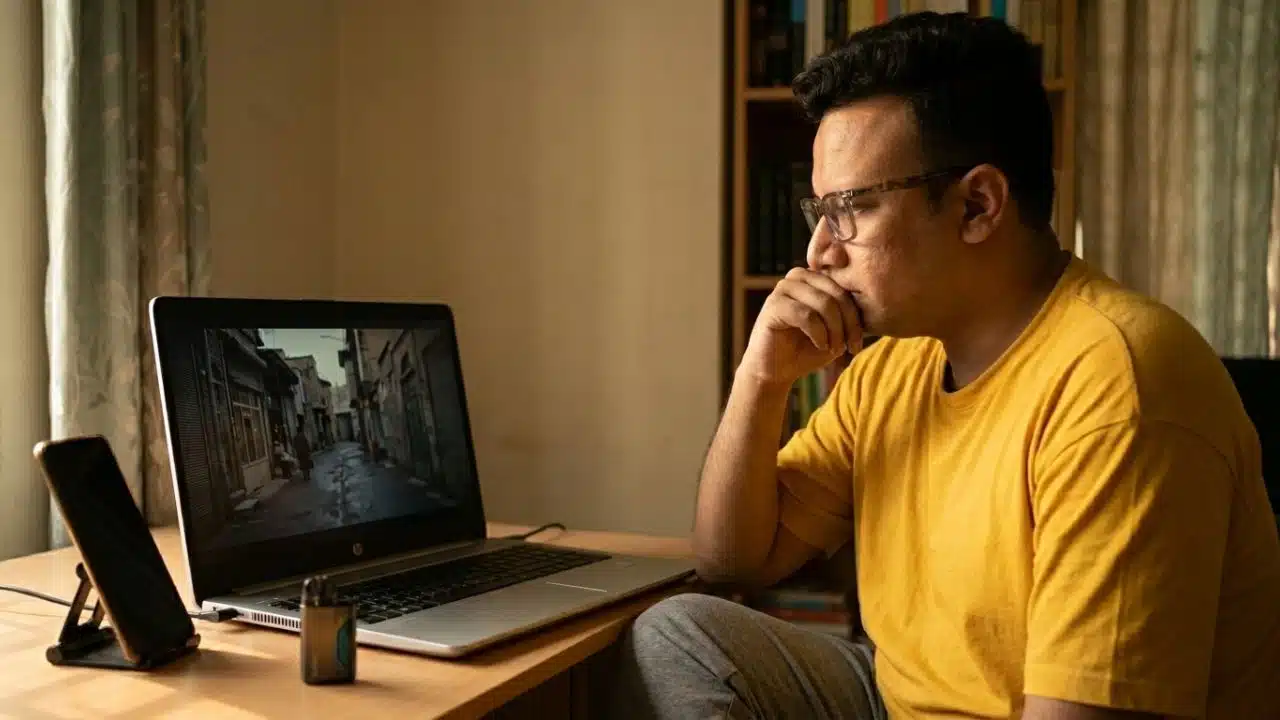
Some Iranian movies do not feel like movies at all. They feel like someone quietly opened a door and allowed me to look into a family, a street, a classroom, a kitchen, or a child’s mind for a few hours.
I have watched movies from Hollywood, Western cinema, Spanish cinema, cult classics, French films, Russian films, Bengali films, Hindi films, Malayalam films, Assamese films, German films, Hungarian films, Turkish films, Indonesian films, Australian films, and many more. I am a movie freak in the truest sense. Watching movies and series, along with reading books, has been one of my deepest hobbies since childhood.
But Iranian cinema has always felt different to me.
I live in Dhaka, the capital of Bangladesh, where I grew up surrounded by noise, people, family emotions, small struggles, and daily survival stories. Maybe that is why Iranian movies feel so close to me. They do not always need a big plot twist, expensive production, or dramatic background score. Sometimes, a lost pair of shoes, a child’s desire to buy a goldfish, a father’s silence, or a mother’s tired eyes can carry the emotional weight of an entire society.
Over the years, I have watched several Persian and Iranian films, including Blackboards, And, Towards Happy Alleys, Taste of Cherry, The White Balloon, Life and a Day, Children of Heaven, The Past, Bashu, the Little Stranger, The Painting Pool, and Killing Mad Dogs. I usually watch them at home, either on my phone or laptop. Sometimes, I watch movies with my wife when I visit her in another city for her job, usually once a month.
That simple personal setting—watching a film alone in Dhaka at night, or watching with my wife during a short visit—has shaped the way I connect with Persian cinema. These films do not entertain me only. They make me pause, think, and feel.
I also keep track of my movie journey through my IMDb watchlist and reviews, and I have written before about my broader viewing habits in pieces like my weekly movie diary and movies I watched last week.
This article is not just a list of the top Iranian movies. It is my personal journey through Iranian movies, the best Persian films I have experienced, and the reasons the Iran film industry continues to produce some of the most human stories in world cinema.
My First Realization: Iranian Movies Trust Ordinary Life
One of the biggest reasons I admire Iranian movies is that they trust ordinary life. In many commercial films, ordinary life is treated as boring. Filmmakers rush to add violence, spectacle, glamour, or extreme conflict. Persian cinema often does the opposite. It slows down. It observes. It allows the viewer to sit with people who may look simple from the outside but are emotionally complex inside.
That is why films like Children of Heaven and The White Balloon work so beautifully. The story may look small, but the emotional world is huge.
Children of Heaven is built around something as ordinary as a pair of shoes. But the film turns that small object into a symbol of poverty, sibling love, responsibility, shame, and hope. The Academy’s official record lists Children of Heaven as Iran’s nominee in the Foreign Language Film category at the 71st Academy Awards in 1999.
The White Balloon, directed by Jafar Panahi and written by Abbas Kiarostami, also begins with a child’s simple desire. A girl wants to buy a goldfish for the Persian New Year. But the film becomes a suspenseful and emotional walk through Tehran. AFI notes that the film won the Caméra d’Or at Cannes in 1995 and describes it as an important early international breakthrough for Iranian cinema.
These are not “small” films to me. They are films that understand how big life can feel when you are poor, young, scared, hopeful, or responsible for someone you love.
Why Persian Cinema Feels So Real to Me
The realism of Persian cinema does not come only from natural acting or real locations. It comes from emotional honesty.
When I watch good Iranian movies, I often feel that the director is not trying to manipulate me. The camera is patient. The characters are not explained too quickly. There is space for silence, confusion, mistakes, and moral discomfort.
In Taste of Cherry, Abbas Kiarostami follows a man driving around Tehran’s outskirts, looking for someone to help bury him after he dies. It is one of the most famous Iranian films in world cinema. Cannes’ official record lists Taste of Cherry as the 1997 Palme d’Or winner, directed by Kiarostami.
But what stays with me is not only the award. It is the feeling of sitting inside that car with a stranger and slowly realizing that the film is not just about death. It is also about loneliness, choice, faith, exhaustion, and the fragile reasons people continue living.
That is the power of Iranian movies. They often avoid loud answers. They ask quiet questions.
The Iranian Movies I Have Watched and What They Gave Me
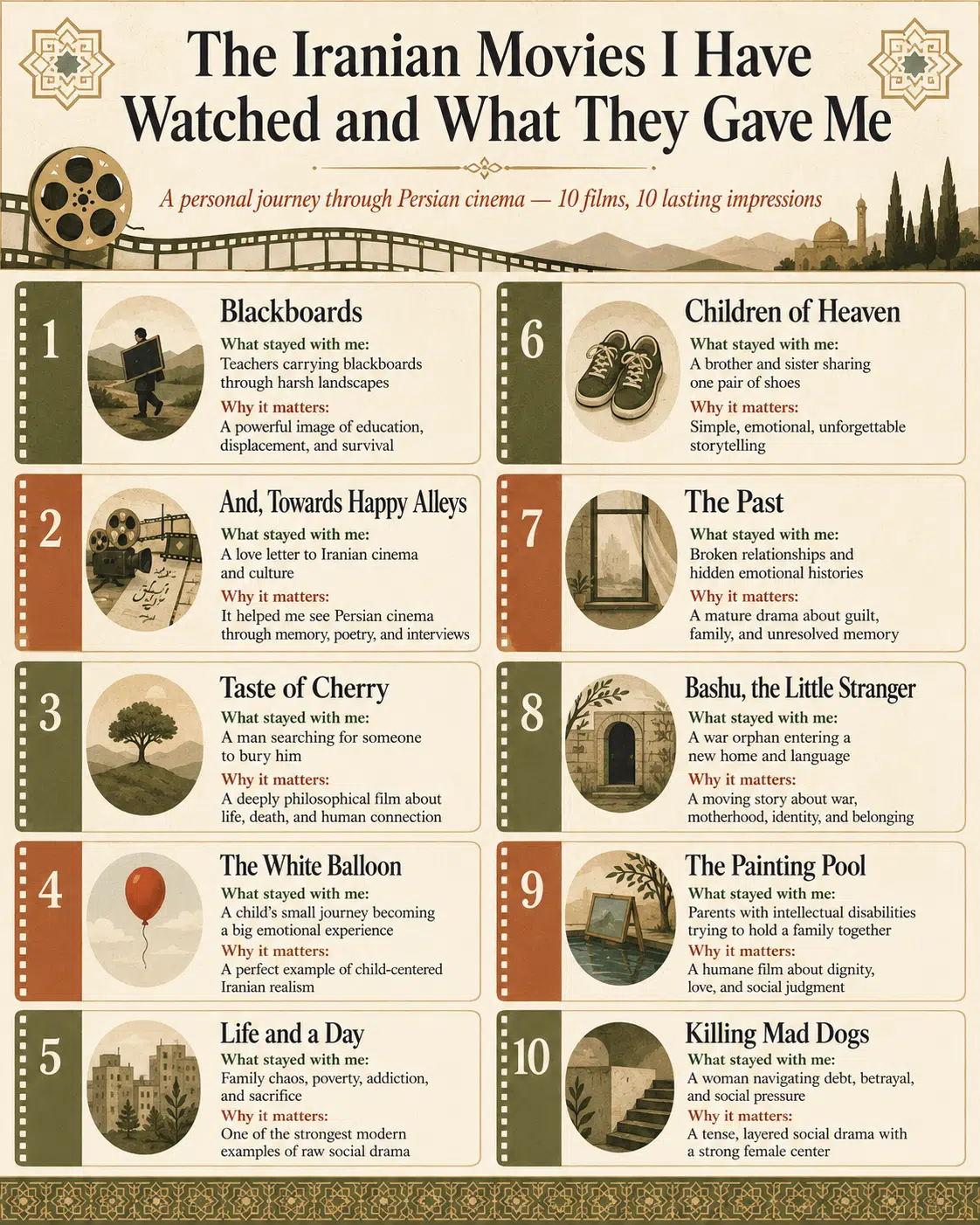
Here is a personal table of the Iranian/Persian films I have watched over the years and what each one added to my understanding of Persian cinema.
| Movie | Director / Context | What Stayed With Me | Why It Matters |
|---|---|---|---|
| Blackboards | Samira Makhmalbaf | Teachers carrying blackboards through harsh landscapes | A powerful image of education, displacement, and survival |
| And, Towards Happy Alleys | Sreemoyee Singh | A love letter to Iranian cinema and culture | It helped me see Persian cinema through memory, poetry, and interviews |
| Taste of Cherry | Abbas Kiarostami | A man searching for someone to bury him | A deeply philosophical film about life, death, and human connection |
| The White Balloon | Jafar Panahi | A child’s small journey becoming a big emotional experience | A perfect example of child-centered Iranian realism |
| Life and a Day | Saeed Roustayi | Family chaos, poverty, addiction, and sacrifice | One of the strongest modern examples of raw social drama |
| Children of Heaven | Majid Majidi | A brother and sister sharing one pair of shoes | Simple, emotional, unforgettable storytelling |
| The Past | Asghar Farhadi | Broken relationships and hidden emotional histories | A mature drama about guilt, family, and unresolved memory |
| Bashu, the Little Stranger | Bahram Beyzai | A war orphan entering a new home and language | A moving story about war, motherhood, identity, and belonging |
| The Painting Pool | Maziar Miri | Parents with intellectual disabilities trying to hold a family together | A humane film about dignity, love, and social judgment |
| Killing Mad Dogs | Bahram Beyzai | A woman navigating debt, betrayal, and social pressure | A tense, layered social drama with a strong female center |
Samira Makhmalbaf’s Blackboards was shown in competition at Cannes and won the Jury Prize, according to Cannes’ profile of the director. And, Towards Happy Alleys is listed by Criterion as a 2023 Indian documentary by Sreemoyee Singh about Iran’s film culture and the world of Iranian cinema.
For me, these films are not only Persian movies to watch. They are emotional studies. They show how people live under pressure, how families break and still hold together, and how children often understand society more clearly than adults.
Best Persian Films Are Often Built on Moral Conflict
When people ask me about the best Persian films, I do not only think of beautiful cinematography or festival awards. I think of moral pressure.
Iranian filmmakers often create situations where there is no easy answer. A character may be right and wrong at the same time. A family may love each other and still hurt each other. A child may be innocent but forced to carry adult burdens. A woman may be trapped by society but still stronger than everyone around her.
This is why Asghar Farhadi’s cinema connects strongly with global audiences. His films often begin with family conflict, then slowly reveal deeper layers of class, truth, guilt, gender, and social expectation.
In The Past, Farhadi moved outside Iran but still carried the emotional DNA of Iranian storytelling. Cannes records The Past as a 2013 competition title and notes that Bérénice Bejo won Best Actress for the film. Farhadi’s profile at Cannes also notes that The Salesman brought Iran its second Oscar in the Best Foreign Language Film category.
I admire this kind of writing because it does not force viewers to choose a villain quickly. It makes us sit with people. It makes us judge less and observe more.
Top Iranian Movies Show Children Without Making Them Decorative
One of the most beautiful features of top Iranian movies is the way they use children. In many films around the world, children are used only for cuteness or sentiment. In Iranian movies, children often become the moral center of the story.
In Children of Heaven, the children are not decorative. They are carrying the emotional weight of poverty. In The White Balloon, the child’s journey becomes a map of society. In Bashu, the Little Stranger, the child is a living wound of war and displacement.
This is one reason I feel emotionally attached to Iranian, Malayalam, Turkish, Spanish, and French films. These cinemas often understand emotional depth better than spectacle. They know that a child looking at an adult world can reveal more truth than a long political speech.
Iranian Old Film, Modern Iranian Film, and the Same Human Core
When I think about an Iranian old film like Bashu, the Little Stranger, and then compare it with a modern film like Life and a Day, I see changes in style but not in emotional core.
Bashu, the Little Stranger, carries the pain of war, displacement, language, and motherhood. It shows how a child from one part of Iran becomes a stranger inside his own country. TIFF describes the film as the story of a young Afro-Iranian boy who flees war after losing his family and finds himself in a new environment.
Life and a Day, on the other hand, feels more modern, more crowded, and more explosive. Saeed Roustayi’s film looks at a poor Tehran family dealing with addiction, marriage, shame, and survival. MUBI describes it as a story of a poverty-stricken family in Tehran before the youngest daughter leaves for marriage.
Different decades. Different filmmaking energy. But the same concern remains: family, survival, dignity, and the pressure of society.
That is why Iranian movies continue to feel timeless.
Famous Iranian Films Do Not Always Behave Like “Famous” Films
Many famous Iranian films are famous for the opposite reason Hollywood blockbusters are famous.
They are not always fast. They are not always loud. They do not always give closure. Sometimes, they are famous because they are brave enough to remain simple.
Taste of Cherry is mostly a man driving and talking. The White Balloon is built around a child trying to buy a fish. Children of Heaven revolves around a pair of shoes. Yet these films reach universal emotions.
This taught me something important as a viewer and content creator: a story does not need to be big to be powerful. It needs to be honest.
That lesson also influences how I watch other cinemas. When I watch Malayalam films, Turkish dramas, Spanish thrillers, French human dramas, or Bengali classics, I often search for the same thing I find in Persian cinema: emotional truth.
The Iran Film Industry and Its Global Respect
The Iran film industry has earned global respect because it turned limitation into artistic strength. Budget, censorship, social pressure, and political complexity have shaped the way Iranian filmmakers tell stories. Instead of depending only on spectacle, many directors use metaphor, realism, children, silence, and moral conflict.
Encyclopaedia Iranica notes that feature-film production in Persia/Iran can be divided into distinct historical periods reflecting social, cultural, and political realities. This is important because Iranian cinema cannot be separated from Iranian society. Its films often carry the weight of history, family, class, war, religion, gender, and state pressure.
Abbas Kiarostami, for example, is widely recognized for blurring the boundary between fiction and reality. Britannica describes him as an Iranian filmmaker known for experimenting with the boundaries between reality and fiction across a four-decade career.
That boundary is exactly what makes many Iranian movies so alive. They feel scripted and unscripted at the same time. They feel like fiction, but they also feel like something you may see in the next street.
Where Can I Watch Iranian Movies?
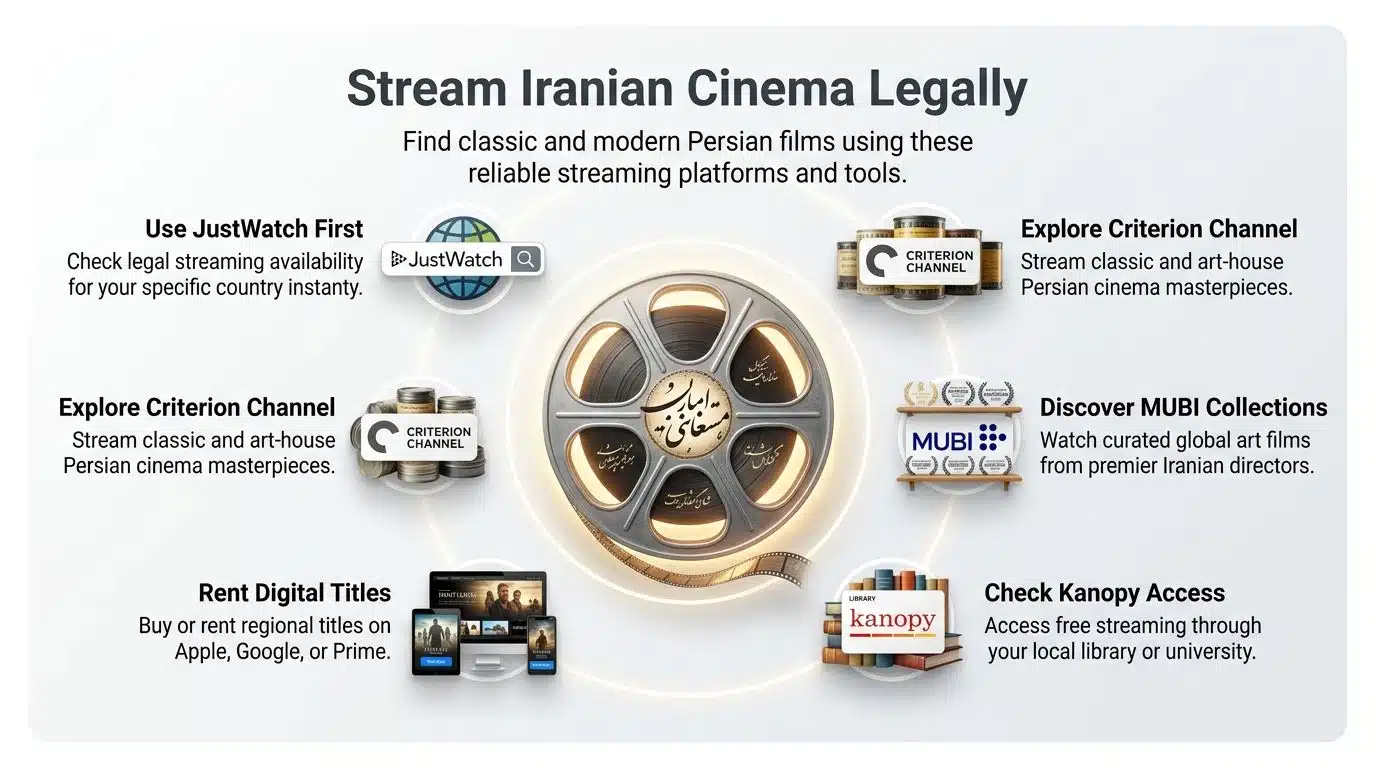
A common question for new viewers is, “Where can I watch Iranian movies legally?”
The answer depends on your country, because streaming rights change often. But these are good starting points:
| Platform / Method | Why It Helps |
|---|---|
| Criterion Channel | Strong collection of classic and art-house Iranian cinema |
| MUBI | Curated Persian and global art films, including works by major Iranian directors |
| Kanopy | Useful if you have access through a library or university |
| Apple TV / Google TV / Prime Video rentals | Some titles are available for rent or purchase by region |
| JustWatch | Helps check where a title is legally streaming in your country |
| Film festivals and cultural screenings | Good for rare Iranian old film titles and restored classics |
| DVD/Blu-ray from trusted labels | Useful for hard-to-find classics |
Criterion’s Iran page lists films by Abbas Kiarostami, Jafar Panahi, Forugh Farrokhzad, Amir Naderi, and others, including Taste of Cherry. MUBI also maintains Iranian cinema collections and pages for filmmakers such as Jafar Panahi, with films like The White Balloon, Offside, and The Circle shown in its catalog depending on region. JustWatch says it helps users check legal streaming, rental, and purchase offers across many streaming services.
So, if someone asks me where can I watch Iranian movies, my practical answer is: first search the exact title on JustWatch for your country, then check Criterion Channel, MUBI, Kanopy, and legal rental stores.
How to Watch Iranian Movies as a Beginner
Another important question is: how to watch Iranian movies without feeling lost?
My suggestion is simple: do not watch them with the same expectation you bring to mainstream thrillers or action films. Persian cinema often asks for patience. It rewards attention.
Here is how I personally watch them:
| Viewing Habit | Why It Helps |
|---|---|
| Watch with subtitles carefully | Persian dialogue often carries emotional and social detail |
| Avoid multitasking | Small gestures matter in Iranian cinema |
| Do not expect fast pacing every time | The rhythm is often closer to real life |
| Notice children, women, and family spaces | They often reveal the deeper social meaning |
| Read a little context after watching | Awards, censorship, history, and director background add more depth |
| Keep a personal watch diary | It helps you remember emotional reactions, not just plot |
When I watch Iranian movies on my laptop or phone at home, I try not to treat them as background content. These films need attention. A small silence, a repeated look, or a family argument may explain more than a dramatic monologue.
Persian Movies to Watch If You Are New to This Cinema
If you are looking for Persian movies to watch, I would divide them into emotional entry points.
For Beginners
Start with films that are emotionally clear and accessible:
| Film | Why Start Here |
|---|---|
| Children of Heaven | Simple, emotional, and universally understandable |
| The White Balloon | A child’s journey that introduces Iranian realism beautifully |
| Where Is the Friend’s House? | Gentle, poetic, and deeply human |
| The Color of Paradise | Emotional and spiritual family drama |
| A Separation | A powerful modern family and moral drama |
For Viewers Who Like Slow, Philosophical Cinema
| Film | Why Watch |
|---|---|
| Taste of Cherry | Minimalist, existential, and unforgettable |
| Close-Up | A brilliant blend of documentary and fiction |
| The Wind Will Carry Us | Poetic and meditative |
| And, Towards Happy Alleys | A documentary gateway into Iranian cinema culture |
For Viewers Who Like Social Drama
| Film | Why Watch |
|---|---|
| Life and a Day | Raw family and poverty drama |
| The Past | Emotional consequences and hidden truths |
| Killing Mad Dogs | Social pressure, betrayal, and a strong female protagonist |
| Bashu, the Little Stranger | War, identity, motherhood, and belonging |
This is not a final list of all top Iranian films. It is a personal path for viewers who want to understand why Persian cinema has such a strong emotional reputation.
Why I Connect Iranian Cinema With Dhaka Life
My connection with Iranian movies is also shaped by where I come from.
Growing up and living in Dhaka, I understand crowded family life, social pressure, emotional silence, financial anxiety, and the way ordinary people carry extraordinary burdens. Iranian films may be set in Tehran, rural Iran, border regions, or immigrant homes, but many emotions feel familiar to me as a Bangladeshi viewer.
A family trying to hide its shame.
A child quietly understanding poverty.
A mother protecting a child from a cruel world.
A man breaking down without saying everything.
A woman carrying responsibility that society does not fully recognize.
These are not only Iranian stories. These are human stories. That is why good Iranian movies travel so well across cultures. They are local in detail but universal in feeling.
What Iranian Movies Taught Me as a Viewer
After watching these films over the years, I feel Persian cinema has taught me five things.
First, small stories can carry big truths. Children of Heaven proves that a pair of shoes can carry a whole world of emotion.
Second, silence can be stronger than dialogue. Taste of Cherry does not explain everything, and that is why it stays in the mind.
Third, children can perceive society better than adults. The White Balloon, Children of Heaven, and Bashu, the Little Stranger all show this beautifully.
Fourth, family is never simple. Life and a Day, The Past, and The Painting Pool show families as places of love, pain, duty, and emotional conflict.
Fifth, cinema does not need glamour to be unforgettable. Some of the best Persian films are powerful because they avoid artificial beauty and stay close to life.
Final Thoughts: Why Iranian Movies Feel So Real
For me, Iranian movies feel real because they respect human complexity.
They do not rush to solve life. They do not always punish the bad person and reward the good person. They understand that people are shaped by poverty, family, shame, love, silence, faith, politics, memory, and survival.
As a movie lover who has watched films from many countries and traditions, I find Persian cinema deeply grounding. It reminds me why I fell in love with movies in the first place.
Not for noise.
Not for glamour.
Not only for entertainment.
But for the rare feeling that someone else’s life, shown honestly on screen, can help me understand my own.
That is why I continue searching for top Iranian movies, top Iranian films, famous Iranian films, and hidden Persian gems. And that is why, whenever someone asks me about good Iranian movies or how to watch Iranian movies, I say, “Start slowly, watch with patience, and let the film breathe.”
Because the best Iranian films do not just tell stories. They sit beside you quietly and stay there long after the movie ends.