

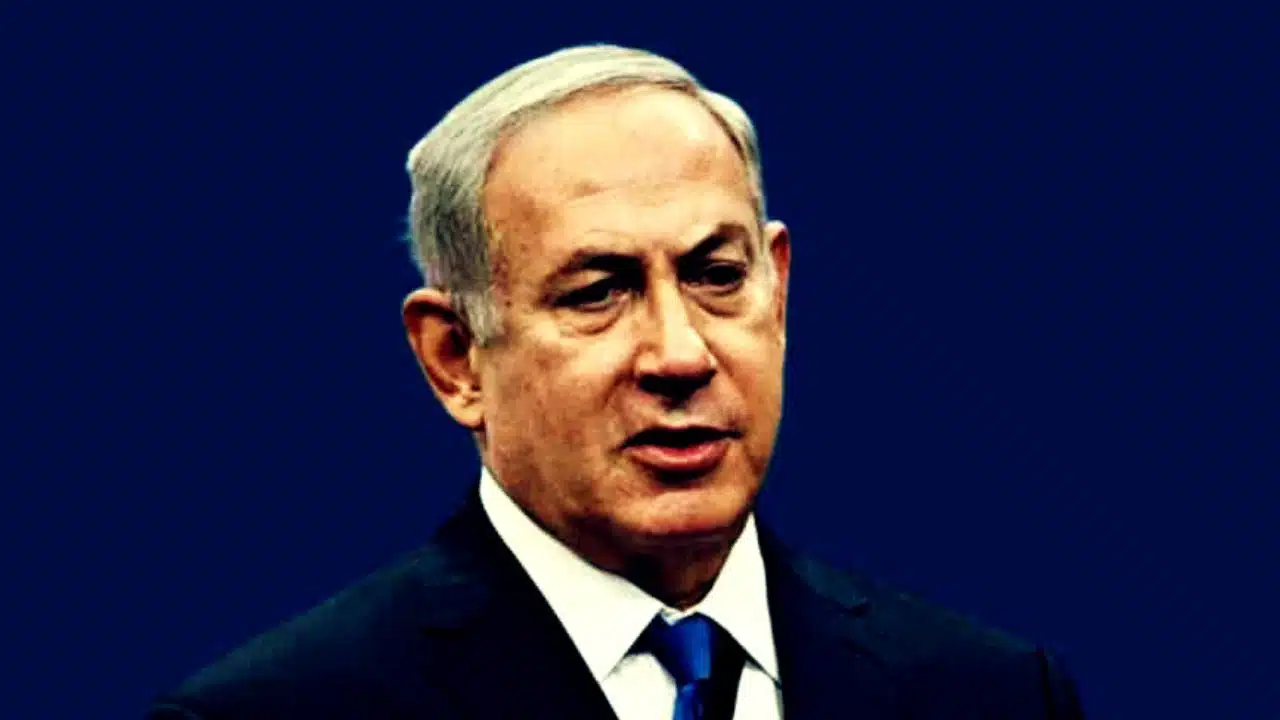
Israeli Prime Minister Benjamin Netanyahu used his address to the 80th United Nations General Assembly in New York to reaffirm his government’s determination to continue military operations in Gaza. He insisted that Israel’s campaign would not stop until Hamas was completely dismantled. Netanyahu stressed that the Israeli Defense Forces were focused on Gaza City, which he described as the last stronghold of Hamas. He said that Israel intended to act swiftly to remove what he called the final remnants of the group in order to prevent any repetition of the deadly attacks of October 7, 2023.
The speech was framed as a justification for Israel’s continuing offensive despite mounting global criticism. Netanyahu argued that Israel’s actions were not only legitimate but necessary for the country’s long-term security. His remarks came at a time when the humanitarian crisis in Gaza has worsened, with international agencies and the International Criminal Court warning that the situation could constitute war crimes. Still, the Israeli leader maintained that the offensive was unavoidable and essential.
A Firm Rejection of a Palestinian State
One of the most striking parts of Netanyahu’s speech was his rejection of international recognition of a Palestinian state. In recent weeks, countries including the United Kingdom, France, Australia, and Canada—long considered close allies of the United States—formally recognized Palestine as an independent state. This move increased the number of countries recognizing Palestine to 157 out of the UN’s 193 member states.
Netanyahu dismissed these recognitions as reckless and dangerous. He argued that allowing the Palestinians statehood after the October 7 attacks was an act of irresponsibility that would, in his words, embolden terrorism rather than promote peace. He compared it to rewarding organizations known for violence and said it amounted to granting legitimacy to those who carried out assaults on Israel. He added that such moves by Western nations did not correct an injustice but instead deepened instability and encouraged extremist violence worldwide.
His statements underscored Israel’s continued rejection of the two-state solution, a framework that has long been supported by the United Nations, the European Union, and much of the international community as the only viable path to peace. Netanyahu insisted that Israel would never agree to such an arrangement.
Diplomatic Walkouts and an Empty Hall
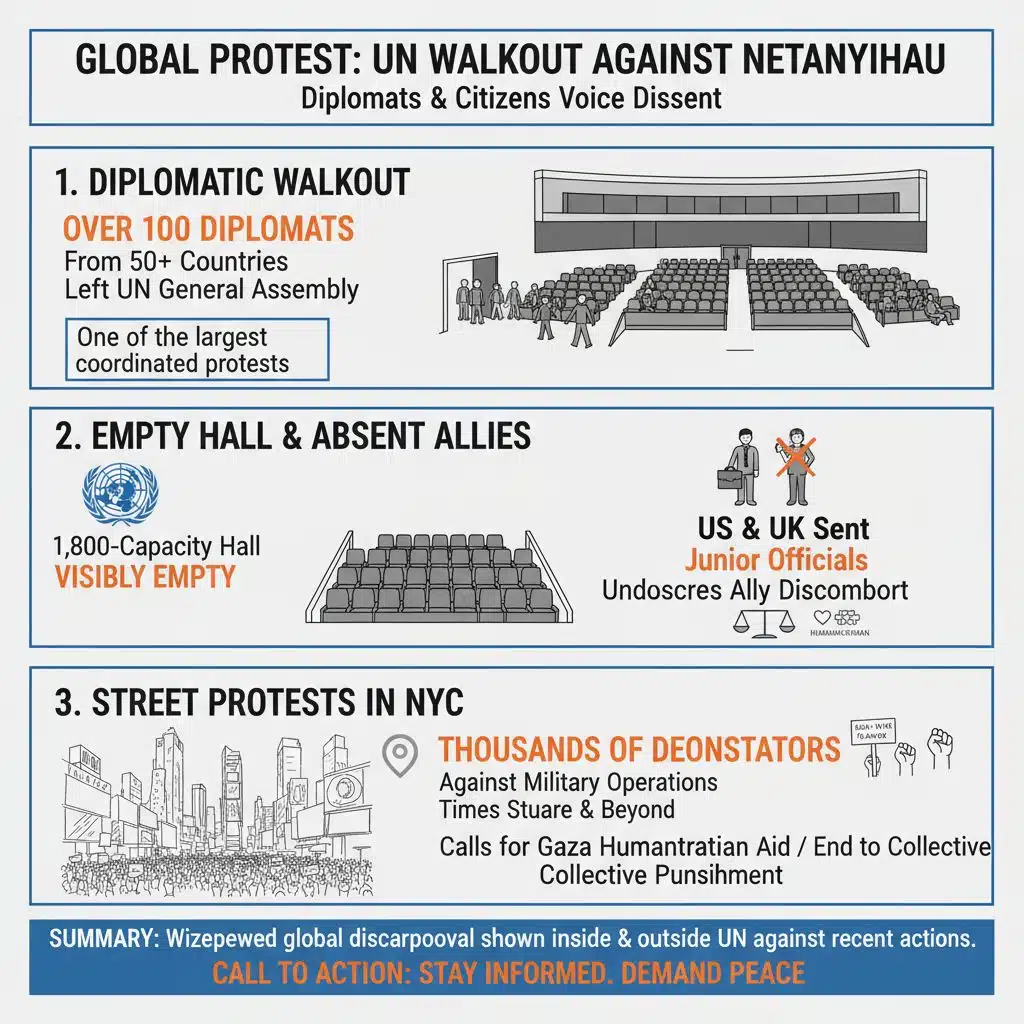
The atmosphere in the General Assembly hall was tense even before Netanyahu spoke. As soon as he entered, more than 100 diplomats from over 50 countries stood up and left the chamber in protest. This mass walkout was one of the largest coordinated demonstrations against a UN speech in recent years. The hall, which can hold nearly 1,800 people, remained visibly empty while Netanyahu delivered his remarks.
Even delegations from the United States and the United Kingdom, which chose to remain present, reportedly sent junior officials instead of senior diplomats. The absence of senior representation underscored the degree of discomfort among Israel’s allies, many of whom have been struggling to balance security concerns with calls for humanitarian protection in Gaza.
Outside the UN, large protests filled the streets of New York. Thousands of demonstrators gathered in places like Times Square, voicing outrage against Israel’s military operations and calling for an end to what they described as collective punishment of Palestinians.
The U.S. Position and the Annexation Debate
Netanyahu’s speech also coincided with significant remarks from former U.S. President Donald Trump, who publicly stated that he would not allow Israel to annex large portions of the West Bank. Some of Netanyahu’s right-wing allies have been advocating annexation of up to 82 percent of West Bank territories, which are formally administered by the Palestinian Authority. UK officials expressed concern that Washington might one day endorse such moves, but Trump sought to reassure the international community by insisting that annexation would not be approved under his leadership.
Netanyahu did not directly address the annexation proposals during his UN appearance. Instead, his office indicated that he would comment on the matter only after a scheduled meeting with Trump at the White House the following Monday. This suggested that the Israeli prime minister was deliberately leaving the door open for negotiation or strategic alignment with Washington before making a final statement.
Claims of International Support and Intelligence Sharing
In his address, Netanyahu emphasized that despite public condemnations, some world leaders have quietly supported Israel. He claimed that these leaders valued Israel’s intelligence capabilities, particularly in preventing terrorist plots abroad. He described how foreign governments had expressed appreciation for the role Israeli intelligence played in foiling planned attacks in their own capitals. However, Netanyahu did not name the countries or leaders involved, leaving those assertions unverifiable.
The implication of his comments was that while Israel faced criticism on the world stage, it remained an indispensable partner behind the scenes in global counterterrorism efforts.
Dramatic Tactics and Propaganda Efforts
Netanyahu’s speech was marked not only by its rhetoric but also by an elaborate media strategy. His team arranged for the address to be broadcast on loudspeakers across Gaza. The Israeli government also claimed to have taken over mobile phone networks in Gaza to transmit the speech directly to residents. Journalists inside Gaza, however, reported that they saw no evidence of the speech being broadcast through phone lines.
During the UN presentation, Netanyahu even used visual props, including a QR code projected onto a screen. The code led viewers to video footage of the October 7 attacks, which Israel has repeatedly used to remind the international community of the brutality of Hamas’s assault and to justify its ongoing military actions. These tactics reflected Netanyahu’s efforts to frame the conflict in stark, emotional terms.
Hostage Crisis and Ultimatum to Hamas
Netanyahu also addressed the ongoing hostage situation. Since the October 7 attacks, dozens of Israeli and foreign hostages remain in Gaza. In his UN speech, the prime minister demanded that Hamas release all hostages immediately. He presented this as the only path for Hamas leaders to avoid further pursuit by Israel. He promised that if the hostages were freed and the group disarmed, survival might be possible for some of its members. Otherwise, Israel would hunt them down relentlessly.
This ultimatum reflected Israel’s longstanding position: that negotiations with Hamas would only be considered if hostages were returned and the group ceased its operations entirely.
International Pushback
Netanyahu’s remarks came just days after the UN General Assembly passed the “New York Declaration”, a non-binding resolution in favor of a two-state solution. Out of 193 UN member states, 142 supported the resolution. European governments, including Spain and France, as well as several Arab nations, reiterated their backing for Palestinian statehood in the days leading up to Netanyahu’s address. Many of these governments argued that peace and stability in the Middle East would remain impossible without granting Palestinians a state of their own.
The wave of recognition of Palestine by Western allies—particularly the UK and France—marked a significant shift in diplomatic positions. For Netanyahu, this development was not only diplomatically isolating but also symbolically damaging, since it showed that Israel was losing support even from traditionally close partners.
A Contentious Moment in World Politics
Netanyahu’s UN speech encapsulated the sharp divisions between Israel and much of the international community. On one side, Israel continues to argue that its military campaign and rejection of Palestinian statehood are essential for survival. On the other side, more than 150 countries now recognize Palestine and insist that coexistence and a two-state solution are the only viable long-term outcomes.
As Israel prepares for further operations in Gaza, the humanitarian toll is expected to worsen, and tensions with allies may deepen. The upcoming meeting between Netanyahu and Trump is seen as critical, with potential implications for the annexation debate, U.S.–Israeli relations, and the broader Middle East peace process.






















