The room is cold. Your phone screen is colder. It is 2:14 AM on a Tuesday, and the blue light is carving hollows into your tired face. You are staring at a cursor. It is a blinking, rhythmic heartbeat in a conversation that has effectively died. This is The Silent Departure. Earlier, those three grey dots appeared. They danced. They promised a sentence, a rebuttal, or even a simple goodbye. Then, they vanished. They left behind a vacuum. In 2026, we have perfected the art of the exit without ever leaving the room. We call it The Silent Departure.
Once, heartbreaks were loud. They involved slammed doors and midnight shouting matches on rain-slicked pavements. They had scripts. Even the worst endings had the dignity of a final word. Today, the most brutal fractures happen in total stillness. You aren’t being dumped. You are being deleted.
The Silent Departure: Beyond Ghosting
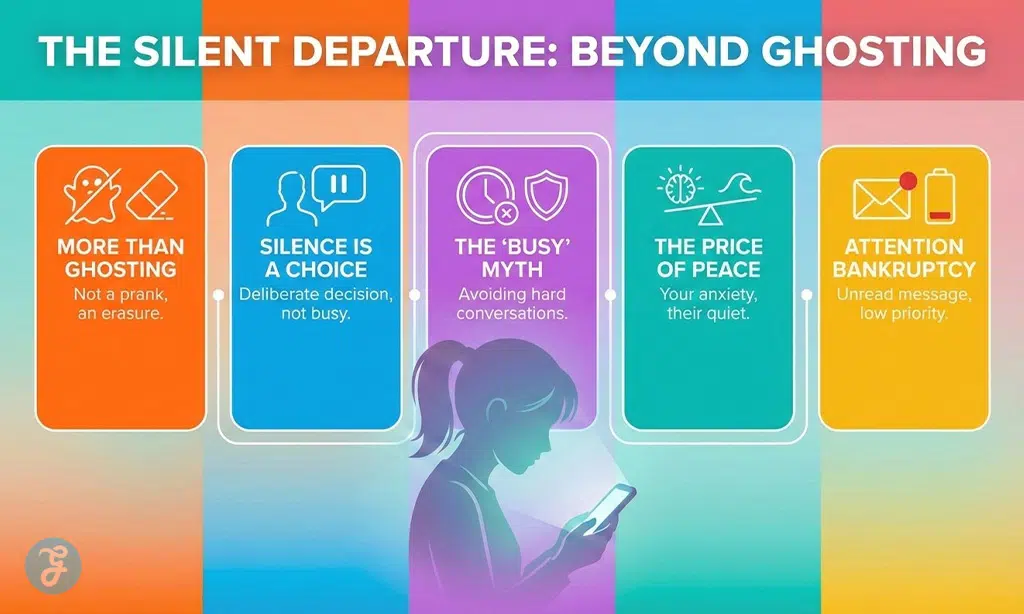
The Silent Departure is the definitive relationship crisis of our decade. It is a quiet, surgical removal of a person from your digital and physical reality. It is more than just ghosting. Ghosting feels like a prank. A silent departure feels like an erasure. It is a calculated withdrawal of energy. Sometimes, it is a power move designed to make the other person feel small. Other times, it is a total emotional collapse where the “sender” simply runs out of words to give. The silence isn’t a lack of communication. It is a declaration.
When someone stops responding, they aren’t “busy.” In a world where we check our phones on an average over 150 times a day, “busy” is a myth we tell to keep our ego intact. The truth is sharper. They have chosen to let the connection atrophy. They have decided that your anxiety is an acceptable price for their peace. We are living in an era where the unread message is the message. It says everything you need to know about your standing in their life. It says they no longer feel the need to explain their absence. It says that in the economy of their attention, you have been declared bankrupt. This is the loudest heartbreak of our time. It is the sound of a notification that never arrives. It is the heavy, suffocating weight of a “Read” receipt that offers no context. It is the realisation that you are grieving a person who is still technically there, but who has already walked out of the back door of the relationship without making a sound.
The Vanishing Act: Somdev and Jennifer
Somdev and Jennifer shared a life in a sun-drenched apartment in Jersey City. They had a routine of Saturday morning diners and a shared Spotify playlist. One Tuesday, Somdev went to work and never mentally came home. There was no fight. Jennifer sent a text about dinner. Then another about a movie. Somdev’s location stayed at his office, then his parents’ house, then vanished. He didn’t block her; he simply stopped existing in her digital world. Two years of shared keys and inside jokes were punctuated by a “Read” receipt at 6:14 PM. For Jennifer, the silence was a physical weight. She had to pack his clothes into boxes while his Instagram story showed him hiking in the Catskills. He was alive, but he had executed The Silent Departure without a single word of explanation.
The Ghosts in the Machine: Pulkit and Rishika
In Bengaluru, Pulkit and Rishika were the “forever” friends. They survived engineering degrees and bad breakups together, speaking in a private shorthand of memes and voice notes. But the dynamic shifted when Pulkit began a string of questionable relationships. When Rishika raised concerns, she was met with a wall of gaslighting. He mocked her, calling her jealous and making her the punchline of his jokes.
Realising the toxicity, Rishika attempted to set a boundary. She stopped being the one to initiate, expecting her absence to be noticed… to perhaps spark a real conversation. Instead, Pulkit used her retreat as an excuse to vanish entirely. When Rishika later got promoted, there was no message. No “congrats.” Nothing.
Rishika waited, assuming he was buried in a product launch, but the silence stretched from weeks into a season. Eventually, she saw him in the background of a mutual friend’s photos at a brewery in Indiranagar. He looked perfectly fine. When she finally reached out to ask what had happened, the blue ticks appeared… but the bubble stayed empty. There was no closure, only the slow, agonising realisation that a decade of loyalty had been retired like an old software update. Pulkit had not left the city. He had simply exited the friendship without the courtesy of a goodbye. In that moment of finality, Rishika realised her silence had been right all along… the boundary was necessary, and Pulkit had simply been taking her presence for granted.
The Expert Lens, A Survival Strategy of the Disengaged: Psychiatrist Dr Sanjay Chugh
Renowned psychiatrist Dr Sanjay Chugh suggests that silence is rarely a random act of cruelty; it is often the final symptom of a relationship starved of safety. When harmony exists, there is no room for the void, but when communication turns into a cycle of “anger and irritability,” silence becomes a survival strategy.

“When I know that if I say something to the partner and I am going to be greeted with this response, I immediately start to avoid saying anything,” Dr Chugh explains. He notes that once a person has decided they no longer wish to continue, they often resort to “shutting the other person out” to avoid the exhaustion of “shouting, bitterness, and fighting”.
Perhaps the most chilling aspect of The Silent Departure is the detachment it requires. Dr Chugh observes that, by the end, the person leaving may not care “at all, or enough to even bother” what their partner endures in the wake of that silence. It is an efficient, albeit bloodless, way to achieve an end.
The Anatomy of the Void: Why Silence Screams

The human brain is a completion machine, biologically programmed to resolve every sentence. In Gestalt psychology, the “law of closure” dictates that when we encounter a gap, our minds reflexively bridge the distance to create a whole. Relationships demand the same finality; we require the “full stop” to process an ending. When a partner initiates The Silent Departure, they leave an open wound in the narrative. Deprived of a concrete explanation, the brain enters a state of frantic internal searching, often inventing self-inflicted reasons far more cruel than any spoken truth.
This absence of closure is a neurological stressor rather than a mere emotional annoyance. An open loop keeps the brain in a state of high alert, constantly scanning for a signal that never arrives. This is the Zeigarnik effect in its most toxic form. It is the mental equivalent of a song cutting off before the final note. The listener is left haunted by a missing chord.
By 2026, social capacity has evolved into a finite, overdrawn currency. We are currently mired in a period of “Communication Bankruptcy”. Digital inboxes function like mounting debt; every ignored text is a social loan left unpaid. When the interest on these obligations becomes insurmountable, many choose to liquidate their connections rather than endure a difficult conversation. They simply vanish.
This marks a definitive shift from the “Dear John” letter to the “Left on Read” era. A letter demanded effort, a physical admission of the end, and a tangible object to hold or destroy. Today, we are left with the sterile void of a screen. In this landscape, the unread message isn’t an absence of news, it is a brutal, final declaration.
The Three Pillars of Silence
Silence is not a monolith. It is a spectrum. To understand why someone vanishes, we have to look at the intent behind the absence. There are three distinct architectures of the quiet.
1. The Power Move [The Case of Somdev]
This is the most predatory form of The Silent Departure. It is a tactical withholding of affection used to reset the hierarchy of a relationship. Consider Somdev’s exit from his life with Jennifer. When he stopped responding, he didn’t block her; he simply let the messages sit on “Read” while his life continued visibly on social media.
This is a digital game of chicken. By refusing to engage, the silent partner forces the other into a state of “performance.” Jennifer began to overcompensate, sending multiple texts for every one of his silences, essentially apologising for a vacuum she didn’t create. In this scenario, silence is a leash. It is a psychological waiting room where one party is left to rot until the “powerful” party decides they have been humbled enough. It is not about a lack of words; it is about a surplus of control.
2. The Protective Boundary: When Silence is a Shield [The Case of Rishika]
Rishika’s story highlights a brutal paradox: sometimes, one person tries to build a fence, and the other person responds by burning the bridge.
However, there is another side to this silence. For many, The Silent Departure is the only way to exit a burning building. This is the “Grey Rock” method… a survival strategy used when a relationship becomes a cycle of circular arguments. When a connection is defined by gaslighting, silence becomes the final act of agency. You stop explaining. You stop defending your position. You become as uninteresting and unresponsive as a pebble on a beach. In this context, the lack of a goodbye is the sound of a door locking from the inside. It is not an act of cruelty; it is the beginning of recovery.
3. The Emotional Shutdown [The Neurological Freeze]
The third pillar is perhaps the most misunderstood: the involuntary collapse of the nervous system. This is where the Silent Departure intersects with Polyvagal Theory. Our brains possess a physical “off” switch for social engagement; when a person is overwhelmed by perceived conflict or historical trauma, they don’t simply choose to be quiet, they enter a state of dorsal vagal shutdown.
As Dr Sanjay Chugh notes, when an individual anticipates that any dialogue will be met with “anger and irritability,” the brain may perceive a mortal threat. The heart rate drops, the throat tightens, and the individual literally loses the physical ability to form sentences. To a partner like Jennifer or Rishika, the person looks bored, stubborn, or indifferent. In reality, they are “drowning in shallow water.”
This is a neurological freeze response, a survival mechanism designed to protect the body by “playing dead.” The person has gone offline. In these instances of The Silent Departure, the individual is not trying to be powerful, nor are they necessarily trying to be protective; they are simply incapable of being present.
As Dr Chugh candidly observes, by this stage, the person may not even care “enough to bother” with the other’s pain because their entire system is focused on its own survival. It is a tragedy of biological proportions: one party is left feeling abandoned, while the other is trapped inside a body that has locked its own doors. It reminds us that sometimes, the person who has gone silent isn’t hiding a secret, they are hiding from a storm that only they can hear.
Friendship vs. Romance: The Ghosting Spectrum
Romantic breakups have a roadmap. There are songs for them. There are scripts. We expect them to be painful, so we prepare for the impact. But the friendship fades with a different kind of ghost. It is a slow, quiet thinning of the blood.
In 2026, we find it strangely easy to let a friend slip into the void. We tell ourselves we are just busy. We tell ourselves we will reply when we have more “capacity.” Days turn into months. Eventually, the thread becomes so translucent it snaps without either person noticing the exact moment of the break.
The heartbreak of a friend’s Silent Departure often outlasts a romantic split. There is no formal ending to point to. There is no clear reason why you were relegated from a best friend to a casual observer of their Instagram stories. This ambiguity creates a unique trauma. You are left mourning someone who is still very much alive and laughing, just not with you.
Much of this is fuelled by a modern mutation of self-care. We have entered the era of the “Main Character” narrative. On social media, we are constantly told that our peace is paramount. We are encouraged to cut off anyone who “drains” us. While this is vital for escaping abuse, it has become a convenient excuse for basic emotional laziness.
We are taught that we owe nobody anything. Not a text. Not an explanation. Not even a final “no.” This version of mental health is hollow. It confuses isolation with boundaries. By framing every difficult social obligation as a “toxic energy,” we have given ourselves permission to be cowards.
When we choose the silence of the Main Character, we aren’t just protecting our peace. We are eroding our community. True mental health is built on the ability to navigate friction, not just delete it. When we treat people like browser tabs that can be closed without thought, we lose our own humanity in the process.
The “Main Character” syndrome suggests that your comfort is the only metric that matters. But a relationship is a shared ecosystem. If you leave without a word, you aren’t just “choosing yourself.” You are leaving a mess for someone else to clean up. In the end, this culture of easy exits doesn’t make us more peaceful. It just makes us more alone. We have gained the right to be silent, but we have lost the skill of being connected.
The Cost of the Unspoken

When someone initiates The Silent Departure, they leave behind a psychological crime scene. For the person left in the dark, the damage is long-lasting. This is not just hurt feelings. It is the birth of hyper-vigilance.
When you are abandoned without an explanation, your brain stops trusting the safety of silence. In your next relationship, a delayed text or a quiet evening is no longer a neutral event. It is a siren. You begin to scan for the exit signs before the first date is even over. You become a detective of your own misery. You look for the “flicker” of the other person’s interest, waiting for the moment they, too, decide to vanish. This is the trauma of the unsaid. It turns future partners into potential ghosts.
But the silence is not free for the one who leaves, either. We like to think that by hitting “delete,” we have avoided the discomfort. We haven’t. We have just moved it to a different part of the basement.
The Zeigarnik Effect suggests that our minds are haunted by unfinished tasks. When you leave a relationship without a final word, you are keeping a mental tab open forever. You carry the weight of that unclosed loop in your subconscious. It sits there as a low-level hum of anxiety.
By avoiding the hard conversation, you fail to develop the “emotional muscle” needed for a mature life. You become a person who runs. Eventually, that running becomes your only setting. The ghoster thinks they have found a shortcut to peace. In reality, they have built a habit of cowardice that follows them into every new room they enter.
Both parties are left diminished. One is left looking over their shoulder, while the other is left running from a shadow. The cost of the unspoken is a permanent dent in your ability to be brave. It is a high price to pay for the temporary comfort of being quiet.
Reclaiming the “Noisy” Goodbye
The antidote to the silence of 2026 is simple. It is also terrifying. We have to bring back the hard conversation. We need to reclaim the “noisy” goodbye.
Radical transparency does not mean being cruel. It means being clear. It is the act of telling someone where they stand. Even if the sentence is “I don’t want to talk to you anymore,” it is an act of mercy compared to the void. A clear rejection allows a person to start grieving. A silent departure forces them to stay in a state of perpetual, anxious waiting.
In a world obsessed with protecting our own energy, we have forgotten that ethics require us to consider the energy of others. Kindness is not the absence of conflict. It is the presence of respect. By giving someone a final word, you are acknowledging their humanity. You are saying that they were important enough to merit a full stop rather than an ellipsis.
We need to stop treating discomfort like a disease. The tension of a difficult breakup or a friendship “talk” is a sign of health. It shows that the connection meant something. When we bypass that tension, we aren’t being “chill.” We are being hollow.
If the unread message is indeed the message, then we are currently a society of cowards. We are people who prefer a clean screen to a clean conscience. We have traded the weight of words for the emptiness of ghosts.
It is time to be louder. It is time to send the text. It is time to have the phone call. We must stop letting our relationships end in the quiet of a 2:00 AM blue light. If we are going to break hearts, let us at least have the courage to say so.
The silence has been the loudest response for long enough. It is time to start talking again. Because the only thing worse than a heartbreak is a heartbreak that you aren’t allowed to finish.
Note: Names in the Bengaluru and Jersey City case studies have been changed to protect the privacy of those who experienced The Silent Departure.