Tesla is officially set to launch its long-anticipated robotaxi service this Sunday in Austin, Texas, marking what could be a historic shift in the company’s growth trajectory and the global ride-hailing industry. This rollout, featuring self-driving Model Y SUVs, is being closely watched by investors, regulators, and autonomous tech competitors alike.
While Elon Musk had originally intended to use Tesla’s much-hyped Cybercab—a futuristic vehicle with no steering wheel or pedals—for this project, it remains under development and isn’t expected to enter production until 2026. Instead, the company is beginning the robotaxi program with modified Model Y electric vehicles, retrofitted with Tesla’s Full Self-Driving (FSD) software and enhanced autonomous capabilities.
The launch represents the beginning of Tesla’s ambitious expansion into autonomous services, which Musk and his supporters claim could revolutionize urban mobility and transform Tesla into a global leader in AI-driven transportation.
A New Chapter After Political Turmoil
This development comes amid renewed focus on Tesla’s core businesses after Elon Musk’s controversial involvement in Donald Trump’s administration. Tensions between Musk and Trump escalated earlier this month, with the two influential figures engaging in a public spat that dominated headlines. The falling out was reportedly intense, with harsh words exchanged on both sides, damaging a once-productive political-business alliance.
Following the breakdown in relations, Musk appears to be doubling down on innovation and Tesla’s strategic direction. He has expressed regret for several of his recent political statements, acknowledging their potential impact on Tesla’s brand and investor confidence. His renewed commitment to the company is reflected in the careful, high-stakes planning of the robotaxi rollout.
Why Austin? The Appeal of Texas for Tesla
The decision to launch in Austin is not random. Texas has cultivated a business-friendly regulatory climate that makes it an attractive testing ground for new transportation technologies. The state allows autonomous vehicle (AV) testing and operations as long as companies meet the same safety and insurance standards required of traditional vehicles.
The Texas Department of Transportation has clarified that companies like Tesla are currently allowed to operate AVs on public roads under existing regulations. This gives Tesla a legal green light to begin its pilot operations without facing significant regulatory hurdles—at least for now.
Austin is already a hub for several AV developers, with six companies known to be active in the region:
-
Tesla
-
Waymo (Alphabet/Google)
-
Zoox (Amazon)
-
Motional (Hyundai)
-
AVRide
-
ADMT (Volkswagen)
Tesla is entering a competitive but promising ecosystem, where local infrastructure and public interest in innovation provide an ideal environment for a phased rollout.
New Laws Could Complicate Tesla’s Plan
Despite the current permissive framework, Texas lawmakers have introduced new legislation aimed at increasing oversight over autonomous vehicles. A recently passed bill, set to take effect on September 1, 2025, will require companies to obtain prior authorization from the Texas Department of Motor Vehicles (TxDMV) before deploying driverless cars on public roads.
The law will also mandate AV operators to:
-
Submit safety evaluations
-
Demonstrate remote operational protocols
-
Work with emergency responders
-
Document how the vehicles handle malfunctions or accidents
In response to the upcoming law, seven Democratic legislators sent a letter to Tesla on June 18, urging the company to delay the launch until the law takes effect. They called on Tesla to voluntarily comply with the forthcoming regulations and provide documentation showing that the rollout will meet the new legal and safety standards.
This political request, however, is not legally binding—so Tesla still has the green light under current rules.
Initial Rollout: A Cautious Approach
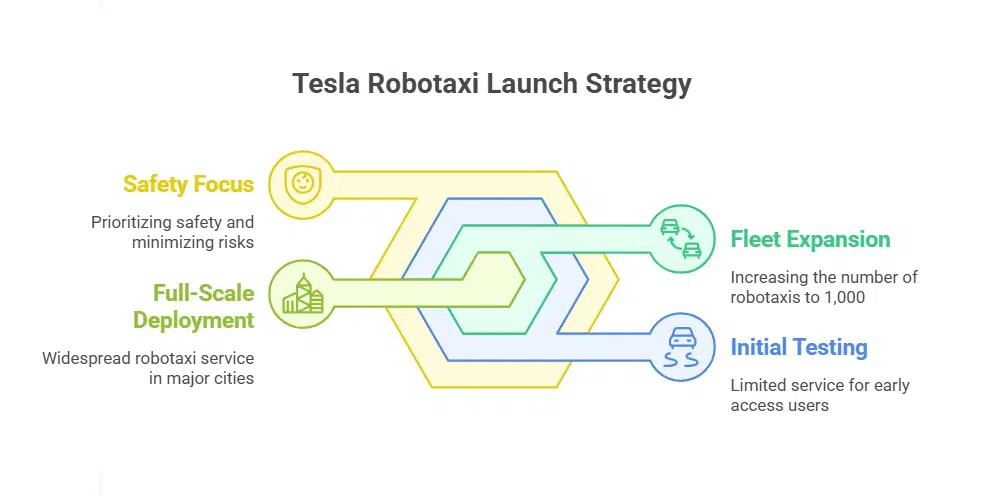
Elon Musk has emphasized that Tesla will proceed slowly and carefully with the robotaxi launch. Originally scheduled for June 12, the launch was postponed to June 23 to allow for further testing and fine-tuning.
In a May 20 interview with CNBC, Musk explained that Tesla is taking a “super paranoid” approach to safety, aiming to minimize risk in the early stages of deployment.
For the initial phase, Tesla will deploy around 10 Model Y robotaxis, operating within a geofenced area of Austin. The service will run from 6:00 a.m. to midnight, exclusively for “early access” users—a group likely to include Tesla investors, employees, and invited guests.
As the system matures and data is collected, the fleet is expected to expand to 1,000 vehicles within a few months, followed by launches in other major U.S. cities such as:
-
San Francisco
-
Los Angeles
-
San Antonio
Safety Measures and Government Oversight
The U.S. National Highway Traffic Safety Administration (NHTSA) has been monitoring Tesla’s Full Self-Driving technology for several years. In October 2024, the agency opened a formal probe into Tesla’s FSD software after receiving multiple crash reports involving the system.
In May 2025, the NHTSA requested more information from Tesla about the company’s safety protocols ahead of the Austin launch. This includes:
-
How Tesla handles emergency situations
-
What backup systems are in place if the software fails
-
Whether a human operator can take control remotely
Importantly, the NHTSA does not pre-approve new vehicle technologies. Instead, the agency operates under a self-certification model, where manufacturers must ensure their vehicles meet all safety standards. The agency investigates after-the-fact if safety issues arise.
Tesla has stated that during the pilot phase:
-
A safety monitor will ride in the front passenger seat (not in the driver’s seat)
-
The vehicle is equipped with remote override technology
-
Each ride can be stopped or redirected by a human in real-time if necessary
The Bigger Picture: Can Tesla Dominate Autonomy?
Tesla is arriving late to the commercial robotaxi race. Rivals such as Waymo and Cruise have already launched paid autonomous ride services in U.S. cities, including Phoenix, San Francisco, and Los Angeles. These services use highly sensor-laden vehicles with lidar, radar, and human teleoperation support.
Tesla, by contrast, relies on its vision-based AI, powered entirely by cameras and deep learning models, without lidar. The boldness of this approach has drawn skepticism from many industry analysts and safety experts. However, Tesla’s software-first philosophy is also what makes it unique—and potentially more scalable.
Dan Ives, a longtime Tesla bull and analyst at Wedbush Securities, believes this launch could unlock trillions in future market value for the company. He argues that autonomy will define Tesla’s next decade, even as short-term issues like falling quarterly profits (down 71% in Q1 2025) pressure the company.
Looking Ahead: From Model Y to Cybercab
While Tesla’s robotaxi launch is starting small and cautiously, Elon Musk’s long-term vision hinges on the future production of the Cybercab, a radical, purpose-built autonomous vehicle with no pedals, no steering wheel, and a sleek futuristic design.
Musk unveiled the Cybercab concept in late 2024, promising full-scale manufacturing by 2026. Once launched, the Cybercab could become the foundation of Tesla’s global autonomous ride-hailing network.
Until then, the Model Y-based service will act as a proving ground for the company’s autonomy ambitions, public trust-building, and regulatory compliance.