


The technical landscape of American e-commerce in 2026 has moved beyond simple keyword optimization into the realm of infrastructure level competition. With the rise of AI driven shopping agents and the Department of Justice’s stricter enforcement of digital accessibility, the backend architecture of a US based store is now its most powerful ranking factor. For retailers operating in the high velocity North American market, technical SEO is no longer about fixing errors but about building a data rich environment that search engines and AI models can trust.
How We Selected These 7 Overlooked Technical Factors
To identify the most critical but often ignored aspects of technical SEO for 2026, we analyzed the performance of the top 100 US e-commerce platforms against the latest Google Merchant Center first indexing updates. We prioritized factors that directly influence visibility in Generative Engine Optimization (GEO) and those that impact the legal compliance landscape unique to the United States. Our selection focuses on the intersection of logistics, accessibility, and AI retrieval.
The data below outlines the performance benchmarks currently separating industry leaders from the rest of the market.
| Technical Metric | Industry Standard (Avg.) | High-Performance (Top 10%) |
| Interaction to Next Paint (INP) | >300ms | <150ms |
| Merchant Schema Accuracy | 65% | >98% |
| Accessibility Compliance (WCAG 2.1) | Partial / Reactive | Full AA / Automated |
| Logistical API Latency | 1.2s | <0.4s |
| AI Retrieval Citation Rate | 12% | 45%+ |
7 Essential Strategies for Technical SEO for American E-Commerce
Mastering the American market requires a deep understanding of how specific US regulations and consumer expectations translate into code. These seven points highlight the technical nuances that most traditional SEO audits overlook.
The first major shift involves a fundamental change in how Google perceives the source of truth for a product.
1. The Merchant Center-First Indexing Architecture
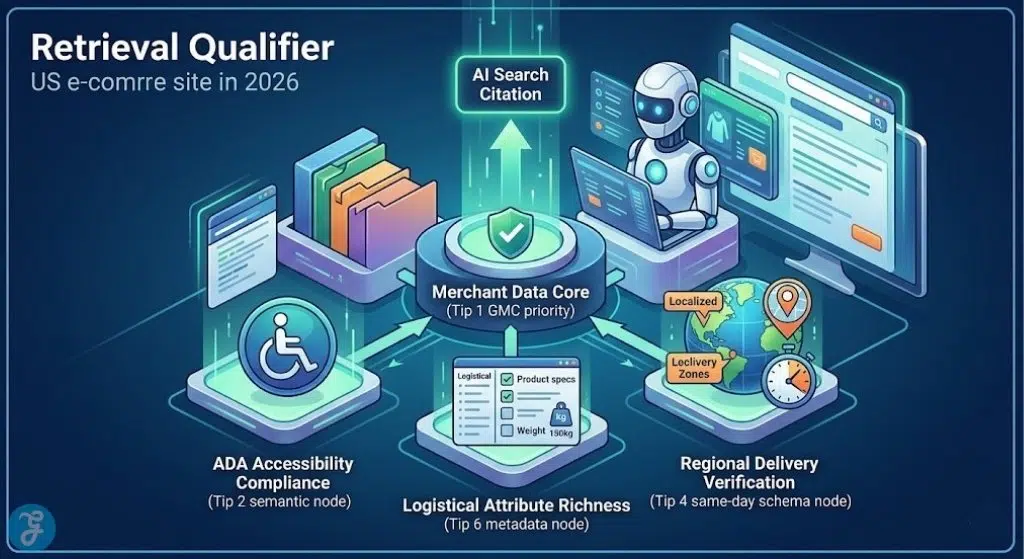
In 2026, Google has increasingly decoupled its shopping index from traditional web crawling. Most people still treat the Google Merchant Center (GMC) as a separate advertising tool. For US e-commerce, it has become the primary retrieval qualifier. If your GMC feed data such as pricing or shipping zones contradicts your on page schema, Google will prioritize the feed. This often results in suppressed search results. Successful stores now treat their GMC feed as their primary technical SEO asset.
Best for: High volume retailers with frequent price changes or regional inventory fluctuations.
Why We Chose It:
-
It is the single most common cause of missing rich results in the current US SERPs.
-
AI shopping agents rely more on GMC feeds than on page text to make recommendations.
-
Accurate feed data acts as a direct ranking signal for buyable queries.
Things to consider: Use a real time API integration for your feed rather than a daily XML upload to ensure data parity.
While technical data is vital, a new regulatory environment has turned accessibility into a hard requirement for visibility.
2. ADA Compliance as a Retrieval Qualifier
Following the April 2024 Department of Justice ruling, digital accessibility is no longer just a legal risk. It is a technical SEO pillar. Most people do not know that Google’s 2026 algorithms now use WCAG 2.1 AA standards as a proxy for User Experience. Sites with poor heading hierarchies or non descriptive link text are being de-prioritized in AI overviews. They are fundamentally harder for machine learning models to parse and summarize.
Best for: US based businesses looking to avoid legal liability while simultaneously boosting crawlable authority.
Why We Chose It:
-
It aligns technical compliance with the trust signals required for high rankings.
-
Semantic HTML required for ADA compliance directly improves machine readability.
-
It expands your potential audience to the millions of Americans living with a disability.
Things to consider: Automated accessibility overlays often create crawl traps and do not count toward true technical SEO compliance.
The complexity of the US logistical system often creates hidden performance bottlenecks that traditional audits miss.
3. Optimizing Real-Time Tax and Shipping APIs
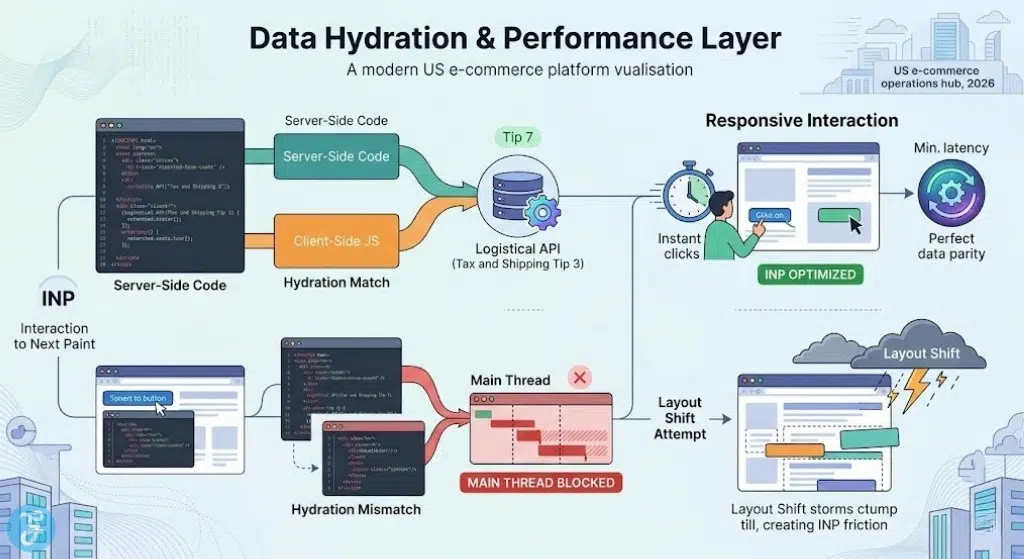
American e-commerce relies heavily on third party APIs for real time sales tax calculation and shipping lead times. These scripts often fire during the Interaction to Next Paint (INP) phase of the page load. Most SEOs focus on image size, but the main thread blocking caused by these US specific logistical calls is the primary reason stores fail their Core Web Vitals. Optimizing how these APIs hydrate on the page is a niche but critical technical requirement.
Best for: Mid to large e-commerce platforms using headless commerce or complex fulfillment networks.
Why We Chose It:
-
INP is now a major Google ranking factor and is directly impacted by these third party scripts.
-
Optimizing API calls can reduce time to interaction by over 500ms.
-
It prevents cart abandonment by ensuring the UI remains responsive during high calculation phases.
Things to consider: Implement Edge SEO or server side pre fetching to handle these calculations before the user reaches the checkout page.
For domestic retailers, local delivery speed has become a visible search engine attribute.
4. Same-Day Delivery Schema as a Localized Trust Signal
Same day delivery is now a standard consumer expectation in urban US hubs. However, most people do not know that there is specific ProductAvailability and ShippingDetails schema that flags this at a technical level. By explicitly declaring SameDay capabilities in your structured data, you become eligible for specific badges in Google Shopping. You also gain visibility in AI generated local recommendations that your competitors using generic schema will miss.
Best for: Multi location retailers or stores utilizing micro fulfillment centers in major US cities.
Why We Chose It:
-
Speed to customer is a primary conversion driver in the North American market.
-
It allows your site to compete with Amazon in local near me search results.
-
The schema acts as a verified Experience signal for Google’s search evaluations.
Things to consider: You must ensure that your logistics team can actually fulfill the SameDay claim as Google tracks delivery performance via user feedback.
Managing the sheer volume of product variants in a massive US catalog requires a specific approach to bot management.
American retailers often offer massive variety such as a single shirt in 12 colors and 6 sizes. This creates millions of potential URL combinations. Most developers use Noindex tags to manage this, but most people do not know that Google still crawls noindexed pages. This wastes your crawl budget. The technical fix is using robots.txt to block parameter strings while using a canonical tag to consolidate authority. This ensures search bots only spend time on your high conversion pages.
Best for: Fashion and hardware retailers with deep catalogs and multiple filter options.
Why We Chose It:
-
It prevents thin content penalties caused by thousands of nearly identical variant pages.
-
Efficient crawl budget management ensures your new products are indexed within hours.
-
It reduces server load and improves overall site stability during peak traffic events like Black Friday.
Things to consider: Be careful not to block parameters that are essential for user facing features like pagination.
As search becomes conversational, the data behind the product is becoming more important than the description.
6. Merchant Data as Retrieval Metadata for AI Agents
When a user asks an AI agent to find a sustainable hiking boot under 150 dollars in a specific size, the agent does not just read your product description. It looks for Retrieval Metadata. This includes structured attributes like material and water resistance status. Most stores leave these fields blank or unstructured. Technical SEO in 2026 requires populating every available ProductGroup attribute so that AI Generative Engines can accurately cite your product.
Best for: Brands selling technical or high specification goods where buyers compare specific features.
Why We Chose It:
-
It is the primary way to secure a Citation in Google’s AI Overviews.
-
Detailed attributes significantly improve the accuracy of internal site search.
-
It reduces returns by ensuring customers find the exact specification they need.
Things to consider: Audit your Product Information Management system to ensure it aligns with the latest Schema definitions.
The final technical challenge often arises from the very tools meant to make the site faster.
7. Addressing Headless Commerce Hydration Errors
Many modern US stores have moved to Headless architectures to improve speed. However, these systems often suffer from Hydration errors. This is where the server rendered HTML does not match the client side JavaScript. Most people do not know that these errors can cause Google to see a blank page or a broken layout even if it looks fine to a human user. Monitoring the rendered HTML against the source HTML is a mandatory technical SEO task for headless stores.
Best for: Enterprises and high growth brands using modern custom frontends.
Why We Chose It:
-
Hydration mismatches are a leading cause of sudden and unexplained ranking drops in headless sites.
-
It impacts the Visual Stability metric within Core Web Vitals.
-
Search bots are increasingly sensitive to JavaScript heavy rendering inconsistencies.
Things to consider: Use tools to render your site and compare the output to your raw server side code.
2026 Technical SEO Audit Checklist for US Retailers
Implementing these strategies requires a coordinated effort between your SEO and development teams. The table below serves as a guide for auditing your store’s readiness for the current American search environment.
This checklist is designed to prioritize high impact technical changes that offer the greatest competitive advantage.
| Audit Area | Key Task | Expected Outcome |
| GMC Parity | Match GMC Feed attributes to on-page Schema. | Consistent Rich Result visibility. |
| Accessibility | Run WCAG 2.1 AA audit on all Add to Cart paths. | Improved GEO citation and legal safety. |
| Latency | Deferred loading of non-critical Tax and Shipping APIs. | Passing Interaction to Next Paint (INP). |
| Schema | Implement localized ShippingDetails for Same-Day zones. | Eligibility for fast-shipping badges. |
| Rendering | Verify Rendered HTML parity in headless setups. | Stable indexation of JavaScript content. |
The 3 Most Critical Technical Factors and Why?
While all seven points are valuable, these three are the most important for any American e-commerce brand that expects to survive the 2026 AI search transition.
-
Merchant Center Parity: Without parity, your buyability signals will fail and you will be invisible to AI shopping assistants.
-
ADA Technical Compliance: This is the new Mobile First index. If your site is not accessible to machines and people, it will not be retrieved.
-
Attribute Richness: The brand with the most structured data wins the AI recommendation battle regardless of their backlink profile.
Future-Proofing Your American E-Commerce Infrastructure
The shift toward a more technical and data driven SEO model in the United States reflects a broader change in the digital economy. We are moving from links and text to entities and attributes. By addressing the hidden bottlenecks in your logistical APIs and prioritizing the richness of your Merchant Center data, you are doing more than just ranking. You are ensuring that your products are discoverable by the AI driven agents that will dominate the shopping journey in the years to come. In 2026, the winner is the retailer who builds the most legible and resilient technical foundation.
Frequently Asked Questions (FAQs) on Technical SEO for American E-Commerce
Why is my Google Merchant Center feed more important than my website text?
Answer: Google now treats the GMC as the primary source of truth for product availability and pricing. AI shopping agents prioritize this verified data over standard web content.
Does ADA compliance actually affect my search rankings?
Answer: Yes. In 2026, Google uses accessibility standards as a proxy for high quality user experience. Inaccessible sites are often excluded from AI generated answers and summaries.
What is an Interaction to Next Paint (INP) score?
Answer: INP is a Core Web Vital that measures how quickly a page responds to a user interaction like clicking a button. For US e-commerce, it is often impacted by tax and shipping calculation scripts.
Answer: When search bots spend time crawling millions of filter combinations instead of your main product pages, they miss new content and updates. This leads to poor indexing performance.
What is a hydration error in headless commerce?
Answer: It is a technical mismatch between the static HTML sent by the server and the interactive version built by the browser. It can lead to broken layouts and invisible content for search bots.






















