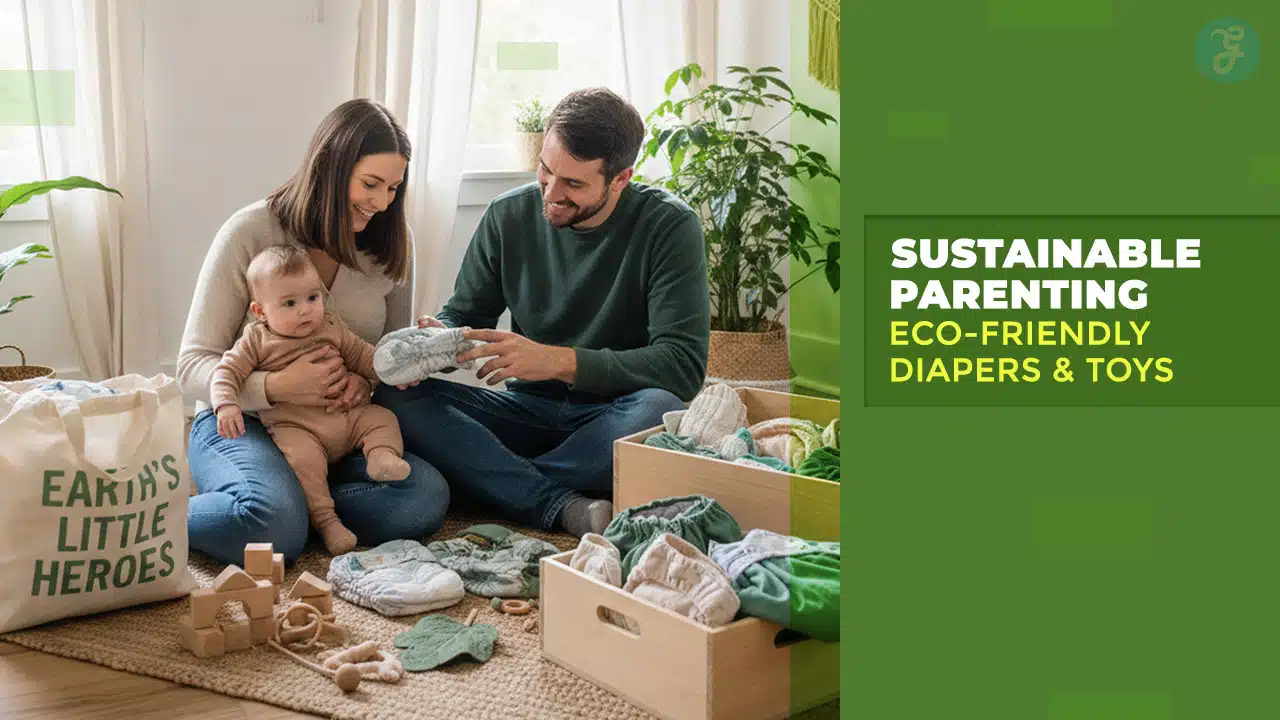
Parenting is a series of messy, beautiful, and exhausting moments. Between the sleepless nights and the first smiles, many of us start looking at the sheer volume of trash a single baby generates—thousands of diapers, piles of plastic toys, and endless wipes—and wonder if there is a better way.
You want to protect your child’s future, both by reducing the waste they inherit and by minimizing the chemicals they are exposed to right now. But you also need solutions that actually work. A leaky diaper is a disaster, regardless of how eco-friendly it is.
The Promise: This guide isn’t about perfection; it’s about better choices. We will help you reduce landfill waste, lower your baby’s exposure to harsh chemicals, and keep your daily routine practical and sanity-saving.
In this deep dive, we will navigate the complex world of eco-friendly diapers (from cloth to plant-based disposables), break down safe toy materials, decode the confusing alphabet soup of certifications, and establish routines that make sustainable parenting stick. Let’s build a nursery that is safe for your baby and kinder to the planet.
What “Eco-Friendly” Really Means For Diapers And Toys
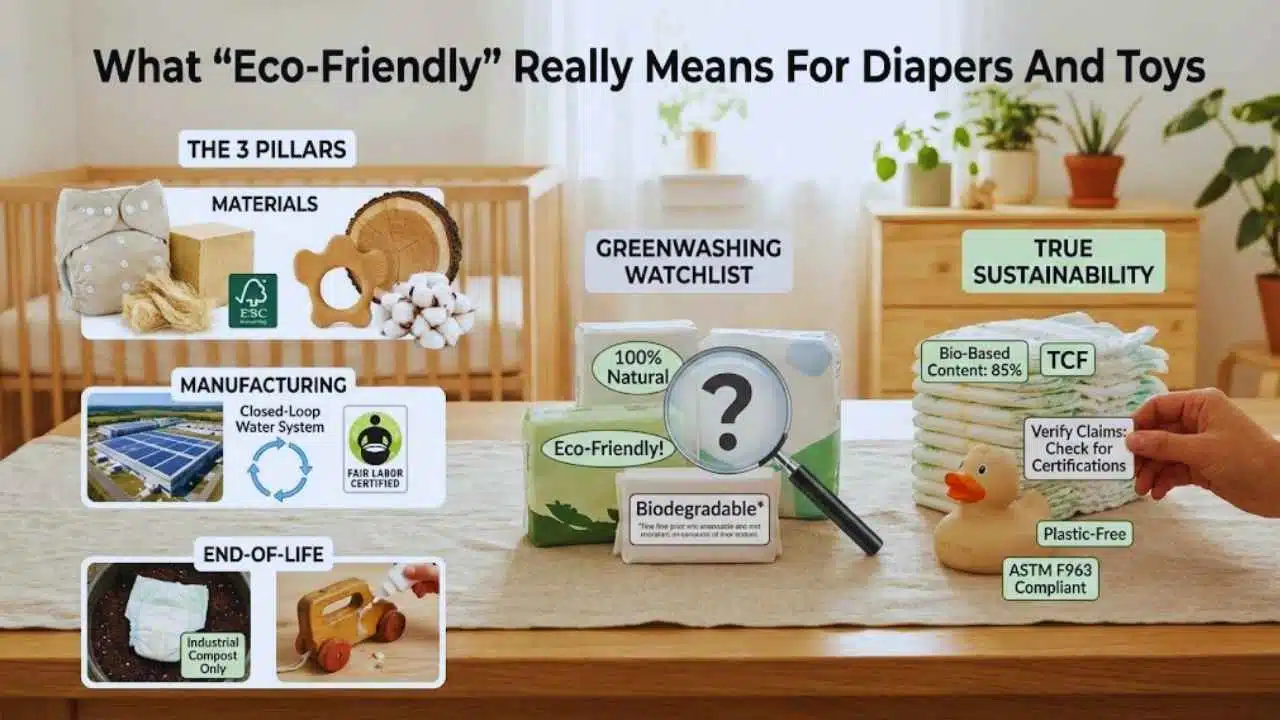
The term “eco-friendly” is plastered on everything from wet wipes to rattle sets, but without a standard definition, it can feel meaningless. To truly parent sustainably, we need to look past the green packaging and understand the lifecycle of a product.
The 3 Pillars: Materials, Manufacturing, End-Of-Life
True sustainability rests on three pillars. If a brand only addresses one, they aren’t giving you the full picture.
- Renewable Inputs (Materials): This refers to what the product is made of. Are the diapers made from petroleum-based plastics, or do they use bamboo, hemp, or FSC-certified wood pulp? For toys, is it virgin plastic, or is it natural rubber, organic cotton, or recycled HDPE? Sustainable inputs are rapidly renewable and require fewer pesticides and water to grow.
- Responsible Sourcing & Manufacturing: How was it made? This covers the human element (fair labor practices) and the environmental footprint of the factory. Look for manufacturers that use closed-loop water systems (recycling water used in production) and non-toxic processing methods (like avoiding chlorine bleaching).
- End-Of-Life (Disposal): This is often the hardest pill to swallow. Where does the product go when you are done? Does it rot in a landfill for 500 years? Is it biodegradable? Can it be composted (commercially or at home)? Or, in the case of toys, is it durable enough to be passed down or repaired rather than thrown away?
Greenwashing Watchlist (Words That Need Proof)
Marketing teams know that parents are worried about the planet, leading to “greenwashing”—exaggerated claims that mask standard products. Here are the buzzwords that require scrutiny:
- “Natural”: This is legally meaningless. Arsenic is natural; it doesn’t mean you want it in a teether. Always check the ingredients list for specific material names (e.g., “100% natural rubber”).
- “Eco”: A generic term. Ask: Why is it eco? Is the packaging recycled, or is the product itself sustainable?
- “Biodegradable”: This sounds great, but it usually requires specific conditions (like high heat and oxygen) found in industrial composting facilities, not in a sealed landfill. Without those conditions, “biodegradable” plastic may just break down into microplastics.
- “Compostable”: Verify if this means home compostable or industrial compostable. Very few diapers are home compostable.
- “Non-Toxic”: A baseline expectation, not a premium feature. Look for third-party lab results that prove the absence of specific toxins like lead, BPA, and phthalates.
Eco-Friendly Diapers: Types, Pros/Cons, And Who Each Is Best For
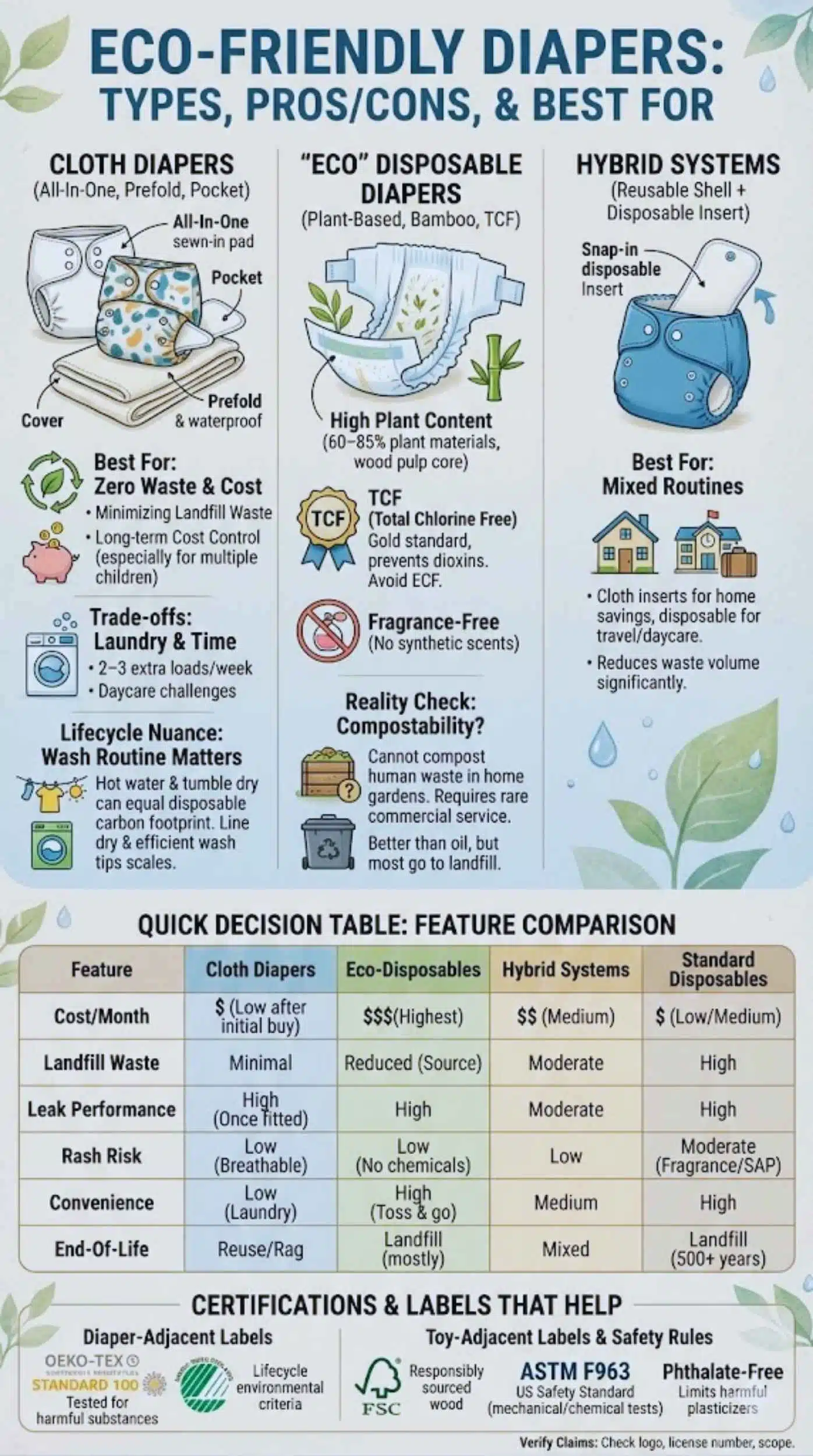
The average baby uses between 2,500 and 3,000 diapers in their first year alone. This is the single biggest waste stream for new parents. Fortunately, the market has evolved beyond the false dichotomy of “cloth vs. Pampers.”
Cloth Diapers (All-In-One, Prefold, Pocket)
Modern cloth diapers are not the safety pins and rubber pants of the past. They are sophisticated, high-tech systems designed for absorption and ease.
- Types:
- All-In-Ones (AIO): The closest thing to a disposable. The absorbent layer is sewn into the waterproof shell. You put it on, take it off, and wash the whole thing.
- Pocket Diapers: A waterproof shell with a “pocket” where you stuff an absorbent insert. This allows you to customize absorbency (great for nights).
- Prefolds & Covers: The old-school rectangle of cotton folded inside a waterproof cover. It is the cheapest and most durable option.
- Best For: Parents focused on minimizing landfill waste to near zero and long-term cost control. If you plan on having multiple children, the savings are massive.
- Trade-offs: The laundry is real. You are committing to 2–3 extra loads of wash per week. It can also be tricky to get daycares on board, as some require disposables.
- Lifecycle Nuance: Cloth is only as eco-friendly as your wash routine. Washing in hot water with inefficient machines and tumble drying every load can result in a carbon footprint similar to disposables. Line drying and energy-efficient washers tip the scales back to eco-superiority.
“Eco” Disposable Diapers (Plant-Based, Bamboo Viscose, TCF/ECF)
These look and function like traditional disposables but swap out petrochemicals for plant materials.
- What to Look For:
- High Plant Content: Look for brands boasting 60–85% plant-based materials. The core is usually wood pulp, and the layers are often bamboo or sugarcane bioplastics.
- TCF (Total Chlorine Free): This is the gold standard. It means the wood pulp was bleached without any chlorine, preventing dioxins (potential carcinogens) from entering the waterways. Avoid “Elemental Chlorine Free” (ECF) if possible, though it is still better than standard bleaching.
- Fragrance-Free: “Fresh baby scent” usually means phthalates and synthetic perfumes. Sustainable diapers should smell like nothing.
- Reality Check on Compostability: Many brands claim to be compostable, but you cannot put human waste in your garden compost. Unless you have access to a specialized commercial composting service that accepts diapers (which is rare), these will likely end up in a landfill. However, they are still better than traditional diapers because they use renewable resources rather than finite oil.
Hybrid Systems (Reusable Shell + Disposable Insert)
The middle ground. You use a cloth outer shell (which you wash) and a disposable insert (which you toss).
- Best For: Families with mixed routines. Use cloth inserts at home to save money, and switch to disposable inserts for travel or daycare. It reduces waste volume significantly compared to full disposables but is more convenient than full cloth.
Quick Decision Table
| Feature | Cloth Diapers | Eco-Disposables | Hybrid Systems | Standard Disposables |
| Cost/Month | $ (Low after initial buy) | $$$(Highest) | $$ (Medium) | $ (Low/Medium) |
| Landfill Waste | Minimal | Reduced (Material source) | Moderate | High |
| Leak Performance | High (Once fit is mastered) | High | Moderate | High |
| Rash Risk | Low (Natural fibers breathe) | Low (No chemicals) | Low | Moderate (Fragrance/SAP) |
| Convenience | Low (Laundry required) | High (Toss and go) | Medium | High |
| End-Of-Life | Reuse/Rag | Landfill (mostly) | Mixed | Landfill (500+ years) |
Certifications And Labels That Actually Help (And What They Cover)
Trusting a brand’s marketing copy is risky. Trusting a third-party lab is smarter. Here are the logos that carry weight.
Diaper-Adjacent Labels
- OEKO-TEX® Standard 100: This is critical for anything touching baby’s skin. It tests for hundreds of harmful substances, including those not yet legally regulated. If a diaper or cloth wipe has this label (specifically Class 1 for babies), it means every thread, button, and elastic has been tested for safety.
- Nordic Swan Ecolabel: Common in European brands but growing globally. This is a rigorous environmental certification that looks at the entire lifecycle—from raw material sourcing (forestry) to chemical use in production and waste handling. It guarantees a high level of environmental friendliness.
Toy-Adjacent Labels + Safety Rules
- FSC (Forest Stewardship Council): The benchmark for wood products. An FSC logo ensures the wood in that puzzle or rattle came from a forest managed responsibly, preserving biodiversity and benefitting local people.
- ASTM F963: This is the standard US toy safety specification. It is mandatory, but seeing it explicitly mentioned on packaging confirms the product has passed mechanical (choking hazards) and chemical (lead, heavy metals) testing.
- Phthalate Limits (CPSIA): The Consumer Product Safety Improvement Act limits phthalates (plasticizers) in children’s toys. A label saying “Phthalate-Free” is essentially confirming compliance with the law, but it’s a good reassurance that the manufacturer is aware of chemical safety.
How To Verify A Claim Without Doing A Deep Dive
You don’t have time to research every SKU. Do a “3-Second Scan” of the packaging or website footer:
- Find the Logo: Look for the actual seal (e.g., the FSC tree tick), not just text saying “sustainably sourced.”
- Check the License Number: Legitimate certifications often have a license number printed near the logo.
- Read the Scope: Does the label apply to the packaging or the product? A common trick is putting a “Recyclable” symbol on a box containing a non-recyclable plastic toy.
Sustainable Toys: Safe Materials, Best Picks By Age, And What To Avoid
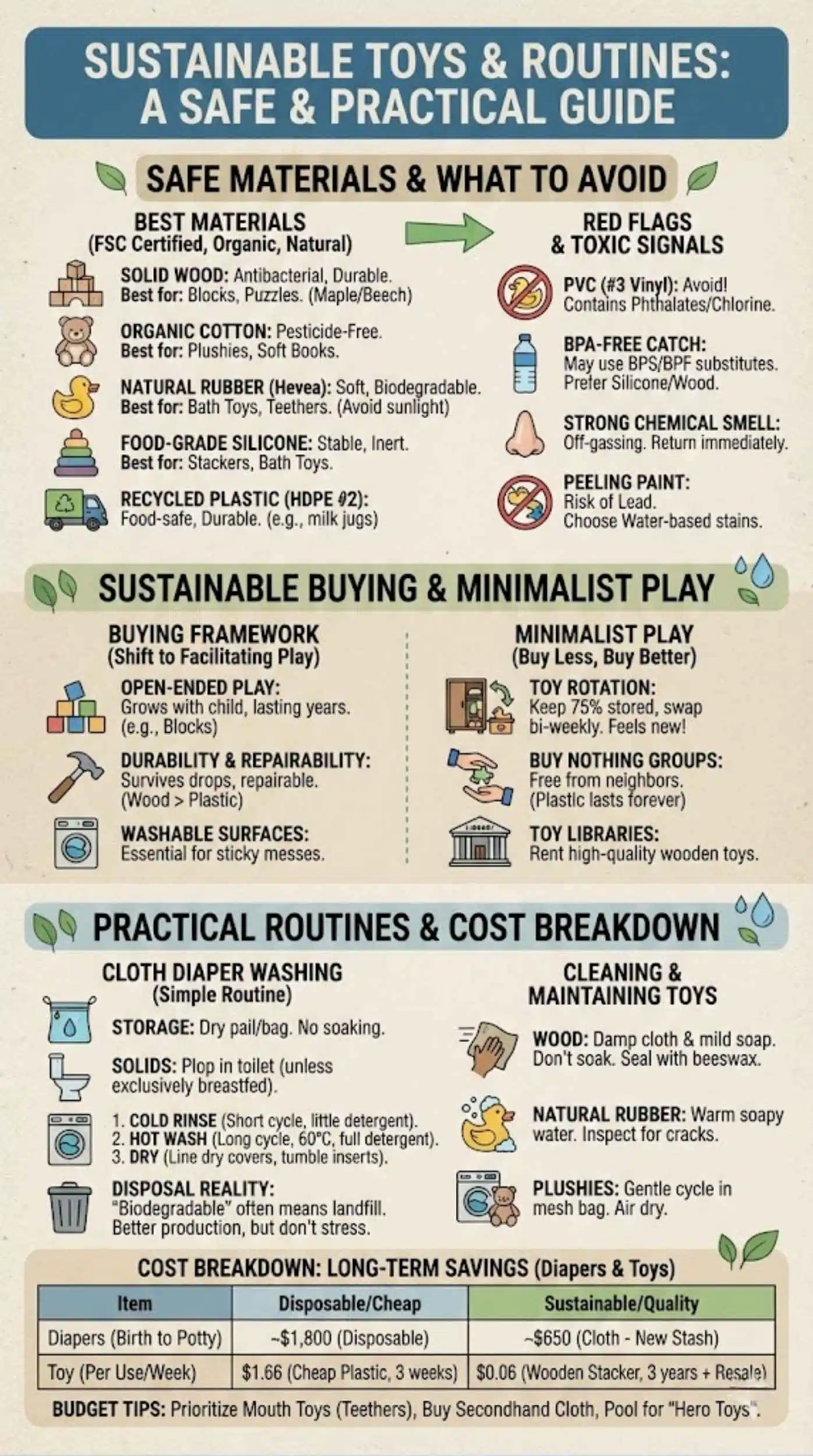
Babies explore the world with their mouths. This makes the chemical composition of a toy just as important as the food they eat.
Best Materials (And When Each Makes Sense)
- Solid Wood (FSC Certified): naturally antibacterial and durable. Maple and beech are excellent hardwoods for teethers because they don’t splinter.
- Best for: Blocks, puzzles, push-carts.
- Organic Cotton: Conventional cotton is one of the “dirtiest” crops due to pesticide use. Organic cotton is free from these residues.
- Best for: Plushies, lovies, soft books.
- Natural Rubber (Hevea): Derived from the sap of the Hevea tree. It is soft, biodegradable, and moldable.
- Best for: Bath toys, teethers, pacifiers. Note: Keep these out of direct sunlight or they will degrade.
- Food-Grade Silicone: While synthetic, high-quality silicone is stable, inert (doesn’t leach chemicals), and durable. It is a great alternative to plastic.
- Best for: Stackers, bath toys (mold resistant), teethers.
- Recycled Plastic (Green Toys): If you must buy plastic, look for HDPE (Type 2) often made from recycled milk jugs. It is food-safe and incredibly durable.
Red Flags And “Toxic” Signals Parents Google
- PVC (Polyvinyl Chloride): Often labeled as “vinyl” or plastic #3. It requires phthalates to be flexible and contains chlorine. It is arguably the most toxic plastic for health and the environment. Avoid strictly.
- BPA-Free (The Catch): BPA is largely banned in baby bottles, but “BPA-Free” plastic often uses BPS or BPF as a substitute, which can have similar endocrine-disrupting effects. This is why switching to silicone or wood is safer than just seeking “BPA-Free” plastic.
- Strong Chemical Smell: If a new toy smells like a shower curtain or gasoline, trust your nose. That is off-gassing. Return it.
- Peeling Paint: Vintage toys may look cool, but they carry a high risk of lead paint. Stick to modern wooden toys with water-based, non-toxic stains (or beeswax finishes).
Sustainable Toy Buying Framework
Shift your mindset from “entertaining the baby” to “facilitating play.”
- Open-Ended Play: A battery-operated dog that sings one song does one thing. A set of wooden blocks can be a castle, a road, a phone, or a sandwich. Open-ended toys grow with the child, lasting years instead of months.
- Durability & Repairability: Can it survive a drop from a high chair? If a wheel falls off, can it be glued back on? Wood repairs easily; cheap plastic shatters.
- Washable Surfaces: Babies are sticky. If you can’t wipe it down or throw it in the wash, it won’t last.
Minimalist Play: Toy Rotation + Secondhand + Library Swaps
Sustainability isn’t just about buying better stuff; it’s about buying less.
- Toy Rotation: Keep 75% of toys in a closet. Every two weeks, swap them out. Old toys feel new again, sparking fresh interest without a purchase.
- Buy Nothing Groups: Join your local “Buy Nothing” Facebook group. Plastic toys last forever—get them for free from a neighbor rather than buying new.
- Toy Libraries: Many cities now have toy libraries where you can rent high-quality wooden toys for a month and return them.
Practical Routines That Make This Lifestyle Stick
Sustainability fails when it becomes a burden. Here is how to integrate these choices into real life.
Cloth Diaper Washing Basics (Simple Routine)
Don’t overcomplicate this.
- Storage: Store dirty diapers in a “wet bag” or a pail with a liner. Do not soak them (this creates a drowning hazard and damages fibers).
- Solids: For exclusively breastfed babies, poop is water-soluble—just toss it in the wash. For formula or solids, plop the poop in the toilet first.
- The Wash (Every 2-3 Days):
- Step 1: Short, cold cycle with a little detergent (rinses away the mess).
- Step 2: Long, hot cycle (60°C/140°F) with the full amount of detergent (cleans the deep fibers).
- Step 3: Line dry covers (sun bleaches stains!); tumble dry inserts.
Disposal Reality For “Biodegradable” Diapers
If you use eco-disposables, wrap them tight. If your city has a “Waste to Energy” program (incineration), these diapers are great because plant materials burn cleaner than plastic. If they go to a landfill, understand that their main benefit was their production (saving oil), not their death. Don’t stress about it—you still made a better choice.
Cleaning And Maintaining Non-Toxic Toys
- Wood: Never soak wood. Wipe with a damp cloth and mild soap. If it feels dry/rough after a year, rub a little beeswax or olive oil on it to seal it.
- Natural Rubber: Wash with warm soapy water. Inspect regularly for cracks (bacteria traps) and replace if they get sticky (sign of degradation).
- Plushies: Check the label. Most organic cotton plushies can handle a gentle cycle in a mesh bag. Air dry to keep the stuffing fluffy.
Cost Breakdown: Eco-Friendly Diapers And Toys On A Real-World Budget
It is a myth that sustainable parenting is only for the wealthy. It requires a higher upfront cost, but often lower long-term costs.
Cost-Per-Use Thinking
- The Diaper Math:
- Disposable: ~$0.30/diaper x 6,000 changes (birth to potty) = ~$1,800.
- Eco-Disposable: ~$0.50/diaper x 6,000 changes = ~$3,000.
- Cloth: ~$500 for a full stash (new) + ~$150 laundry costs = ~$650.
- Savings: Cloth saves you over $1,000 on the first child, and is essentially free for the second child.
- The Toy Math:
- A $5 cheap plastic toy breaks or loses interest in 3 weeks. Cost per week: $1.66.
- A $20 wooden stacker lasts 3 years and is sold for $10 later. Net cost: $10. Cost per week: $0.06.
Budget Tips That Don’t Sacrifice Safety
- Prioritize What Goes in the Mouth: If you have a limited budget, buy organic/natural for teethers and pacifiers. Use cheaper (but safe) options for toys they just look at or push around.
- Buy Secondhand Cloth: “Pre-loved” cloth diapers are a massive market. You can buy a high-end stash for 30% of the retail price. Strip them (deep clean) and they are good as new.
- Hero Toys: Instead of 10 small gifts, ask grandparents to pool money for one high-quality “Hero Toy” (like a Pikler triangle or a solid wood wagon) that will last for years.
Quick Shopping Checklists
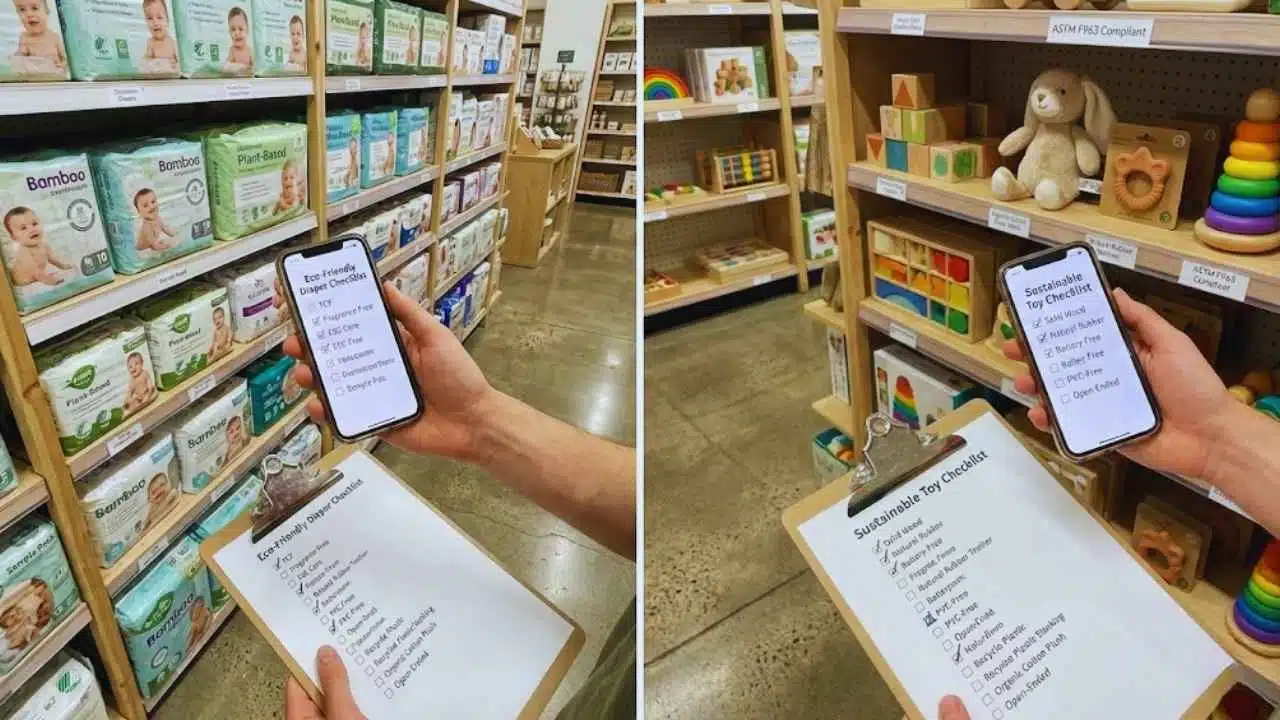
Use these checklists when you are in the store or browsing online to cut through the noise.
Eco-Friendly Diaper Checklist
- Transparency: Full ingredients list provided (not just “absorbent polymer”).
- Bleaching: Labeled “TCF” (Total Chlorine Free).
- Fragrance: Explicitly “Fragrance-Free” and “Lotion-Free.”
- Core: Made from FSC-certified wood pulp or bamboo.
- Ink: Water-based inks (or no print at all).
- Certifications: OEKO-TEX Standard 100 or Nordic Swan.
- Fit: Features tall leak guards (blowout protection).
- Sizing: Sample packs available (to test fit before bulk buying).
- Packaging: Is the outer bag recyclable or made from plant plastic?
- Brand Ethics: Do they donate to diaper banks or offset carbon?
Sustainable Toy Checklist
- Material: Solid wood, organic cotton, natural rubber, or food-grade silicone.
- Finish: Water-based, non-toxic paint or oil/wax finish.
- Smell Test: No strong chemical or plastic odor.
- Construction: glued or screwed securely (no loose small parts/magnets).
- Battery-Free: Powered by the child’s imagination, not AA batteries.
- Certifications: ASTM F963 compliant; FSC for wood.
- Plastic Type: If plastic, is it recycled (HDPE) or Bioplastic? No PVC/Vinyl (#3).
- Washability: Can it be easily cleaned?
- Open-Ended: Can it be used in more than one way?
- Longevity: Will this interest a child 6 months or 1 year older than my baby?
Final Thoughts
Parenting is the ultimate long game. When you choose an organic cotton teether over a plastic one, or swap just one disposable diaper a day for cloth, you aren’t just reducing trash. You are casting a vote for the kind of world you want your child to grow up in.
It is easy to get overwhelmed by the data, the certifications, and the pressure to be the “perfect” eco-parent. But remember: sustainability is not an all-or-nothing sport. A family that uses cloth diapers part-time is still preventing hundreds of pounds of plastic from hitting the landfill. A parent who buys just one durable wooden toy instead of five cheap plastic ones is still reducing demand for petrochemicals.
Start where you are. Pick one switch from this guide that feels manageable—whether it’s checking labels for “fragrance-free” or buying your next set of blocks secondhand. Your baby won’t notice if their toys are brand new or pre-loved, but they will benefit from a home with fewer toxins and a future with less waste.