
For many Canadian students, getting into medical school can feel like trying to enter a locked room where the key is hidden inside another locked room. Competition is fierce, seats are limited, and the dream of becoming a doctor can start to look financially and emotionally exhausting. That is why more students are exploring whether they can Study Medicine Abroad on a Budget without sacrificing credibility, clinical exposure, or a realistic path back to Canada.
But “budget” does not simply mean cheap tuition. A country can look affordable on paper and still become costly once you add living expenses, licensing exams, travel, clinical placements, language barriers, visa requirements, and the long road back into Canadian residency. For Canadian students, the smartest destination is not always the cheapest one. It is the one that balances affordability, academic quality, English-taught options, recognition, and a realistic post-graduation strategy.
Our Selection Criteria
To build this list, I looked beyond tuition alone. The focus was on countries that offer a more affordable route than the most expensive international medicine destinations while still giving Canadian students a practical education pathway.
Here is the selection logic used for this guide.
| Selection Factor | Why It Matters for Canadian Students |
|---|---|
| Tuition affordability | Medicine is expensive everywhere, so lower annual tuition matters |
| English-taught programs | Canadian students usually need English-medium instruction |
| Living cost | Rent, food, insurance, and transport affect the real budget |
| Degree recognition | The medical school should be listed and recognized through relevant global directories |
| Pathway back to Canada | Graduates must understand IMG exams, CaRMS, and residency competition |
| Clinical exposure | Strong clinical training matters for licensing and residency applications |
| Student support | International student services, advising, and exam support can make a difference |
| Risk level | Language barriers, agent-heavy admissions, and unclear claims can create problems |
For Canadian students, one important reality must be clear from the beginning: graduating from medical school abroad usually means returning to Canada as an International Medical Graduate. The Medical Council of Canada explains that IMGs generally need to apply through CaRMS and complete a Canadian residency pathway if they want to practise in Canada. CaRMS also states that IMG applicants need a degree from a recognized international medical school and must usually pass the MCCQE Part I and NAC Examination for R-1 match eligibility.
Whom This Is For
This list is mainly for Canadian citizens or permanent residents who are considering medicine outside Canada because of cost, competition, or limited local seats.
It is especially useful for:
- students who want English-taught medical programs abroad;
- families comparing total medical education costs;
- Canadians who plan to return home for residency;
- students considering Europe, the Caribbean, or other lower-cost routes;
- applicants who want a practical shortlist before speaking with universities.
Now let’s look at the countries that offer the strongest balance of cost, access, and practical value.
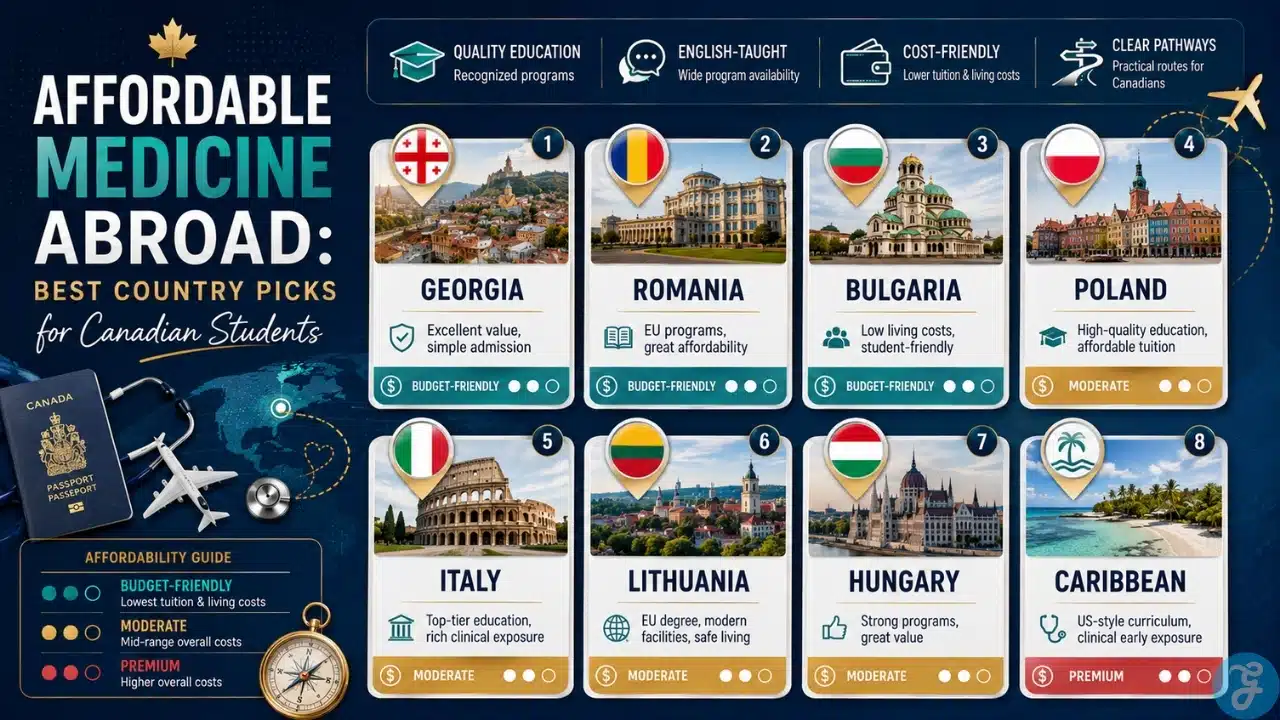
The 8 Best Countries to Study Medicine Abroad on a Budget as a Canadian Student
Each country below has a different value proposition. Some are best for low tuition, some for EU medical education, some for English-language convenience, and some for proximity to North America.
1. Georgia
Georgia has become one of the more affordable destinations for international students seeking English-taught medical programs. Tbilisi State Medical University lists its English-medium Medical Doctor program at USD 8,000 per year, while the University of Georgia lists its English MD program at USD 6,500 per year. That makes Georgia one of the more budget-friendly options compared with Western Europe, Ireland, or many private medical schools.
For Canadian students, Georgia’s biggest attraction is cost control. The country offers several English-medium programs, relatively lower living costs, and a growing international medical student community. However, students must be careful to choose schools with transparent admissions, strong clinical training, and clear recognition status.
Best for:
- Students looking for one of the lowest tuition routes
- Canadians comfortable studying outside Western Europe
Why We Chose It:
- Tuition can be significantly lower than many European or Caribbean options
- English-medium MD programs are available
- Living costs are generally more manageable than in Western Europe
- Good fit for budget-focused students who are willing to do serious due diligence
Things to consider:
- Returning to Canada still means IMG exams and residency competition
- Students should verify school recognition, clinical rotations, and graduate outcomes before applying
2. Romania
Romania is a strong option for students who want European medical education at a relatively moderate cost. The Carol Davila University of Medicine and Pharmacy in Bucharest lists tuition for its English-taught Medicine program for non-EU international students at €10,000 per year for 2025–2026. Other sources tracking Romanian medical programs show many public routes clustering around roughly €8,000 to €10,000 per year, depending on university and citizenship category.
Romania is not always the cheapest option in Europe, but it offers a useful balance of affordability, EU location, and established medical universities. For Canadian students, it may be attractive if they want a traditional European university environment without the higher price tag of Ireland or the UK. The main challenge is ensuring the chosen program offers enough English-language support during preclinical and clinical years.
Best for:
- Students who want an EU-based medical education at moderate cost
- Canadians looking for a more traditional university setting
Why We Chose It:
- English-taught medical programs are available
- Tuition is often lower than Ireland, the UK, and many Western European options
- Romania has established public medical universities
- Good choice for students who want an EU academic environment
Things to consider:
- Clinical years may require local language skills for patient interaction
- Admission details and fees vary by university, so students must confirm directly
3. Bulgaria
Bulgaria is another European option that often appears on budget-conscious medical school shortlists. Medical University of Varna lists Medicine in English at €10,000 per year for a six-year program, while Medical University Sofia lists Medicine in English at €9,950 per year. These figures make Bulgaria a mid-budget European option rather than an ultra-cheap destination.
The appeal is straightforward: English-taught medicine, EU location, and lower tuition than many Western destinations. Bulgaria can work well for Canadian students who want a structured medical program in Europe and are prepared for language learning during clinical exposure. Like Romania, it requires careful planning for licensing exams and Canadian residency applications.
Best for:
- Students who want an English-taught EU medical program
- Canadians comparing moderate-cost European options
Why We Chose It:
- Tuition is lower than many Western European medical schools
- English-medium medicine is available at multiple universities
- EU location may appeal to students seeking European mobility
- Established medical universities provide structured long-cycle programs
Things to consider:
- Students may need local language skills during clinical training
- Canadian residency planning should begin early, not after graduation
4. Poland
Poland is a popular destination for international medical students because it offers English-taught medical programs and a well-known European academic environment. Medical University of Gdańsk lists its M.D. program tuition at 32,100 PLN per semester, while other Polish medical programs can vary widely by university. This places Poland above the cheapest options but still below many premium English-speaking destinations.
For Canadian students, Poland’s value comes from its established medical universities, student cities, and structured six-year medical programs. It may not be the cheapest country on this list, but it can offer a more familiar European university experience with strong academic organization. The trade-off is that living costs in major Polish cities and tuition at top medical schools can push the total budget higher than expected.
Best for:
- Students who want a recognized European medical education environment
- Canadians who prefer larger university cities and established programs
Why We Chose It:
- English-taught medicine is available at several Polish medical universities
- Poland has a strong reputation among international medical applicants
- Student cities offer good infrastructure and international communities
- Useful option for students balancing budget and academic familiarity
Things to consider:
- Tuition varies widely and can be higher than Georgia, Romania, or Bulgaria
- Living costs in major cities should be calculated carefully
5. Italy
Italy can be surprisingly affordable for students who secure a place in a public English-taught medical program. Public medical school tuition in Italy is often income-based and can range from low hundreds to several thousand euros per year, depending on the university and student circumstances. Several guides tracking Italy’s medical school costs place public tuition roughly around €400 to €4,000 per year, though private universities can be much more expensive.
For Canadian students, Italy’s biggest advantage is the possibility of high academic value at relatively low tuition. The catch is competition, entrance exams such as the IMAT route for many English-taught public programs, and non-EU seat limitations. Italy is one of the best “high-upside” choices, but it is not the easiest route.
Best for:
- Strong applicants who want low public university tuition in Europe
- Students willing to prepare seriously for entrance exams
Why We Chose It:
- Public medical school tuition can be very affordable
- English-taught medicine options exist at public universities
- Italy offers strong academic and cultural appeal
- Good value if the student wins a public university seat
Things to consider:
- Admission can be competitive, especially for non-EU applicants
- Private medical schools in Italy can be far more expensive
6. Lithuania
Lithuania offers a more structured European option with tuition that sits between low-cost Eastern Europe and higher-cost Western Europe. Lithuanian University of Health Sciences lists Medicine at €12,800 per year for the first three years and €13,300 per year for years four to six. That is not the lowest fee on this list, but it remains below many Irish, UK, and North American alternatives.
Lithuania may suit Canadian students who want a smaller EU country with English-taught medicine and a clear university pricing structure. The country can be attractive for students who value safety, European education standards, and a quieter academic environment. The main issue is that it may not be the cheapest route once living costs, travel, and licensing preparation are included.
Best for:
- Students who want transparent EU medical school pricing
- Canadians looking for a quieter European study destination
Why We Chose It:
- English-taught Medicine is available
- Official tuition figures are clearly published
- EU-based medical education environment
- Good middle-ground option for students who want structure and predictability
Things to consider:
- Tuition is higher than some lower-cost Eastern European countries
- Students should confirm clinical language expectations early
7. Hungary
Hungary is a well-established destination for English-taught medicine, especially in cities such as Budapest. However, it is more expensive than several other budget options. Semmelweis University lists medical tuition at €12,000 per semester or €22,000 per academic year for 2025, making it a premium European option rather than a low-cost one.
So why include Hungary? Because “budget” does not always mean lowest possible tuition. For some Canadian families, Hungary may still be more affordable than other international medicine routes while offering long-standing English-taught programs and a strong academic reputation. It is best for students who want a respected European option and can handle a higher annual cost.
Best for:
- Students who want a long-established English-taught European medicine route
- Families with a moderate-to-higher international education budget
Why We Chose It:
- Strong international reputation for medical education
- English-taught medicine has a long history in Hungary
- Budapest offers a major student environment
- Good fit for students prioritizing reputation over lowest cost
Things to consider:
- Tuition can be much higher than Georgia, Romania, Bulgaria, or Italy’s public route
- Budget-conscious students should compare total six-year cost carefully
8. Caribbean Region
The Caribbean is often considered by Canadian students because of English-language instruction, North American-style medical pathways, and clinical rotation links. However, it is not always a true budget option. Some Caribbean schools can be expensive, especially when tuition, clinical years, exam preparation, travel, and living costs are included.
The Caribbean’s main value is convenience for English-speaking students and alignment with North American exams such as the USMLE for students also considering U.S. residency. For Canadian students, it can be a practical route only if the school has strong outcomes, transparent match data, and real clinical placement quality. The cheapest-looking option is not always the safest one.
Best for:
- Students who want English-medium medical education close to North America
- Canadians considering both Canadian and U.S. residency pathways
Why We Chose It:
- English instruction is common
- Some schools are built around North American licensing pathways
- Geographic proximity can be helpful compared with Europe or Asia
- May suit students targeting U.S. clinical exposure or USMLE preparation
Things to consider:
- Costs vary widely and can become high quickly
- Students must investigate residency match outcomes, accreditation, attrition, and clinical rotation quality
An Overview Of 8 Countries to Study Medicine Abroad on a Budget
Every destination has trade-offs. Georgia and Italy may offer the strongest affordability upside, Romania and Bulgaria provide moderate-cost EU routes, Poland and Lithuania offer more structured European options, Hungary is stronger on reputation but heavier on cost, and the Caribbean is convenient but financially unpredictable.
Overview Comparison Table
Here is a clear snapshot of how the eight countries compare for Canadian students.
| Rank | Country | Approximate Tuition Snapshot | Best Fit | Budget Level |
|---|---|---|---|---|
| 1 | Georgia | Around USD 6,500–8,000 per year at cited universities | Lowest-cost English MD route | Very budget-friendly |
| 2 | Romania | Around €8,000–10,000 per year at many public routes | Moderate-cost EU medicine | Budget-friendly |
| 3 | Bulgaria | Around €9,950–10,000 per year | English-taught EU medical programs | Budget-friendly |
| 4 | Poland | Varies; Gdańsk M.D. listed at 32,100 PLN per semester | Established European medical education | Moderate |
| 5 | Italy | Public programs can be low-cost; private programs are expensive | Strong applicants seeking public seats | Very strong value if admitted |
| 6 | Lithuania | Around €12,800–13,300 per year at LSMU | Structured EU option | Moderate |
| 7 | Hungary | Semmelweis listed at €22,000 per academic year | Reputation-focused applicants | Higher-cost |
| 8 | Caribbean Region | Wide range; can become expensive | English/North American-style pathway | Highly variable |
Our Top 3 Picks and Why?
For Canadian students, the best choice depends on whether the priority is lowest cost, European structure, or long-term licensing strategy.
| Pick | Why It Stands Out |
|---|---|
| Georgia | Strong tuition affordability and English-medium options |
| Italy | Potentially excellent value through public medical programs if admitted |
| Romania | Balanced EU option with moderate tuition and established medical universities |
These three are not automatically the best for every student. They simply offer the strongest mix of affordability, access, and practical value for budget-conscious Canadian applicants.
How to Choose the Right Country to Study Medicine Abroad on a Budget by Yourself
Choosing a medical school abroad is not like choosing a holiday destination. A nice city, pretty campus, or friendly recruiter is not enough. The decision affects your debt, licensing path, clinical training, and future residency chances.
The Selection Framework:
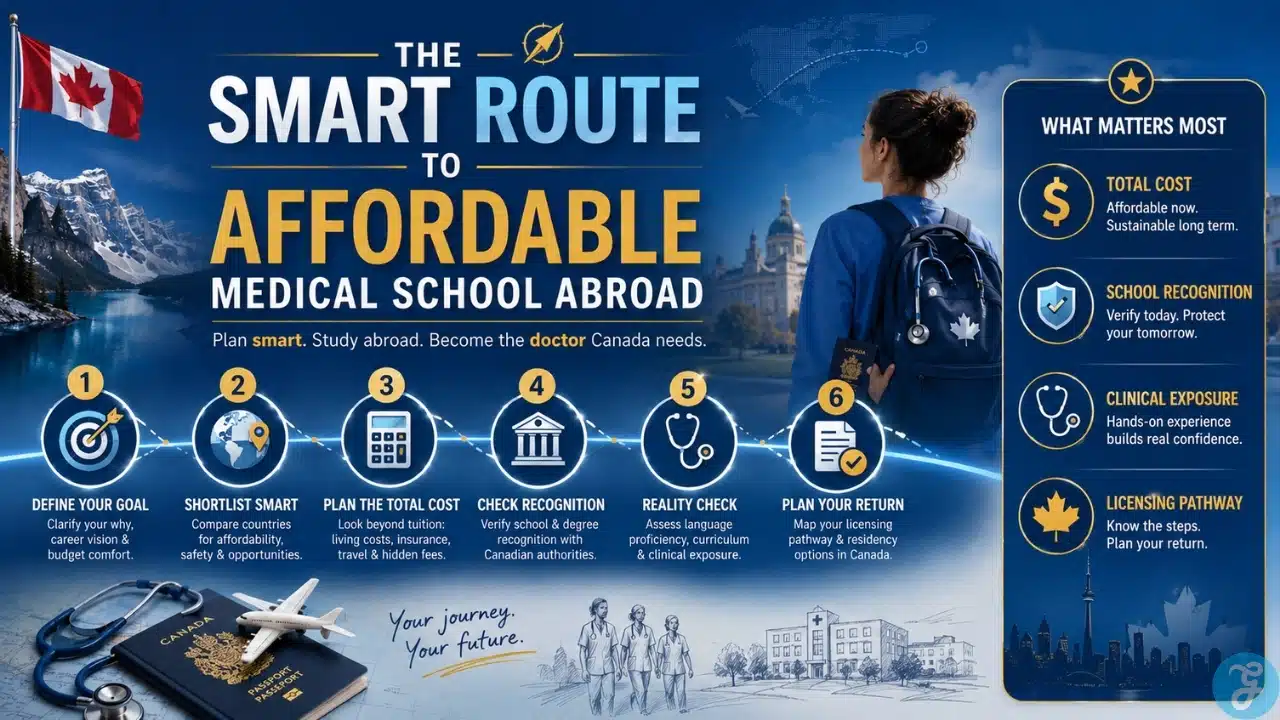
- Verify recognition first: Check whether the school is listed in the World Directory of Medical Schools and whether it supports your intended Canadian or U.S. licensing pathway.
- Calculate total cost, not tuition alone: Add rent, insurance, exam fees, flights, visa renewals, clinical placement costs, and licensing preparation.
- Study the return-to-Canada pathway early: Canadian students abroad usually compete as IMGs and may need MCCQE Part I, NAC, and CaRMS planning.
- Check clinical training quality: A cheap preclinical program is not enough if clinical exposure is weak, poorly supervised, or hard to document.
The Final Checklist
Before committing to a school abroad, Canadian students should work through this quick checklist.
- Confirm the medical school’s recognition and directory listing.
- Ask for recent residency match data for Canadian or North American graduates.
- Compare total six-year cost, not just first-year tuition.
- Check whether clinical years require local language skills.
- Speak with current students or graduates before paying deposits.
The Smarter Way to Think About Affordable Medical School Abroad
The dream of becoming a doctor should not collapse just because the local pathway is brutally competitive. But the uncomfortable truth is that leaving Canada for medical school does not remove the competition. It moves the competition to a different stage.
Students who Study Medicine Abroad on a Budget need to think like long-term planners, not just applicants looking for a cheaper acceptance letter. The cheapest option can become expensive if the school has weak clinical support, poor exam preparation, unclear recognition, or limited graduate outcomes. The best option is the one that gives you a realistic path from admission to graduation to residency.
My honest view is that studying medicine abroad can make sense for disciplined students who understand the licensing challenge from day one. It is not a shortcut. It is a different road, and sometimes a harder one. But for the right student, with the right country, the right school, and the right strategy, it can still be a financially smarter way to keep the medical dream alive.
Frequently Asked Questions (FAQs) About Study Medicine Abroad on a Budget
Is it possible for Canadian students to study medicine abroad cheaply?
Yes, but “cheaply” needs context. Countries such as Georgia, Romania, Bulgaria, and some public programs in Italy can be more affordable than many high-cost international options, but students must include living costs, exams, travel, and licensing expenses.
Can Canadian students return to Canada after medical school abroad?
Yes, but they usually return as International Medical Graduates. That means they may need to pass required exams, apply through CaRMS, and compete for residency positions under IMG rules.
Which country is the cheapest for Canadian students to study medicine abroad?
Georgia is one of the most affordable options among the countries listed here, based on published English MD tuition at universities such as Tbilisi State Medical University and the University of Georgia. Italy can also be very affordable if a student secures a public medical school seat.
Is studying medicine in the Caribbean a budget-friendly choice?
Not always. The Caribbean can be convenient for English-speaking students and North American-style pathways, but total costs can rise quickly. Students should compare tuition, clinical rotation costs, match outcomes, and attrition rates before choosing.
What should Canadian students check before applying abroad?
They should verify recognition, tuition, clinical training quality, residency outcomes, language requirements, and the pathway back to Canada. They should also speak with graduates who have successfully matched or entered postgraduate training.