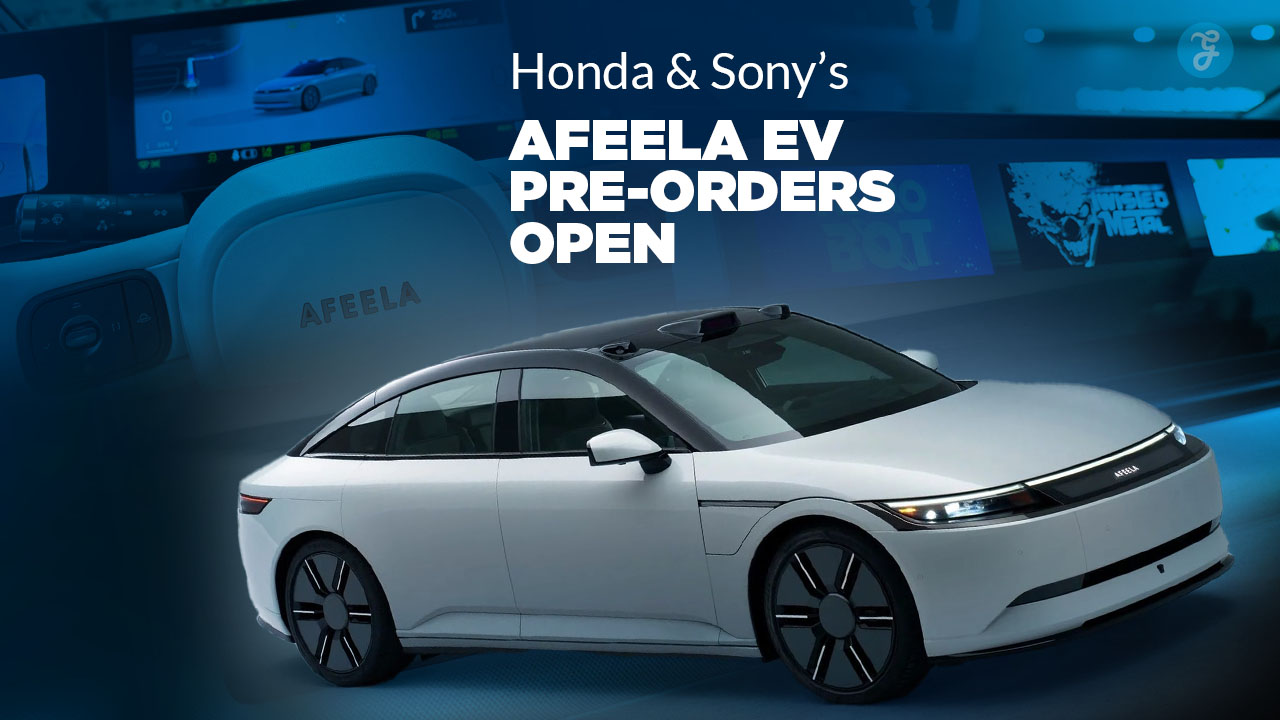
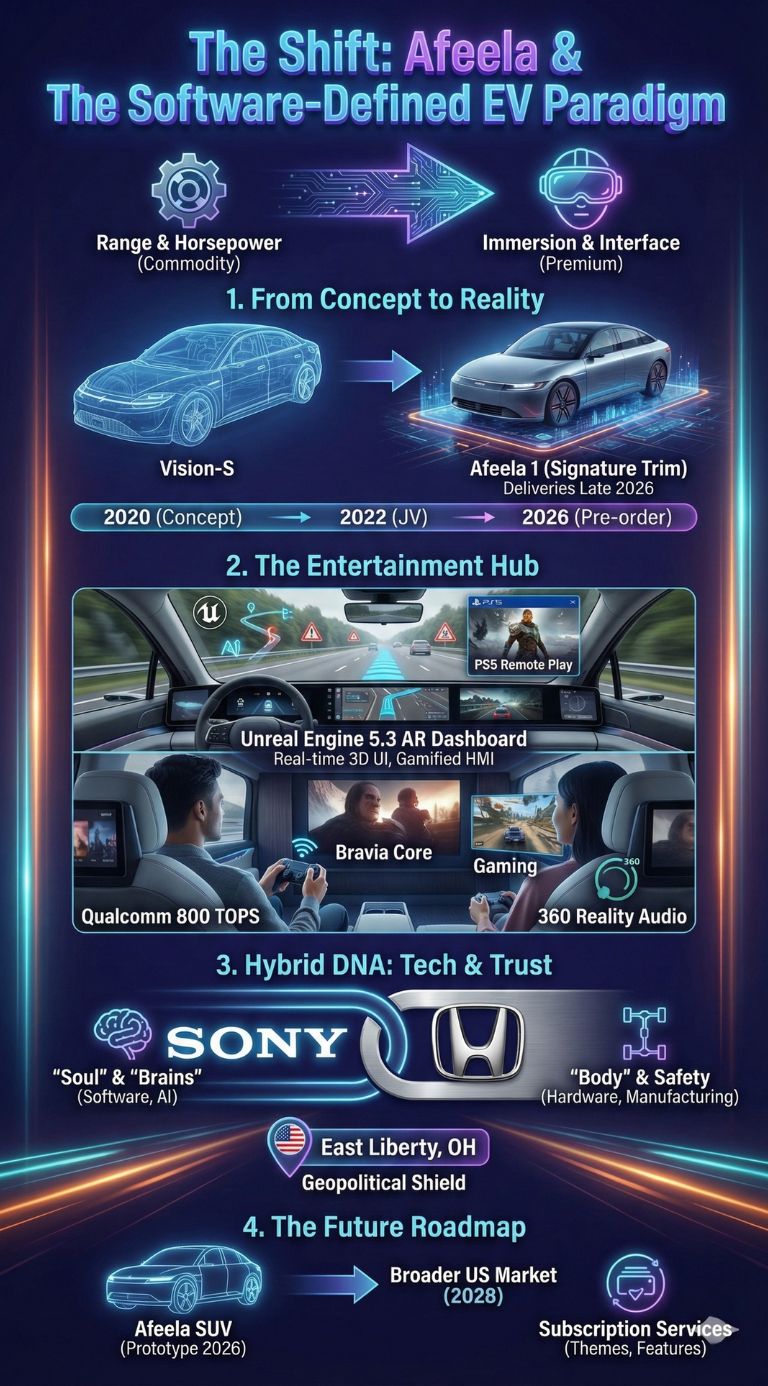
The opening of pre-orders for the Sony Honda Mobility (SHM) “Afeela” EV marks a pivotal moment in automotive history: the official transition of the car from a mechanical utility to a “software-defined” entertainment hub. With a starting price of $89,900 and deliveries slated for late 2026 in California, the Afeela isn’t just challenging Tesla—it is attempting to redefine the metric of value in the EV market from “range and horsepower” to “immersion and interface.”
Key Takeaways
- Strategic Pivot: Sony and Honda have moved from concept (Vision-S) to commercial reality, opening configurations for the Afeela 1 sedan. Deliveries for the high-end “Signature” trim begin late 2026.
- The AR Differentiator: The dashboard, powered by Unreal Engine 5.3, represents the most advanced integration of Augmented Reality (AR) in a consumer vehicle, turning the windshield into a dynamic data layer.
- Premium Pricing: At nearly $90,000–$103,000, Afeela bypasses the mass market to compete directly with the Tesla Model S and Lucid Air, banking on Sony’s entertainment ecosystem (PS5 Remote Play, Bravia Core) to justify the cost despite average range specs.
- Tech vs. Auto: The joint venture validates a new industry model where “Tier 1” tech companies don’t just supply parts but co-own the brand, signaling a threat to legacy automakers who lack in-house software pedigree.
- SUV Fast-Follower: SHM also revealed the “Afeela Prototype 2026” (SUV) at CES, confirming a two-vehicle lineup strategy to capture the broader US market by 2028.
The Long Road to “Mobility as Entertainment”
The journey to this moment has been a six-year odyssey of shifting strategies and deepening partnerships. It began at CES 2020, where Sony shocked the world with the “Vision-S” concept—a vehicle initially intended merely to showcase Sony’s sensor technology for other automakers. The overwhelming public interest, coupled with the rapid disruption of the automotive sector by Tesla and Chinese newcomers like Xiaomi and BYD, forced Sony to reconsider.
By 2022, the hypothetical became real: Sony forged a 50-50 joint venture with Honda, creating Sony Honda Mobility (SHM). The division of labor was clear—Honda would handle the complex “metal bending,” safety compliance, and manufacturing at its East Liberty, Ohio plant, while Sony would build the “brains” and “soul” of the car.
The opening of pre-orders in early 2026 is the final validation of this experiment. Unlike the “vaporware” often seen in the EV startup space, Afeela is utilizing Honda’s established supply chains, mitigating the “production hell” that plagued Tesla a decade ago. However, the market they are entering in 2026 is vastly different from 2020; it is crowded, price-sensitive, and dominated by aggressive software-first competitors.
Core Analysis: The “Gadgetification” of the Automobile
1. The Unreal Engine Dashboard: A UI/UX Revolution
The headline feature of the Afeela isn’t its 0-60 time or its battery chemistry—it is the “Panoramic Screen” spanning the entire dashboard. While Mercedes-Benz has the Hyperscreen, Afeela’s implementation is fundamentally different because of what runs it: Epic Games’ Unreal Engine 5.3.
This game engine allows the car to render 3D environments in real-time. The “AR Dashboard” overlays navigation, safety warnings, and entertainment metadata onto a digital twin of the road ahead. This is not just a pretty map; it is a fundamental shift in Human-Machine Interface (HMI). By gamifying the driving experience, Sony is betting that the next generation of luxury buyers (who grew up with PlayStations, not carburetors) will prioritize UI smoothness and graphical fidelity over mechanical specs.
2. The “Media Bar” and External Communication
A unique hardware feature is the Media Bar, a micro-LED strip embedded in the front bumper between the headlights. While currently limited by regulations to displaying charging status and welcome animations, its potential is “social mobility.”
- Current Utility: Shows battery percentage while charging (visible from outside).
- Future Utility: Vehicle-to-Pedestrian (V2P) communication. It could flash “I See You” to a pedestrian at a crosswalk or display ride-share user names. This transforms the car’s exterior into a programmable canvas.
3. The Living Room on Wheels
The integration of a PS5-grade computing platform (utilizing the Qualcomm Snapdragon Digital Chassis with 800 TOPS of performance) allows for features no other car currently matches. The Remote Play capability lets passengers stream games from their home console to the car with virtually zero latency via 5G.
This creates a “third space” economy. The car becomes a private cinema or gaming booth while charging or parked. In a world where autonomous driving (Level 3 and eventually Level 4) is the goal, the driver eventually becomes a passenger. Sony is pre-positioning the Afeela to dominate the attention economy of that future passenger.
4. Manufacturing & Supply Chain Hybrid
The decision to manufacture in Ohio is a geopolitical masterstroke. It likely qualifies the vehicle for partial US federal tax incentives (depending on battery material sourcing), but more importantly, it insulates the brand from potential trade tariffs that are currently hammering Chinese imports like the Xiaomi SU7.
Honda’s role here cannot be overstated. While Sony grabs the headlines, Honda’s multi-link suspension and proven chassis architecture ensure the car drives like a Honda—competent, safe, and reliable. This “Hybrid DNA” attempts to solve the biggest weakness of new EV players: build quality.
Data & Visualization: The Competitive Landscape
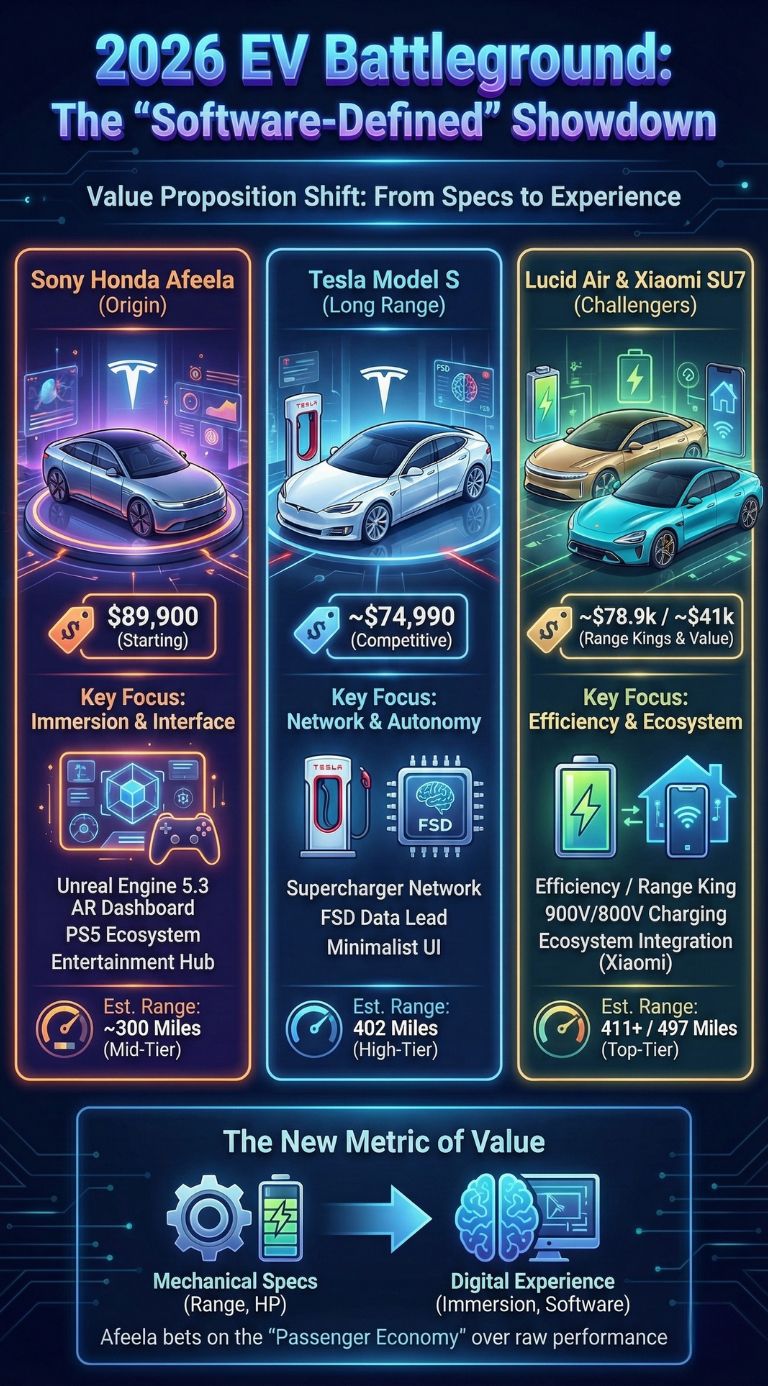
The 2026 EV market is a battle of philosophies. Afeela is priced as a luxury product ($90k+), yet its “mechanical” stats (range, charging speed) are mid-tier. The value proposition is entirely digital.
Table 1: The “Software-Defined” Showdown (2026 Specs)
| Feature | Sony Honda Afeela (Origin) | Tesla Model S (Long Range) | Lucid Air (Touring) | Xiaomi SU7 (Max) |
| Starting Price | $89,900 | ~$74,990 | ~$78,900 | ~$41,000 (China Converted) |
| Est. Range | ~300 Miles | 402 Miles | 411 Miles | 497 Miles (CLTC) |
| Charging Speed | 150 kW | 250 kW | 300 kW+ (900V Arch) | 400 kW+ |
| 0-60 MPH | ~4.8 sec | 3.1 sec | 3.4 sec | 2.78 sec |
| Dashboard Tech | Unreal Engine 5 AR + Media Bar | Minimalist 17″ Screen | 34″ Glass Cockpit (5K) | HyperOS + Flip Instrument |
| Key Advantage | Entertainment / PS5 Ecosystem | FSD Data Lead / Supercharger Network | Efficiency / Range King | Ecosystem Integration |
| Availability | Pre-Order (Late 2026) | Immediate | Immediate | China Only (Global 2027?) |
Key Statistics: The Afeela Tech Stack
- Sensors: 45 total (LiDAR, Radar, Ultrasonic, Cameras) for Level 2+/3 ADAS.
- Compute Power: 800 TOPS (Trillions of Operations Per Second).
- Audio: 360 Reality Audio with seat-embedded speakers (Sony Spatial Sound).
- Battery: 91 kWh Lithium-Ion.
Expert Perspectives
The industry reaction to the Afeela pre-order launch has been polarized, reflecting the divide between “Car People” and “Tech People.”
The Tech Bull Case:
“Sony isn’t building a car; they are building a moving platform for their content services. In 2026, margins on hardware are thinning. The real money is in the subscription capabilities—movies, games, and themes sold directly to the dashboard. Afeela is the first vehicle designed from the ground up to monetize the ‘passenger economy’.”
— Dr. Elena Rosetti, Senior Analyst at Future Mobility Institute.
The Automotive Bear Case:
“At $90,000 with only 300 miles of range and 150kW charging, the Afeela is technically behind the curve. Early adopters will buy it for the novelty, but once the ‘shiny gadget’ factor wears off, they will realize they paid Porsche money for Honda specs. The AR dashboard is impressive, but is it worth a $20k premium over a Model S?”
— Markus Weber, Automotive Columnist, EuroAuto Insights.
Future Outlook: What Comes Next?
As the initial wave of pre-orders is processed, three key developments will define the next 12-24 months for Sony Honda Mobility.
- The Subscription Reality Check
SHM has hinted at subscription models for unlocking certain AR features, “High-Definition” navigation, or entertainment packages. The market response to this will be a litmus test. If users reject paying monthly fees for dashboard themes (as they rejected BMW’s heated seat subscriptions), Afeela may have to pivot its revenue model.
- The “Afeela Prototype 2026” SUV
Just shown at CES 2026 alongside the sedan launch, the SUV variant is the inevitable fast-follower. The sedan (Afeela 1) is the flagship, but the SUV will be the volume seller. Expect pre-orders for the SUV to open in 2027 with a similar tech stack but a higher price tag.
- Expansion Beyond California
The current rollout is geofenced to California (and soon Arizona). The infrastructure challenge of servicing these high-tech vehicles in the Midwest or East Coast of the US will be the true test of Honda’s dealer network adaptation. Can a Honda mechanic fix a Sony software bug?
Final Words
The Afeela EV is a bold, perhaps desperate, attempt to leapfrog the EV commoditization curve. By focusing on AR and entertainment, Sony and Honda are betting that the future of driving is actually about not driving. Whether the market is ready to pay $90,000 for that privilege remains the biggest gamble of 2026.