In 2026, the era of the “purely technical” career is effectively over. For decades, Intelligence Quotient (IQ)—measured by analytical logic, pattern recognition, and rote problem-solving—was the primary predictor of professional success. But as Artificial Intelligence (AI) has commoditized data analysis and code generation, the human value proposition has shifted.
Today, we are witnessing the emergence of a distinct “Soft Skills Premium”: a tangible economic advantage for professionals who possess the traits AI cannot replicate. While algorithms now handle the hard skills of execution, humans are paid for the soft skills of navigation, judgment, and connection. This shift isn’t just about workplace harmony; it is now directly correlated with income stability, leadership longevity, and career growth.
Key Takeaways
- The Value Shift: As AI commoditizes “hard” skills like coding and data analysis, the market value of human-centric “soft” skills (EQ) has skyrocketed.
- The “Premium” is Real: Data suggests that professionals with high EQ now command salaries 20–30% higher than their purely technical peers due to their scarcity.
- Leadership has Transformed: In 2026, managers are paid to be “psychological coaches” who retain talent and manage burnout, rather than just monitors of workflow.
- Top 5 Future-Proof Skills: The most critical skills for the next decade are Emotional Self-Regulation, Adaptive Communication, Learning Agility, Empathy, and Conflict Resolution.
- The Winning Formula: The ultimate career advantage is Hybrid Intelligence—the ability to wield AI tools for execution while using Emotional Intelligence to drive strategy and influence people.
What Is the “Soft Skills Premium”?
The “Soft Skills Premium” refers to the measurable increase in salary, employability, and job security enjoyed by workers with high levels of social and emotional proficiency. It is the extra value the market assigns to “human-centric” capabilities in an automated economy.
Defining Soft Skills in a Modern Context
Historically dismissed as “nice-to-haves,” soft skills in 2026 have been reclassified by HR leaders as “power skills.” They are no longer just about being polite; they are complex cognitive and social abilities:
- Adaptive Communication: Synthesizing complex AI outputs into clear human narratives.
- Cognitive Empathy: Understanding why a team member or client feels a certain way, not just predicting their behavior.
- Contextual Intelligence: Knowing when to apply a rule and when to break it—something AI still struggles with.
- Self-Regulation: Managing stress and maintaining focus in a hyper-accelerated, notification-heavy work environment.
Why These Skills Now Carry Economic Value
The economic logic is simple: supply and demand. “Hard” skills like basic coding or accounting are abundant and cheap due to AI agents, while high-level emotional regulation and nuanced leadership are scarce.
The Shifting Value of Workplace Skills (2020 vs. 2026)
| Skill Category | 2020 Value Driver | 2026 Value Driver | Market Trend |
| Technical Execution | Speed & Accuracy | AI Oversight & Strategy | Commoditized |
| Data Analysis | Calculation Ability | Insight Extraction | Automated |
| Management | Task Monitoring | Team Psychology & Coaching | High Demand |
| Communication | Information Relay | Persuasion & Storytelling | High Premium |
| Crisis Response | Logical Fixes | Emotional De-escalation | Critical |
EQ vs IQ: What Has Changed in the AI Era?
The equation for professional value has flipped. In the early 2000s, IQ was the engine; EQ was the lubricant. In 2026, IQ is the commodity; EQ is the engine.
Why IQ Alone Is No Longer a Competitive Advantage
By 2026 standards, “smart” is the baseline. AI models can pass professional licensing exams and complex coding interviews with ease. If your primary value add is processing information, spotting logical errors, or retaining facts, you are competing directly with a machine that costs fractions of a cent per hour.
How EQ Complements (and Surpasses) IQ
While IQ solves defined problems, EQ (Emotional Quotient) identifies which problems are worth solving.
IQ vs. EQ Functional Comparison
| Feature | IQ (Cognitive Intelligence) | EQ (Emotional Intelligence) | AI Replication Risk |
| Primary Function | Logic, learning, reasoning | Empathy, self-regulation, social skill | IQ: High / EQ: Low |
| Conflict Handling | Analyzes the facts of the dispute | Manages the feelings causing the dispute | IQ: High / EQ: Low |
| Decision Making | Identifies the most logical path | Identifies the most adoptable path | IQ: High / EQ: Low |
| Leadership Style | Command and Control | Influence and Inspire | IQ: High / EQ: Low |
Why Emotional Intelligence Is Critical in 2026
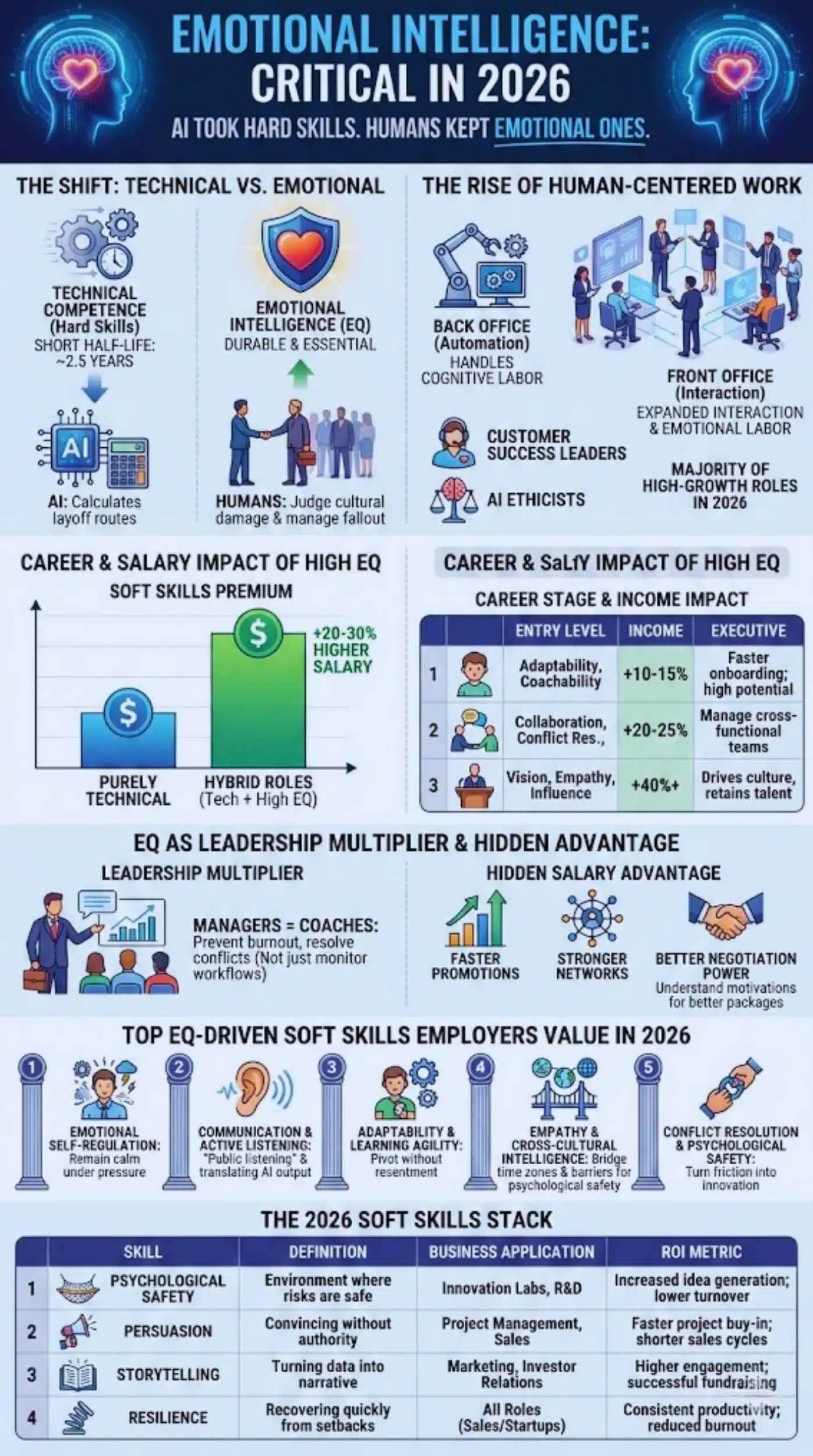
AI Took Hard Skills. Humans Kept Emotional Ones.
We have reached a point where technical competence has a short half-life—estimated now at just 2.5 years. By contrast, emotional intelligence is durable. AI can calculate the most profitable route for a layoff strategy, but it cannot judge the long-term cultural damage of that decision or manage the fallout.
The Rise of Human-Centered Work
As automation handles the “back office” of cognitive labor, the “front office” has expanded. Work is increasingly defined by interaction rather than transaction. The majority of high-growth roles in 2026—from Customer Success Leaders to AI Ethicists—require deep emotional labor.
The Career & Salary Impact of High EQ
The “Soft Skills Premium” is visible in compensation data. Recent trends suggest that hybrid roles—those combining technical literacy with high EQ—command salaries 20-30% higher than purely technical equivalents.
EQ as a Leadership Multiplier
In 2026, the definition of a “manager” has changed. We no longer need managers to monitor workflows (software does that). We need leaders to manage psychology, acting as coaches to prevent burnout and resolve cross-cultural conflicts.
The Hidden Salary Advantage of Soft Skills
High EQ professionals earn more indirectly through faster promotions, stronger networks, and better negotiation power. They understand the other party’s motivations, allowing them to negotiate better starting packages and raises.
The “Soft Skills Premium” by Career Stage
| Career Stage | Primary Soft Skill Focus | Estimated Income Impact | Why It Pays |
| Entry Level | Adaptability, Coachability | +10-15% | Faster onboarding; perceived as “high potential.” |
| Mid-Senior | Collaboration, Conflict Res. | +20-25% | Can manage cross-functional teams without friction. |
| Executive | Vision, Empathy, Influence | +40%+ | Drives culture; retains top talent; manages stakeholders. |
Top EQ-Driven Soft Skills Employers Value Most in 2026
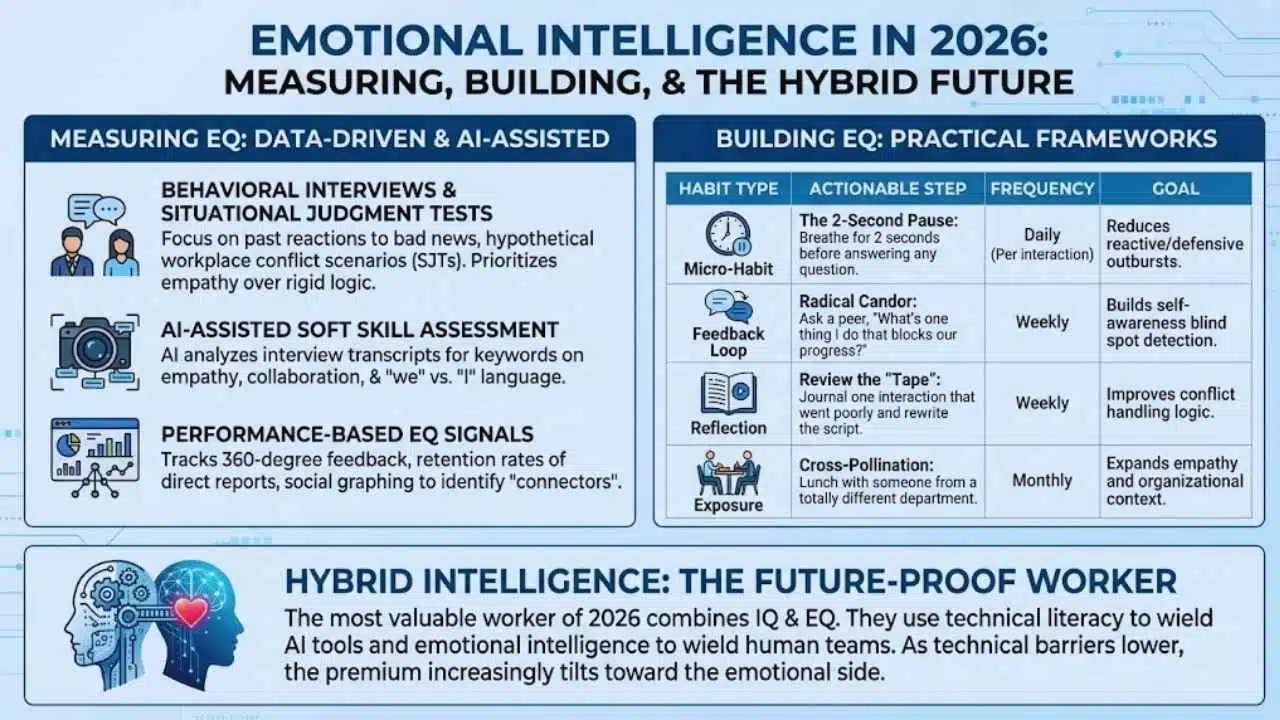
If you are looking to upskill, these are the five pillars of the modern soft skills stack.
1. Emotional Self-Regulation
The ability to remain calm and clear-headed under pressure. In a 24/7 connected world, the person who doesn’t react impulsively to a slack message or a crisis is the steady hand everyone looks to.
2. Communication & Active Listening
It is no longer about “public speaking”; it is about “public listening.” Can you hear what is not being said? Can you prompt an AI effectively (which requires clear linguistic logic) and then translate that output for a non-technical stakeholder?
3. Adaptability & Learning Agility
The World Economic Forum identifies this as a top skill. It is the emotional resilience to pivot to learning new tools without resentment or paralysis.
4. Empathy & Cross-Cultural Intelligence
With global remote teams being the norm, empathy is the tool that bridges time zones and cultural barriers. It allows for “psychological safety,” which is the key driver of high-performing teams.
5. Conflict Resolution & Psychological Safety
Disagreement is inevitable; destruction is optional. The skill lies in turning friction into innovation rather than toxicity.
The 2026 Soft Skills Stack
| Skill | Definition | Business Application | ROI Metric |
| Psychological Safety | Creating an environment where risks are safe to take. | Innovation Labs, R&D Teams | Increased idea generation; lower turnover. |
| Persuasion | Convincing others without authority. | Project Management, Sales | Faster project buy-in; shorter sales cycles. |
| Storytelling | Turning data into a compelling narrative. | Marketing, Investor Relations | Higher engagement; successful fundraising. |
| Resilience | Recovering quickly from setbacks. | All Roles (especially Sales/Startups) | Consistent productivity; reduced burnout. |
How Companies Are Measuring EQ Today
Soft skills are no longer “intangible.” In 2026, companies use sophisticated methods to quantify them before hiring.
Behavioral Interviews & Situational Judgement Tests
Interviewers prioritize questions like: “Tell me about a time you had to deliver bad news to a peer. How did you prepare, and how did they react?” Situational Judgement Tests (SJTs) present candidates with hypothetical workplace conflicts to see if they choose the path of empathy or the path of rigid logic.
AI-Assisted Soft Skill Assessment
Ironically, companies are using AI to measure humanity. Tools now analyze video interview transcripts for keywords related to empathy, collaboration, and “we” language versus “I” language.
Performance-Based EQ Signals
Internally, companies track EQ through 360-degree feedback, retention rates of direct reports, and social graphing to identify “connectors” within the organization.
How to Build Emotional Intelligence (Practically)
EQ is not fixed; it is a muscle. You can build the Soft Skills Premium into your own career profile.
Practical EQ Building Framework
| Habit Type | Actionable Step | Frequency | Goal |
| Micro-Habit | The 2-Second Pause: Breathe for 2 seconds before answering any question. | Daily (Per interaction) | Reduces reactive/defensive outbursts. |
| Feedback Loop | Radical Candor: Ask a peer, “What’s one thing I do that blocks our progress?” | Weekly | Builds self-awareness blind spot detection. |
| Reflection | Review the “Tape”: Journal one interaction that went poorly and rewrite the script. | Weekly | Improves conflict handling logic. |
| Exposure | Cross-Pollination: Lunch with someone from a totally different department. | Monthly | Expands empathy and organizational context. |
Is EQ the Ultimate Future-Proof Skill?
Is EQ the only thing that matters? No. Hybrid Intelligence is the goal.
The most valuable worker of 2026 is not the one with the highest IQ or the highest EQ, but the one who can combine both. They use technical literacy to wield AI tools and emotional intelligence to wield human teams. However, as technical barriers lower, the differential value—the “premium”—will increasingly tilt toward the emotional side.
Final Thoughts
In 2026, your technical skills are your ticket to the game, but your emotional intelligence is how you win. As algorithms standardize excellence in execution, the human monopoly on empathy, trust, and leadership becomes the primary driver of value. To future-proof your career, stop optimizing solely for efficiency and start optimizing for connection. The premium belongs to the most human among us.