There is no magical birthday that transforms a toddler into a letter-ready student overnight. Some three-year-olds can point out capital letters on street signs, while four-year-olds might prefer building block towers until one afternoon they suddenly want to scribble their own name.
Teaching the alphabet before a child shows foundational interest often leads to frustration for both of you. True alphabet readiness is not about memorizing flashcards. It is built on curiosity, visual processing, and print awareness. Paying attention to the main signs child is ready to learn letters will help you introduce concepts at the exact moment your child is equipped to absorb them.
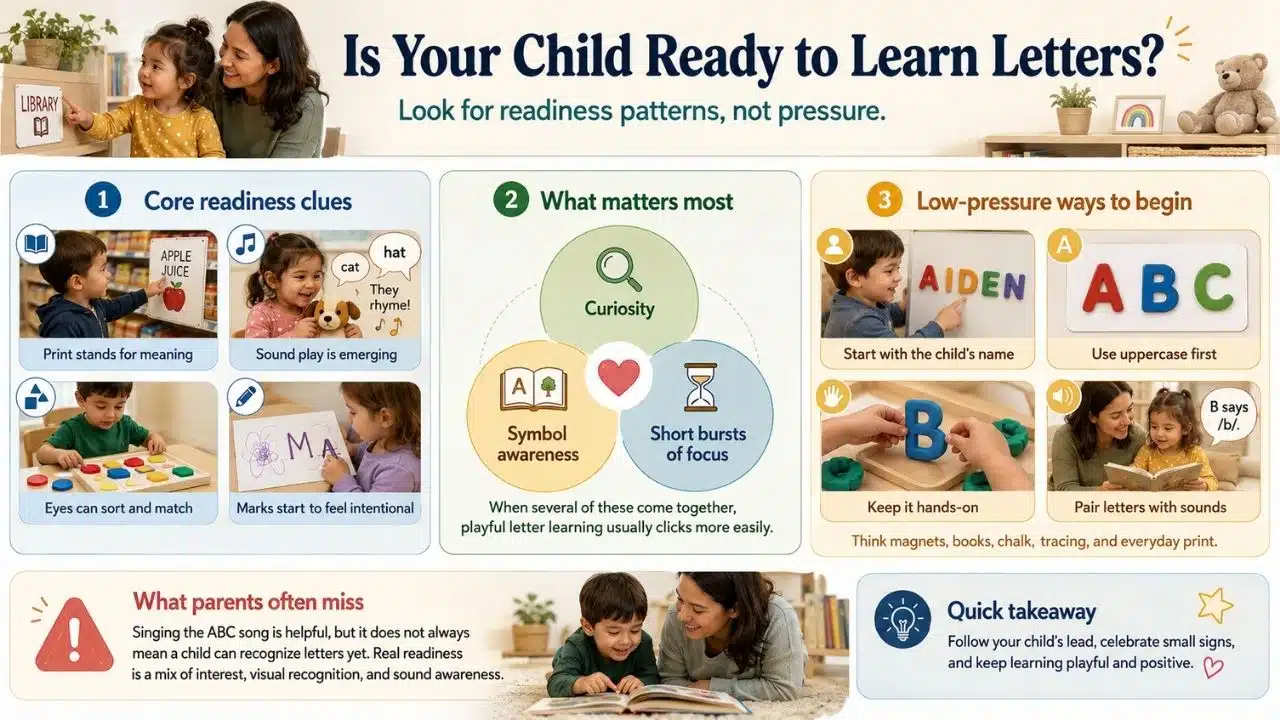
1. They Notice Print in the Real World
Long before children understand that letters make specific sounds, they realize those tiny black shapes mean something.
If your child points to the red octagonal sign on the corner and says “Stop,” or points to a cereal box and says “That is my cereal,” they are demonstrating environmental print awareness. They are not necessarily reading the letters yet. Instead, they are recognizing the visual icon as a symbol that carries meaning. This understanding is a crucial precursor to learning that squiggles on a page represent spoken words.
2. They Show Curiosity About Books and Reading
Handing a book to a child who only wants to chew on the spine or flip through pages in two seconds is very different from sitting with a child who genuinely engages with print.
You will know readiness is building when your child points to pictures and asks what the text says, pretends to read aloud by memory while turning pages, or directs your finger toward lines of text rather than just looking at illustrations. This curiosity signals that they view books as stories waiting to be unlocked rather than just stacks of paper.
3. They Recognize the First Letter of Their Own Name
A child’s name is usually the most important word in their universe.
Around age three or four, children often develop a sudden ownership over their letter. If your child is named Maya and shouts that she found her letter M on a storefront sign, she has crossed a major cognitive milestone. Connecting a specific abstract visual shape to a personal identity creates a strong mental anchor that makes the rest of the alphabet much easier to learn.
4. Their Rhyming and Sound Awareness Is Developing
Learning the alphabet requires both visual recognition and phonological awareness, which is the ability to hear and manipulate sounds in spoken language.
Notice how your child responds to nursery rhymes, silly songs, or wordplay. If they laugh when you swap a word in a rhyming song, or if they attempt to make up their own simple rhymes like cat, bat, and mat, their brain is tuning into the small sound units that make up speech. This sound-matching ability is what makes phonics click later on.
5. They Can Sort Objects by Visual Differences
Before a child can tell a capital B apart from a capital D, or a lowercase b from a d, their eyes must learn visual discrimination.
You do not need letters to test this. Pay attention to how they play with basic toys:
-
Can they sort red blocks into one pile and blue blocks into another?
-
Can they spot the difference between a big triangle and a small triangle?
-
Do they enjoy basic matching games or simple shape puzzles?
If they can easily spot subtle differences in shapes, colors, and patterns, their visual system is mature enough to differentiate between straight lines, curves, and angles in letters.
6. Their Scribbles Are Starting to Look Intentional
Early writing begins long before a child holds a pencil with a perfect tripod grip.
Watch what happens when you hand them crayons and paper. Early scribbles are usually circular and wild. As readiness approaches, those scribbles start changing:
-
Lines become horizontal or vertical strokes.
-
They make small, controlled loops or cross hatches.
-
They hand you a paper covered in squiggles and say they wrote a letter for you.
This pretend writing shows they realize that thoughts can be drawn as symbolic marks on paper.
7. They Can Categorize Letters vs. Non-Letters
Around age three or four, children begin grouping symbols in their minds. If you show them a page with a picture of a dog, a drawn circle, and the letter S, they can tell you that the letter is a word symbol rather than a picture of a physical object.
They might not know the name of the letter S yet, but they know it belongs in the category of things adults read, which is a distinct step forward in literacy development.
8. They Ask Direct Questions About Text
One of the clearest indicators of readiness is simply direct verbal interest. Recognizing these direct questions as signs child is ready to learn letters allows you to respond when their curiosity is highest.
When a child asks what a street sign says, why your shirt has writing on it, or how to spell their name, they are explicitly asking for instruction. These questions mean their brain is open and seeking input. Teaching a child who is actively asking questions is smooth and playful; trying to force-teach a child who has not asked yet often feels like pushing a boulder uphill.
9. They Can Focus on a Single Activity for 5 to 10 Minutes
Learning letter names and sounds requires a small degree of sustained attention. This does not mean your toddler needs to sit quietly at a desk, as they should not be expected to do that.
However, they do need enough focus to sit through a short picture book, complete a six-piece puzzle, or play with alphabet magnets on the fridge for a few uninterrupted minutes. While these behavioral shifts are strong signs child is ready to learn letters, forced lessons can quickly stall that momentum if the child is not ready for sustained focus.
Bridging Readiness with Playful Interactive Tools
Recognizing readiness is only the first step. Once you observe the primary signs child is ready to learn letters, you can support their natural curiosity with interactive tools that make letter recognition feel like play.
Guided Phonics and Tracing Practice
While hands-on activities like tracing letters in sensory bins or playing with refrigerator magnets remain essential, thoughtful digital tools can offer structured practice with letter formation and phonics sounds.
For example, Alphabet Magic trace & phonics on Google Play provides toddlers with guided uppercase and lowercase letter tracing alongside phonics games and matching challenges.
If you want to learn more about how this app structures its learning activities and ad-free play environment, read our full Alphabet Magic Trace & Phonics review. Pairing tactile offline activities with well-designed learning apps keeps early letter practice engaging, low-pressure, and effective.
What to Try First
If your child is showing four or five of these signs, you do not need to buy a rigid preschool curriculum or flashcards. Start small and keep it conversational:
| Focus Area | Simple Daily Practice |
| Start with Their Name | Point out the first letter of their name on mail, signs, and labels. |
| Focus on Uppercase First | Capital letters (A, B, M, T) have distinct, straight lines and curves that are easier for young eyes to distinguish than lowercase shapes. |
| Integrate Hands-On Play | Use magnetic letters on the fridge, trace letters in play-dough, or write them with sidewalk chalk. |
| Emphasize Sounds Early | When pointing out a letter, pair it with its sound immediately (“That is a B, it says /b/ like ball”). |
Key Signs Child Is Ready to Learn Letters: What Parents Often Miss
A common mistake is treating alphabet song recitation as proof of letter knowledge.
Singing the ABC song is a wonderful memory and auditory exercise, but it is a language skill, not a reading skill. Many toddlers who can sing the alphabet flawlessly cannot identify the letter K when shown a picture of it, because to them, “elemeno-p” is just one big word in a tune.
Real readiness happens when visual recognition, sound awareness, and curiosity come together, not simply when a song is memorized. Watching for these signs child is ready to learn letters ensures that early reading instruction feels like a natural extension of play rather than a forced chore.
Final Thoughts on Alphabet Readiness
Every child develops at their own distinct pace, and observing the signs child is ready to learn letters is about following their natural curiosity rather than adhering to a strict timeline. When you notice these early hints of print awareness and sound play, keep the learning environment light, playful, and interactive. Early literacy is not a race to complete flashcards, but a gradual process of connecting spoken words to visual symbols. Trust your child’s signals, celebrate their small discoveries, and let their enthusiasm guide your next steps.
Frequently Asked Questions(FAQs) on Signs Child Is Ready to Learn Letters
What age should a child know all their letters?
Developmental timing varies widely. Many children begin recognizing a few letters around age three, while most master uppercase and lowercase letter names and basic sounds between ages four and six (during preschool and kindergarten).
Should I teach letter names or letter sounds first?
Both are helpful, but focusing heavily on letter sounds (phonics) gives children a direct path toward actual reading. Knowing that S makes the /s/ sound helps them decode words much faster than simply knowing its name is “Es”.
What if my child is 4 and shows no interest in letters?
This is normal for many kids. Focus on building fine motor control, reading aloud together daily, playing rhyming games, and doing hands-on art. Pushing flashcards onto a reluctant four-year-old can backfire; keeping print positive and low-pressure builds genuine long-term interest.