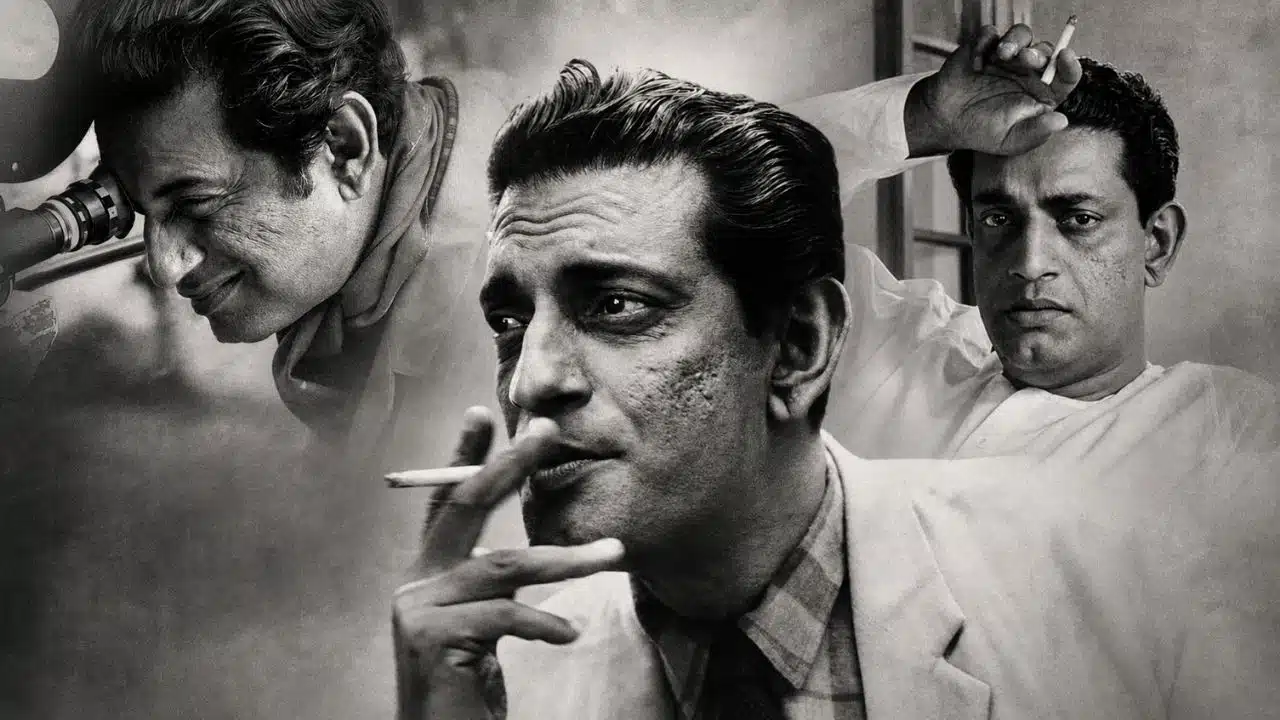
Satyajit Ray was not just a filmmaker. He was a storyteller, writer, illustrator, music composer, lyricist, designer, and one of the greatest creative minds Bengal has ever produced. Born on May 2, 1921, in Kolkata, Ray changed the language of Indian cinema and introduced Bengali storytelling to the world with rare honesty, beauty, and humanity.
On his 105th birth anniversary, we remember a master artist whose films still speak to audiences across generations. His cinema was deeply rooted in Bengal, yet universal in emotion. Through simple stories, ordinary people, and unforgettable details of life, Satyajit Ray proved that great cinema does not need noise; it needs truth.
Early Life and Family Background
Satyajit Ray was born into one of Bengal’s most respected literary and artistic families. His grandfather, Upendrakishore Ray Chowdhury, was a renowned writer, illustrator, printer, and musician. His father, Sukumar Ray, was a legendary writer of nonsense verse and children’s literature. Ray’s mother, Suprabha Ray, raised him with great care after he lost his father at a very young age.
This rich cultural background shaped Ray’s mind from childhood. Literature, music, drawing, printing, and storytelling were not distant subjects for him. They were part of his everyday environment.
Ray and Rabindranath Tagore
As a child, Satyajit Ray was known by his nickname, Manik. One memorable incident from his childhood connects him with Rabindranath Tagore. When Ray was around ten years old, he visited Tagore with his mother to get an autograph.
Tagore asked him to leave the autograph book and return the next day. When Ray came back, Tagore had written a short poem for him. The poem carried a simple but powerful message: people often travel far to see great wonders yet fail to notice the beauty lying just beside them.
This thought stayed close to Ray’s artistic spirit. His films would later show the same truth. He looked deeply at ordinary life and found extraordinary beauty in it.
Education and the Growth of His Artistic Mind
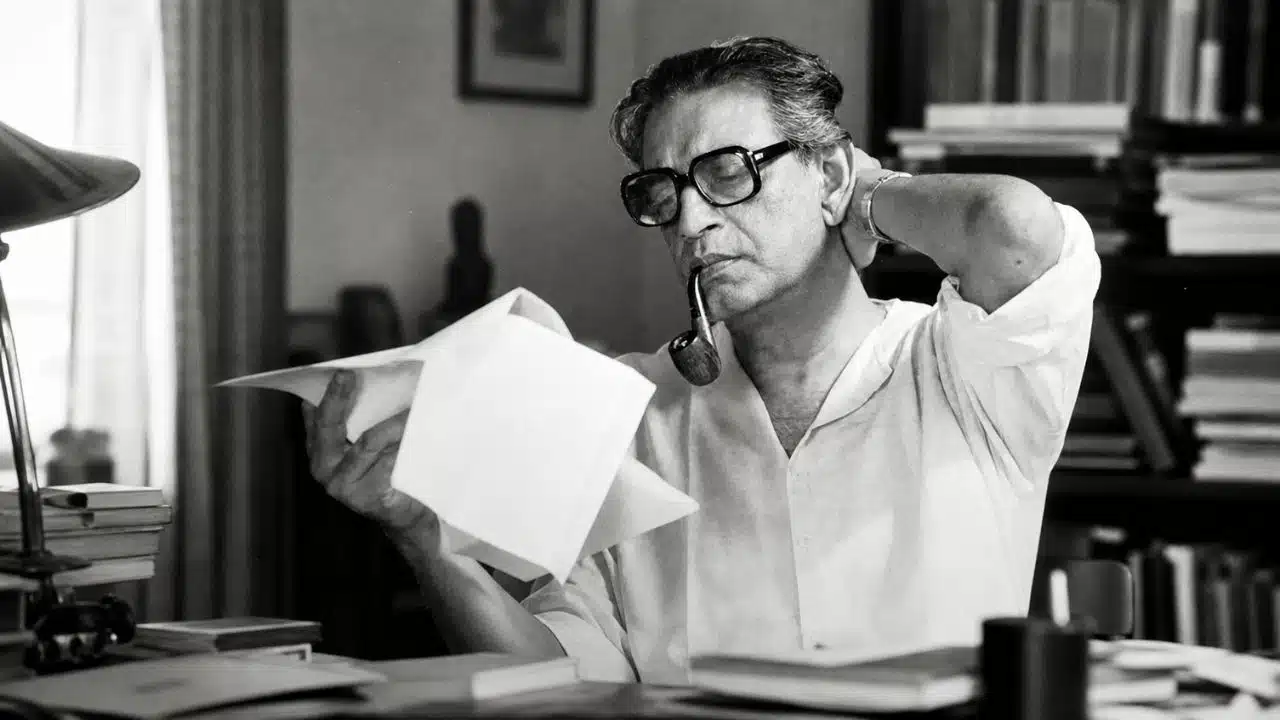
Ray studied at Presidency College in Kolkata. Although he took economics, his real interests were literature, music, art, and cinema. He was deeply curious about films and began studying them seriously. He read books on film theory and subscribed to Sight and Sound, a respected British film magazine.
Ray later said that film writing opened a new world before his eyes. He began to observe how cameras moved, how scenes were cut, how stories were built, and how one director’s style differed from another’s.
Shantiniketan: Learning to See
In 1940, Ray joined Kala Bhavana at Shantiniketan, founded by Rabindranath Tagore. This period had a deep influence on him. Under the guidance of artists like Nandalal Bose and Benode Behari Mukherjee, Ray learned not only painting but also how to see nature, people, and tradition with a more sensitive eye.
Shantiniketan helped Ray understand Indian art and culture more deeply. It gave him a foundation that later became visible in his films, illustrations, and visual compositions.
From Commercial Art to Cinema
After returning to Kolkata, Ray began working as a junior visualizer at the advertising agency D. J. Keymer in 1943. His training as a commercial artist sharpened his sense of design, layout, typography, and visual storytelling. Later, he became an art director.
This experience helped him greatly as a filmmaker. Ray’s films are known for their precise framing, careful details, natural rhythm, and strong visual identity.
The Birth of the Calcutta Film Society
Ray’s love for cinema grew stronger during this period. In 1947, he and a group of like-minded film lovers founded the Calcutta Film Society. This opened the door for serious discussion and viewing of world cinema in Kolkata. According to Satyajit Ray’s official biography, he founded Calcutta’s first film society in 1947 and later made Pather Panchali while still working in advertising.
The film society exposed Ray to the works of great international filmmakers. It also helped him understand cinema as an art form, not just entertainment.
The Making of Pather Panchali
The story of Pather Panchali entered Ray’s life through his work as a book illustrator. He was asked to design illustrations for a children’s edition of Bibhutibhushan Bandyopadhyay’s novel. After reading the book, Ray was deeply moved.
The story of Apu, Durga, Sarbajaya, Harihar, and Indir Thakrun stayed in his mind. Ray realized that this simple story of a poor family in rural Bengal could become a powerful film.
Jean Renoir’s Influence
In 1949, French filmmaker Jean Renoir came to Kolkata to work on his film The River. Ray met him and discussed his dream of making Pather Panchali. Renoir encouraged him to use the richness of Bengal and not simply copy Hollywood.
This advice became central to Ray’s artistic journey. He absorbed global cinematic knowledge but kept his stories deeply rooted in Bengali life.
A New Language for Indian Cinema
Released in 1955, Pather Panchali changed Indian cinema forever. It rejected artificial melodrama and brought realism, silence, nature, poverty, childhood, and human dignity to the screen in a new way. The film became the first part of the celebrated Apu Trilogy, followed by Aparajito and Apur Sansar.
In Pather Panchali, Ray showed rural Bengal with tenderness and truth. The sound of rain, the movement of insects, the discovery of a train, the pain of poverty, and the quiet dreams of children all became part of a living cinematic experience.
Why Pather Panchali Was Revolutionary
Before Pather Panchali, Indian cinema was often dominated by theatrical acting, songs, glamour, and dramatic storytelling. Ray introduced a different style. He focused on ordinary people and their daily struggles.
Harihar’s family was not shown as a symbol of misery alone. Ray gave them dignity, humor, hope, pain, and emotional depth. This humanistic approach became one of the strongest qualities of his cinema.
Bengal on the World Stage
Pather Panchali brought Ray international recognition and helped bring Indian cinema to global attention. Britannica notes that Ray brought Indian cinema to world recognition through Pather Panchali and its two sequels, known as the Apu Trilogy.
The film proved that a local story could speak to the world. Ray did not need to abandon Bengal to become international. Instead, he became global by being deeply rooted in his own culture.
Satyajit Ray’s Creative Genius
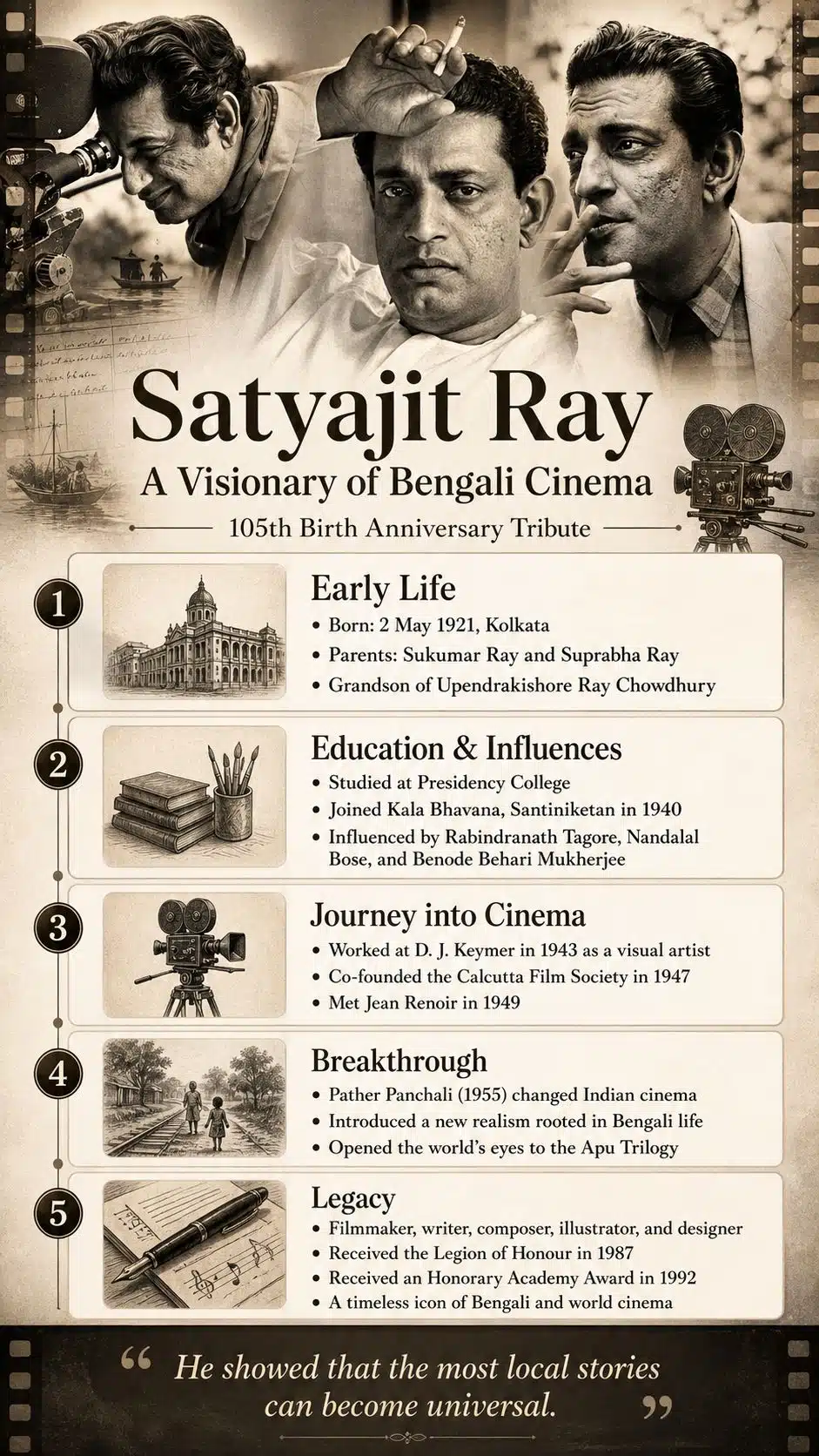
Ray was a complete artist. He wrote scripts, composed music, designed posters, created title cards, handled visual concepts, and wrote stories. He was also the creator of beloved literary characters such as Feluda and Professor Shonku.
His creative range made him unique. In every field he touched, he brought elegance, intelligence, and originality.
A Humanist Storyteller
Ray’s cinema was built on humanism. He did not judge his characters harshly. He observed them with patience and compassion. Whether he was showing a poor village family, a lonely housewife, a city professional, or a child discovering the world, Ray always searched for the human truth beneath the surface.
This is why his films remain relevant even today. They are not limited to one time, place, or language.
Awards and Global Recognition
Satyajit Ray received many national and international honors during his lifetime. In 1987, he received France’s Legion of Honor. In 1992, he received an Honorary Academy Award for his mastery of motion pictures and his profound humanitarian outlook.
The Academy later began the Ray Preservation Project after he received the honorary Academy Award, helping preserve many of his films for future generations.
These awards recognized what audiences had already known for decades: Ray was not only a Bengali filmmaker or an Indian filmmaker. He was a world-class filmmaker.
Legacy of Satyajit Ray
Satyajit Ray was born once in a century. He did not create films merely to win medals or awards. He created films to reveal life, question society, celebrate humanity, and expand the possibilities of cinema.
His work changed the way people looked at Indian films. He showed that cinema could be artistic, realistic, emotional, and socially meaningful at the same time.
Even today, filmmakers, writers, artists, and viewers continue to learn from him. His legacy lives on through his films, books, music, illustrations, and the powerful human values he left behind.
Final Words
Satyajit Ray remains one of the brightest names in world cinema. His art was modern yet rooted, simple yet profound, local yet universal. From the lanes of Kolkata to the villages of Bengal, from children’s imagination to adult loneliness, from social change to personal emotion, Ray captured life with unmatched grace.
On his 105th birth anniversary, we pay tribute to the visionary who gave Bengali cinema a global voice and taught the world to see beauty in the smallest details of life.