

A comprehensive investigation by the Yale School of Public Health’s Humanitarian Research Lab (HRL) has revealed that thousands of Ukrainian children abducted during Russia’s full-scale invasion are being forcibly held and “re-educated” in facilities spread across Russia and Russian-occupied Ukraine. The study documented at least 210 separate facilities, showing the scale and organized nature of the system.
The abducted children largely come from eastern and southern territories occupied by Russian forces since February 2022. Many were separated from their parents during active combat, evacuated from state institutions, or taken from families in areas under military control. Vulnerable groups such as children with disabilities, those from low-income households, or those without guardians were particularly targeted.
Indoctrination, Militarization, and Exploitation
According to the Yale report, children sent to these camps are often placed in programs that aim to reshape their cultural identity and integrate them into pro-Russian frameworks. The indoctrination process includes patriotic education, suppression of the Ukrainian language, and the promotion of narratives portraying Russia as a liberating force.
In some facilities, children undergo forced militarization. This includes drills, combat and paratrooper training, and even lessons in assembling or producing military equipment. Researchers found evidence that children in certain locations were involved in the manufacture of drones and other supplies for the Russian armed forces. These practices demonstrate how abducted children are being integrated into Russia’s war effort, far beyond the stated claim of providing them “safety.”
Variety of Facilities Used
The 210 identified facilities span different types of institutions, illustrating how widespread the practice has become. They include:
-
Summer camps and youth centers run by Russian state organizations.
-
Cadet schools and military bases where teenagers receive structured combat training.
-
Sanatoriums and mental health institutions used to detain children under the guise of medical care.
-
Religious institutions such as monasteries that host indoctrination programs.
-
State-run facilities and family centers where children face coerced fostering and adoption processes.
Researchers note that children who enter this network are at risk of being permanently separated from their families, with some ending up in Russian households and receiving Russian citizenship through coerced adoption.
International Law and War Crime Allegations
The international community has already recognized these acts as violations of international law. In March 2023, the International Criminal Court (ICC) issued arrest warrants for Russian President Vladimir Putin and Maria Lvova-Belova, the Russian Presidential Commissioner for Children’s Rights. The ICC accused both of committing war crimes for the unlawful deportation and transfer of children from occupied Ukrainian territories into the Russian Federation.
The ICC’s charges emphasize that the forced relocation of children, combined with re-education and adoption practices, amounts to an attempt to erase Ukraine’s national identity by targeting its most vulnerable population.
Ukrainian Estimates of Abductions
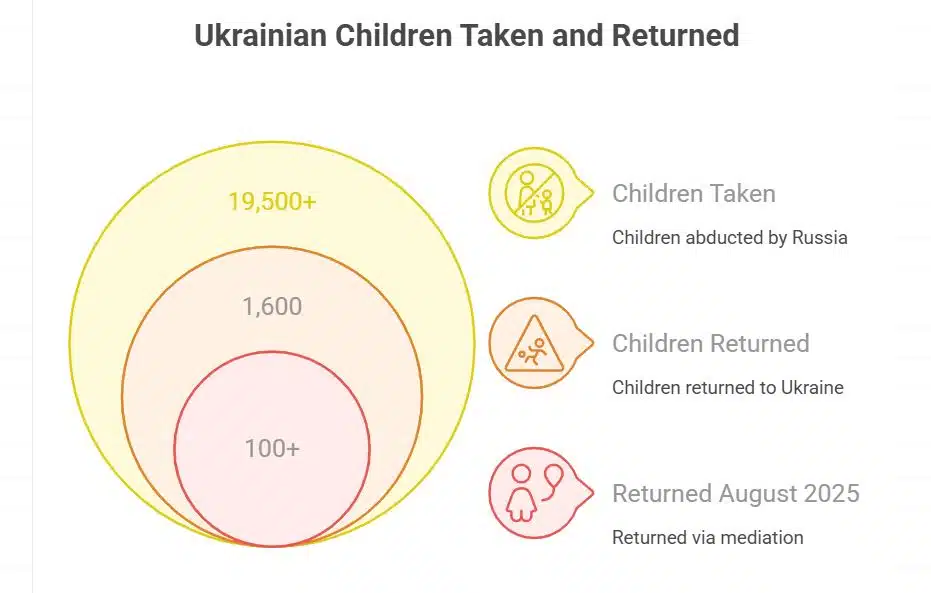
Ukraine’s state-run program Bring Kids Back UA, launched under President Volodymyr Zelenskyy, estimates that more than 19,500 children have been taken by Russia since the beginning of the invasion. Official figures suggest that only around 1,600 have been successfully returned to Ukraine. This includes just over one hundred children who were brought back in August 2025 through international mediation and humanitarian efforts.
The Ukrainian government has described the abduction and indoctrination campaign as one of the gravest consequences of Russia’s aggression, warning that it not only deprives families of their children but also threatens to destroy Ukraine’s future by erasing its next generation.
Reactions From Global Leaders
The Yale report has added urgency to international discussions. Ukrainian President Zelenskyy announced that the issue of abducted children would be a priority at the upcoming United Nations General Assembly in New York, where he will host a dedicated session with Canadian Prime Minister Mark Carney. Multiple world leaders are expected to join this event to push for stronger global action.
In August, during meetings in Washington with Zelenskyy and European leaders, U.S. President Donald Trump raised the problem of abducted children as part of a broader conversation on missing minors worldwide. While Trump avoided directly naming Russia in his public remarks, European Commission President Ursula von der Leyen responded by emphasizing that every abducted Ukrainian child must be returned to their families.
First Lady Melania Trump also entered the debate weeks earlier by writing an open letter addressed to Putin, urging the protection of children’s innocence. According to reports, Donald Trump personally handed this letter to the Russian leader during a meeting in Alaska. However, Russian state media provided no acknowledgment or response to the appeal.
Russia’s Position and Propaganda Narratives
Russia continues to deny allegations of abduction and forced re-education. Official narratives, amplified by state-run media, claim that Ukrainian children were evacuated for their own safety from war zones and provided with humanitarian aid, education, and shelter.
Earlier responses to ICC charges also included attempts to discredit international institutions, with threats against ICC judges and accusations that Western nations were conducting experiments on children or spreading anti-Russian propaganda. The Kremlin has maintained that the relocations are voluntary or protective, though evidence from satellite imagery, open-source data, and survivor testimonies directly contradicts these claims.
U.S. and International Response
Two years prior to this report, under the Biden administration, the U.S. State Department released a detailed assessment titled “The Kremlin’s War Against Ukraine’s Children.” That report noted mounting evidence of deportations and highlighted Russia’s use of nuclear threats and disinformation to deflect international scrutiny. The findings from Yale build on these earlier assessments, providing fresh, verifiable data and mapping a much larger network of facilities.
As of now, the current U.S. administration has not issued a formal response to the latest Yale findings. CBS News confirmed that the State Department had been asked to comment on whether it accepts the new conclusions, whether it intends to support Zelenskyy’s initiative at the UN, and if Washington plans additional steps to address the issue as part of ongoing diplomatic efforts to end the war. No reply has yet been made public.
An Attempt to Erase Ukraine’s Identity
Human rights observers warn that the systematic relocation, indoctrination, and adoption of Ukrainian children amounts to more than a humanitarian tragedy. It represents a deliberate attempt by Moscow to weaken Ukraine’s national identity by assimilating its future generation into Russian society.
By stripping children of their language, culture, and family ties, Russia is not only committing war crimes but also waging a campaign that could have long-lasting effects on Ukraine’s ability to recover as an independent nation. Analysts stress that this policy appears designed to erase Ukraine’s existence as a state by robbing it of its future.
The Yale Humanitarian Research Lab’s report paints a detailed picture of how abducted Ukrainian children are being used as tools of war, indoctrination, and political manipulation. With more than 19,500 children taken and only a fraction returned, the scale of the crisis underscores why it remains one of the most urgent humanitarian issues of the ongoing conflict.
International leaders, courts, and institutions are now under pressure to ensure accountability, push for the children’s safe return, and prevent further violations. As Zelenskyy prepares to spotlight the issue at the UN, the findings add weight to calls for stronger collective action against a practice that many view as one of the darkest dimensions of Russia’s war against Ukraine.






















