

You would feel it even before the ball was airborne. This was not from a playbook. The plan was devised instantly: a split-second decision made out of chaos as opposed to code. These moments are becoming increasingly rare nowadays. Sure, the game’s pulse is still alive, but it is at the very least being reprogrammed. The question now becomes: “Are we stripping away the warmth that made us fall in love with sports during childhood?”
Natural Instinct vs. Calculated Precision
An iconic player’s raw skills make them even more exciting; from Messi slicing through defenders to a purely spontaneous strike from Federer. That kind of play is what keeps fans on the edge of their seats—and what makes platforms like Melbet so popular, where people bet not just on stats but on the unexpected. Moments such as this remain free-flowing, instinctive, and downright impossible to predict, regardless of the expansive data being analyzed.
Every day, more and more teams rely on the numbers of the players instead of the players themselves. A significant problem is that players often focus on the optimal trajectory during the game, which ultimately undermines any chance of improvisation.
Fan Experience and Emotional Connection
Emotion is the apparent reason why we get excited when we watch specific TV competitions, why we risk money on bets that we probably won’t win, and why we hope for a comeback. Having an emotional attachment to something is what makes most fans willing to invest their time and attention in the activity. The problem arises when the emotion begins to dissipate due to an overabundance of pre-planned narratives.
Here’s the disconnection that hits the hardest:
- The feeling of watching a “live” event being simulated is absolute stagnation.
- Analyzed becomes the new focus of the post-event discussion.
- Miracle-like cases are vanishing from narratives, making them less frequent.
- Even hyper-optimized algorithms yield fewer shocking payouts.
When people start anticipating overwhelming outcomes based on AI-generated numbers instead of spontaneous movement, the excitement instantaneously turns into monotony.
The Rise of Algorithmic Decision-Making
There’s a coach who isn’t pacing the sideline but sits quietly behind the scenes—calm, calculated, and entirely digital. Every substitution, pitch choice, or risky play seems to be filtered through AI first. Even platforms like Melbet reflect this shift, where odds often mirror algorithm-driven decisions. The game has steadily moved from gut-driven calls to strategy shaped by cold, calculated commands.
Coaches Following Predictive Models
Coaches with tablets instead of clipboards, and instead of looking at the court, they’re looking at charts. Winning probability analyses are now being utilized during live games; 70% of head coaches were reported to use them in 2024 NBA games.
When strategy becomes a math problem, something fundamental is missing. Take the instance of Mike Tomlin, who went for two instead of tying with an extra point. That wasn’t data, that was pure guts. Coaches nowadays tend to be more cautious, opting to avoid taking risks and relying solely on numbers. Those fans, depending on the hypotheses predicting momentum shifts to undergo via machine learning algorithms, are now watching action-drama lose value.
Scouting Led by Machine Learning
It used to be long bus drives, amateur intuition, and notes scrawled from an Omaha bleacher seat. Now AI can do competency checks for teenagers ahead of them stepping onto the court at age 16 through a wide array of algorithms, and flag talent waiting for humanity to catch up and set eyes on the game.
The statistics are accurate, although they are not all-knowing. For example, a machine learning system would tell you a child has a 92% pass completion rate, but it would never fathom why that child had tears of joy in his eyes after winning. Data-driven scouts miss out on late bloomers, mentally tough individuals, and extreme under-pressure performers. That is one gap an algorithm will never be able to fill.
Injury Risk and Overtraining Through Metrics
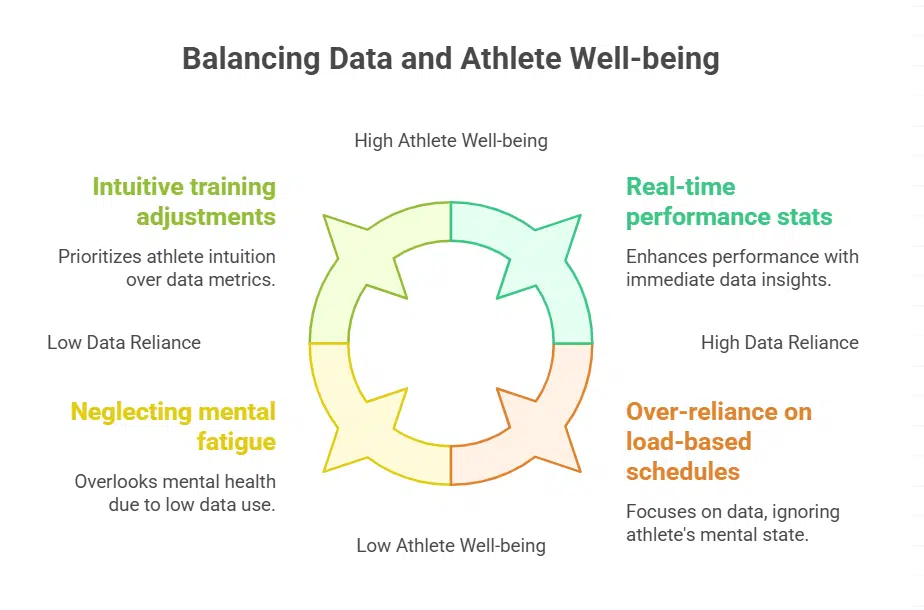
From a distance, monitoring heart rates and recovery times is a sport science in itself. The danger begins once athletes become data points, as the line between safety and strain quickly becomes indistinguishable. In elite-level football, wearables have started providing real-time stats on a player’s performance while they are on the field.
During the 2022 Bundesliga season, some players erroneously attributed their soft tissue injuries to “load-based schedules,” neglecting mental fatigue. In a situation where an abundance of graphs accompanies training, people will always be at risk.
Why the Soul of Sports Still Matters
No computer algorithm can replicate the goosebumps of a penalty kick shootout or the silence that precedes a buzzer-beating shot. It’s in those moments that fans deepen their love of the sport, as stories and multiple perspectives emerge. Take those elements out of the sport, and you’re not just taking away the unpredictability; you’re taking away the essence of the sport.






















