
Choosing between robo-advisors vs human financial advisors often comes down to two things: how much guidance you need and what you are willing to pay. A robo-advisor can automate portfolio management online. A human advisor can discuss your broader circumstances and may help with decisions beyond investing.
Neither option guarantees better returns. The right comparison of robo-advisors vs human financial advisors starts with the work you want done. This article focuses on U.S. services; fees and regulations can differ elsewhere and may change.
What’s the Difference Between Robo-advisors Vs Human Financial Advisors?
A robo-advisor is a digital investment advisory service. You answer questions about your goals, time horizon, finances, and comfort with risk. The service uses your answers to recommend or manage a portfolio. Many also rebalance investments to keep a portfolio closer to its target allocation.
A human financial advisor may manage investments, create a financial plan, or provide both. Depending on the agreement, the work may include retirement planning, cash-flow decisions, or help weighing competing goals. “Financial advisor” is a broad label, so ask what services are actually included.
| Feature | Robo-advisor | Human financial advisor |
| Interaction | Mostly through an app or website | Meetings, calls, email, or a mix |
| Main service | Automated investment advice and management | Investment advice and, depending on the agreement, broader planning |
| Personalization | Based on the information and choices the service collects | May include discussion of circumstances a questionnaire misses |
| Fees | May be asset-based, subscription-based, or no advisory fee for a particular tier | May be asset-based, hourly, flat-fee, subscription-based, or commission-based |
Some digital services offer access to people, and human advisors may use automated tools. The practical difference in robo-advisors vs. human financial advisors is the service you receive, not simply whether a person or software is involved.
Robo-Advisors vs Human Financial Advisors: How Do the Costs Compare?
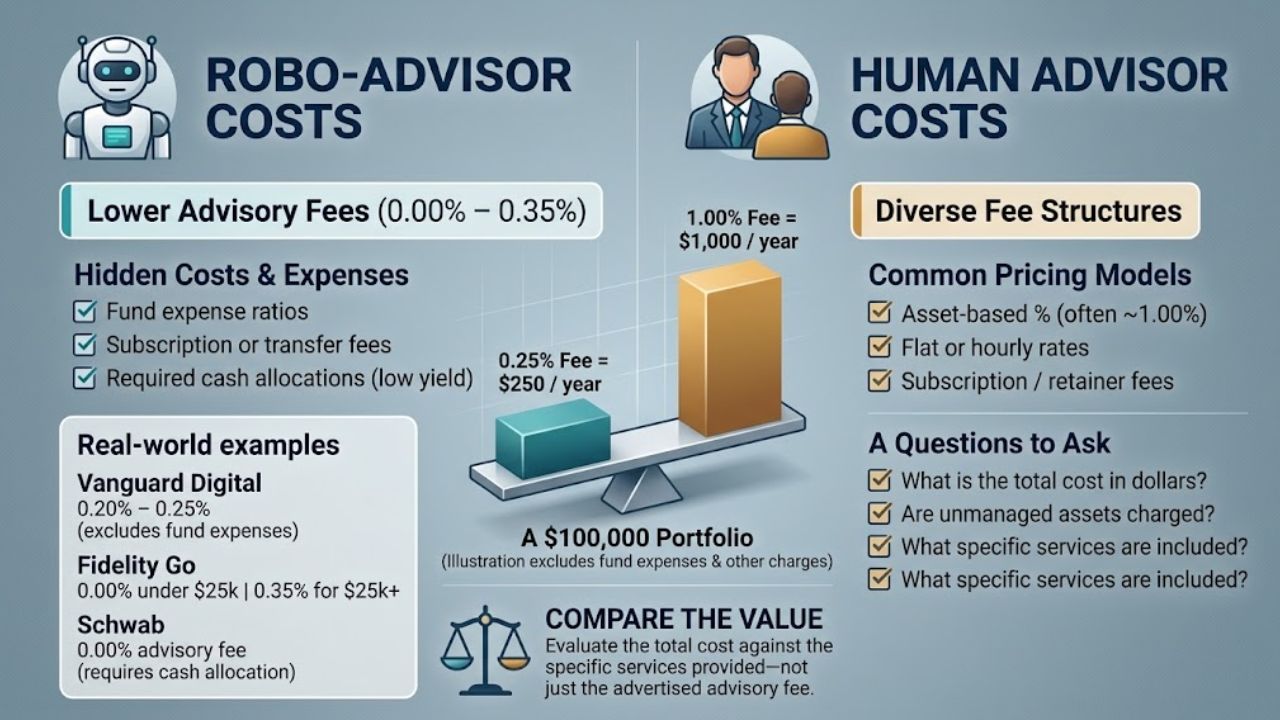
Robo-advisors often have lower advisory fees, but that fee is only one part of the cost. Investors may also pay fund expenses, subscription charges, or transfer fees. The SEC warns that a low advisory fee does not necessarily mean low overall costs if the service uses investments with higher expenses.
Provider examples show why the details matter. Vanguard Digital Advisor lists gross advisory fees of 0.20% for all-index options and 0.25% for an active/index mix; these figures exclude investment expense ratios. Fidelity Go charges no advisory fee below a $25,000 balance and 0.35% annually at or above that level. Schwab Intelligent Portfolios charges no advisory fee, but investors pay ETF operating expenses and hold a cash allocation. Schwab notes that some alternatives outside the program may pay a higher yield, so check how the cash allocation fits your needs. Fees and terms can change; review the current disclosures before enrolling.
For scale, 0.25% of a $100,000 portfolio is $250 a year; 1% is $1,000. This illustration excludes fund expenses and other charges. It does not show whether a fee is worthwhile; that depends on what services it covers.
Human advisors may charge an asset-based percentage, an hourly or flat fee, or a subscription or engagement fee. The SEC notes that fees vary with the service and the agreement. Ask for the total cost in dollars, whether the fee applies to assets the advisor does not manage, and exactly what work is included. A fair comparison of robo-advisors vs. human financial advisors weighs the total cost against the actual service—not just the advertised advisory fee.
What Robo-advisors Do Well
A robo-advisor can simplify routine investing. It can recommend a portfolio from your answers and handle tasks such as rebalancing. That can suit someone who wants a defined process and prefers managing an account online.
Automation does not make investing risk-free or guarantee better results. Rebalancing keeps a portfolio closer to a planned allocation; it cannot prevent market losses. Be wary of any provider or tool that promises superior performance.
Where Robo-advisors Fall Short
A digital recommendation depends on the questions a service asks and the information you provide. It may not account for your full situation, including outside investments, near-term cash needs, or changing goals. FINRA cautions that automated tools can rely on limited assumptions and may not consider every relevant circumstance.
Consider someone investing for retirement who also plans to buy a home in three years. If that short-term goal is not entered—or the service does not account for it—the recommendation may not reflect the whole picture. Review your answers carefully and confirm that the service supports the goals you need it to consider.
What can a Human Advisor add?
A human advisor can ask follow-up questions and help weigh goals that compete for the same money. That can be useful during a major life change or when investment choices connect to retirement, taxes, or other planning needs. The advisor may not provide tax preparation or legal services, so confirm the scope rather than assuming.
Human support can also help some investors stay focused when markets fall or plans change. It does not guarantee better decisions or performance. In robo-advisors vs human financial advisors, personal guidance is most valuable when it helps you make decisions that a basic portfolio service cannot address.
Limits of Hiring a Person
A human advisor is not automatically more qualified, objective, or suitable for you. Advisors have different credentials and compensation arrangements. Ask how the professional is paid, whether they receive compensation connected to particular products, and what standard of conduct applies to your account.
In the U.S., investment advisers are subject to a fiduciary duty under the Investment Advisers Act. Broker-dealers are subject to Regulation Best Interest when making covered recommendations to retail customers. Some professionals are registered in both capacities, so ask which role they are acting in when advising you.
Which Option Fits Your Situation?
A robo-advisor may suit you if you want automated portfolio management, have straightforward goals, and feel comfortable managing your account online. A human advisor may be a better fit if you need help coordinating several goals, want to discuss decisions with a person, or have circumstances a digital service does not handle well.
These are starting points, not rules. Some investors use a digital service for routine investing and consult a professional for a separate financial plan. The robo-advisors vs human financial advisors choice should follow the work you need done and whether the cost makes sense for you.
The Limits of Hiring a Person
A human advisor is not automatically more objective, more skilled, or better suited to your needs. People vary in experience and qualifications, and compensation arrangements can create conflicts that clients should understand. Before signing, ask how the advisor is paid, what products or services they can recommend, and whether they have incentives connected to those recommendations.
Ask for the relationship summary and advisory brochure, then review them. In the U.S., Investor.gov’s Investment Adviser Public Disclosure search can help you check a firm or professional’s registration information and disciplinary history. FINRA also recommends using Form CRS to compare services, costs, conflicts, and standards of conduct.
A Hybrid Option May Provide a Middle Ground
Some services combine automated investing with access to human support. Others let clients pay a planner for a one-time or hourly review without handing over investment management. A hybrid service can be a useful middle ground, but “access to an advisor” can mean different things.
Ask how often you can speak with someone, what topics they can cover, and whether they will review your full financial picture. Fidelity Go, for example, says clients with balances of $25,000 or more can access one-on-one coaching calls. That is a provider-specific feature; it does not mean every hybrid plan includes comprehensive financial planning.
Questions to Ask Before Choosing
Before opening an account or hiring an advisor, ask:
- What services are included?
- What is the total cost, including fund expenses?
- What information does the service consider, and what might it miss?
- Can I speak with a person, and what can they advise me on?
- How is the provider paid, and what conflicts should I understand?
- What happens if I transfer or close the account?
For U.S. firms and professionals, review Form CRS and Form ADV. Investor.gov’s search tool can help you check registration and disciplinary information. These checks cannot decide whether a provider is right for you, but they help clarify the relationship before you sign.
Final Thoughts
In robo-advisors vs human financial advisors, a robo-advisor can make straightforward portfolio management more convenient, while a human advisor may help with decisions that need context and discussion. Neither guarantees returns, and a higher fee alone does not prove a service is better.
Write down the help you need, compare total costs, and read the provider’s disclosures. Choose a service whose limits you understand and whose support matches the decisions you need to make.
Frequently Asked Questions (FAQs) About Robo-advisors Vs Human Financial Advisors
Does “no advisory fee” mean a robo-advisor is free?
Not necessarily. You may still pay fund operating expenses or other charges. Schwab, for example, says investors in Intelligent Portfolios pay ETF expenses and hold a cash allocation.
Is every human financial advisor a fiduciary?
No. The title alone does not establish a professional’s registration, role, or standard of conduct. Ask how the advisor is registered and which capacity they are acting in for your account.
What should I prepare for a first meeting with an advisor?
Bring a clear list of your goals, approximate time frames, major expenses, debts, and the accounts you want advice about. You do not need a perfect financial plan; the point is to give the advisor enough context to explain what the engagement would cover.