Reduce Cart Abandonment, it is the single most expensive leak in the e-commerce bucket. As we move into 2026, the global average for abandonment sits stubbornly around 70%, meaning seven out of every ten shoppers who add an item to their cart will leave without paying. For mobile users, that number spikes to nearly 85%. The cost? An estimated $18 billion in lost sales annually. But here is the silver lining: you don’t need to win back everyone. Recovering just a fraction of these “almost-buyers” can double your profit margins.
The mistake most brands make is treating checkout as a generic, static form. In reality, a checkout that converts in New York often fails in Dubai. A flow that feels secure to a Londoner might feel tedious to a shopper in Los Angeles. To truly cut abandonment in half, we must move beyond basic “best practices” and adopt a hyper-localized, friction-free strategy.
This guide breaks down 9 scientifically backed optimizations to reduce cart abandonment across the USA, UK, and UAE markets, updated for the consumer behaviors and technologies of 2026.
Key Takeaways
If you only implement three things from this guide to prepare for 2026, make them these:
-
Go Local with Payments: Do not launch in Dubai without Tabby/Tamara, and do not launch in the UK without Klarna.
-
Kill the Account Wall: Move account creation to the “Thank You” page. This single change can lift conversions by 35%.
-
Mobile First, Always: Design for the “Thumb Zone” and use sticky buttons. If your mobile checkout is hard, your business is invisible to 80% of buyers.
The Psychology of the “Almost-Customer”
Before fixing the pixels, we must fix the psychology. Why do users abandon? In 2026, it is rarely because they “changed their mind.” It is because the friction of buying outweighed the desire for the product.
According to the latest Baymard Institute data, the top reasons for abandonment have evolved:
-
Unexpected Costs (48%): Shipping, taxes, and duty fees (crucial for UK/EU cross-border in 2026).
-
Forced Account Creation (24%): The “login wall” is a conversion killer.
-
Trust Deficit (18%): “Is my credit card safe here?”
-
Payment Friction (13%): “Why can’t I just use Apple Pay?”
The following 9 optimizations directly dismantle these four barriers.
The Optimization Trinity: A Strategic Framework
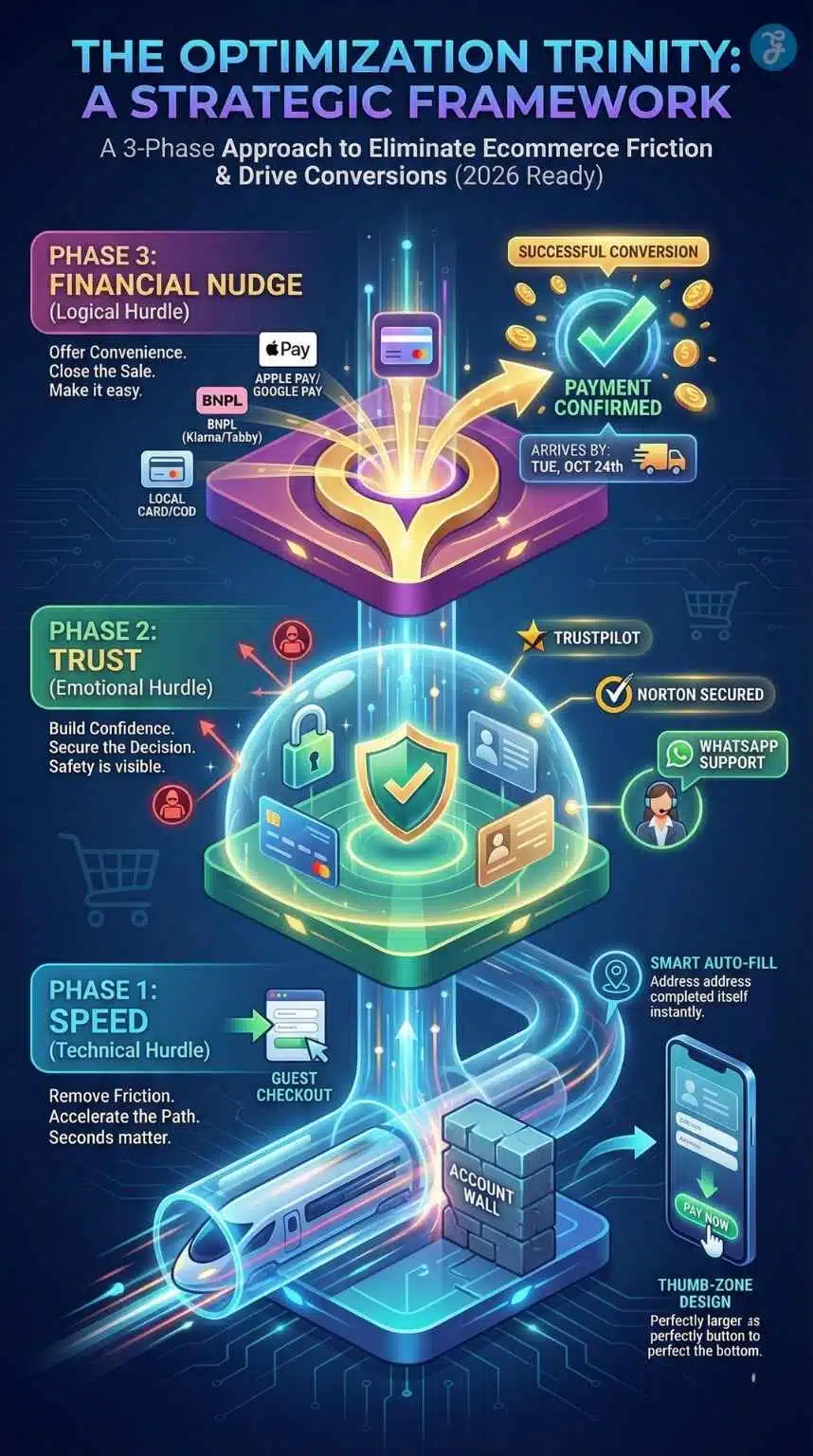
To effectively reduce cart abandonment in 2026, random tweaks—like changing a button color or adding a logo—are no longer enough. You need a cohesive architecture that addresses the user’s hesitation in the exact order it arises.
Think of your checkout process as a hierarchy of needs. If the foundation is unstable, the structure collapses. We have organized the following 9 optimizations into three distinct phases that mirror the live decision-making process of a global shopper:
-
Phase 1: Speed (The Technical Hurdle) – Can I get through this quickly? If the process is slow or clunky, users leave immediately. This is about removing friction.
-
Phase 2: Trust (The Emotional Hurdle) – Is my money and data safe? Once the flow is fast, the user pauses to evaluate security. This is about building confidence, particularly in cross-border markets like the UK and Dubai.
-
Phase 3: The Financial Nudge (The Logical Hurdle) – Is this payment method convenient for me? The final step is the transaction itself. This is about offering the right regional payment options to close the deal.
By optimizing these three pillars in order, we transform a leaky checkout into a conversion engine. Let’s start with the foundation: Speed.
Phase 1: Radical Speed (Removing Friction)
Speed is the currency of the modern web. In the USA, where “Agentic Commerce” (AI shopping assistants) is rising, users expect transactions to happen in seconds, not minutes.
1. The “Guest-First” Architecture
Forcing a user to create an account before they buy is the digital equivalent of a store clerk asking for your ID before you can hand them cash. It feels intrusive and unnecessary.
-
The 2026 Strategy: Implement a “Guest Checkout by Default.”
-
The Twist: You still want their data. The solution is to ask for account creation after the “Thank You” page.
-
Implementation: Once the order is confirmed, show a simple button: “Save my details for next time.” Since they have already entered their name, email, and address, creating the account now only requires one click to generate a password.
-
Impact: Brands switching to post-purchase account creation see a 35% lift in conversion rates.
2. Intelligent Address Auto-Complete (Regionally Adaptive)
Typing a 4-line address on a smartphone keyboard is a nightmare. If a user has to switch keyboards (from letters to numbers) more than twice, they are likely to bounce.
-
USA & UK: Use advanced APIs (like Google Places or Loqate) that predict the full address after just 3 keystrokes. In 2026, these tools will also validate “deliverability” in real-time to prevent failed shipments.
-
Dubai (UAE): This is where Western tech often fails. UAE addresses are often non-standard (e.g., “Near the white mosque, Villa 4”).
-
The Fix: Implement a “Pin on Map” interface. Allow users to drop a pin via GPS, which auto-fills the coordinates. Include specific fields for “Building Name” and “Landmark,” which are essential for Dubai logistics couriers.
3. Mobile “Thumb-Zone” Design
With mobile commerce dominating 80% of traffic, your checkout UI must be designed for the human thumb.
-
The Thumb Zone: The bottom third of the phone screen is the only “safe” area for easy clicking.
-
The Optimization: Move your primary Call-to-Action (CTA)—the “Pay Now” or “Continue” button—to the bottom of the viewport and make it sticky. It should float there regardless of how much the user scrolls.
-
Keyboard Triggers: Ensure your form fields trigger the correct keyboard.
-
Phone Number Field → Triggers Numeric Keypad.
-
Email Field → Triggers Keyboard with “@” symbol prominent.
-
Name Field → Triggers Text Keyboard with Auto-Capitalization.
-
| Feature | Standard Checkout | Optimized “Thumb-Zone” Checkout |
| CTA Button | Top or bottom of long page | Sticky footer (always visible) |
| Navigation | Top Menu visible (distraction) | Enclosed (Menu removed) |
| Error Messages | “Error” at the top of the page | Inline (Red highlight on specific field) |
Phase 2: The Geography of Trust (Security & localization)
Trust signals are not universal. A badge that signifies security in London might mean nothing in Dubai. To reduce cart abandonment, you must speak the local language of trust.
4. Hyper-Localized Trust Badges
Users scan for visual cues that tell them their money is safe.
-
USA: The Norton Secured, BBB (Better Business Bureau), and “Free Returns” badges are the gold standard.
-
UK: In 2026, social proof reigns supreme. A Trustpilot rating (4.5 stars or higher) placed near the credit card field converts better than a security padlock. Also, clear “GDPR Compliant” text is a subtle but powerful reassuring signal.
-
Dubai: The market here relies heavily on interpersonal trust.
-
The Fix: Add a WhatsApp Support Icon floating on the checkout page. Knowing a human is just one click away removes the fear of buying from a “faceless” website. Additionally, display “Secure Payment” badges in both English and Arabic.
5. Pre-Calculated “Landed Cost” Transparency
Nothing kills a sale faster than “Sticker Shock.” This occurs when a $50 item suddenly becomes $75 at checkout due to shipping and taxes.
-
The 2026 UK/EU Context: New customs regulations removing the €150 duty exemption mean that cross-border fees are now applied to almost everything.
-
The Strategy: Calculate and display these costs early.
-
Product Page: Show “Estimated Shipping: $5.00” right under the price.
-
Cart Drawer: Use a “Free Shipping Progress Bar” (e.g., “You are $12 away from Free Shipping!”). This not only removes the fear of hidden costs but also actively encourages a higher Average Order Value (AOV).
-
-
DDP (Delivered Duty Paid): For international orders, always offer DDP. This means the customer pays duties at checkout, not at their doorstep. Surprise fees upon delivery ensure a customer never returns.
6. Precise “Get It By” Dates
“Shipping: 3-5 Business Days” is ambiguous. Does that mean weekends? Is handling time included? Ambiguity breeds hesitation.
-
The Fix: algorithmic delivery prediction. Change the text to: “Arrives by Tuesday, October 24th.”
-
Psychology: This shifts the user’s mindset from “paying for shipping” to “receiving a reward.” It creates a mental deadline that encourages immediate action.
Phase 3: The Financial Nudge (Payment & Recovery)

The final hurdle is the payment itself. In 2026, the “Big 3” payment methods had diverged significantly by region.
7. The “Big 3” Payment Split
If you offer only Credit Cards, you are ignoring 50% of the market.
-
USA: The land of Digital Wallets. You must offer Apple Pay, Google Pay, and Shop Pay. These “One-Click” express buttons should appear at the very top of the checkout, letting users skip address entry entirely.
-
UK: Debit is king, but BNPL (Buy Now, Pay Later) is the queen. Services like Klarna and Clearpay are non-negotiable for fashion and retail. Users expect to try before they commit.
-
Dubai: Cash is still a factor, but digital adoption is rapid.
-
Must-Haves: Visa/Mastercard, Tabby or Tamara (the dominant local BNPL players), and Cash on Delivery (COD).
-
Note: If you offer COD, add a small fee or verify the order via SMS to prevent “fake” orders.
-
8. Exit-Intent & SMS Recovery
Sometimes, despite your best efforts, life happens. The doorbell rings, the bus arrives, and the user leaves. You need a safety net.
-
Desktop Strategy: Use Exit-Intent Technology. When the mouse cursor moves rapidly toward the “X” close button or the browser tab, trigger a pop-up.
-
The Offer: Do not just say “Don’t go!” Say, “Wait! Complete your order now to get 5% Off / Free Shipping.”
-
Mobile Strategy: Mobile browsers don’t have cursors. Instead, trigger the pop-up based on Scroll Speed (rapid scrolling up) or Idle Time (60 seconds of inactivity).
-
The Channel Shift: In 2026, email open rates are dropping.
-
USA & Dubai: Switch to SMS Recovery. A text message saying “Hey Sarah, you left your items! Here is a link to complete your order” has a 98% open rate compared to an email’s 20%.
-
9. One-Page vs. Multi-Step Accordion
The debate is over. For most B2C brands, the Accordion Style (Single page, but sections open/close as you finish them) wins.
-
Why it works: A true “One-Page” checkout can look cluttered and overwhelming with 20 visible fields. An “Accordion” shows progress without the clutter.
-
Step 1: Email (Open)
-
Step 2: Shipping (Hidden until Step 1 is done)
-
Step 3: Payment (Hidden until Step 2 is done)
-
-
The Micro-Copy: Change the header of the “Payment” section from “Billing” to “Secure Payment.” Small word changes reinforce safety.
Phase 4: The Invisible Checkout (Optimizing for AI Agents)
In 2026, a growing percentage of your “shoppers” aren’t human at all—they are AI Agents acting on behalf of humans. “Agentic Commerce” means personal AI assistants will scour the web, compare prices, and even execute purchases for their owners.
If your checkout code is messy, these AI agents will get stuck, and you will lose the sale without ever knowing why.
-
The Strategy: Structure your data for machines.
-
Schema Markup: Ensure your product pages and checkout flow use valid Schema.org/Product and Schema.org/Offer markup. This allows an AI to instantly read “Price,” “Availability,” and “Shipping Cost” without “visually” scanning the page.
-
The “Zero-Click” Reality: Platforms like TikTok and Instagram are moving toward “Zero-Click Commerce,” where the checkout happens inside the app.
-
Action: Ensure your payment gateway (Stripe/Shopify Payments) is fully integrated with Apple Pay/Google Pay tokens. This allows an external AI or social platform to securely pass payment data without the user ever visiting your actual website URL.
-
The Legal Safety Net: Accessibility & Compliance 2026
High abandonment isn’t always about preference; often, it is about impossibility. 15% of the global population lives with a disability, and in 2026, excluding them is not just bad business—it is a legal risk.
With the European Accessibility Act (EAA) now fully enforced (as of mid-2025), any site selling to EU citizens must meet WCAG 2.2 AA standards.
-
The “Tab” Test: Can a user navigate your entire checkout using only the “Tab” key on their keyboard? If they get stuck in a “coupon code” box and can’t get out, you fail.
-
Screen Reader Tags: Every form field must have an aria-label.
-
Bad Code: <input type=”text” name=”cc”> (A screen reader just says “Text”).
-
Good Code: <input type=”text” aria-label=”Credit Card Number”> (The screen reader tells the blind user exactly what to type).
-
-
Contrast ratios: Your “Place Order” button must have a contrast ratio of at least 4.5:1 against the background. Light grey text on a white background is an “accessibility violation” that causes abandonment among visually impaired users.
Comparative Table: Regional Checkout Strategy
To visualize the differences, here is a breakdown of how to tailor your checkout for each specific market.
| Element | United States | United Kingdom | Dubai (UAE) |
| Top Payment Methods | Credit Card, Apple Pay, PayPal | Debit Card, Klarna, Clearpay | Visa, Tabby/Tamara, COD |
| Address Format | Zip Code Validation (Auto-fill) | Postcode Lookup (Strict) | “Pin on Map” / Landmark |
| Top Trust Signal | “Free Returns” / Norton | Trustpilot Score / GDPR | WhatsApp Support / Arabic Text |
| Delivery Speed | Standard (2-Day) | Next Day Delivery | Same Day / Next Day |
| Recovery Channel | SMS / Text Message | Email (GDPR sensitive) | WhatsApp / SMS |
Measuring Success: KPIs to Watch
You cannot improve what you do not measure. To ensure you effectively reduce cart abandonment, track these three metrics weekly:
-
Checkout Conversion Rate (CCR): The percentage of people who enter the checkout flow and actually buy. (Target: >45%).
-
Cart Abandonment Rate: The inverse of the above. (Target: <65%).
-
Form Completion Time: How many seconds does it take to finish the checkout? (Target: <90 seconds).
The 24-Hour Implementation Checklist
To satisfy Google’s “Experience” requirement (proving you know how to do this, not just write about it), here is a practical checklist for e-commerce managers to use immediately.
| Priority | Task | Tool/Method | Time to Fix |
| Urgent | Enable “Guest Checkout” | eCommerce Settings (Shopify/Woo/Magento) | 10 Mins |
| High | Fix “Thumb Zone” Buttons | CSS / Developer | 2-4 Hours |
| High | Add Trust Badges (Local) | Graphic Design/footer.liquid | 1 Hour |
| Medium | Install Address Auto-Complete | Google Places API / Loqate App | 1 Day |
| Medium | Test “Tab” Navigation | Manual Test (Keyboard only) | 30 Mins |
Frequently Asked Questions (FAQ)
1. Is “Guest Checkout” really necessary if I want to build a loyal customer base?
Absolutely. You cannot build loyalty with a customer who never buys. By offering Guest Checkout, you secure the sale first. Once they have bought, they are much more likely to create an account on the confirmation page because the “hard work” (entering data) is already done. It’s about timing.
2. How does the 2026 EU/UK customs change affect my checkout?
The removal of the €150 duty exemption means customers will be charged tax on every order entering the EU/UK. If you don’t calculate this at checkout (DDP), the courier will demand cash from your customer at the door. This leads to rejected packages and angry reviews. You must integrate a landed-cost calculator.
3. Why is “Cash on Delivery” (COD) still popular in Dubai/UAE?
It is a cultural preference for tangible security. Many shoppers prefer to inspect the physical goods before parting with cash. However, digital payments and BNPL (Buy Now, Pay Later) are rapidly eating into COD’s share. If you offer COD, consider adding a small fee to incentivize digital prepayment.
4. Should I use a One-Page Checkout or a Multi-Step Checkout?
For digital goods or very simple products, a One-Page is best. For physical products with shipping, the “Accordion” style (Multi-step on one page) is superior. It reduces “cognitive load” by focusing the user on one task at a time (e.g., “Just enter your address”) rather than overwhelming them with 20 empty fields at once.
5. How effective are SMS recovery messages compared to email?
In 2026, SMS is significantly more effective for immediate recovery. SMS open rates hover around 98%, usually read within 3 minutes. Email open rates are often below 20%. However, SMS is intrusive, so use it sparingly—only one well-timed message 30 minutes after abandonment is usually the “sweet spot.”
Final Thought: The Checkout is No Longer Just a Form
For years, we have treated the checkout page as a digital cash register—a boring, functional necessity. But in the hyper-competitive landscape of 2026, that mindset is obsolete. Your checkout page is the final handshake in a digital conversation.
If that handshake is limp, sweaty, or confusing, the relationship ends there. But if it is firm, assuring, and respectful of the user’s time, you don’t just get a sale; you get a loyal customer. Whether you are serving a busy commuter in London who needs Apple Pay speed, or a discerning shopper in Dubai who needs WhatsApp reassurance, the goal remains the same: empathy. We optimize code, pixels, and APIs, but what we are really optimizing is confidence.
The technology will keep changing—from mobile wallets today to AI agents tomorrow—but the human desire for a frictionless, trustworthy experience is timeless. Don’t let your checkout be the reason they say “goodbye.” Make it the reason they say, “See you next time.”
Now, go turn those abandoned carts into revenue.