The seismic shift in Venezuela’s political landscape following the January 3, 2026, U.S. military operation has plunged the nation into its most volatile chapter in decades. With Nicolás Maduro now in federal custody in New York and the United States asserting a direct role in the country’s governance, the Venezuelan opposition’s urgent call for dialogue is no longer just a political slogan—it is a desperate safeguard against civil war. As the dust settles on the raid that decapitated the Chavista regime, the opposition, led by Edmundo González Urrutia and María Corina Machado, faces the paradoxical challenge of managing a transition they did not orchestrate, in a country fractured by years of authoritarian rule and now, foreign intervention. This analysis explores the perilous vacuum left by Maduro, the geopolitical shockwaves, and the critical path forward as Venezuela teeters between restoration and collapse.
Contextual Background
To understand the magnitude of the current crisis, one must look back at the trajectory of the last 18 months. The crisis stems directly from the contested presidential election of July 28, 2024.1 Despite credible evidence produced by the opposition—specifically tally sheets indicating Edmundo González won with approximately 70% of the vote—the National Electoral Council (CNE) declared Nicolás Maduro the winner with 51.2%.
This theft of the election set the stage for a grueling standoff. Throughout 2025, the Maduro regime dug in, weathering a “Maximum Pressure 2.0” campaign from the returned Trump administration. The U.S. strategy escalated from diplomatic non-recognition to severe economic strangulation, culminating in a total embargo and naval blockades by late 2025. Domestically, the opposition maintained a disciplined, non-violent resistance, despite the exile of González to Spain and the constant persecution of Machado.
The turning point came with the January 10, 2025 inauguration, which cemented Maduro’s pariah status in the West. However, the regime’s resilience fractured under the weight of hyperinflation (reaching 216% by mid-2025) and internal paranoia. The U.S. operation on January 3, 2026—a lightning raid targeting the Miraflores Palace—was not just a military strike but a decapitation of the state’s command structure, leaving a power vacuum that the opposition is now racing to fill before anarchy takes hold.
Core Analysis
1. The Legitimacy Vacuum and Governance Crisis
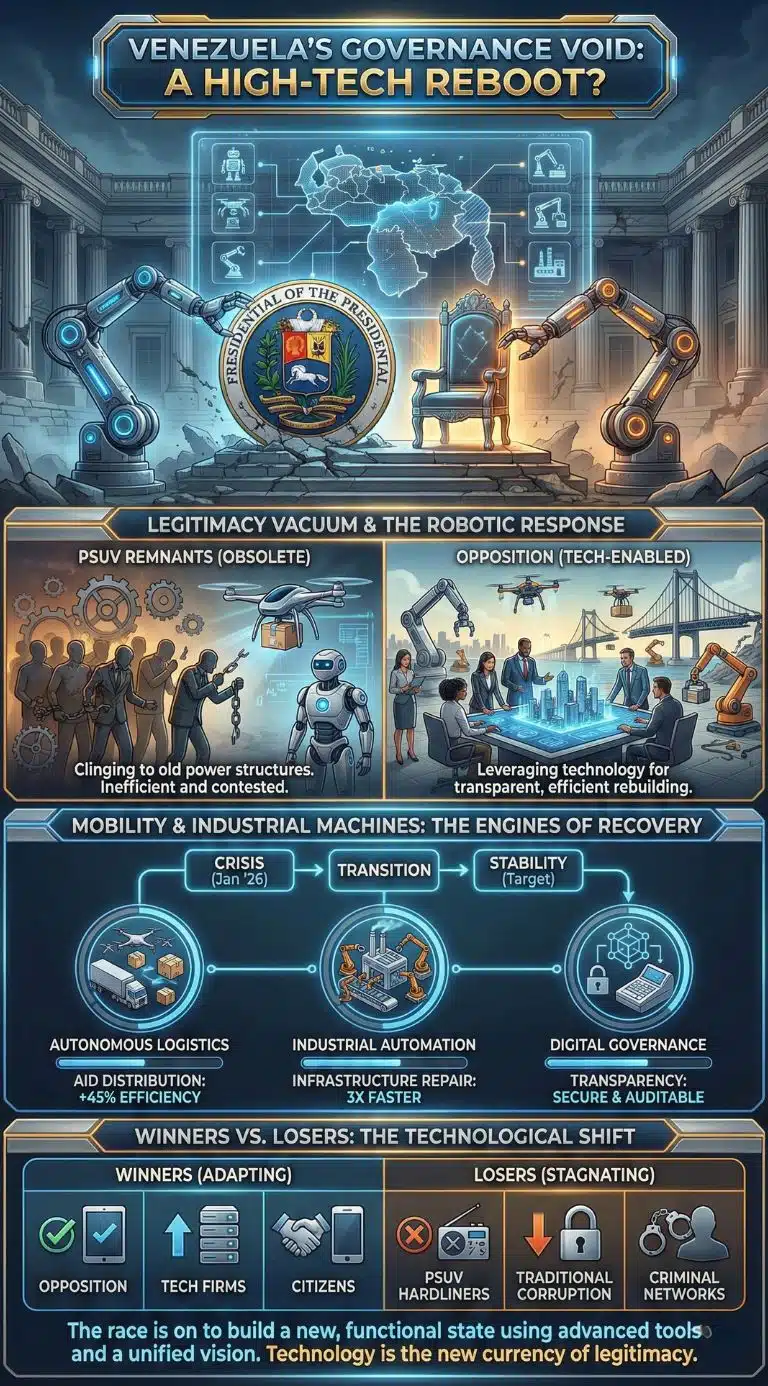
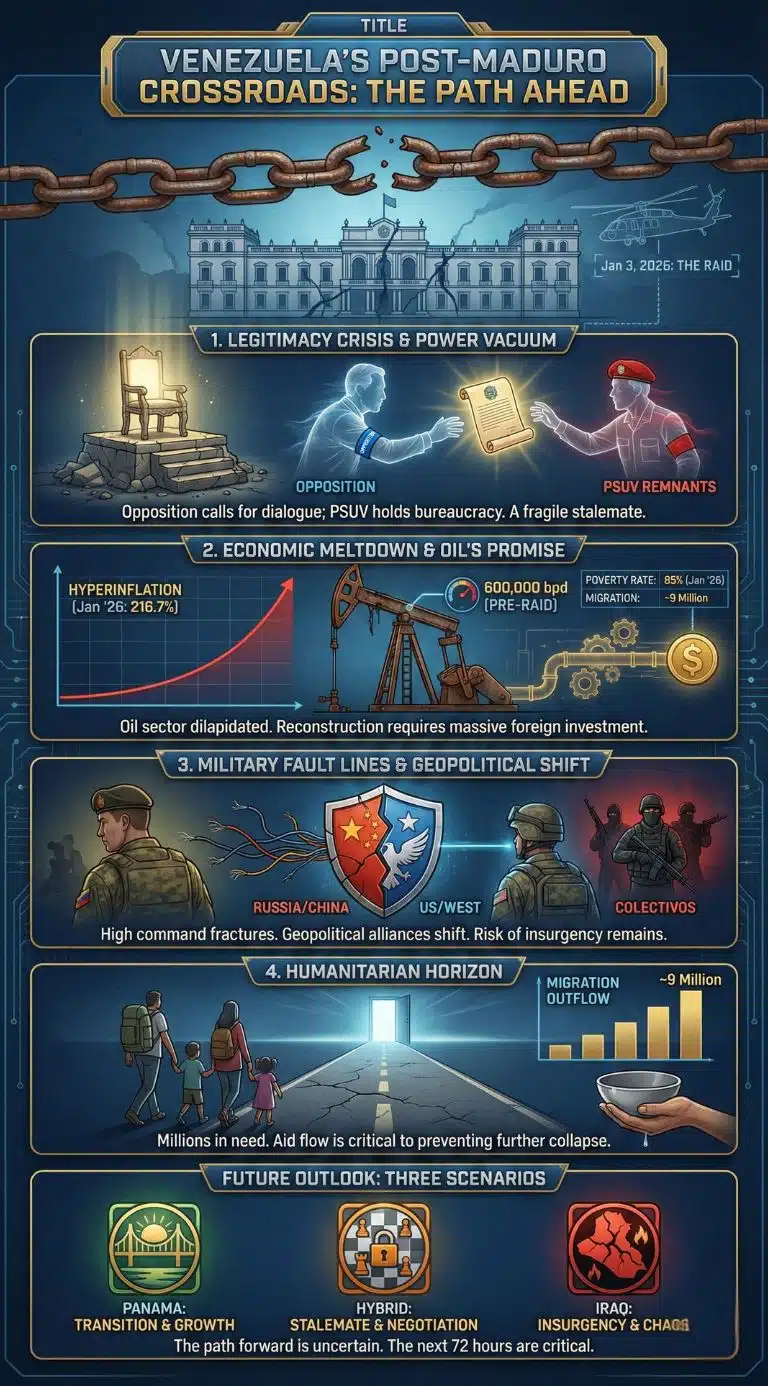
The immediate aftermath of Maduro’s capture has created a bizarre and unprecedented governance crisis.5 While the U.S. has effectively removed the head of state, the body of the Chavista state remains largely intact. Delcy Rodríguez, the Vice President, has claimed the role of interim president, a move rejected by the U.S. but supported by the lingering institutional framework of the United Socialist Party of Venezuela (PSUV).
The opposition’s call for dialogue is strategically astute but politically fraught. They are urging the remaining PSUV leadership to negotiate a surrender of power rather than fight a proxy war for a leader who is already in a U.S. jail cell. The “governance triangle“—the U.S. occupation forces, the González-led opposition, and the remnants of the Chavista regime—creates a confused chain of command. The risk is not just stalled bureaucracy but the emergence of warlordism, as regional governors and military zone commanders may choose to operate independently of Caracas.
2. The Military Dilemma: Loyalty vs. Survival
The Bolivarian National Armed Forces (FANB) are the kingmakers in this transition. For years, their loyalty was purchased through control over key industries (oil, mining, food distribution). Now, with their patron removed and facing the threat of U.S. military prosecution, the High Command is fracturing.
The opposition’s plea for “dissent” is effectively an offer of amnesty. Machado’s strategy has pivoted from confrontation to offering a “golden bridge” for military officers who disavow the Rodríguez interim claim and facilitate the transition. However, the lower ranks, suffering from the same poverty as civilians, may be more aligned with the transition than the generals who fear extradition. The danger lies in the “colectivos”—armed paramilitary groups—who may view the transition as an existential threat and launch an insurgency, prompting a protracted conflict that the U.S. has little appetite to police.
3. Economic Shock Therapy and the Oil Market
The economic implications of the raid are immediate and global. Venezuela, holding the world’s largest proven oil reserves, has been offline or under-producing for a decade. The U.S. administration has signaled a desire to “reimburse” American losses through Venezuelan oil, a controversial stance that smells of colonial extraction to critics but offers a lifeline to the Venezuelan economy.
Goldman Sachs analysts noted in early January 2026 that the removal of sanctions—likely to follow a successful transition—could flood the market with Venezuelan crude, potentially depressing global prices. For Venezuela, the challenge is infrastructure; the oil sector is dilapidated. The “recovery” will not be a flip of a switch but a massive, capital-intensive reconstruction project requiring billions in foreign direct investment (FDI). The opposition must navigate the optics of this: welcoming Western investment without appearing to sell off national sovereignty to the power that just invaded.
4. Geopolitical Fallout: The End of the Multi-Polar Proxy
Venezuela was the Western Hemisphere’s anchor for the “anti-hegemonic” bloc led by Russia, China, and Iran. Maduro’s fall is a strategic catastrophe for Moscow and Beijing. Russia’s condemnation of the raid as “unlawful and destabilizing” reflects a loss of a key ally and billions in loans and military hardware.7
For the region, the impact is mixed. Left-leaning governments in Colombia (Petro) and Brazil (Lula) are in a difficult position; they condemned the U.S. intervention as a violation of sovereignty but can hardly defend the fallen dictator. The opposition’s diplomatic task is to reassure these neighbors that a post-Maduro Venezuela will not be a U.S. puppet state but a stable partner. The “contagion effect” of a successful democratic transition in Venezuela could reshape Latin American politics, potentially reversing the “Pink Tide” by discrediting the authoritarian left.
5. The Humanitarian and Migration Horizon
Perhaps the most tangible impact of the crisis is on the 8 million Venezuelans who fled the country. The “diaspora” is watching with bated breath. The opposition’s dialogue is crucial here: if the transition is bloody, migration will surge as people flee the violence. If it is peaceful, 2026 could see the beginning of the “Great Return.”
However, the country they return to is broken. Public services—water, electricity, healthcare—are decimated. The “Opposition Urges Dialogue” narrative is fundamentally about securing the stability needed to allow humanitarian aid to flow. The U.S. and EU have pledged support, but the logistics of receiving and distributing aid in a post-conflict zone are daunting.
Data & Visualization
Key Statistics: The Cost of the Crisis (2024–2026)
| Metric | July 2024 (Election) | Jan 2025 (Inauguration) | Jan 2026 (Current) |
| Inflation Rate (Annualized) | 50% | 180% | 216.7% |
| Exchange Rate (Bs/$) | 36.5 | 150.2 | 258.8 |
| Poverty Rate | 81% | 83% | 85% (Est.) |
| Oil Production (bpd) | 850,000 | 700,000 | 600,000 (Pre-Raid) |
| Political Prisoners | 280 | 1,900+ | 887 (Documented) |
| Migration (Total Outflow) | 7.7 Million | 8.2 Million | ~9 Million |
Timeline of Escalation
-
July 28, 2024: CNE declares Maduro winner; Opposition produces tally sheets proving landslide defeat.
-
Jan 10, 2025: Maduro inaugurated for 3rd term; US/EU reject legitimacy.
-
May 2025: Russia-Venezuela strategic treaty signed in Moscow.
-
Late 2025: US “Maximum Pressure” blockade begins; Hyperinflation returns.
-
Jan 3, 2026: US Military operation captures Nicolás Maduro; Delcy Rodríguez claims interim presidency.
-
Jan 5, 2026: Opposition urges national dialogue; Maduro scheduled for NY court appearance.
Expert Perspectives
-
The Optimist View: Christopher Sabatini (Chatham House) suggests that while the raid was a shock, it broke the “authoritarian stalemate” that sanctions alone could not. He argues that with the dictator gone, the transaction costs for the military to switch sides have dropped significantly, opening a window for a rapid democratic restoration.
-
The Skeptic View: Regional Leaders (Lula/Petro) warn that “lawlessness without consequences helps dictators.” They fear the precedent of U.S. regime change will destabilize the region, validating anti-American sentiment and potentially sparking a guerrilla insurgency in Venezuela that spills across borders.
-
The Legalist View: Human Rights Watch emphasizes that while Maduro’s rule was marked by atrocities, the “abduction” without clear international legal justification presents a moral quandary. They urge that any transition must prioritize justice—not just for Maduro in NY, but for the victims of repression in Venezuela, cautioning against a blanket amnesty that breeds impunity.
Future Outlook
As we look toward the rest of 2026, three scenarios emerge:
-
The “Panama” Scenario (Best Case): The FANB, seeing the writing on the wall, forces the PSUV hardliners to step down. An interim government led by González/Machado is established by March 2026. Oil investment flows back, and a “Marshall Plan” for Venezuela begins.
-
The “Iraq” Scenario (Worst Case): The PSUV fractures into warring factions. The U.S. is drawn into a long-term occupation to secure oil fields, facing an insurgency from armed colectivos. The migration crisis worsens as violence spikes.
-
The “Hybrid” Stalemate: Delcy Rodríguez maintains control of the bureaucracy while the U.S. holds the purse strings. A prolonged, messy negotiation ensues, where the opposition gains ground slowly but the Chavista “deep state” remains a powerful obstructionist force.
Prediction: The immediate days are critical. If the opposition can secure a public defect from a high-ranking General (Padrino López or his successor) within the next week, the “Panama” scenario becomes likely. The upcoming trial of Maduro in New York (set to begin arraignment Jan 5) will serve as a constant news cycle draining the remaining legitimacy of the Chavista movement. The era of Chavismo is over; the era of reconstruction—painful and chaotic—has begun.