

Every date on the calendar serves as a silent witness to the relentless march of time, but some days carry a heavier historical footprint than others. April 16 is one such date. It is a day that has seen the birth of pioneers who took to the skies, the passing of artists who painted the human soul, and the eruption of socio-political movements that reshaped entire nations. Whether we are looking at the vast expanses of the global stage or the culturally rich soils of the Indian subcontinent, the historical currents of this day continue to ripple into our modern world. Understanding these events is not just about memorizing facts; it is about grasping the interconnected narratives that have built the societies we navigate today. Let us embark on a comprehensive journey through the annals of April 16, exploring the triumphs, tragedies, and transformative moments that define this remarkable day in history.
To provide a clear and organized perspective, we have meticulously categorized these historical milestones, beginning with the sweeping global events that altered the course of human civilization.
Monumental Global Events on April 16
The world stage has seen dramatic shifts on this date, from the blood-soaked battlefields of Scotland to the quiet, reflective confines of a Birmingham jail cell. These events highlight the enduring human struggle for power, equality, and technological advancement.
1. The Battle of Culloden (1746)
Fought on a grim, rain-swept moor near Inverness, Scotland, the Battle of Culloden marked the violent and decisive end of the Jacobite rising. The British government forces, led by the Duke of Cumberland, crushed the Jacobite army of Prince Charles Edward Stuart in less than an hour. The Jacobite forces, primarily composed of Highland clansmen wielding broadswords, were decimated by the highly disciplined musket fire and artillery of the British redcoats.
This clash forever altered the landscape of the Scottish Highlands. It remains the last pitched land battle fought on British soil, marking a definitive turning point in British and Scottish history. The brutal aftermath of the battle led to the aggressive suppression of Highland culture by the British government. Draconian laws were implemented to dismantle the clan system, ban the wearing of tartan, and disarm the populace, leading to long-lasting socio-political ramifications that are still discussed in Scottish politics and cultural studies today.
2. Lenin Returns to Petrograd (1917)
Amidst the chaos of World War I and the crumbling Russian Empire following the February Revolution, Vladimir Lenin returned from a decade of exile in Switzerland. Traveling in a “sealed train” facilitated by the German government, Lenin arrived at the Finland Station in Petrograd. Germany’s strategic hope was that Lenin’s return would destabilize Russia and take them out of the ongoing global conflict.
This journey remains one of the most consequential covert operations of the 20th century. Lenin’s arrival immediately radicalized the ongoing Russian Revolution. He quickly published his “April Theses,” denouncing the provisional government and calling for a transfer of power to the workers’ councils (Soviets). This pivotal moment ultimately catalyzed the Bolshevik rise to power, leading directly to the October Revolution and the creation of the Soviet Union, fundamentally altering global geopolitics for the rest of the century.
3. The Texas City Disaster (1947)
Industrial history witnessed one of its darkest days when the French-registered vessel SS Grandcamp exploded at the dock in Texas City, Texas. The ship was carrying approximately 2,200 tons of ammonium nitrate, a compound widely used as fertilizer but also as a highly explosive material during World War II. A small fire in the cargo hold rapidly spiraled out of control.
The initial explosion triggered a devastating chain reaction of fires and secondary explosions in other docked ships and nearby oil-storage facilities, leveling massive portions of the city and destroying a nearby Monsanto chemical plant. Recognized as the deadliest industrial accident in United States history, the disaster claimed nearly 600 lives, injured thousands, and shattered windows all the way in Houston. The catastrophe revolutionized the way hazardous materials, particularly ammonium nitrate, are regulated, packaged, and transported globally.
4. Martin Luther King Jr. Pens the “Letter from Birmingham Jail” (1963)
Arrested for participating in nonviolent demonstrations against extreme racial segregation in Birmingham, Alabama—a campaign known as “Project C”—Dr. Martin Luther King Jr. found himself confined in a harsh city jail. From his cell, he drafted a profound response to a public statement made by eight white Alabama clergymen who had criticized his methods as “unwise and untimely” and urged patience.
Because he was initially denied formal writing paper by the jail authorities, King began writing the letter on the margins of a smuggled newspaper. The resulting document is a masterpiece of rhetorical power and moral clarity. It is arguably the most important written document of the American Civil Rights Movement, eloquently defending the strategy of nonviolent resistance to racism and asserting that people have a moral responsibility to break unjust laws. His critique of the “white moderate” remains a powerful sociological observation studied widely today.
5. The Launch of Apollo 16 (1972)
Mankind’s quest to understand the cosmos took another massive leap when the United States launched Apollo 16 from the Kennedy Space Center in Florida. Commanded by veteran astronaut John Young, alongside Lunar Module Pilot Charles Duke and Command Module Pilot Thomas Mattingly, this was the fifth and penultimate crewed mission to land on the Moon.
The mission was historically significant as it was the first to land in the lunar highlands—specifically the Descartes Highlands. Scientists initially believed this region was formed by volcanic action, but the astronauts’ geological sampling proved it was actually formed by meteoritic impacts. Bringing back invaluable geological data and over 200 pounds of lunar samples, the mission reshaped our understanding of the Moon’s formation. Furthermore, at age 36, Charles Duke became the youngest person ever to walk on the lunar surface.
Before we move to the subcontinental narratives, below is a consolidated view of these monumental global milestones for a quick overview.
Quick Glance at Global Historical Events
| Year | Event | Location | Core Significance |
| 1746 | Battle of Culloden | Scotland, UK | Last pitched battle on British soil; ended the Jacobite Rising. |
| 1917 | Lenin returns from exile | Petrograd, Russia | Radicalized the Russian Revolution; paved the way for the Soviet Union. |
| 1947 | Texas City Disaster | Texas, USA | Deadliest US industrial accident; overhauled global chemical regulations. |
| 1963 | “Letter from Birmingham Jail” | Alabama, USA | Core philosophical and moral text of the American Civil Rights Movement. |
| 1972 | Apollo 16 Launch | Florida, USA | First mission to explore the lunar highlands, advancing space geology. |
Transitioning from the global theater, we find equally compelling and transformative narratives within the rich tapestry of the Indian subcontinent.
The Bangalee Sphere: Subcontinental Milestones
April 16 holds profound significance for Bangladesh, India, and the broader Bangalee diaspora. This day marks technological leaps under colonial rule, fierce acts of collective resistance, and moments of deep, enduring cultural resonance.
1. The First Passenger Train Runs in India (1853)
The physical and economic landscape of subcontinental transportation changed forever when the first passenger train in India took its maiden journey. Operating between Bori Bunder in Mumbai and Thane, the train covered a distance of roughly 34 kilometers. Hauled by three powerful steam locomotives named Sahib, Sindh, and Sultan, the 14-carriage train carried 400 distinguished passengers amidst massive fanfare and a 21-gun salute.
While the railway system was primarily conceived and built under Lord Dalhousie to serve British economic extraction and military mobilization, it yielded massive unintended consequences. It marked the birth of the vast Indian Railway network, which eventually became the circulatory system of the subcontinent’s economy. More importantly, it accelerated the physical unification of the Indian populace, allowing ideas, leaders, and movements to cross the vast subcontinent with unprecedented speed, ultimately fueling the independence movement.
2. Mahatma Gandhi’s Nationwide Fast (1919)
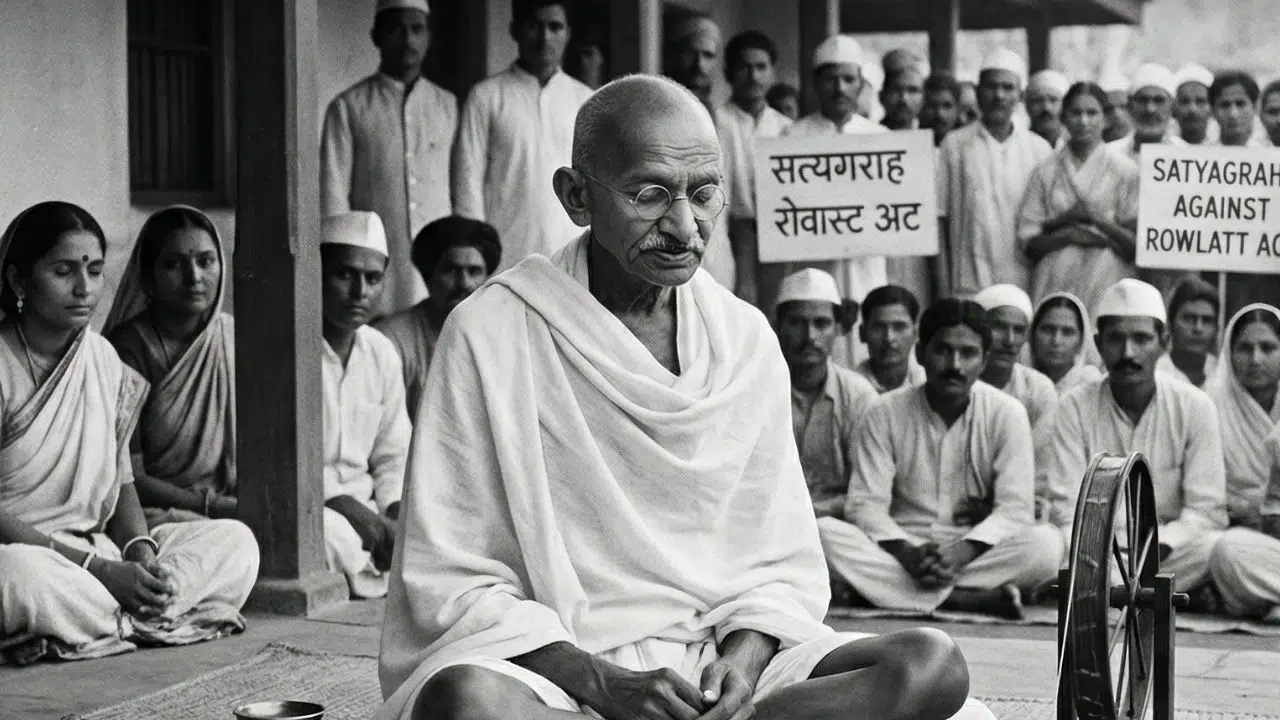
The spring of 1919 was a boiling point in colonial India. Following the passing of the oppressive Rowlatt Act—which allowed the British colonial government to imprison Indians without trial—and the horrific Jallianwala Bagh massacre in Amritsar just three days prior, Mahatma Gandhi called for a day of nationwide “prayer and fasting” on April 16.
This act of collective civil disobedience was a deeply spiritual and political maneuver built on his concept of Satyagraha (truth-force). It signaled a massive shift in the independence struggle, moving from localized, elite-led protests to unified, subcontinental mass mobilization involving the working class and peasantry. The emotional fallout from the events of mid-April 1919 effectively ended any remaining Indian faith in the morality of British colonial rule, setting the stage for the Non-Cooperation Movement.
3. The Enduring Legacy of the Malo Community Documented (1951)
While not a singular historical “event” of action like a battle or a treaty, the passing of Bengali literary titan Advaita Mallabarman on this day cemented a legacy that forever changed Bangalee literature. His deep, authentic documentation of the marginalized Malo fishing community in East Bengal (modern-day Bangladesh) via his magnum opus Titas Ekti Nadeer Naam (A River Called Titas) became an undisputed cultural milestone.
Mallabarman’s work captured the raw, unfiltered socio-economic realities, the vibrant folklore, and the tragic decline of riverine communities in Bengal. It stands as a foundational text that gave an insider’s voice to Dalit and marginalized communities, ensuring their stories were woven permanently into the region’s cultural fabric. His work was later adapted into a critically acclaimed, surrealist masterpiece film by the legendary director Ritwik Ghatak, beautifully bridging the worlds of classic literature and subcontinental cinema.
To easily digest these localized historical pivots, review the informational table provided below.
Quick Glance at Subcontinental Milestones
| Year | Event/Milestone | Focus Region | Cultural & Historical Impact |
| 1853 | First Passenger Train Journey | Mumbai to Thane, India | Dawn of the subcontinental railway network; inadvertent unification catalyst. |
| 1919 | Gandhi’s Nationwide Fast | Indian Subcontinent | Crucial catalyst for mass nonviolent resistance against British rule. |
| 1951 | Legacy of Advaita Mallabarman | East Bengal / Bangladesh | Immortalized the struggles of the marginalized Malo community in literature. |
Beyond events and movements, history is fundamentally driven by the people who walk its stage. Let us explore the remarkable individuals born on this day.
Legends Born on April 16
The individuals born on April 16 span a wildly diverse array of disciplines. From the absolute frontiers of early aviation to the highest echelons of global religious leadership and groundbreaking entertainment, these figures have left an indelible mark on humanity.
1. Wilbur Wright (1867)
Born in Millville, Indiana, Wilbur Wright, along with his brother Orville, fundamentally changed the relationship between humanity and gravity. Wilbur was arguably the visionary driver of the duo, possessing a brilliant, analytical mind that pushed their aerodynamic research forward. Through meticulous observation of birds, extensive wind tunnel testing, and sheer determination, the Wright brothers achieved the first powered, sustained, and controlled airplane flight in 1903 at Kitty Hawk, North Carolina. His contributions broke the earthly bounds of human travel, paving the way for the modern aerospace industry before his untimely death from typhoid fever in 1912.
2. Charlie Chaplin (1889)
Born in London, England, into severe poverty and a turbulent childhood, Charles Spencer Chaplin rose to become one of the most important and recognizable figures in the history of the film industry. His iconic character, “The Tramp,” with his ill-fitting suit, bowler hat, and cane, became a universal symbol of comedy and pathos during the silent film era. Chaplin was a true cinematic auteur who directed, wrote, produced, edited, starred in, and even composed the music for most of his films. Beneath the slapstick comedy, his masterpieces like Modern Times and The Great Dictator carried sharp political and social commentary regarding industrialization, poverty, and fascism that remains deeply relevant today.
3. Kandukuri Veeresalingam (1848)
Born in the Madras Presidency of British India, Kandukuri Veeresalingam was a fierce social reformer, a towering intellect, and a prolific writer. He is widely considered the father of the Telugu Renaissance. Veeresalingam dedicated his life to campaigning against orthodox social evils. He fiercely advocated for women’s education, establishing the first school for girls in Rajahmundry in 1874, facing immense backlash and threats from conservative society. Furthermore, he championed the remarriage of widows, challenging deeply entrenched patriarchal norms and leaving an incredible legacy of social progress in South India.
4. Pope Benedict XVI (1927)
Born Joseph Aloisius Ratzinger in Bavaria, Germany, he grew up during the tumultuous era of the Weimar Republic and Nazi Germany. A brilliant intellectual, he became a prominent theologian, a cardinal, and a close confidant of Pope John Paul II. In 2005, he was elected as the head of the global Catholic Church. He was a deeply influential theological voice in the late 20th and early 21st centuries, strictly defending traditional Catholic doctrine against encroaching secularism. He made unprecedented modern history in 2013 by becoming the first pope to voluntarily resign from the papacy since Pope Gregory XII in 1415, citing advanced age and a decline in physical strength.
5. Selena Quintanilla (1971)
Born in Lake Jackson, Texas, Selena became the undisputed “Queen of Tejano music.” Her incredible vocal range, iconic fashion sense, and radiant stage presence propelled Tejano music—a genre with roots in Mexican and European folk traditions—into the mainstream American market. She broke major gender and cultural barriers in the heavily male-dominated Tejano music industry and won a Grammy Award for Best Mexican/American Album. Her tragic murder by the president of her fan club at the young age of 23 cut short a massive crossover career, but she remains a legendary cultural icon whose influence resonates strongly across the Americas.
Just as we celebrate those who entered the world on this day, we must also honor those who departed, leaving behind enduring legacies.
Remembering the Departed on April 16
The individuals who passed away on April 16 left incredible marks on art, science, literature, and subcontinental culture. Their life works continue to be studied, admired, and utilized in the modern era to better understand our world.
1. Francisco Goya (1828)
The great Spanish romantic painter and printmaker passed away in exile in Bordeaux, France, at the age of 82. Goya is universally recognized as the most important Spanish artist of the late 18th and early 19th centuries. His work chronicled the beauty of the Spanish aristocracy, but more importantly, it captured the intense horrors, madness, and political upheavals of his era, bridging the gap between the Old Masters and modern art. His later works, known as the “Black Paintings,” were painted directly onto the walls of his home while he was deaf, isolated, and deeply disillusioned with humanity. They remain some of the most haunting psychological artworks in history.
2. Rosalind Franklin (1958)
Rosalind Franklin was an incredibly brilliant English chemist and X-ray crystallographer whose meticulous work was central to the understanding of the molecular structures of DNA, RNA, viruses, coal, and graphite. She passed away tragically from ovarian cancer at the young age of 37. Her X-ray diffraction images of DNA, specifically the famous “Photo 51,” were the critical pieces of empirical evidence needed by James Watson and Francis Crick to correctly identify the DNA double helix structure. Her pivotal contribution was largely uncredited during her lifetime, highlighting the systemic challenges faced by women in STEM fields during the mid-20th century.
3. Marie Tussaud (1850)
Born Marie Grosholtz in Strasbourg, France, she survived the blood-soaked Reign of Terror during the French Revolution by utilizing her unique, morbid skills in wax modeling. To prove her loyalty to the republic and avoid the guillotine, she was forced to make wax death masks of prominent victims, including King Louis XVI, Marie Antoinette, and Maximilien Robespierre. She later moved to London, navigating the patriarchal business world of the 19th century to establish the globally renowned Madame Tussauds wax museum. Her work revolutionized public entertainment, journalism, and celebrity culture, and she passed away peacefully at the age of 88.
4. Nandalal Bose (1966)
Passing away on this day, Nandalal Bose was an undisputed pioneer of modern Indian art and a key figure in the Contextual Modernism movement. Deeply influenced by the Tagore family and his intensive studies of the ancient murals of Ajanta, his unique artistic vision helped define the aesthetic of an independent India. He actively moved away from Western academic styles, rooting his art in Indian mythology, rural life, and nature. Because of his immense stature, he was bestowed with the profound historical responsibility of illustrating the original, handwritten manuscript of the Constitution of India, cementing his art into the very foundation of the republic.
Following the remarkable lives of these historical figures, it is also important to look at the communal observances that tie the world together today.
International Observances and Global Holidays
The global community has designated April 16 as a day to recognize both the wonders of human biology and the urgent, critical need for environmental conservation. These observances help bind international efforts toward common educational and humanitarian goals.
1. World Voice Day
Established initially by a group of vocal care professionals in Brazil in 1999 as a national day of voice care, this observance quickly evolved into a recognized global phenomenon. World Voice Day is dedicated to celebrating the marvel of the human voice and raising widespread awareness regarding vocal health. It highlights the critical importance of the voice in our daily communication, artistic expression, and professional lives. Medical professionals, speech-language pathologists, and vocal coaches use this day to offer free vocal screenings, host seminars, and educate the public on preventing vocal cord damage and recognizing the early warning signs of laryngeal cancer and other voice-impairing diseases.
2. Save the Elephant Day
This vital international awareness day is dedicated entirely to the world’s largest land mammal. It aims to highlight the dire and immediate threats elephants face from the brutal illegal ivory trade, rising human-wildlife conflicts, and massive habitat loss across the African and Asian continents. Because elephants are keystone species, their survival is absolutely critical to maintaining the biodiversity of the ecosystems they inhabit; if they fall, the ecosystem collapses. Conservation organizations globally use this day to raise funds for armed anti-poaching units on the ground, lobby international governments to close domestic ivory markets, and promote ethical, cruelty-free wildlife tourism to the general public.
Final Thoughts
As we look back upon the vast chronological landscape of April 16, the sheer density of human experience is staggering. This is a day that reminds us of the fragility of human life through the tragic loss of brilliant minds like Rosalind Franklin and Advaita Mallabarman, and the devastating industrial disaster that leveled Texas City. Yet, it simultaneously stands as a towering monument to human resilience, courage, and ambition. The roaring engines of the Wright brothers’ early aviation experiments, the powerful, morally unyielding words flowing from Martin Luther King Jr.’s pen in a segregated Birmingham, and the fiery, earth-shaking launch of Apollo 16 all share this date on the calendar. Whether we are looking through the lens of subcontinental resistance, artistic genius, or global scientific triumph, April 16 proves that history is not a static list of dates, but a dynamic, living force that continually shapes the trajectory of our future.





















