We are standing on the edge of a new era in 2026, where the “phone” is disappearing into ambient AI, smart glasses, and tri-fold canvases. But to understand this “invisible” future, we must look at the brick-sized ancestors that paved the way. The Most Iconic Phones That Changed Tech History didn’t just sell millions of units; they fundamentally rewired how the human species communicates, works, and perceives reality.
From the first wireless call on a New York sidewalk to the AI-integrated neural networks we carry today, this evolution is a masterclass in innovation. We have moved from “calling places” to “calling people,” and finally, to “calling upon intelligence.”
Key Takeaways
-
The “Brick” Started It All: The Motorola DynaTAC proved that mobility was worth paying for, even at $4,000+.
-
Software Won Over Hardware: The iPhone and Android (G1) killed the physical keyboard by turning phones into adaptable software platforms.
-
Cameras Changed Culture: The Sharp J-SH04 birthed the “selfie” and visual communication, killing the compact camera industry.
-
Form Factor Cycles: We moved from bricks to tiny candy bars, to massive glass slabs, and in 2026, we are returning to folding/clamshell designs.
-
The Next Shift: We are transitioning from “Smartphones” to “Intelligent Surfaces” where AI (like Gemini and ChatGPT) is the operating system.
The Anatomy of Disruption: Defining “Iconic”

To understand how we arrived at the AI-integrated reality of 2026, we must look beyond mere sales figures. A best-selling phone is popular, but an iconic phone is a paradigm shift. The devices on this list did not just iterate on existing technology; they disrupted it entirely, forcing competitors to adapt or die.
We have categorized this evolution into four distinct eras of the mobile revolution:
-
The Analog Era (1983–1999): When the primary goal was simply cutting the cord and making communication portable.
-
The Utility Era (2000–2006): Defined by the miniaturization of hardware, the birth of SMS culture, and the “CrackBerry” workforce.
-
The Software Era (2007–2018): Triggered by the iPhone, where the physical screen became a canvas for apps, killing the keypad.
-
The Form & Intelligence Era (2019–2026): The current age of folding glass, spatial computing, and generative AI.
Each device listed below served as a specific tipping point in this timeline, altering user behavior and setting the standards for the technological milestones we enjoy today. The journey begins, ironically, with a device that was anything but pocket-friendly.
The Iconic Pioneers [1983–1999]

This era represents the dawn of mobile technology, where pure functionality triumphed over form and aesthetics. It was a time of heavy experimentation and massive hardware, proving that humanity was willing to pay a premium to finally cut the cord and connect wirelessly.
Here is the definitive, research-backed list of the 10 mobile devices that built the modern world, viewed through the lens of 2026.
1. Motorola DynaTAC 8000X [1983]
The Device That Cut the Cord
Before 1983, if you wanted to make a call, you needed a wire or a car. Martin Cooper changed that forever. The DynaTAC 8000X is the Genesis of mobile tech. While it looks comical today, its impact was deadly serious: it decoupled communication from location.
| Feature | 1983 Spec | 2026 Equivalent |
| Price | $3,995 (~$12,000 inflation-adjusted) | Price of a high-end Foldable + Vision Pro headset |
| Weight | 1.75 lbs (0.8 kg) | The weight of ~4 iPhone 17s |
| Battery | 30 minutes talk time | 24+ hours of active use |
| Charging | 10 hours to recharge | 15 minutes for 50% |
Why It Changed History: It proved that people craved mobility enough to carry a literal brick. It created the cellular industry from scratch.
The 2026 Perspective: Holding a DynaTAC today feels like holding a dinosaur bone. Yet, without this heavy, expensive plastic shell, the sleek, AI-infused slates we use in 2026 would not exist. It reminds us that all ubiquitous technology starts as a clunky, expensive luxury.
2. IBM Simon [1994]
The World’s First “Smartphone”
Fifteen years before the App Store, IBM tried to do it all. The Simon Personal Communicator was a visionary failure. It was a phone, a fax machine, a pager, and a PDA all in one, featuring a monochrome touchscreen and a stylus.
Why It Changed History: It was the first device to introduce “Apps” (Calculator, Calendar, Sketchpad) on a phone. It predicted the convergence of computing and telephony.
The 2026 Perspective: The Simon was right about everything but the timing. In 2026, as we see devices merging again (phones becoming tablets via Tri-Folds), we can look back at the Simon as the grandfather of the “One Device to Rule Them All” philosophy.
3. Nokia 3310 [2000]
The Indestructible Cultural Icon
While others chased features, Nokia chased reliability. The 3310 didn’t just make calls; it created a culture. With its interchangeable Xpress-on covers, it was the first phone to become a fashion accessory. It also cemented SMS text messaging as the primary way young people communicated.
| Impact Metric | Detail |
| Durability | Legendary. It could survive drops, water, and cars running over it. |
| Sales | 126 million units sold. |
| Cultural Legacy | The game Snake II and the “Nokia Tune.” |
Why It Changed History: It democratized mobile ownership. It wasn’t for businessmen; it was for teenagers, grandmothers, and everyone in between. It taught the world to text.
The 2026 Perspective: In an era of fragile glass foldables that cost $2,000, the 3310 is looked back upon with deep nostalgia. It represents a simpler time when a “dead battery” was a weekly anxiety, not a daily one.
4. Sharp J-SH04 [2000]
The Birth of the Camera Phone
You might expect to see a Samsung or Apple device here, but this Japanese exclusive changed society more than most realize. The J-SH04 was the first phone with a fully integrated rear camera (0.11 megapixels) that allowed you to send photos electronically (“Sha-Mail”).
Why It Changed History: It turned the phone into a tool for documenting life. It killed the standalone digital camera market and gave birth to social media, citizen journalism, and the “Selfie.”
The 2026 Perspective: Today, our phones use AI to hallucinate pixels and “fix” memories (Magic Editor). The J-SH04 gave us the raw, pixelated truth. It started the visual revolution that now dominates 80% of internet traffic.
5. BlackBerry 6210 [2003]
The Office in Your Pocket
If the Nokia 3310 was for the people, the BlackBerry was for the boardroom. The 6210 was the first BlackBerry that was actually a phone (integrated voice), but its killer feature was “Push Email.” It created the always-on, 24/7 work culture we still struggle with today.
Why It Changed History: It tethered humanity to the internet. The “CrackBerry” addiction was the first sign that mobile devices would eventually dominate our attention spans completely. Its QWERTY keyboard was, for a decade, the gold standard of input.
The 2026 Perspective: The physical keyboard is long dead, but the “Phantom Vibration Syndrome” and the expectation of instant replies started here. Every time you check a Slack notification at 9 PM in 2026, you are living in the world that the BlackBerry 6210 built.
6. Motorola Razr V3 [2004]
When Tech Became Jewelry
Before the Razr, phones were utilitarian blobs of plastic. The V3 was chemically etched aluminum, impossibly thin, and snapped shut with a sound that defined a generation. It sold 130 million units, proving that design was a feature.
| Feature | Razr V3 (2004) | Modern Flip (2026) |
| Thickness | 13.9mm | ~7-9mm (unfolded) |
| Material | Aircraft-grade Aluminum | Ultra-Thin Glass (UTG) & Armor Aluminum |
| Cool Factor | 10/10 | 10/10 (Nostalgia driven) |
Why It Changed History: It forced every other manufacturer to stop making ugly phones. It bridged the gap between electronics and high fashion.
The 2026 Perspective: The “Clamshell” is back. With the success of modern flip phones (like the Z Flip series and the iPhone Air Flip rumors), the Razr V3’s DNA is more alive today than it was ten years ago. We realized we missed the satisfaction of hanging up on someone by snapping the phone shut.
7. Apple iPhone [2007]
The “Jesus Phone” / The Slab
Steve Jobs didn’t invent the smartphone, but he perfected the interface. The original iPhone ditched the stylus for “Multi-Touch.” It combined a widescreen iPod, a phone, and a breakthrough internet communicator.
Why It Changed History: It established the “Standard Form Factor”—a rectangular slab of glass with a grid of apps—that 99% of phones followed for the next 15 years. The 2008 App Store launch (iPhone 3G) turned the phone into a software platform, spawning Uber, Instagram, and TikTok.
The 2026 Perspective: The iPhone is the baseline of modern civilization. However, by 2026, its rigid “slab” design will finally be challenged by wearables and foldables. We are just now starting to move past the paradigm this device set almost 20 years ago.
8. T-Mobile G1 / HTC Dream [2008]
The Robot That Opened the Garden
While Apple built a walled garden, Google bought Android and built a playground. The G1 wasn’t pretty (it had a chin and a slide-out keyboard), but it was the first vessel for the Android OS.
Why It Changed History: It brought “Open Source” to mobile. It allowed Samsung, Xiaomi, Pixel, and Motorola to exist as smartphone competitors. Without the G1, the smartphone market would have been an Apple monopoly. It brought the notification drawer and widgets—features Apple eventually copied.
The 2026 Perspective: Android now powers over 70% of the world’s devices. The G1’s legacy is the democratization of the internet; it ensured that smartphones were accessible to everyone, not just the wealthy.
9. Samsung Galaxy Note [2011]
The Rise of the “Phablet”
When the Galaxy Note launched with a 5.3-inch screen, tech reviewers mocked it. They called it holding a piece of toast to your ear. They were wrong. The Note proved that people wanted screens, not phones.
Why It Changed History: It killed the 3.5-inch screen and the compact tablet. It paved the way for the massive 6.9-inch displays we consider “standard” today. It also kept the stylus (S-Pen) alive for creatives.
The 2026 Perspective: We consume 90% of our media on mobile because of the Note. In 2026, the “Phablet” concept has evolved into the “Foldable,” where the screen can expand even further. The Note didn’t just make phones bigger; it made them our primary computers.
10. Samsung Galaxy Fold [2019] -> Galaxy Z Tri-Fold [2025/26]
The Shapeshifter
The original Galaxy Fold (2019) was fragile and flawed, but it was the first crack in the “glass slab” monotony. It used a polymer screen to fold a tablet into a pocket-sized device.
Why It Changed History: It proved physics could be bent. It kick-started a new arms race for form factors, leading to the sophisticated dual-hinge and tri-fold devices we see gaining traction in 2026.
The 2026 Perspective: By 2026, the “Tri-Fold” (a device that unfolds into a 10-inch true tablet) is the ultimate status symbol for power users. The original Fold is remembered as the brave, clunky prototype that saved us from boring phone designs. It broke the boundaries of hardware, just as AI is now breaking the boundaries of software.
Comparison: The Evolution of Specs
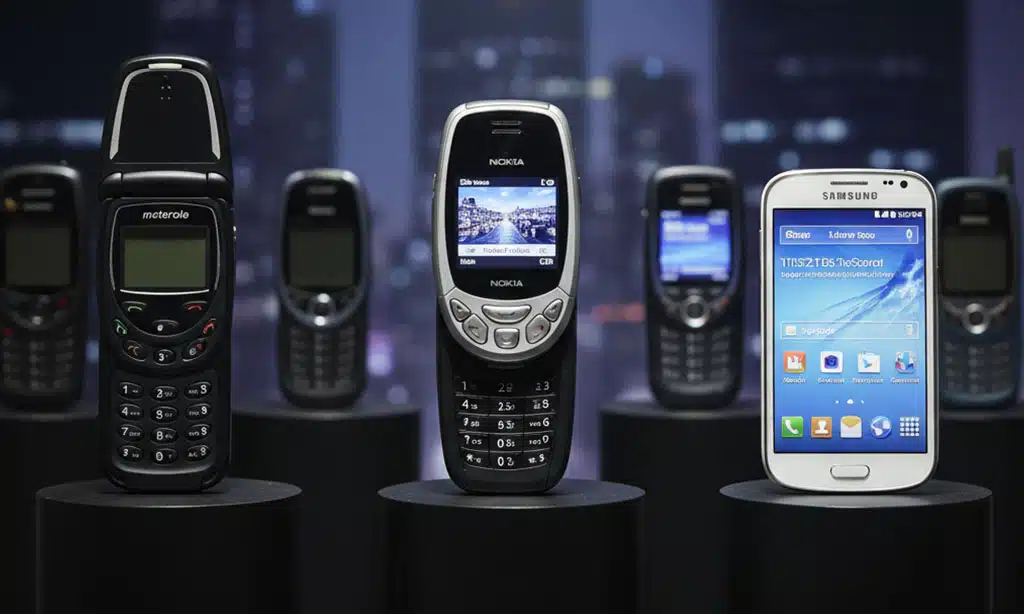
| Era | Representative Device | Primary Input | Killer Feature | 2026 Equivalent Status |
| 1980s | DynaTAC 8000X | Voice | Being Wireless | Satellite Connectivity |
| 1990s | IBM Simon | Stylus | Email/Fax | Productivity AI Agents |
| 2000s | Nokia 3310 | T9 Keypad | SMS/Durability | Digital Detox Phones |
| 2007 | iPhone | Multi-Touch | Web Browser | Spatial Computing (Vision Pro) |
| 2020s | Galaxy Fold/Tri-Fold | Flex Touch | Screen Real Estate | Hybrid Tablet-Phone |
| Future | AI Wearables | Voice/Gaze | Contextual Awareness | The “Invisible” Phone |
Frequently Asked Questions (FAQ)
1. What is technically considered the “First Smartphone”?
While the iPhone is often credited with popularizing the modern smartphone, the IBM Simon (1994) is technically the first. It combined telephony with PDA features like email, fax, and a touchscreen interface, predating the iPhone by 13 years.
2. Which iconic phone had the highest sales volume?
The Nokia 1100 (a close relative of the 3310) is actually the best-selling mobile phone of all time, with over 250 million units sold. However, the iPhone 6/6 Plus holds the record for the best-selling smartphone series, moving over 220 million units.
3. Why did BlackBerry fail if it was so iconic?
BlackBerry failed because it ignored the shift from “Communication” (email/text) to “Consumption” (apps/media). They insisted people wanted physical keyboards when the world was moving toward large touchscreens for video and gaming. They reacted too late to the iPhone and Android revolution.
4. Are flip phones making a comeback in 2026?
Yes. The “Foldable” market has matured significantly. Devices like the Samsung Galaxy Z Flip series and rumored contenders from Apple have revived the “clamshell” form factor. It offers the nostalgia of the Razr V3 with the utility of a massive smartphone screen.
5. What is the next big change after Foldables?
The next “iconic” shift is Ambient AI and AR Glasses. We are moving away from holding a device to wearing one. By late 2026, high-end smartphones will act as the “compute core” for smart glasses and AI pins, slowly removing the need to look down at a screen.
Final Thought: The Device That Disappears
Looking back at these 10 devices, a clear pattern emerges: technology inevitably moves from awkward (DynaTAC) to fashionable (Razr) to invisible.
As we navigate 2026, the “Most Iconic Phone” isn’t just about the hardware in your hand; it’s about the intelligence in the cloud. We are entering the post-smartphone era. The devices listed above were the bricks that built the road, but AI is the vehicle now driving us forward. The next “iconic” device might not be a phone at all.