


If you are looking for the Most Iconic JDM Cars to understand the “Golden Era” of Japanese engineering, you have arrived at the definitive list. For car enthusiasts, the 1990s represented a brief, magical window in time. It was an era when Japanese manufacturers—flush with cash from the economic bubble—waged a technological war for supremacy, resulting in machines that prioritized driving dynamics and over-engineered durability above all else.
What makes this list special isn’t just speed; it is the story of the “Gentleman’s Agreement.” To avoid a horsepower war that could lead to increased road fatalities, Japanese automakers agreed to cap advertised power at 276 horsepower (280 PS). However, this was merely on paper. In the real world, these cars were detuned beasts waiting to be unleashed, often capable of handling double or triple their factory power with stock internal components.
Key Takeaways
-
The “Golden Era”: These vehicles (roughly 1989–2002) were born from Japan’s economic bubble, where engineers had unlimited budgets to pursue perfection.
-
The “Gentleman’s Agreement”: All these cars were advertised at 276 hp to satisfy Japanese regulators, but most produced significantly more in reality.
-
Investment Grade: Due to US import laws (the 25-Year Rule), values for these legends have shifted from “affordable used cars” to “high-end collectibles,” with some rivaling modern supercar prices.
-
Cultural Impact: From Initial D to The Fast and the Furious, these chassis defined the global tuner culture.
The Perfect Storm: What Created the “Golden Era”?
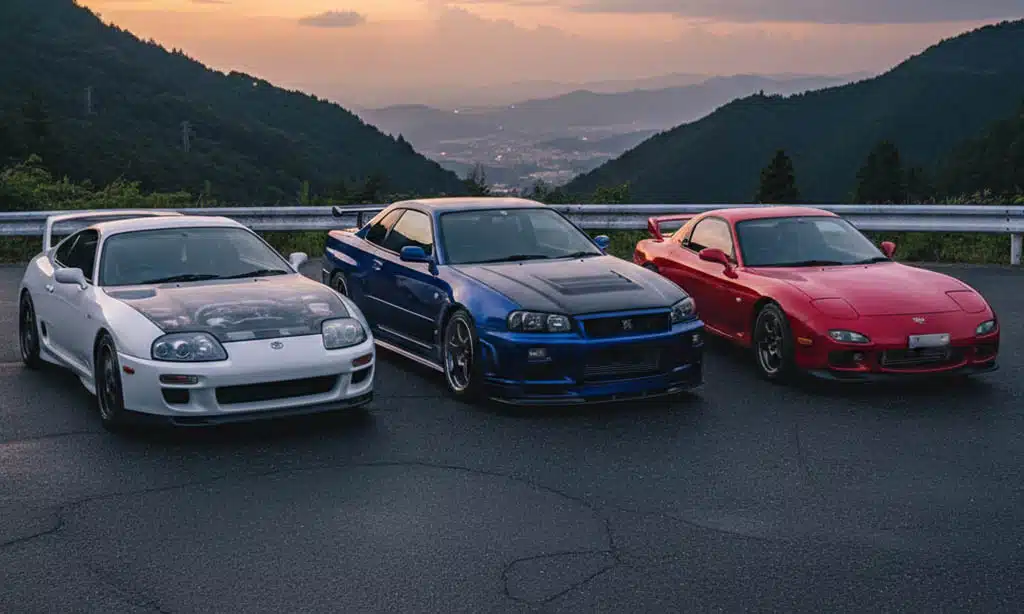
To truly appreciate why these seven cars are revered as legends, you have to understand the unique environment that created them. The 1990s JDM scene wasn’t just about fast cars; it was a “perfect storm” of economic prosperity, technological rivalry, and global pop culture that will likely never happen again.
This era is often defined by three key factors:
-
The Bubble Economy: In the late 80s and early 90s, Japan’s economy was booming. Manufacturers like Toyota, Nissan, and Mazda had massive R&D budgets. They weren’t just building cars to make a profit; they were building over-engineered machines to showcase their technological dominance. This is why a 1993 Supra has a more robust engine block than many modern supercars—cost-cutting wasn’t part of the vocabulary.
-
The Tech War: While American muscle cars relied on displacement and European cars focused on luxury, Japanese engineers turned to technology. They pioneered sophisticated twin-turbo systems, active aerodynamics, and all-wheel steering. They were squeezing supercar performance out of efficient 6-cylinder and 4-cylinder engines, proving that brains could beat brawn.
-
The Digital Explosion: For many enthusiasts outside Japan, these cars were forbidden fruit, first experienced not on the road, but on the screen. The release of the Gran Turismo video game series and the Fast & Furious franchise exported JDM culture to the world, turning domestic Japanese commuters into global superstars overnight.
Out of this hyper-competitive era, dozens of great sports cars emerged—but only a select few transcended to become icons. The following seven vehicles represent the absolute peak of that engineering revolution.
The JDM Hall of Fame: 7 Cars That Changed History
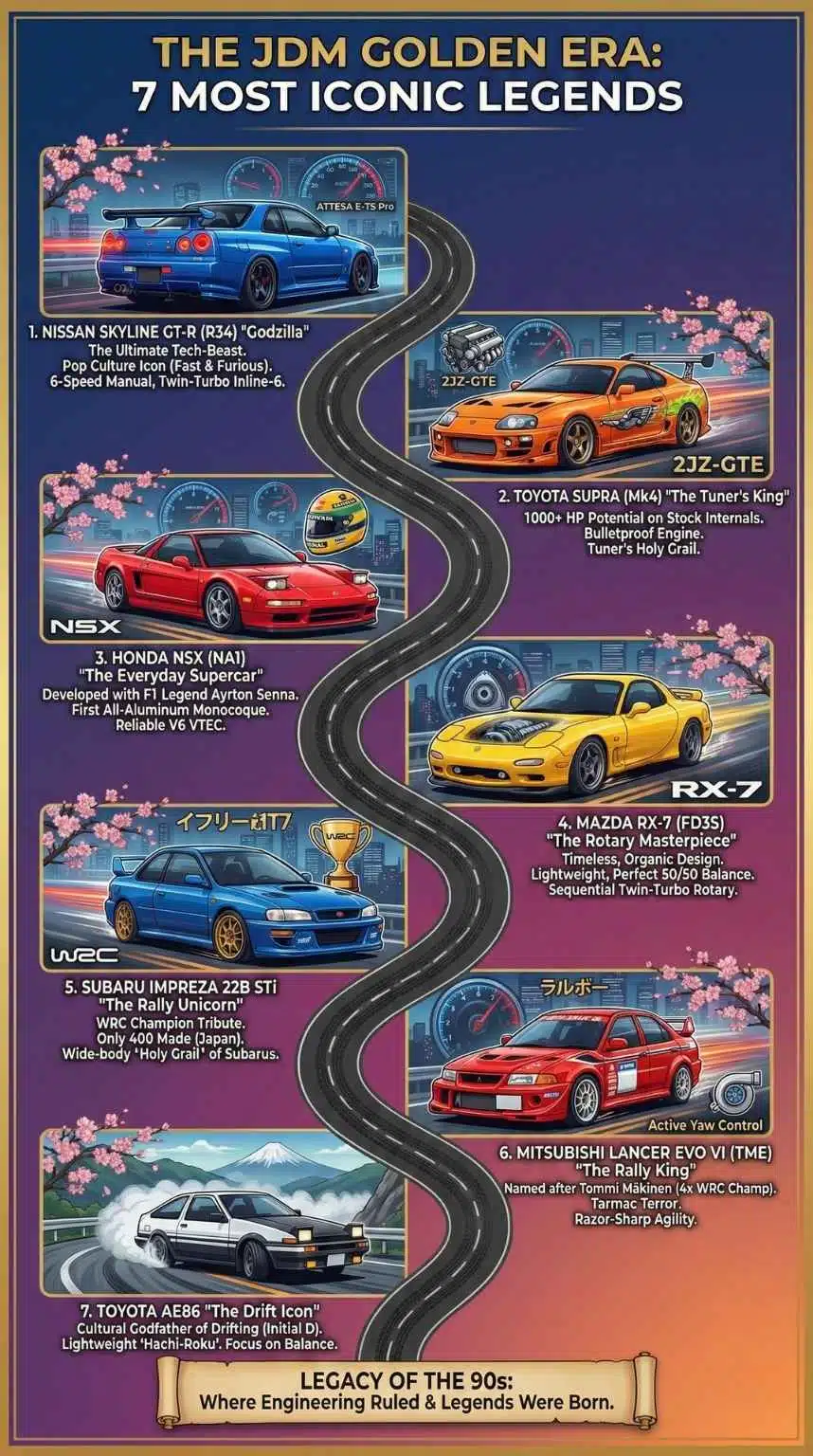
For enthusiasts and collectors alike, these vehicles represent the absolute zenith of Japanese engineering, blending rally-bred performance with timeless design. They didn’t just compete with the European elite; they rewrote the rulebook on what a sports car could be, influencing car culture for generations to come.
Below, we rank and analyze the “Big 7″—the vehicles that didn’t just compete with the world’s best, but embarrassed them.
1. Nissan Skyline GT-R (R34)
The Ultimate Godzilla
If the JDM world has a king, the R34 GT-R is it. Released at the tail end of the 90s, it was the culmination of everything Nissan had learned from decades of racing dominance. While the R32 earned the nickname “Godzilla” for crushing Australian V8s on the track, the R34 refined that brutality into a technological masterpiece.
The Story & Engineering
The R34 was years ahead of its time. It featured a 5.8-inch LCD Multi-Function Display (MFD) on the dashboard—long before modern infotainment screens—that displayed live telemetry like G-force, boost pressure, and lap times. Under the hood sat the legendary RB26DETT, a twin-turbo inline-6 engine that is arguably one of the most durable engines ever made.
But the real magic was the ATTESA E-TS Pro all-wheel-drive system. Unlike standard AWD systems that induce understeer, this system could send 100% of the power to the rear wheels for agility, only engaging the front wheels when it detected slip. This allowed the heavy GT-R to dance through corners like a car half its weight.
Why It Is A Legend Today
Aside from being the hero car of the Fast & Furious franchise (driven by the late Paul Walker), the R34 is the ultimate investment car. With early models now legal to import into the USA, demand has outstripped supply, turning the R34 into a six-figure asset.
| Specification | Details |
| Engine Code | RB26DETT (2.6L Twin-Turbo Inline-6) |
| Drivetrain | AWD (ATTESA E-TS Pro) |
| Advertised Power | 276 hp @ 6,800 rpm |
| Real Power | ~330+ hp (Stock) |
| Transmission | 6-Speed Manual (Getrag) |
| Current Market Status | Skyrocketing (Blue Chip Investment) |
2. Toyota Supra (Mk4 / A80)
The Tuner’s Holy Grail
While the GT-R was a track weapon, the Mk4 Supra was the king of the highway. When it debuted in 1993, critics praised its braking and handling, but it was the aftermarket scene that turned it into a deity.
The Heart of the Beast: The 2JZ
The Supra’s legacy rests almost entirely on its engine: the 2JZ-GTE. With a cast-iron block and a closed-deck design, this engine was so over-engineered that tuners discovered they could double the horsepower without changing the pistons or rods. It is not uncommon to see street-legal Supras pushing 1,000 horsepower.
The car also featured active aerodynamics (a motorized front spoiler) and a cockpit designed purely for the driver, with all gauges wrapping around the pilot like a fighter jet.
The Driving Experience
Stock Supras are actually grand tourers—heavy, comfortable, and smooth. However, once the sequential turbos kick in (or are swapped for a massive single turbo), the car transforms into a rocket ship that dominates drag strips and roll races worldwide.
| Specification | Details |
| Engine Code | 2JZ-GTE (3.0L Twin-Turbo Inline-6) |
| Drivetrain | Rear-Wheel Drive (RWD) |
| Advertised Power | 276 hp (Japan) / 320 hp (Export) |
| Modding Potential | 1,000+ hp on stock internals |
| Transmission | 6-Speed Manual (V160) or 4-Speed Auto |
| Current Market Status | High & Stable (Especially Manual Turbos) |
3. Honda NSX (NA1)
The Supercar That Changed Everything
Before 1990, if you bought a Ferrari or Lamborghini, you accepted that it would be uncomfortable, unreliable, and difficult to drive. Honda changed that forever with the NSX (New Sportscar eXperimental).
Senna’s Touch
Honda invited Formula 1 legend Ayrton Senna to test the prototype at the Suzuka Circuit. Senna famously told the engineers, “It feels a little fragile.” In response, Honda stiffened the chassis by 50%.
The result was the world’s first all-aluminum semi-monocoque production car. It was light, rigid, and possessed a suspension geometry that offered telepathic handling. Unlike its rivals, it had a reliable V6 engine and an interior you could actually see out of. It forced the European giants to go back to the drawing board and improve their own build quality.
Why It Is Unique
The NSX is not about brute power; it is about precision. The connection between the steering wheel, the pedals, and the road is unfiltered and analog, a sensation that modern digital supercars simply cannot replicate.
| Specification | Details |
| Engine Code | C30A (3.0L V6 VTEC) |
| Layout | Mid-Engine, Rear-Wheel Drive (MR) |
| Advertised Power | 270 hp @ 7,100 rpm |
| Chassis | All-Aluminum Monocoque |
| Redline | 8,000 rpm |
| Current Market Status | Rising (Collectors seek “Analog” purity) |
4. Mazda RX-7 (FD3S)
The Rotary Masterpiece
The third-generation RX-7 is often cited as one of the most beautiful cars ever designed. Its organic, flowing curves have aged gracefully, looking as modern today as they did in 1992. But its true claim to fame lies under the hood.
The Wankel Rotary Spirit
The FD3S is powered by the 13B-REW, a twin-rotor Wankel engine. Instead of pistons moving up and down, it uses triangular rotors spinning eccentrically. This allows for a tiny displacement (1.3L) to produce massive power with incredibly smooth delivery.
Mazda implemented the world’s first mass-produced sequential twin-turbo system. The first turbo provided boost at low RPMs for instant torque, while the second turbo pre-spooled and joined the party at 4,500 RPM for top-end power.
The Drawbacks & Joys
The Rotary engine is notoriously maintenance-heavy (burning oil by design and requiring frequent rebuilds). However, for the driving purist, the perfect 50/50 weight distribution and the engine’s ability to rev to the moon make the headaches worth it.
| Specification | Details |
| Engine Code | 13B-REW (1.3L Twin-Rotary) |
| Induction | Sequential Twin-Turbo |
| Weight | ~1,300 kg (Very Lightweight) |
| Handling | 50/50 Weight Distribution |
| Design | Timeless “Organic” Styling |
| Current Market Status | Moderate Growth (Maintenance scares some buyers) |
5. Subaru Impreza 22B STi
The Rally Unicorn
While the other cars on this list were mass-produced, the 22B is a true unicorn. Built to celebrate Subaru’s 40th anniversary and their third consecutive World Rally Championship (WRC) title, only 400 units were sold in Japan—and they reportedly sold out in 30 minutes.
A Road-Legal Rally Car
The 22B is visually distinct due to its wide-body fenders, which were taken directly from the WRC car. Under the hood, the standard 2.0L engine was bored out to 2.2 Liters (hence the name 22B, though “22B” is also hexadecimal for 555, the cigarette sponsor of the rally team).
It featured a twin-plate ceramic clutch, Bilstein suspension, and a larger turbocharger. This wasn’t a car you bought to commute; it was a car you bought to attack a gravel road or a twisty mountain pass.
Collector Status
Today, the 22B is the “Holy Grail” of Subarus. It represents the absolute peak of the Subaru vs. Mitsubishi rally rivalry that defined 90s motorsport.
| Specification | Details |
| Engine Code | EJ22 (2.2L Turbocharged Flat-4) |
| Production | 400 Units (Japan) + handful of prototypes |
| 0-60 mph | ~4.7 Seconds |
| Body Style | Wide-body Coupe |
| Drivetrain | Symmetrical AWD with DCCD |
| Current Market Status | Extreme (Prices can exceed $300k) |
6. Mitsubishi Lancer Evolution VI (Tommi Mäkinen Edition)
The Tarmac Terror
You cannot mention Subaru without mentioning its arch-nemesis, the Lancer Evolution. While there are ten generations of the Evo, the VI (6) is widely considered the rawest, and the Tommi Mäkinen Edition (TME) is the crown jewel.
Named After a Champion
Released to commemorate Finnish driver Tommi Mäkinen’s four consecutive WRC drivers’ titles, the TME (often called the Evo 6.5) featured a redesigned front bumper for better cooling, a faster-spooling titanium turbine, and a suspension tuned specifically for tarmac agility.
The 4G63T engine is legendary for its torque. Unlike the high-revving Honda or Rotary engines, the Evo punches you in the gut with torque the moment you touch the throttle. The Active Yaw Control (AYC) differential was magic, literally transferring torque between the rear wheels to eliminate understeer and make the car pivot like a go-kart.
| Specification | Details |
| Engine Code | 4G63T (2.0L Turbo Inline-4) |
| Special Features | Titanium Turbo, Tarmac Suspension |
| Color | Iconic “Passion Red” with decals |
| Handling Tech | Active Yaw Control (AYC) |
| Rivalry | Direct competitor to the Subaru Impreza |
| Current Market Status | Rising Fast (The definitive Evo to own) |
7. Toyota AE86 (Sprinter Trueno)
The Drift Godfather
At first glance, the AE86 doesn’t fit on this list. It isn’t fast. It isn’t turbocharged. It doesn’t have high-tech AWD. Yet, it is perhaps the most culturally significant car here.
The Power of Balance
Known as the “Hachi-Roku” (Eight-Six), this lightweight Corolla (under 2,300 lbs) taught a generation that power isn’t everything. Equipped with the 4A-GE engine—a peppy 1.6L twin-cam developed with Yamaha—the AE86 wasn’t about straight-line speed; it was about momentum.
It became a legend thanks to the “Drift King” Keiichi Tsuchiya, who used it to defeat high-horsepower skylines on winding mountain passes, and the anime Initial D, which immortalized the car as the ultimate underdog delivery vehicle.
Why It survives
It is one of the last simple, front-engine, rear-wheel-drive cars ever made. It is a car that forces you to be a better driver because you cannot rely on power to fix your mistakes.
| Specification | Details |
| Engine Code | 4A-GE (1.6L NA Inline-4) |
| Weight | ~950–1,000 kg |
| Layout | Front Engine, Rear-Wheel Drive |
| Power | ~128 hp (High revving) |
| Fame | Initial D, Drift Culture Origins |
| Current Market Status | “Tofu Tax” (High prices for clean examples) |
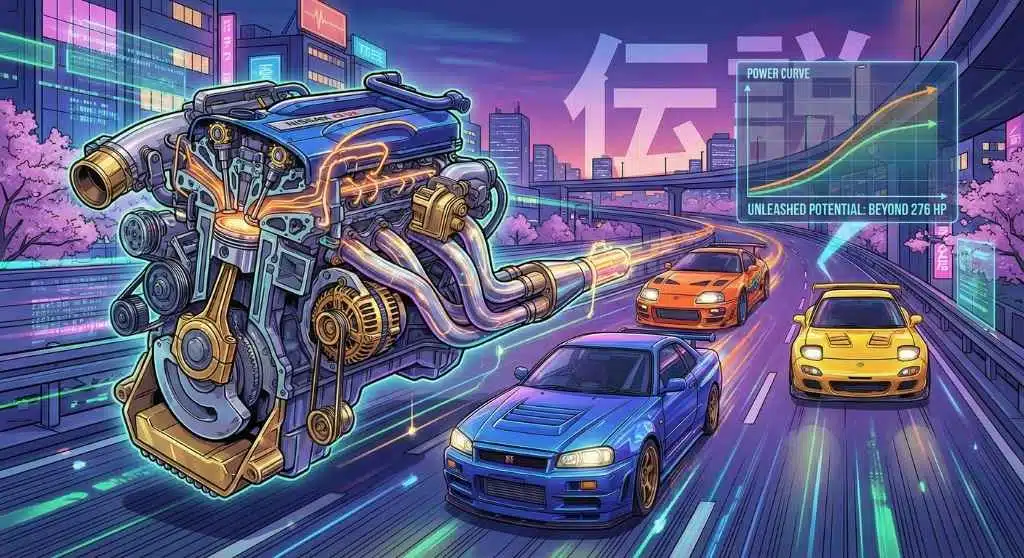
If you are looking to acquire one of these Most Iconic JDM Cars, the market has changed drastically in recent years. Here is what you need to know:
-
The “25-Year Rule”: In the USA, cars must be 25 years old to be legally imported without restriction. As each of these legends hits that 25-year mark, American demand floods the market, causing prices in Japan and globally to spike immediately.
-
Auction Grades Matter: When buying from Japanese auctions, cars are graded.
-
Grade 4/4.5: Excellent condition.
-
Grade 3.5: Good driver’s car, some cosmetic flaws.
-
Grade R: Repaired accident history (proceed with caution).
-
-
Rust is the Enemy: Japan is an island nation with humid summers and snowy winters. Check shock towers, wheel arches, and underneath the chassis. A rust-free chassis is worth paying a premium for.
-
Stock vs. Modified: In the 90s/’00s, everyone modified these cars. Today, stock examples command the highest prices. A completely original Supra or R34 is a rare gem and is valued as a collector’s item.
Frequently Asked Questions (FAQ)
1. Why are JDM cars so expensive right now?
It is a “perfect storm” of factors: The US 25-Year Import Rule has opened the massive American market to these cars; the “Gran Turismo generation” (people who played the games as kids) now have the income to buy them; and modern cars lack the mechanical, analog feel of the 90s, driving enthusiasts toward these vintage machines.
2. Which is the fastest JDM car on this list?
In terms of stock performance, the Nissan Skyline GT-R (R34) and the Honda NSX are generally the quickest around a track. However, in a straight line, a modified Toyota Supra (Mk4) has the highest potential ceiling, often capable of beating modern hypercars in drag races.
3. Are these cars reliable for daily driving?
Generally, yes—Japanese engineering is famous for reliability. The Toyota Supra (2JZ) and Honda NSX are renowned for being robust enough for daily use. However, the Mazda RX-7 requires specialized maintenance (checking oil levels every fuel fill-up) and is less suited for a daily commute.
4. What does “JDM” actually mean?
JDM stands for Japanese Domestic Market. It refers to vehicles that were originally built and sold in Japan. A “true” JDM car has the steering wheel on the right side (RHD) and often features different bumpers, lights, and engines compared to the export versions sold in the US or Europe.
5. Will prices for these cars ever drop?
It is unlikely. These cars were produced in limited numbers, and many have been crashed or heavily modified over the last 30 years. As the supply of clean examples shrinks and demand remains high, they are becoming asset classes similar to vintage Ferraris or Porsches.
Final Thoughts: The End of an Era
We will likely never see an era like this again. Modern safety regulations, emissions standards, and the shift toward electrification have made the raw, mechanical purity of the 90s impossible to replicate. The Most Iconic JDM Cars on this list are not just vehicles; they are time capsules from a period when driving pleasure was the only metric that mattered.
Whether you are a collector looking for the next blue-chip investment or an enthusiast dreaming of that perfect mountain pass run, owning one of these legends is owning a piece of automotive history.
Which of these 7 legends would you put in your dream garage?





















