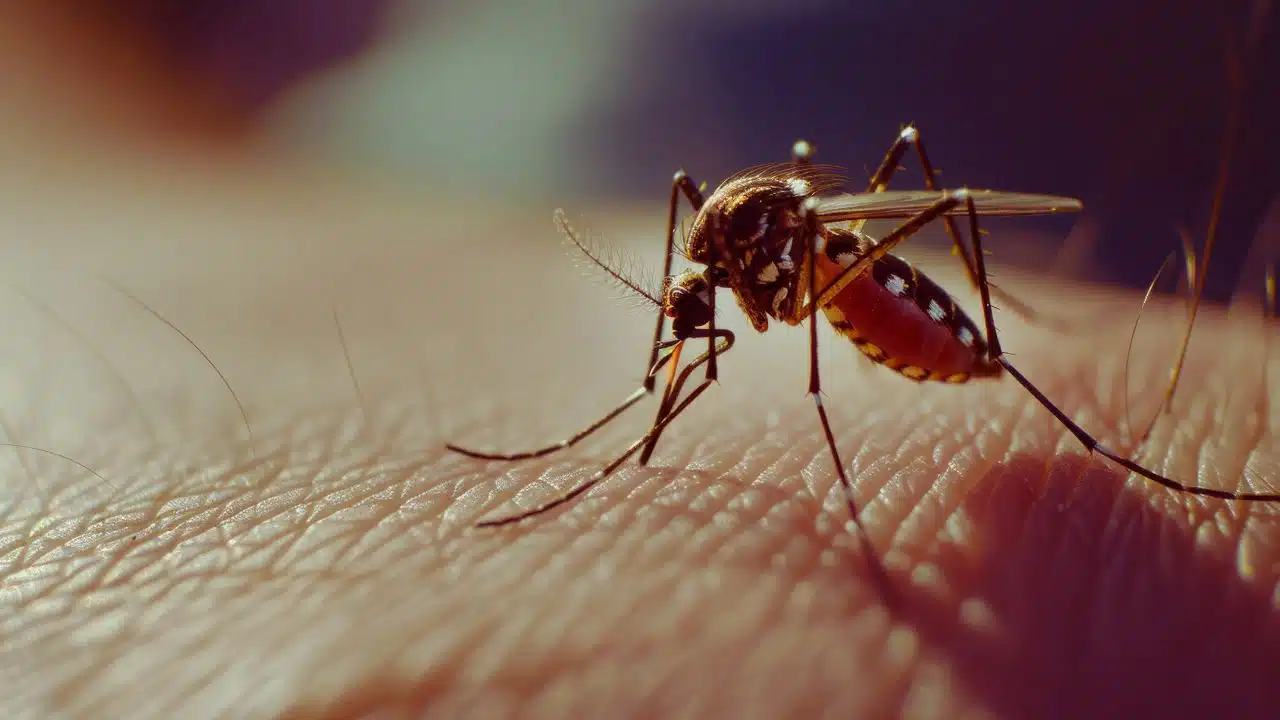
Iceland’s long-standing, proud distinction as one of the only mosquito-free countries on Earth has officially ended. Entomologists at the Icelandic Institute of Natural History (IINH) this week confirmed the first-ever discovery of mosquitos found in Iceland’s natural environment, a finding scientists are linking directly to the nation’s rapidly warming climate.
The historic discovery was made on October 16, 2025, by citizen scientist Björn Hjaltason in the Kjós municipality, a valley region just north of the capital, Reykjavík. Three specimens—two females and one male—were captured and sent to the IINH for verification. The species has been identified as Culiseta annulata, a cold-tolerant mosquito common across Northern Europe.
While a single mosquito was famously found in an aircraft cabin at Keflavík airport in the 1980s and is preserved in a jar at the IINH, this week’s finding marks the first time the insects have been captured “in the natural environment in Iceland,” as confirmed by experts.
The discovery shatters the long-held scientific theory that Iceland’s unique, unstable freeze-thaw cycles made it impossible for mosquito pupae to survive. Now, amid record-breaking temperatures and a climate warming four times faster than the rest of the Northern Hemisphere, that natural barrier appears to have been breached.
Key Facts: The End of an Era
- First-Ever Wild Finding: Three Culiseta annulata mosquitoes (two female, one male) were found in Kiðafell, Kjós, on October 16, 2025. This is the first confirmed discovery of mosquitoes living on Icelandic soil, outside of stowaways on aircraft.
- Expert Confirmation: Entomologist Matthías Alfreðsson of the Icelandic Institute of Natural History confirmed the identification, telling national broadcaster RÚV the insects are “very likely here to stay.”
- The Species: Culiseta annulata, also known as the “banded mosquito,” is a cold-resistant species known to survive harsh winters by sheltering in basements, barns, and cellars.
- The Climate Link: Scientists directly attribute the mosquito’s potential establishment to climate change. Iceland is reportedly warming at four times the rate of the rest of the Northern Hemisphere.
- A New Record: The discovery follows a period of unprecedented warmth, including the “hottest May temperature ever recorded in the country” (26.6°C / 79.88°F) at Egilsstaðir Airport earlier this year.
- The Last Bastion: With mosquitoes now found in Iceland, Antarctica is the only continent on Earth that remains mosquito-free.
A Citizen Scientist and a Red Wine Trap
The discovery was not the result of a coordinated government survey, but the work of an observant amateur naturalist. Björn Hjaltason, an insect enthusiast, had set up “red wine ropes”—a common method for attracting moths and other insects—in the Kjós region.
On the evening of October 16, he spotted what he described on the “Insects in Iceland” (Skordýr á Íslandi) Facebook group as a “strange fly.
“I immediately suspected what was going on and quickly collected the fly. It was a female,” Hjaltason wrote in his post, which quickly drew the attention of the country’s scientific community. He captured two more specimens in the following days and delivered them to Matthías Alfreðsson at the Icelandic Institute of Natural History.
Alfreðsson, an insect specialist at the institute, confirmed the identification to multiple news outlets. The significance, he explained, is not just the finding, but its implication.
In a statement to Anadolu Ajansı (20 Oct 2025), Alfreðsson warned: “It is very likely that the mosquito is here to stay. It tends to keep itself warm over the winter in shaded places such as cellars and livestock houses.”
This ability to overwinter in artificial shelters, combined with a warming climate, provides Culiseta annulata a viable path to establishing a permanent, breeding population—something Iceland has never had to contend with.
The Climate Culprit: How Iceland’s Natural Barrier Failed
For decades, Iceland’s mosquito-free status was a celebrated scientific anomaly. Neighboring countries like Greenland, Norway, and Scotland all have significant mosquito populations. So why not Iceland?
The Gíslason Hypothesis
The prevailing theory, long championed by Professor Emeritus Gísli Már Gíslason of the University of Iceland, centered on Iceland’s unstable oceanic climate.
Mosquitoes lay their eggs in stagnant water. The pupae then develop in the water, often hibernating beneath ice during winter and hatching en masse when the ice melts in a stable spring thaw.
Iceland, however, rarely has a stable thaw. Its winters are characterized by sudden, drastic temperature swings. A mid-winter warm spell will melt the ice on ponds, signaling the pupae to begin hatching. But, as the “Gíslason hypothesis” explained, this thaw is almost immediately followed by another hard freeze, which freezes the ponds solid again, killing the developing pupae before they can mature. This “freeze-thaw-refreeze” cycle effectively broke the mosquito’s life cycle.
A Warming World Thaws the Defense
Climate change has rendered that hypothesis obsolete. The persistent, record-breaking warmth is stabilizing Iceland’s seasons.
Here are the key climate statistics underpinning this ecological shift:
- Accelerated Warming: Multiple reports, cited by The Guardian and The Independent, confirm that Iceland’s environment is heating up at four times the rate of the rest of the Northern Hemisphere.
- Record-Breaking Heat: While 2024 was noted as being unusually cold overall (RÚV.is, 21 Jan 2025), recent months have seen extreme spikes. In May 2025, Egilsstaðir Airport recorded a temperature of 26.6°C (79.88°F), the “hottest May temperature ever recorded in the country.
- Glacial Melt: This warming is most visible in Iceland’s glaciers, which are collapsing and receding at historic rates, confirming a fundamental shift in the island’s long-term temperature baseline.
This sustained warming means ponds and marshes may no longer freeze solid, or if they do, the spring thaw is becoming more stable. This creates, for the first time, the “hospitable” standing water environments that mosquitoes require to breed.
Scientists have been warning of this moment. The arrival and establishment of other biting insects, such as the louse fly (also known as the biting midge or “lúsfluga”) in 2015, was seen as a precursor. The louse fly has since spread across the country, becoming a significant nuisance to humans and livestock, particularly horses. The mosquito, experts fear, will now follow that same path.
Impact on Ecology, Health, and Tourism
The arrival of Culiseta annulata is more than a scientific curiosity; it marks a profound ecological, economic, and cultural shift for Iceland.
For tourism, “no mosquitoes” has long been a quirky and effective marketing tool, promising visitors a blissfully bite-free summer. That advantage is now lost.
Ecologically, the introduction of a new, blood-sucking insect could have unforeseen consequences for Iceland’s native wildlife, particularly its rich bird populations.
From a public health perspective, the arrival is less immediately alarming, but still a concern. Culiseta annulata is not a primary vector for major diseases like Zika or dengue, which are carried by Aedes species. However, it can be a vector for the West Nile virus, though transmission to humans is rare. For now, the primary impact will be the “nuisance” factor of bites.
Dina Fonseca, director of the Center for Vector Biology at Rutgers University, noted that this species often lays eggs in artificial containers like rain barrels, flowerpots, and discarded tires. This behavior allows it to spread easily through human transport, which is the suspected method of its arrival in Iceland—likely via a ship or cargo container.
What to Watch Next
Scientists at the Icelandic Institute of Natural History will be ramping up monitoring efforts, especially as spring 2026 approaches, to see if these mosquitoes survived the winter and established a breeding population.
The discovery in Kjós is likely not an isolated incident. The focus will now shift to biosecurity at ports and public awareness, as Icelanders must learn to live with an insect they have only ever read about.
This event serves as a stark, tangible example of climate change’s cascading consequences. An ecological barrier that has defined Iceland for centuries has been erased not by a volcano, but by a gradual, persistent rise in temperature. As of this week, Antarctica stands alone as the planet’s last mosquito-free continent.