

In a major move that has ignited both praise and criticism, the Trump administration has declassified and released over 240,000 pages of FBI records related to Dr. Martin Luther King Jr., the American civil rights icon assassinated in 1968. The release, initiated by a Justice Department request to lift a decades-long court seal, has stirred national debate—especially among King’s surviving family members and civil rights advocates—regarding the motives, timing, and implications of making these files public.
An Unprecedented Release of FBI Surveillance Files
The documents, held under seal since 1977, detail years of surveillance conducted by the Federal Bureau of Investigation on Dr. King. These records include notes from wiretaps, hotel room bugging, informant testimony, and internal FBI communications. The files had originally been sealed under a court order until 2027. However, under a renewed push for declassification and transparency, especially surrounding politically sensitive assassinations of the 1960s, the Trump administration accelerated their public release.
Many of the files had never been digitized until now. According to U.S. intelligence officials, a large portion of the newly released records have now been scanned and made publicly available via the National Archives and Records Administration (NARA). These materials provide insight into the federal government’s surveillance efforts—not only in tracking King’s civil rights activities but also in monitoring his connections to international movements focused on peace, anti-poverty campaigns, and criticism of U.S. foreign policy.
King’s Children Express Deep Concerns and Urge Empathy
Martin Luther King III and Bernice King, the only surviving children of Dr. King and Coretta Scott King, have voiced their concerns about the public release of these records. While they acknowledged that their father’s assassination has been a source of intense public curiosity for decades, they emphasized that this is also a deeply personal and painful chapter in their lives. Dr. King’s death, they said, has left a void that has lingered in their family for over 57 years.
They received early access to the files and began conducting their own review through independent research teams. Despite their efforts to contextualize the content, they remain worried that portions of the files could be misinterpreted or weaponized against King’s legacy. Their hope is that the public will approach the files with a deep sense of historical awareness, compassion, and understanding of the political atmosphere in which they were created.
Files Include Leads After the Assassination and CIA Involvement
Among the most notable content in the documents are investigative leads received by the FBI after King’s assassination, as well as references to the Central Intelligence Agency’s increasing interest in King’s activities in the years before his death. The files reflect the CIA’s monitoring of King’s shift toward broader international advocacy—including his public opposition to the Vietnam War and his participation in global anti-poverty initiatives.
Dr. King’s transformation from civil rights leader to global human rights advocate made him a target of suspicion among U.S. intelligence agencies. His growing influence was viewed by many within the government as a potential threat to national stability—particularly by those who equated criticism of U.S. foreign policy with communist sympathies during the Cold War era.
Historical Background: FBI’s Campaign Against King
It has long been documented that FBI Director J. Edgar Hoover was intensely focused on Dr. King. Under Hoover’s direction, the FBI initiated a series of covert operations aimed at discrediting King both privately and publicly. These efforts fell under the broader COINTELPRO initiative, a secret intelligence program designed to surveil, infiltrate, and disrupt political organizations deemed subversive or radical.
Through COINTELPRO, the FBI wiretapped King’s home and office phones, placed bugs in his hotel rooms, recruited informants from within the civil rights movement, and spread damaging information about his personal life. These tactics were part of a broader campaign not just to monitor King, but to actively undermine his credibility, disturb his mental state, and fragment the civil rights coalition he helped build.
The Family’s Continuing Rejection of the Official Assassination Narrative
King was assassinated on April 4, 1968, in Memphis, Tennessee, while supporting a strike by sanitation workers. James Earl Ray, a fugitive at the time, was arrested two months later in London and extradited to the U.S., where he pleaded guilty to avoid the death penalty. He was sentenced to 99 years in prison but later recanted his confession, claiming he was set up. Until his death in 1998, Ray maintained his innocence.
The King family has long questioned the legitimacy of Ray’s conviction. In 1999, they filed a civil suit against a man they believed had been involved in a broader conspiracy. In that case, a Memphis jury concluded that King had been assassinated as part of a conspiracy involving government agencies and private individuals. While the civil verdict did not have criminal weight, it reinforced the family’s belief that Ray was not the lone assassin—or possibly not involved at all.
These newly released FBI files have reignited those questions. The King family says they will review the documents carefully to determine whether they offer further support for their long-held belief in a broader conspiracy.
Political Motives and Public Skepticism Surrounding the Timing
Although the release was carried out under the Trump administration’s transparency initiative, many see political calculation behind the timing. President Donald Trump had previously ordered the declassification of files related to the assassinations of President John F. Kennedy and Senator Robert F. Kennedy. The JFK files were unsealed in March, followed by a partial release of RFK documents in April.
Critics argue that the release of the MLK files in July was intended to distract from the controversy surrounding Trump’s handling of the Jeffrey Epstein case. Epstein, a wealthy financier accused of sex trafficking minors, died in jail under suspicious circumstances during Trump’s first term. Facing public criticism for not releasing all of Epstein’s court records, Trump instead ordered the release of grand jury testimony while withholding the full case file.
Civil rights leaders have openly criticized what they see as a political diversion. Some believe that using the memory of Martin Luther King Jr. to deflect from Epstein-related scandals is a gross misuse of historical material. Others view it as an attempt to curry favor with Trump’s conservative base while minimizing backlash from African American communities.
Divided Reactions from the Broader King Family
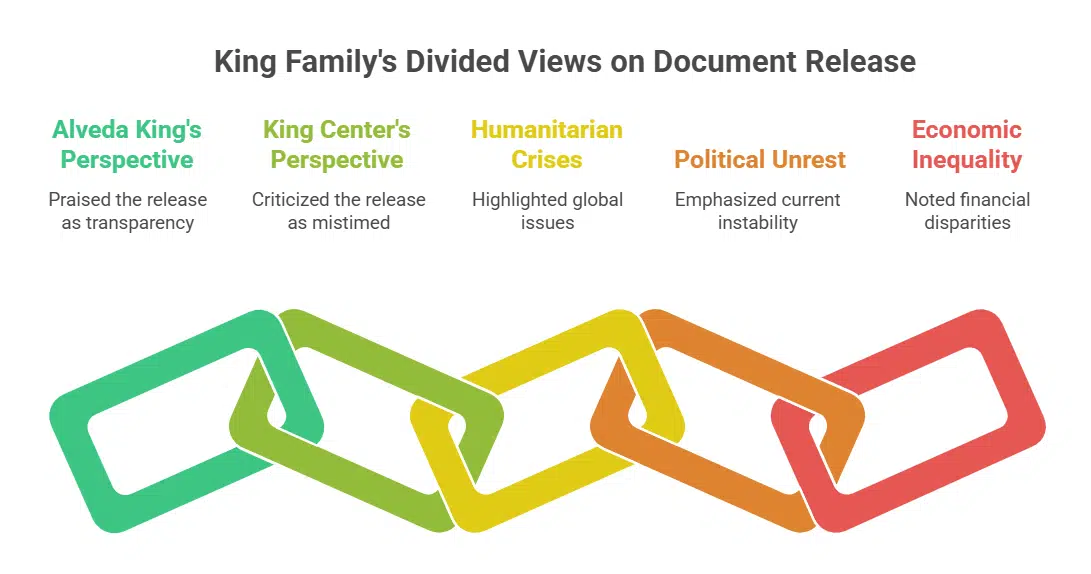
The King family itself is not unified in its response. Alveda King, a niece of Dr. King and a conservative political commentator, has praised the release and thanked Trump for making the documents public. She has frequently taken positions that differ from those of her cousins, Martin III and Bernice, particularly on political issues. She described the declassification as an act of transparency that will help the public understand the broader historical context.
In contrast, the King Center—founded by Coretta Scott King and now led by Bernice King—released a statement criticizing the release as mistimed and unnecessary. The organization highlighted that the world is currently facing significant humanitarian crises, political unrest, and economic inequality. The focus, they argued, should be on continuing King’s work for peace, equity, and justice, not on unearthing surveillance files from a dark chapter in American history.
Civil Rights Groups Denounce the FBI’s Role
Organizations like the Southern Christian Leadership Conference (SCLC), which Dr. King co-founded in 1957, have condemned the surveillance campaign documented in the files. They argue that the FBI’s actions not only violated civil liberties but also represent an attempt to suppress the most important social movement in American history. The SCLC opposed the premature release of the files, stating that the FBI’s conduct was unlawful and unethical, particularly in its targeting of King and other civil rights leaders.
The files reinforce what many already believed—that King’s rise as a moral leader was met with institutional resistance not just from political opponents but from federal agencies tasked with protecting civil liberties. The extent of surveillance and the aggressive tactics used have sparked renewed calls for the U.S. government to officially apologize for its role in undermining the civil rights movement.
New Material for Researchers and Journalists
While the King family and civil rights groups have expressed concern, historians, journalists, and academic institutions have welcomed the release as an invaluable trove of primary source material. For scholars of 20th-century American history, especially those focusing on the civil rights era, the records provide new avenues of research into government overreach, political surveillance, and the internal workings of the FBI during a critical period in U.S. history.
The documents may also reveal new information about King’s final years, particularly his shift toward economic justice and global peace advocacy—topics that were less emphasized during earlier historical treatments of his life.
Legacy, Justice, and the Ongoing Fight for Truth
As debate continues over the timing and intent behind the release of these documents, one thing is clear: Dr. Martin Luther King Jr.’s life and legacy remain central to American conversations about justice, transparency, and the power of truth. The newly released records, while controversial, are now part of the public archive. They offer an opportunity to reexamine not only King’s life but also the forces that sought to silence him.
For his family, the files are a painful reminder of their personal loss and the institutional betrayal their father endured. For historians and truth-seekers, they may serve as a window into one of the most complex and impactful chapters in U.S. history.
As the King family continues to review the documents, the public is being asked to approach them not with curiosity alone, but with the empathy and reverence that Dr. King’s legacy demands.






















