

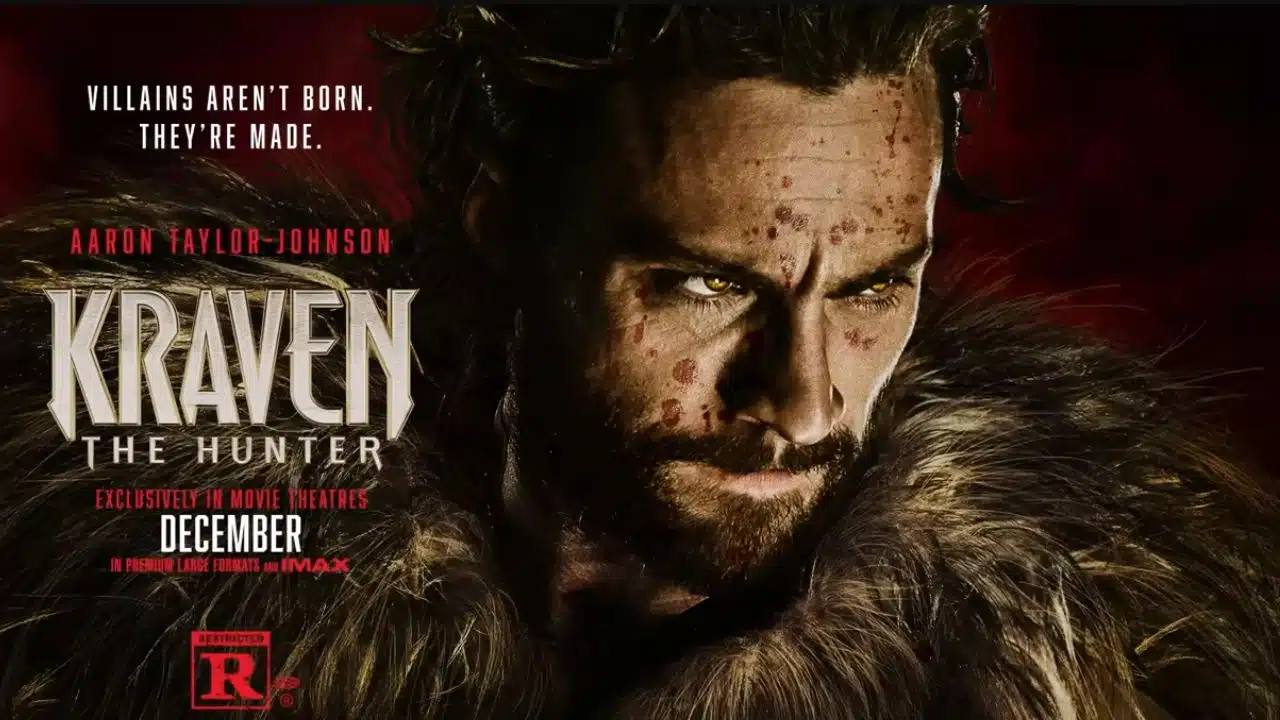
As portrayed by Aaron Taylor-Johnson, Kraven the Hunter should have been a thrilling addition to Sony’s Spider-Man Universe. With his panther-like agility, deadly skills, and savage determination, Kraven seemed destined to captivate audiences.
Yet, despite its intense action sequences and a character described as an “apex predator,” the movie failed to achieve the one thing Hollywood values most: a strong theatrical audience.
A Disastrous Opening Weekend
Released in over 3,200 theaters across North America, Kraven the Hunter opened to a disappointing $11 million during its first three days. This weak performance landed the film in the No. 3 spot, trailing behind Moana 2 and Wicked, movies that have been in theaters for weeks.
What makes this result even more concerning is that prerelease tracking estimates had predicted an opening weekend gross of $20 million to $25 million. Instead, Kraven underperformed even Madame Web, another Sony superhero title, which managed to earn $15.3 million earlier this year. Critics and audiences were equally unimpressed, with Kraven receiving a devastating 15% score on Rotten Tomatoes and a low “C” rating on CinemaScore.
Internationally, the film’s struggles were even more apparent. It failed to make a mark, falling to fourth place behind the Indian blockbuster Pushpa: The Rule — Part 2.
A Pattern of Superhero Fatigue
Kraven the Hunter’s failure highlights a growing problem for Hollywood: the decline of interest in superhero movies. Outside of Marvel’s Deadpool & Wolverine, which grossed a massive $1.3 billion this summer, recent superhero films have struggled to draw audiences.
Sony’s Spider-Man Universe, in particular, has suffered repeated setbacks.
- Venom: The Last Dance performed poorly compared to its predecessors, earning only $473 million compared to the first Venom’s $856 million global success.
- Morbius, released in 2022, was also a critical and box-office failure.
- Madame Web struggled to find an audience, despite featuring well-known actors and a hefty budget.
David A. Gross, a leading analyst at Franchise Entertainment Research, explained this trend: “There used to be a floor for these secondary superhero openings, but audiences are saying, ‘If you don’t give us something reasonably entertaining, we’re not going.’” He further emphasized that Kraven was disliked by both critics and audiences, continuing a pattern of diminishing returns for Sony’s standalone Spidey villain films.
Budget Troubles and Industry Shifts
The production of Kraven the Hunter faced additional hurdles due to financial issues surrounding last year’s Hollywood writers and actors strikes. Initially greenlit with a $90 million budget, costs reportedly ballooned to $110 million. These high expenses now place further pressure on the film, as its lackluster box-office results make it unlikely to break even.
Sony, however, denied rumors that Kraven had permanently damaged the future of the Spider-Man Universe. Still, the absence of mid- or post-credit scenes—a common setup for future sequels—suggests limited confidence in the film’s ability to launch additional storylines.
The Superhero Origin Story Problem
Beyond Sony’s struggles, Kraven’s failure is part of a broader issue in Hollywood: the decline of superhero origin stories. According to Gross, “The classics will continue to do well, but we haven’t had a successful new character and story in years — since Venom and Aquaman in 2018.”
This decline is clear when looking at films like Shazam! (2019), which opened to $53 million. At the time, that number seemed moderate, but it now feels like an unreachable goal for most new superhero titles. As audiences demand more engaging and innovative content, Hollywood is realizing that simply producing a film in the superhero genre no longer guarantees success.
Hollywood’s Fear Realized
The failure of Kraven the Hunter confirms one of Hollywood’s worst fears: superhero fatigue is real. Audiences are no longer willing to accept poorly received or uninspired entries into the genre, especially from lesser-known characters and franchises. Sony’s inability to connect its Spider-Man villain universe to the popular web-slinger himself further complicates the issue.
While major franchises like Deadpool and Spider-Man can still deliver record-breaking results, the days of automatic success for secondary superhero titles appear to be over. As David A. Gross concludes, “The genre has simply stopped growing.” For studios, this marks a turning point—a warning that future projects must deliver quality storytelling and entertainment to win back audiences.
Kraven the Hunter was meant to be a bold new entry into Sony’s Spider-Man Universe, but its disastrous opening confirms that superhero fatigue is a growing challenge for Hollywood. With its weak box-office numbers, negative reviews, and underwhelming audience reception, Kraven adds to a string of failures that prove audiences demand more from the superhero genre. For now, Sony and other studios will need to rethink their strategies if they hope to revive interest in these films.
The Information is Collected from Vulture and Yahoo.





















