
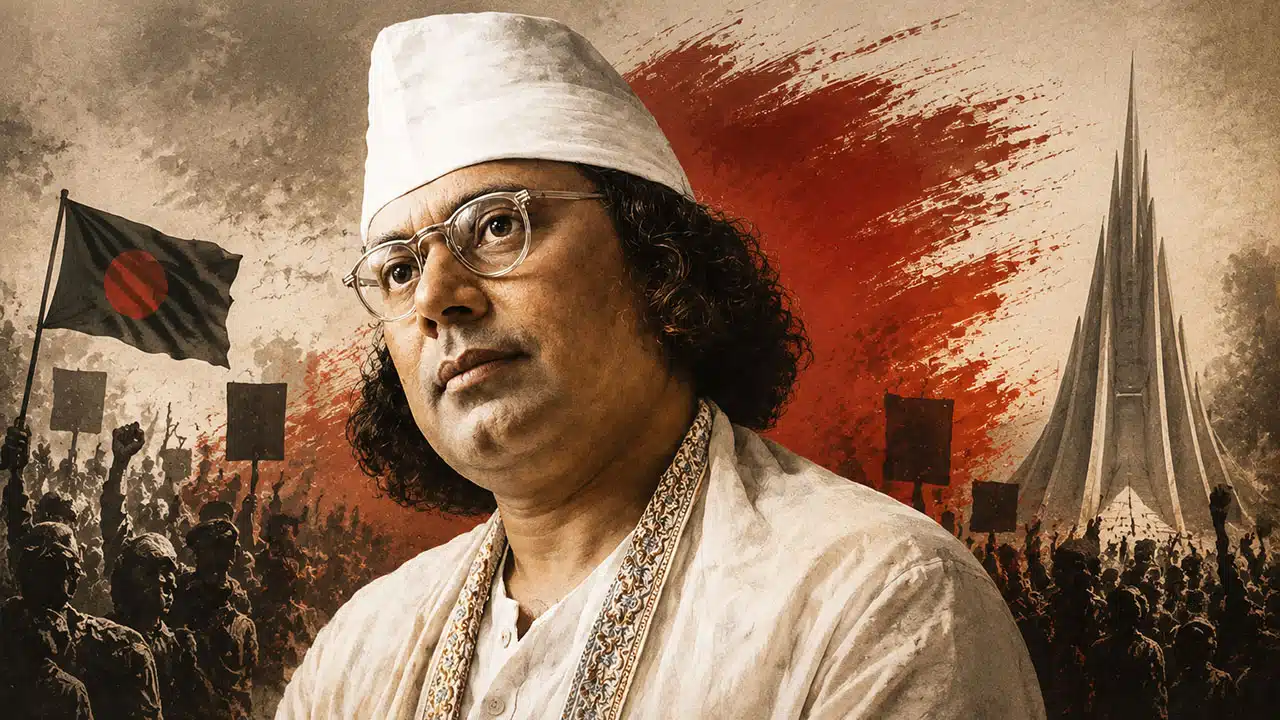
I was in class eight the first time I heard Bidrohi read out loud. It was a Nazrul Jayanti program, the kind every school holds. A boy stood on stage and recited it. I did not understand half the words. I understood the sound. That memory sat quietly for years. It came back when I started reading about how the Bidrohi poem has been used in 1952, in 1971, and in almost every angry season since.
My first thought was that this is just habit. Bengalis love Nazrul, so Bengalis quote Nazrul. But that answer is too easy, and I no longer believe it. Today is the 50th death anniversary of the national poet of Bangladesh, Kazi Nazrul Islam. Bangladesh celebrates his birth and death anniversaries in accordance with the Bengali month. It means the 12th of Vadra (a Bengali month) is celebrated as his death anniversary, which is today. However, according to the Gregorian calendar, the death anniversary of Kazi Nazrul Islam will be on August 29th.
I think the poem keeps coming back for a reason built into the poem itself. And I think the way we use it says something uncomfortable about us.
What I Actually Noticed on that Stage
The boy did not read the whole poem. Nobody does. He read maybe thirty lines and stopped, and it still felt finished.
I did not think about that at the time. I think about it now. Most famous poems break if you cut them. You cannot recite the middle of a sonnet and call it done. Bidrohi can be cut almost anywhere and it still lands. That is not an accident of length. It is how the poem is made.
The Bidrohi Poem Was Written for a Mouth, Not a Page
Kazi Nazrul Islam wrote it around the end of 1921, and it went into print soon after, first in the weekly Bijli, then in other papers, then in Agnibeena. He was twenty-two. He had come out of the British Indian Army a year earlier.
Three things about how it is built matter more than anything about its meaning.
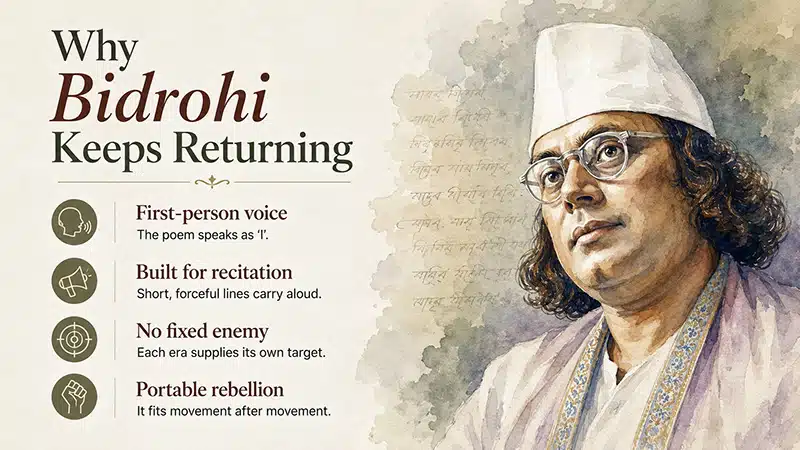
First, it is spoken in the first person. The poem says “I.” Not “the people should rise.” Not “we must resist.” Just “I.” Anyone who reads it out becomes the rebel for as long as the reading lasts. A crowd of five hundred people reciting ami is five hundred rebels, not an audience listening to a description of one.
Second, the lines are short and heavy. They are built to carry over noise. Long, delicate lines die in an open field. These do not.
Third — and this is the part I keep returning to — the poem names no enemy. There is no British officer in it. No date. No party. No specific law. It is furious at power in general and at nothing in particular. That looked like a weakness to some critics at the time. It turned out to be the whole point.
A poem that names its enemy expires when that enemy does. Bidrohi never expires, because the blank is always available for refilling.
1952: The State Handed Us Nazrul and It Backfired
Here is the part of the story that gets skipped in school programs.
After 1947, the Pakistani state did not suppress Nazrul. It promoted him. Rabindra Sangeet was restricted and pushed out of state broadcasting, while Nazrul-giti was raised up in its place. The logic was simple and stupid: Tagore was the Hindu poet, and Nazrul was the Muslim poet, so use one against the other. This went far enough that a Pakistani law minister wrote to Ayub Khan in the mid-1960s worrying about Tagore’s influence on young Bengali Muslims—the alarm having been raised partly because state royalty receipts for Rabindra Sangeet had overtaken those for Nazrul.
Think about what that means. A government that wanted obedient citizens spent years pushing a poet whose most famous poem is a threat to whoever sits on top.
I will be honest about the limits of what I found. I have not seen evidence that Bidrohi itself was chanted in the Ekushey processions. The song of 1952 was Abdul Gaffar Choudhury’s Amar Bhaiyer Rokte Rangano, written at the bedside of a wounded activist. What Nazrul supplied in that decade was something broader—a language of refusal that the state had itself made respectable and could not then take back.
You cannot hand people a poem about tearing down the throne and then act surprised when they read it correctly.
1971: A Radio Station that Opened on His Birthday
By 1971 Nazrul had been silent for nearly thirty years. Illness took his speech and his writing in 1942, and he never got them back.
It did not matter. The Swadhin Bangla Betar Kendra ran his work constantly. Karar Oi Louho Kopat and Chal Chal Chal went out over the air to the Mukti Bahini again and again. The station’s Kolkata phase went on air on 25 May 1971 — Nazrul’s birthday. That was not a coincidence, and everyone involved knew it.
Then the war ended, and the new country moved fast. Chal Chal Chal was adopted as the national marching song on 13 January 1972, at the government’s first meeting after independence. Nazrul himself was brought to Dhaka in 1972. He was given citizenship in February 1976. He died that August and was buried beside the Dhaka University central mosque.
I find this sequence hard to sit with. A country won a war partly on the strength of his voice, and what it could physically bring home was his silence. He was here, in Dhanmondi, for four years, and could not say a word about any of it.
There is a further detail that says even more. Bangladesh did not formally gazette him as national poet until 2024, backdated to 1972. For over fifty years the title was real in every way that mattered and had never actually been written down. We assumed he would. We did not check.
So Why This Poem But Not a Newer One?
Every movement produces its own songs. 1952 had one. 1971 had dozens. Each later movement has written its own slogans, its own walls, its own hashtags.
And each one still reaches back for the Bidrohi poem.
The comfortable explanation is that Nazrul was a genius and nothing has matched him. I do not think that is the real reason, and I do not think it is a compliment to him either.
The real reason is the one I gave earlier. The poem is portable because it is empty in exactly the right place. It supplies the fury and lets the protester supply the target. In 1922 the target was the Raj. In the 1960s it was Islamabad. Since then it has been whoever is in the chair. The poem does not have to be updated because it was never specific enough to go out of date.
That portability is a real achievement. It is also a warning. A slogan that fits every situation is a slogan that examines none of them. Reaching for the same lines every time can be a way of feeling militant without having to think.
What We Lose By Only Reciting Him
Here is my sharpest complaint, and it is not about Nazrul.
We have turned him into a recitation event. Competitions, medals, a stage, a clean shirt, a certificate. The Bidrohi poem is the standard set piece—the one the confident boy gets, the one the crowd claps for. It is taught as sound. It is rarely taught as an argument.
Meanwhile the poems that would actually cost us something stay on the shelf.
Naari argues that no achievement in the world belongs to men alone. He published that in the 1920s. Kuli-Mojur looks straight at who carries the load and who rides on it. Manush puts the mullah and the priest in the same frame and finds both of them wanting when a hungry man is at the door. He married a Hindu woman and took the abuse that followed from both directions. He wrote Hamd, and he wrote Shyama Sangeet, and he did not think this required an explanation.
None of that fits neatly on a stage. All of it is aimed at us, at home, and not only at some government.
So we take the one poem that lets us shout at power and leave the ones that would ask questions about our own households, our own mosques and temples, and our own comfort. That is a choice. We just do not admit it is a choice.
Final Thoughts
Fifty years after his death, the Bidrohi poem is still the loudest thing in Bengali. It will be reached for again, and I do not think it should be put down. It earns its place every time.
But reaching for it should cost something. If you are going to recite the poem this year, read Naari and Kuli-Mojur in the same sitting. Read Rajbandir Jabanbandi, the statement he made in a colonial courtroom at twenty-four, and notice how specific he was willing to be when it was his own neck.
That is the difference I keep coming back to. Nazrul named things. We use his most famous poem precisely because it does not.
He would have hated being a set piece. The least we can do is read the parts of him that still make us uncomfortable.