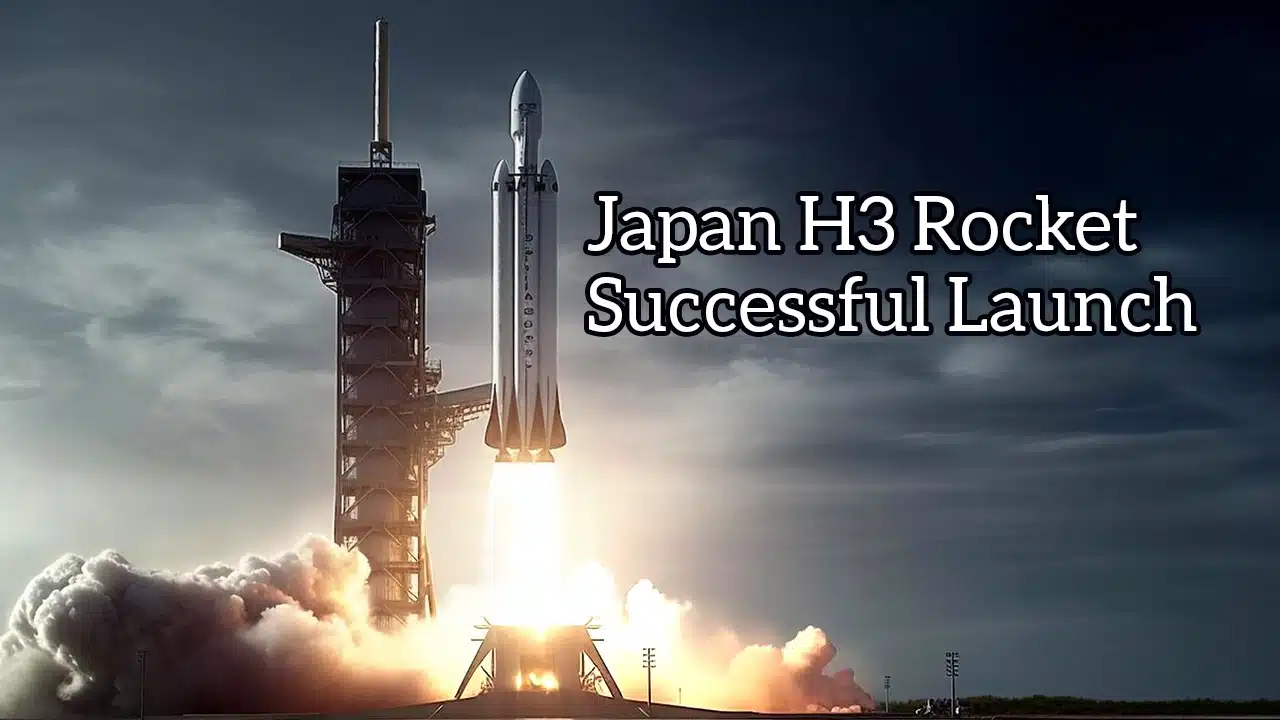
Japan’s H3 Rocket Triumph: Successful Launch a Year After Initial Failure

Japan H3 Rocket Successful Launch After Initial Failure

Japan’s space agency has announced the successful launch of its flagship H3 space rocket, following a failed attempt a year ago.

The H3 departed from the Tanegashima Space Center in southern Japan at 9:22 a.m. local time on Saturday, according to the Japan Aerospace Exploration Agency (JAXA).

The space body confirmed that the second-stage engine had finished burning and the rocket had successfully reached orbit as intended.

The H3 rocket is intended to be more cost-effective than its predecessors, the H-2A and H-2B, by utilizing commercial off-the-shelf products instead of specialized aerospace components, as stated by JAXA.

JAXA anticipates that the H3 will have the capability to launch government and commercial missions in the future. If successful, the space agency intends to launch it up to six times a year for the next two decades.

The first launch of H3 ended in failure in March when its second stage did not ignite, leading to a destroy command being issued 15 minutes after lift-off. This was just one of several issues during the maiden launch, which had been delayed previously due to ignition failures affecting two of the rocket’s secondary booster engines.

The successful launch on Saturday marks another achievement for JAXA, coming just two months after its robotic explorer landed on the moon in January.

JAXA celebrated the event as a major milestone for future lunar and planetary exploration, even though technical issues had rendered the Smart Lander for Investigating Moon, or SLIM, inoperable for several days after landing.

The spacecraft landed in the wrong direction, which hindered the solar cells from producing power. But after 10 days, it regained consciousness.

JAXA also utilized new precision technology to showcase a “pinpoint” landing within 100 meters of the SLIM’s target.

Japan has successfully landed a spacecraft on the moon, becoming the fifth country to achieve this feat after India’s Chandrayaan-3 mission last August. The United States, the former Soviet Union, and China have all successfully landed spacecraft on the moon.

The recent surge in space exploration is fueled by nations’ interest in extracting water from ice in the perpetually dark areas of the moon’s southern pole. According to experts, this could potentially be utilized for drinking water or as fuel as we continue to expand our reach into space exploration.



Subscribe to Our Newsletter

Related Articles

Top Trending

How AI Overviews Choose Citations
How AI Overviews Choose Which Sites to Cite
Best Document Collaboration Tools
10 Best Online Document Collaboration Tools for Teams
Important Signs When Should Raise Prices on Your SaaS
10 Signs It's Time to Raise Prices on Your SaaS
How to Restart a Productivity System After Falling Off the Wagon
My 20 SEO Lessons From 15 Years in Search
20 Lessons Learned From My 15 Years in Search Engine Journey

Technology & AI

Best Document Collaboration Tools
10 Best Online Document Collaboration Tools for Teams
Important Signs When Should Raise Prices on Your SaaS
10 Signs It's Time to Raise Prices on Your SaaS
Nostalgia economy
The Nostalgia Economy Is Selling Us a Past We Never Lived
Best CRM Tools for Small Marketing Teams
10 CRM Tools for Small Marketing Teams Worth Using
SaaS partnership tools
10 Best Tools for Managing SaaS Partnerships and Integrations

GAMING

Intentional Screen Time
How to Spend Your Screen Time More Intentionally
Complete Guide on Game Programgeeks
Game Programgeeks: A Complete Guide on PC, Game Dev, and Tech
Online Color Game Philippines
Online Color Game Philippines: What Every Beginner Should Know Before Playing
Ways to Reduce Game Development Costs
12 Ways Studios Cut Game Development Costs
NFT game development cost
How Much Does NFT Game Development Cost? A Realistic Budget Breakdown

Business & Marketing

Email Marketing Agency vs DIY Platform
Email Marketing Agency vs DIY Platform: When Outside Help Adds Value
Critical Path Method
The Critical Path Method Explained in Plain English
Time to Value: How SaaS Teams Can Reach Results Faster
How to Onboard New Team Members With a Self-Serve Wiki
How to Document Team Processes for Better Teamwork

EdTech & E-Learning

Alphabet Magic vs ABC Kids: Which Offers Clearer Letter Practice
Alphabet Magic vs ABC Kids: Which Gives Clearer Uppercase and Lowercase Practice?
Alphabet Magic vs LetterSchool comparison review
Alphabet Magic vs LetterSchool: Letter-Tracing Accuracy on the Same Letters [A Hands-on Review]
Alphabet Magic Trace and Phonics vs Teach Your Monster to Read
Alphabet Magic Trace and Phonics vs Teach Your Monster to Read: Which Is Best?
how many numbers should a toddler recognize
How Many Numbers Should a Toddler Recognize?
Best Educational YouTube Channel for Kids
Best Educational YouTube Channel for Kids: 10 Picks for Ages 2 to 8

Software & Apps

Best Document Collaboration Tools
10 Best Online Document Collaboration Tools for Teams
Important Signs When Should Raise Prices on Your SaaS
10 Signs It's Time to Raise Prices on Your SaaS
Best CRM Tools for Small Marketing Teams
10 CRM Tools for Small Marketing Teams Worth Using
SaaS partnership tools
10 Best Tools for Managing SaaS Partnerships and Integrations
White-Label SaaS Platform to Resell
8 Best White-Label SaaS Platforms to Resell